
A betavoltaic battery can sit inside a device for half a century without ever being plugged in, recharged, or replaced. No electrolyte dries out, no lithium catches fire, and nothing wears down. By one measure it stores more energy per kilogram than any chemical cell ever built.
It also produces roughly one fifty-thousandth of the power your phone needs.
Both statements are true, and the tension between them is the whole story. Betavoltaic cells convert the steady decay of a radioactive isotope directly into electricity, with a reliability no chemical battery approaches. They pay for that longevity by surrendering almost all their power.
What Is a Betavoltaic Battery?
A betavoltaic battery is a solid-state device that generates electricity from the beta particles emitted by a radioactive isotope. Beta particles are electrons, released when an unstable nucleus decays.
The word “battery” is a convenience. These devices are not electrochemical and cannot be charged or recharged. They do not store energy in chemical bonds; they harvest radiation as it is produced, delivering a small, continuous current for as long as the isotope stays active.
The idea is old. Henry Moseley demonstrated a current from charged-particle radiation in 1913, RCA built a prototype atomic battery for radios and hearing aids in 1954, and NASA began flying radioisotope thermoelectric generators in 1961. Nuclear batteries have since split into two families: thermal converters, which turn decay heat into electricity, and non-thermal converters, which capture energy from the emitted radiation before it becomes heat. Betavoltaics are non-thermal, which is why they can be built small enough to sit on a circuit board.
How Betavoltaic Cells Turn Decay Into Electricity
The mechanism is closer to solar power than to anything you would call a battery.

Beta Particles Instead of Photons
A solar panel uses a semiconductor junction to turn photons into electricity. A betavoltaic cell uses the same architecture and swaps the input: beta particles strike the semiconductor and generate electron-hole pairs through impact ionisation. A built-in electric field separates those pairs at the depletion region and drives a current. One beta particle carries tens to hundreds of keV, enough to spawn thousands of electron-hole pairs in a single cascade.
Why the Current Stays in the Microamp Range
Here the physics stops being generous. The flux of beta particles from a practical isotope source is orders of magnitude lower than the flux of photons arriving from sunlight, as a review in the ECS Journal of Solid State Science and Technology sets out. Each particle does far more work, but incomparably fewer arrive each second. Output lands in the nanoamp to microamp range, and that is not a manufacturing problem waiting to be solved. It follows from how little radiation a safe, compact source emits.
Efficiency: An 8% Ceiling and a 10.79% Outlier
Atomic batteries typically convert 0.1% to 5% of decay energy into electricity, with well-engineered betavoltaics reaching 6% to 8%. A perovskite-based cell using carbon-14 and an electron avalanche effect has been reported at a record 10.79% conversion efficiency. Even doubling efficiency moves a microwatt device to two microwatts. The problem is scale, not percentage.
The Energy Density Paradox
Ask what makes a battery good, and most people think of how much energy it holds. By that measure, betavoltaics are extraordinary.
A 2018 nickel-63 device from the Moscow Institute of Physics and Technology was reported at 3,300 milliwatt-hours per gram, or roughly 3,300 watt-hours per kilogram. Commercial lithium-ion cells manage 100 to 265. That tenfold advantage is why isotope power sources get described as the highest-energy-density technology in existence, and the same arithmetic underpins claims about nuclear-waste diamond batteries.
Now ask how fast a battery can release that energy. That is a separate property called power density, and here the story collapses.
Nickel-63 has a half-life of about 101 years. Its average power output over that first century works out to roughly 0.2 microwatts per gram. Scale that to a 40-gram 18650 lithium cell, and you get about 8 microwatts, while the lithium cell it matches in mass can discharge at a couple of amps: millions of microwatts.
None of this is a design flaw. It is the arithmetic of radioactive decay. A battery that will still be delivering current in 2126 can only do so because it spends that energy at a trickle. What the trickle buys is time, and on that measure the technology has no rival.
What 100 Microwatts Actually Buys You
The most visible product in the category is the BV100 from Beijing Betavolt New Energy Technology. Announced in January 2024 and reported to be in pilot production for medical implants and aerospace sensors, it measures 15 by 15 by 5 millimetres, smaller than a coin, and generates 100 microwatts at 3 volts.
Its construction is the interesting part: a two-micron-thick sheet of nickel-63 sandwiched between two diamond semiconductor converters, using a single-crystal diamond layer just ten microns thick. Nickel-63 decays into stable copper, so no radioactive residue is left behind. Betavolt quotes operation from minus 60 to 120 degrees Celsius, modular units that combine in series or parallel, and a 50-year service life.
The company also said in 2024 that it planned a one-watt version for 2025. As of 2026 its published plans refer more generally to higher-power variants, and no one-watt product has appeared. The gap matters: one watt is ten thousand times the BV100’s output.
| Device | Typical power draw | Betavolt BV100 cells required |
|---|---|---|
| Digital wristwatch (average) | About 5 microwatts | Fewer than one |
| Duty-cycled wireless sensor | About 100 microwatts | 1 |
| Hearing aid | About 1 milliwatt | 10 |
| Smartwatch during active use | About 30 milliwatts | 300 |
| Smartphone at peak draw | About 5 watts | Roughly 50,000 |
| LED light bulb | About 10 watts | Roughly 100,000 |
The pattern is unforgiving. A hearing aid needs about a milliwatt, and a smartphone at peak draw is about 5 watts, which is 5 million microwatts. Even a digital wristwatch, among the least demanding electronics in common use, draws around 5 microwatts, though in brief surges rather than a flat trickle.
Where the numbers do line up is with duty-cycled sensor nodes, which sleep most of their lives and wake briefly to measure and transmit. A sensor averaging 0.1 milliwatts sits in exactly the range a 100-microwatt cell can serve for decades. The wider push toward battery-free electronics, from Bluetooth sensor tags to microchips that need no battery at all, is chasing the same goal from another direction.
How Much Does a Betavoltaic Battery Cost?
A great deal, relative to what it delivers. City Labs, the Florida company behind the NanoTritium line, describes itself as the only supplier of commercially available tritium batteries in the United States and lists base pricing starting at $5,250 per battery.
For that money the P100 series offers 0.8, 1.6, or 2.4 volts and 50 to 350 nanoamps. A more capable P200 series, quoted at 52 to 156 microamps, is listed as in development. Lifespan is quoted above 20 years, decaying predictably with tritium’s 12.3-year half-life.
The honest comparison is not “$5,250 versus a $3 coin cell.” It is “$5,250 for a power source that cannot be replaced in a place where replacement is impossible or prohibitively expensive.” If a sensor sits at the bottom of the North Sea or in a patient’s chest, the arithmetic changes completely.
Nuclear Pacemakers Already Ran This Experiment
We do not have to speculate about whether isotope power works in the field. We ran the test, it succeeded, and we abandoned it anyway.
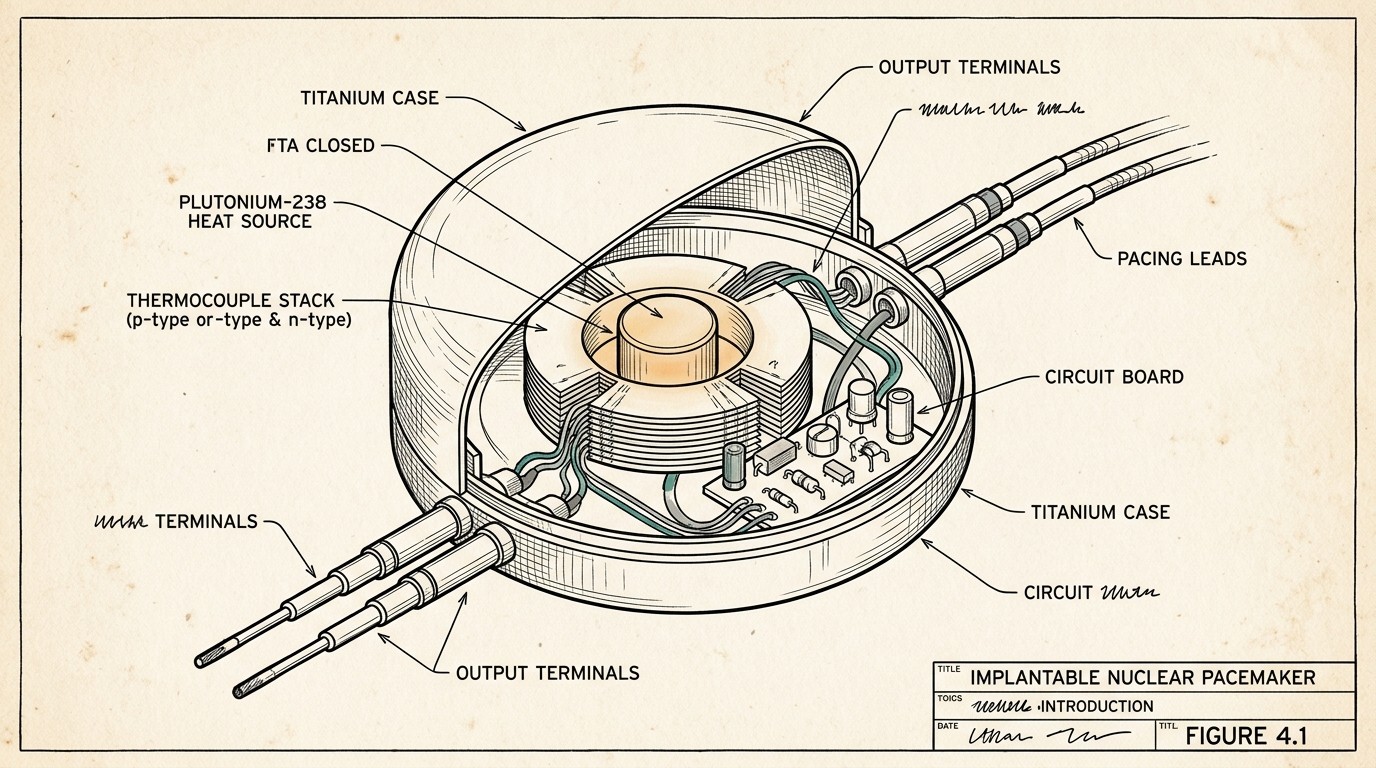
In 1970 Medtronic and the French company Alcatel implanted the first nuclear-powered pacemaker, the Numec NU-5, built around a 2.5-curie slug of plutonium-238. Radiation heated its container, and a stack of thermocouples converted that heat into the current that paced the heart. Roughly 139 units were implanted during the 1970s, and Cordis and Coratomic built competing models.
They worked. Plutonium-238 has an 88-year half-life, and one recipient who received a unit in 1973 reported it was still functioning adequately 34 years later. Dr. Victor Parsonnet noted that even after 88 years, with half the plutonium decayed, the batteries would still hold enough power. Conventional pacemakers of the era needed surgical replacement every five to ten years.
The last nuclear pacemaker was implanted in 1988. Lithium cells offered ten or more years without the radiation concerns or the regulatory apparatus, and proved easier to live with. As of 2003, an estimated 50 to 100 people still carried functioning nuclear pacemakers. The lesson is not that nuclear batteries failed, but that they were beaten by good-enough alternatives that avoided an entire category of complication.
Where Betavoltaic Batteries Genuinely Make Sense
Strip away the phone-charging question and a real niche appears. Betavoltaic cells suit applications where three conditions hold at once: the power requirement is microscopic, replacement is impractical, and extreme conditions would destroy a chemical cell. That points to:
- Implantable medical devices, particularly leadless pacemakers and physiological sensors, where surgical replacement carries real risk.
- Structural and industrial monitoring, including sensors embedded in bridges, pipelines, and concrete that must outlive the inspection cycle.
- Remote and offshore installations, such as subsea equipment where a battery change needs a vessel and a weather window.
- Aerospace and deep space, where solar panels fade and temperature swings exceed any chemical cell’s tolerance.
- Mesh networks, asset tags, and wake-up circuits that draw so little current a coin cell would be overkill.
NASA has pursued this directly. A programme combining MicroLink Devices and City Labs, presented at a NASA space photovoltaics conference, pairs a wide-bandgap III-V junction with a high beta-flux metal tritide. The stated goal is to lift conversion efficiency from 8% to 12% and cut cost by up to 90%, in junctions thin enough to stack inside ordinary rectangular or cylindrical packages.
Other routes to the same goal are being explored in parallel, including sensors that harvest power from vibration and sound instead of from a decaying isotope.
What a Nuclear Battery Still Cannot Do
Three obstacles keep betavoltaics out of consumer electronics, and none is close to being solved.
- Power. A phone needs watts; a betavoltaic delivers microwatts. Stacking thousands of cells would be absurd on cost, mass, and volume grounds.
- Cost. At $5,250 for a nanoamp-tier device, betavoltaics cannot compete where a replaceable battery is acceptable.
- Regulation. Radioactive materials are controlled. Under NRC rules, a general licence covers a device containing byproduct material only if it was manufactured and distributed under a specific licence from the NRC or an Agreement State. The isotope supply chain is narrow and specialised, and analysts consistently name isotope dependency and regulatory complexity as the primary brakes on the category.
Is There a Nuclear Battery That Can Be Used in Phones?
No, and not in any near-term sense. A smartphone at peak draw needs roughly 5 watts against the BV100’s 100 microwatts, a shortfall of about 50,000 times. The output is nowhere near enough to charge a phone, though it suits medical implants, environmental sensors, and small tracking devices that need a constant, reliable source over very long periods.
Betavoltaic vs Lithium-Ion vs RTG
These three technologies are often discussed as if they compete. They barely overlap.
| Property | Betavoltaic | Lithium-ion | Radioisotope thermoelectric generator |
|---|---|---|---|
| Power output | Nanowatts to microwatts | Watts to kilowatts | Tens to hundreds of watts |
| Service life | 10 to 100+ years | 2 to 15 years | Decades |
| Conversion efficiency | 6% to 8% at the high end | Around 85% round-trip | Roughly 5% to 7% |
| Energy density | Up to about 3,300 Wh/kg | 100 to 265 Wh/kg | Very high, but heavy shielding |
| Typical size | Coin-sized | Coin cell to shipping container | Large, shielded assembly |
| Cost | From $5,250 | Cents to thousands | Millions per unit |
| Where it is used | Implants, remote sensors, space | Phones, cars, grid storage | Spacecraft and defence |
Radioisotope thermoelectric generators are the heavy-lift branch, powering spacecraft by converting decay heat, but their low efficiency and shielding needs confine them to government space and defence missions. Lithium-ion covers everything from phones to grid storage and wins on power and cost, and the push toward solid-state batteries aims to raise its energy density further. For grid-scale storage the contenders are different again, such as flow batteries and lithium-iron-phosphate packs, not isotope cells. Nor is grid storage the only long-duration race: hydrogen storage targets a different timescale entirely. Betavoltaics occupy the narrow strip where nothing else survives.
The Bottom Line
Energy density tells you how much energy a device holds. Power density tells you how fast it can hand it over. A technology can dominate on the first measure and be unusable on the second, and betavoltaics are the clearest illustration of that distinction in energy technology.
That does not make them a curiosity. They are a specialist tool doing a job chemical batteries cannot: running continuously, without maintenance, for longer than the systems they power will last. The nuclear pacemaker story is the caution attached. A technology can be technically successful and still be abandoned for a cheaper, simpler alternative.
What to watch is unglamorous: higher-power variants from Betavolt, the P200 series from City Labs, the NASA and MicroLink programme, and any movement in isotope supply chains. The energy density is already there. The technology needs a way to spend it faster.


