
Battery technology is undergoing one of the most significant transformations since the lithium-ion cell was commercialized in 1991. Solid-state batteries have moved from laboratory curiosity to near-commercial reality, with major manufacturers including Toyota, Samsung SDI, and CATL racing toward production timelines. But what exactly sets solid-state batteries apart from the lithium-ion cells that power everything from smartphones to electric vehicles today? This solid-state battery vs. lithium-ion comparison breaks down the key differences across every metric that matters.
What Is a Solid-State Battery?
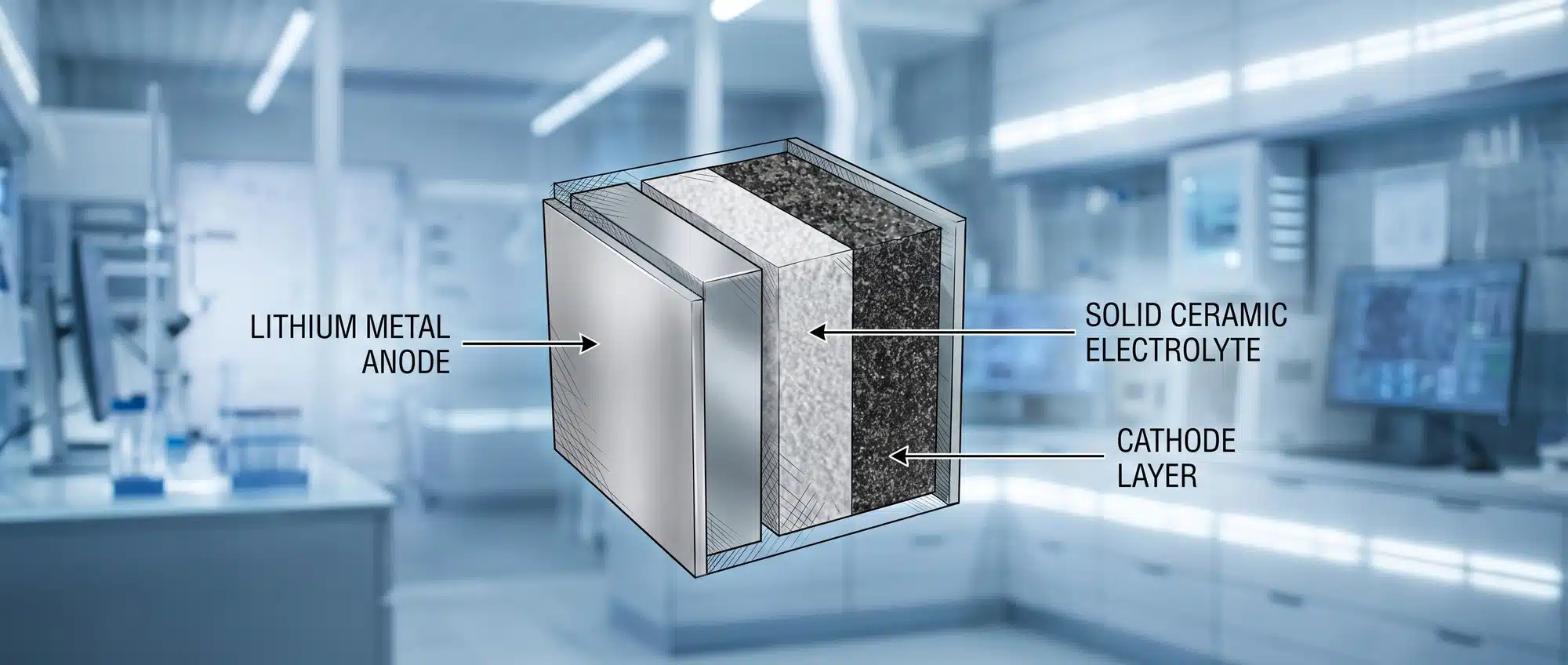
A solid-state battery replaces the liquid electrolyte found in conventional lithium-ion cells with a solid electrolyte material—typically a ceramic, polymer, or sulfide-based compound. In a traditional battery, the liquid electrolyte (a lithium salt dissolved in an organic solvent) serves as the medium through which lithium ions travel between the cathode and anode during charging and discharging. By substituting this flammable liquid with a non-flammable solid, solid-state batteries eliminate one of the most significant safety vulnerabilities in current battery design.
The solid electrolyte also enables the use of a lithium metal anode instead of the graphite anode used in conventional cells. Lithium metal can store far more energy than graphite, which is why solid-state designs can achieve substantially higher energy densities. This architectural change is the foundation for nearly every performance advantage solid-state batteries promise.
How Lithium-Ion Batteries Work
Lithium-ion batteries operate by shuttling lithium ions between two electrodes through a liquid electrolyte. During discharge, lithium ions move from the graphite anode to the metal oxide cathode, releasing electrons that power the connected device. During charging, an external power source reverses the flow, pushing ions back into the anode. This design has been refined over three decades and currently delivers energy densities of approximately 250 to 300 watt-hours per kilogram (Wh/kg) in the best commercial cells.
However, the liquid electrolyte introduces inherent limitations. It is flammable, can degrade over time, and restricts the use of higher-energy anode materials. The electrolyte also contributes to the formation of dendrites—needle-like lithium structures that can pierce the separator between electrodes and cause short circuits, leading to thermal runaway and fire.
Key Differences at a Glance
| Metric | Lithium-Ion (2026) | Solid-State (Near-Term Target) |
|---|---|---|
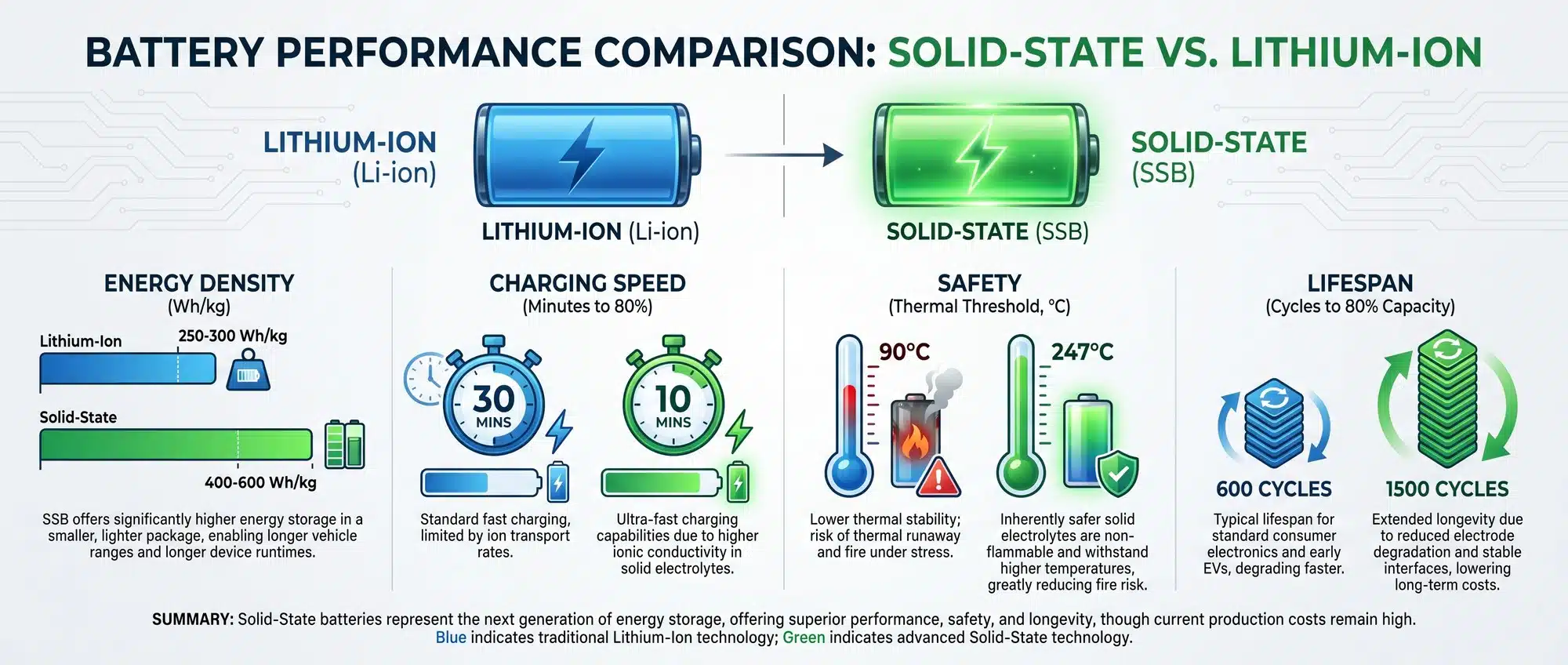
| Gravimetric Energy Density | 250–300 Wh/kg | 400–600 Wh/kg |
| Volumetric Energy Density | 700–800 Wh/L | 1,000–1,300 Wh/L |
| Thermal Runaway Onset | ~90°C | ~247°C |
| 10–80% Fast-Charge | 22–35 minutes | Under 10 minutes |
| Typical Cycle Life | 500–1,000 cycles | 1,000–1,500 cycles (90–95% retention) |
| Electrolyte Material | Flammable liquid solvent | Non-flammable solid (ceramic, polymer, or sulfide) |
| Anode Material | Graphite / Silicon-Carbon | Lithium metal (or anode-free design) |
| Cost per kWh (Pack) | $100–130 | 5–10× higher (declining with scale) |
| Commercial Availability | Mass-market now | Semi-solid available; full SSB ~2027 |
The differences are stark. Solid-state batteries outperform lithium-ion on nearly every technical metric, but cost and manufacturing complexity remain significant barriers to widespread adoption.
Energy Density: Range and Storage
Energy density is arguably the most transformative advantage solid-state batteries bring to the table. Current lithium-ion cells top out at roughly 250–300 Wh/kg gravimetric density and 700–800 Wh/L volumetric density. Solid-state designs with lithium metal anodes are targeting 400–500 Wh/kg commercially, with laboratory demonstrations reaching 600 Wh/kg and beyond.
In practical terms for electric vehicles, a 350 Wh/kg solid-state pack could deliver approximately 1,000 kilometers of range, while a 400–500 Wh/kg pack could push beyond 1,200 kilometers. Samsung SDI’s silver-carbon solid-state architecture has achieved volumetric densities of 900 Wh/L—roughly double that of the best lithium-ion cells—meaning automakers could pack twice the energy into the same physical battery compartment.
This density advantage also matters for consumer electronics, where thinner and lighter devices with longer battery life become possible, and for grid-scale energy storage, where space efficiency translates directly into lower installation costs.
Safety: Fire Risk and Thermal Runaway
The safety gap between the two technologies is substantial. Lithium-ion battery fires, while statistically rare given the billions of cells in circulation, are notoriously difficult to extinguish and can reignite hours after being put out.
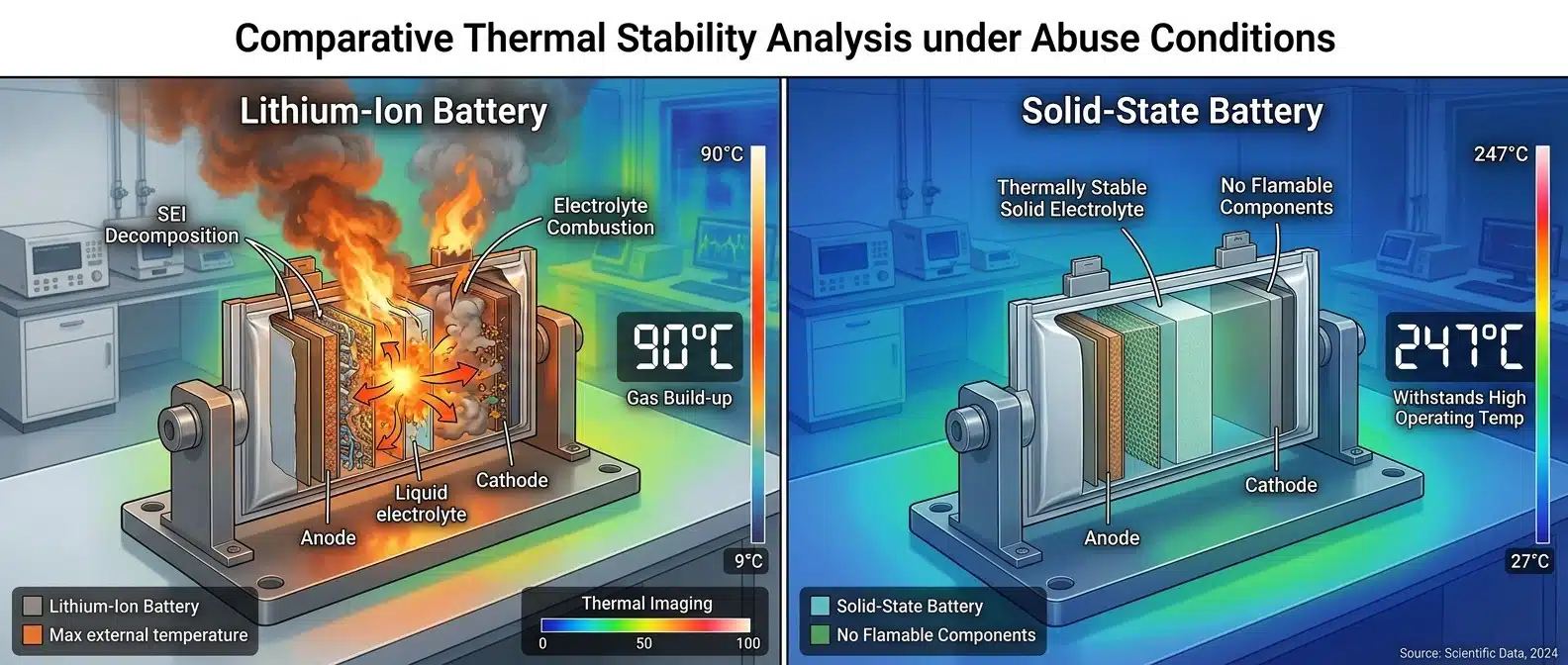
The root cause is the flammable organic liquid electrolyte, which can ignite when a cell is punctured, overcharged, or exposed to high temperatures.
Solid-state batteries address this at the most fundamental level. The solid electrolyte is non-flammable, eliminating the fuel source for battery fires. Comparative testing shows that thermal events in solid-state systems begin at around 247°C, compared to just 90°C for conventional lithium-ion cells. This wider thermal safety margin also means solid-state batteries can tolerate more aggressive fast-charging without risking damage, and they perform better across extreme temperature ranges.
Charging Speed and Efficiency
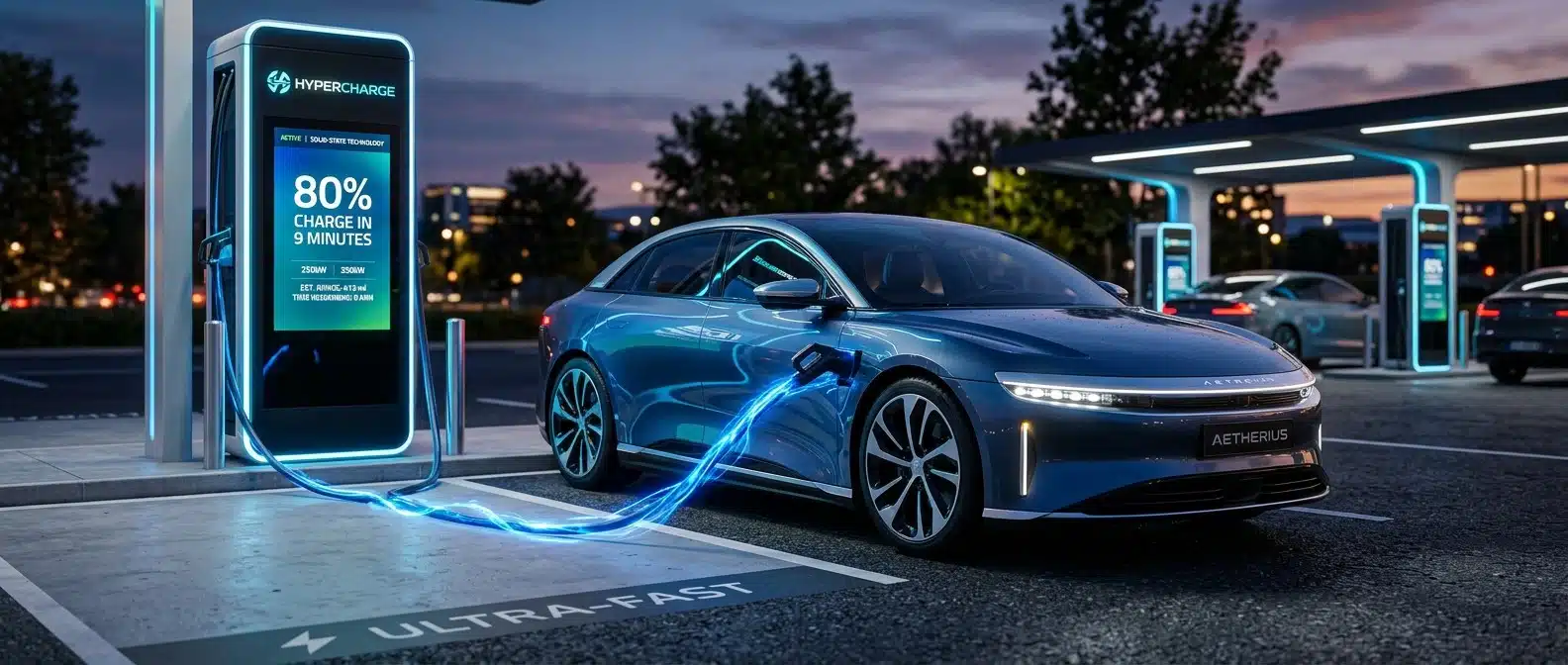
Fast-charging capability is one area where solid-state batteries show dramatic improvement. Today’s lithium-ion EVs typically require 22–35 minutes to charge from 10% to 80% on a high-power DC fast charger. Solid-state prototypes from multiple manufacturers have demonstrated the same charge in 9–10 minutes—roughly the time it takes to refuel a conventional car.
This speed is possible because solid electrolytes can remain stable at higher current densities without the degradation and safety risks that plague liquid electrolytes under the same conditions. Additionally, solid-state cells exhibit better Coulombic efficiency—the ratio of charge extracted versus charge put in—meaning less energy is lost as heat during both charging and discharging cycles.
Lifespan and Durability
Battery longevity is a critical factor for both EV resale value and total cost of ownership. Lithium-ion batteries typically retain about 70–80% of their original capacity after 500–1,000 charge cycles, depending on chemistry, temperature exposure, and charging habits. For an EV with 400 kilometers of range, that translates to roughly 200,000–400,000 kilometers before noticeable degradation.
Solid-state batteries are demonstrating markedly better cycle life. Testing shows 1,000–1,500 cycles with 90–95% capacity retention and capacity retention of 80–85% even after 2,000 cycles. The solid electrolyte is less prone to the side reactions and degradation mechanisms that gradually consume the liquid electrolyte in conventional cells. This means solid-state batteries could realistically last the entire lifetime of a vehicle without replacement, reducing both waste and long-term ownership costs.
Cost and Manufacturing Challenges
If solid-state batteries have an Achilles’ heel, it is cost. Manufacturing an all-solid-state cell is extraordinarily complex, requiring precise environmental controls, specialized equipment, and materials that have not yet been produced at scale. Current estimates place solid-state cell production at five to ten times the cost per kilowatt-hour of conventional lithium-ion cells. The U.S. Department of Energy has awarded $50 million to accelerate domestic solid-state battery manufacturing, signaling strong government backing for the technology.
Several factors contribute to this premium. Solid electrolytes—particularly sulfide-based materials—are sensitive to moisture and must be handled in dry-room environments. The lithium metal anodes used in many designs are difficult to manufacture in thin, defect-free sheets. And the stack pressure required to maintain good contact between solid layers adds mechanical complexity to pack design.
However, costs are expected to decline substantially as production scales. Industry analysts project that solid-state batteries could reach cost parity with lithium-ion by the early 2030s, particularly at the system level, where simpler thermal management and packaging can offset some of the cell-level cost premium.
Environmental Impact
Both battery technologies carry environmental considerations throughout their lifecycle. Lithium-ion batteries require cobalt, lithium, nickel, and graphite—materials whose mining and processing have documented environmental and social impacts. Solid-state batteries may reduce or eliminate the need for cobalt and graphite, depending on the specific chemistry, but some designs still use these materials.
Where solid-state batteries offer a clearer environmental advantage is in longevity and safety. A battery that lasts twice as long means half as many batteries need to be manufactured, and the elimination of flammable electrolytes reduces the environmental risks associated with battery fires at recycling facilities and landfills. Additionally, the higher energy density means fewer raw materials are needed per kilowatt-hour of storage capacity.
When Will Solid-State Batteries Be Available?
The timeline for solid-state battery commercialization has firmed up considerably. Semi-solid batteries—a transitional design that uses a gel-like electrolyte—are already in limited production. Chinese manufacturer NIO, in partnership with WeLion, has deployed a 150 kWh semi-solid pack offering approximately 930 kilometers of range in its vehicles.
For fully solid-state batteries, the consensus among manufacturers points to 2027 as the inflection point. Toyota, which holds thousands of patents in sulfide-based solid electrolytes, has committed to a commercial release between 2027 and 2028. Samsung SDI is targeting mass production by 2027 using its anode-less silver-carbon architecture. CATL, the world’s largest battery manufacturer, is also aiming for small-scale production around 2027.
China plans to release its first national solid-state battery standard in 2026, signaling the technology’s transition from research to a regulated commercial product. Meanwhile, domestic U.S. solid-state battery manufacturing is also accelerating, with companies like Greater Bay achieving A-sample production milestones. By 2030, most industry roadmaps anticipate large-scale production at volumes sufficient for mainstream electric vehicles, with energy densities around 500 Wh/kg.
Frequently Asked Questions
What does Elon Musk say about solid-state batteries?
Elon Musk has been publicly skeptical of solid-state battery timelines, arguing that Tesla’s continued refinement of lithium-ion technology—including the 4680 cell format and dry electrode manufacturing—will keep lithium-ion competitive on both cost and performance for years to come. Tesla has filed patents related to solid-state technology, but the company has not announced any near-term plans to commercialize it, instead focusing on lithium-iron-phosphate (LFP) and high-nickel lithium-ion chemistries for its vehicles.
Why don’t EVs use solid-state batteries yet?
The primary barrier is manufacturing at scale. While solid-state batteries have been demonstrated in laboratories and small pilot runs for years, producing them in the millions of units required for automotive production—with consistent quality and at a competitive price—remains unsolved. The specialized manufacturing environments, material handling requirements, and quality control processes are still being developed. Additionally, automakers need to validate that solid-state packs can survive a vehicle’s entire lifetime under real-world conditions before committing to them.
What are the disadvantages of solid-state batteries?
Solid-state batteries face several challenges. Manufacturing costs are currently five to ten times higher than lithium-ion. Solid electrolytes, particularly ceramics, can be brittle and prone to cracking under physical stress or repeated expansion and contraction during cycling. Some solid electrolytes have lower ionic conductivity than liquid electrolytes, which can limit power output at low temperatures. Dendrite formation—the same problem that plagues lithium-ion—has also been observed in some solid-state designs using lithium metal anodes, though solid electrolytes are generally more resistant to dendrite penetration than liquid separators.
Why can’t we make solid-state batteries?
Solid-state batteries can be made, and they are being made today in research laboratories and pilot production lines. The challenge is making them at the scale, consistency, and cost required for mass-market products. Key hurdles include developing manufacturing processes that can produce solid electrolyte sheets thin enough for high energy density while remaining defect-free, ensuring good and lasting contact between solid layers under real-world conditions, and building the supply chain for materials that have never been produced at commercial volumes. Each of these challenges is the subject of active research and investment, and incremental progress is being reported regularly.


