
A language model can summarize thousands of battery papers in seconds, yet it still struggles to picture the thing those papers are about. A crystal is not a sentence. It is a repeating 3D arrangement of atoms, where the same elements can behave very differently depending on how they are stacked and bonded. MIT researchers built a model called CLaC to close that gap by teaching AI to read the structure and the description together.
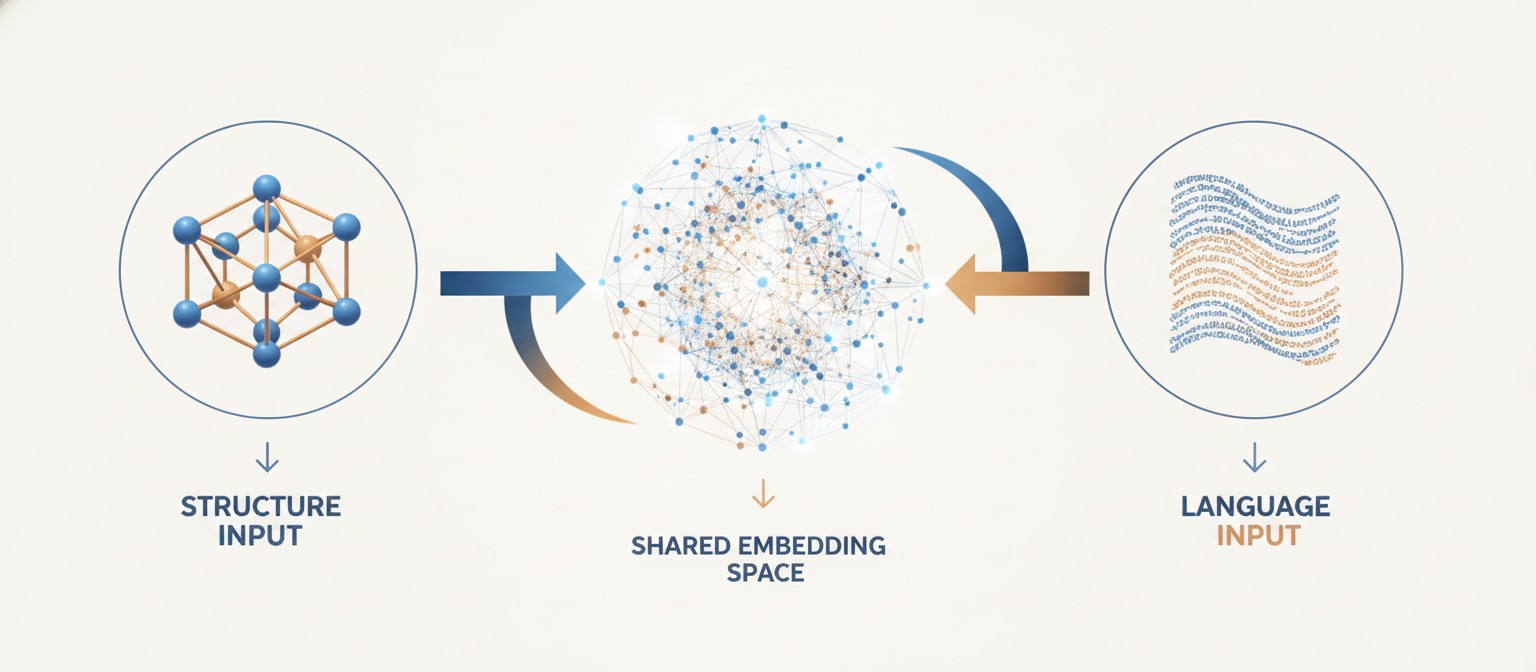
CLaC stands for Contrastive Language-Crystal model. It is a vision-language model, meaning a system that learns from two kinds of input at once, in this case 3D crystal structures and natural language. The team trained it with contrastive learning, a method that shows the model matched and mismatched pairs of structures and texts until it learns which description belongs with which arrangement. When asked in plain language for solid-state battery electrolyte candidates, its shortlist included materials that separate studies had already flagged as promising.
That result is a retrieval success, not a battery breakthrough. No new cell was built, and no material was commercialized. What matters is the method behind it, because it points to a practical way around two stubborn problems in materials data: there are too few crystal-text pairs to train on, and the papers that do exist focus heavily on a small set of popular materials.
Why Crystals Are Hard for Language Models
Think of the published literature as a shelf of travel journals and a crystal database as a drawer of maps. A text-only model has read many journals but has rarely studied the maps. It knows which places get mentioned most often, but it cannot reliably judge an unvisited street from its shape on the page.
Crystals present the same mismatch. More than 90 percent of solid materials on Earth are crystalline, with atoms arranged in highly ordered, repeating patterns, according to the MIT team. Most AI tools for crystals treat those arrangements as 3D graphs, with atoms as nodes and bonds as edges. Large language models, by contrast, learn mainly from streams of text in papers and books.
That creates two blind spots. First, many possible crystal structures live in computational databases rather than in prose, so a text-only model never sees them clearly. Second, the experimental literature is biased toward a few heavily studied classes of crystals, which pushes AI outputs toward familiar materials. A model trained only on papers inherits that popularity contest.
What CLaC Does Differently
CLaC keeps both the map and the journal on the table. One branch of the model, a crystal graph encoder, reads the 3D atomic arrangement in a way that preserves geometric relationships. The other branch, a text encoder, reads a natural language description. Contrastive training pulls the two encodings for a true pair closer together in a shared space while pushing mismatched pairs apart.
The shared space is the useful part. Once structures and descriptions sit in the same mathematical neighborhood, a researcher can type a property description and retrieve crystals whose structures land nearby. The query does not need to name a formula or a fixed label. The model is matching meaning to geometry.
This is similar to how image and text models learned to connect pictures with captions, except crystals are stricter than photographs. A small shift in symmetry or bonding can change what a material does, so the structural reader must respect geometry rather than treat the crystal as a flat picture.
How the Training Works
The team started with about 126,000 materials from the Materials Project, an open computational database of computed crystal properties. For text, they used two sources. One was paragraphs pulled directly from about four million academic papers by searching for chemical formulas. The other was synthetic narratives, descriptions generated by a language model that were grounded in computed properties from the database.
A synthetic narrative is not a copied paper paragraph. It is a generated summary that can cover composition, structure, properties, processing considerations, and possible applications for a specific crystal, even when no human has written a full paper about that crystal. The paper reports that these narratives covered about 300 times more diverse crystals than the team could find described in the literature sample, which directly addresses the bias toward heavily studied materials.
The comparison was direct. One version of the model, called CLaC-Paper, trained on literature text. Another, called CLaC-Synthetic, trained on the generated narratives. Only the synthetic-trained version learned a structured alignment between geometric structures and text descriptions, while the paper-only version did not, a difference the authors attribute to semantic clarity rather than data volume alone.
| Training text | What it contains | What the model learned |
|---|---|---|
| Literature paragraphs | Sentences mentioning a formula, often incomplete and skewed toward popular materials | Weak alignment, with retrieval near random selection on property queries |
| Property-grounded synthetic narratives | Generated descriptions tied to computed properties, covering composition, structure, behavior and uses | Structured alignment, with systematically better retrieval and clearer ordering by meaning |
As Ju Li, the Carl Richard Soderberg Professor in Power Engineering at MIT, put it in the MIT News release describing the work: “Structure is really at the heart of the materials science field. If you understand the structure, you can infer quite a lot about the properties and performance of materials. We wanted to build the connection between a material’s atomic structure and its properties and processing for the model.”
What the Tests Actually Showed
The team focused on zero-shot tests, meaning tasks the model had not been directly trained to do. In a multiple-choice retrieval setup, the model had to pick the right text description for a given crystal structure or the right crystal for a given description without extra fine tuning.
The pattern was uneven in an informative way:
- Composition was strong. CLaC-Synthetic matched structures to the correct composition description 95.4 percent of the time, compared with 17.8 percent for a text-only Gemma baseline and 13.5 percent for an untrained version. That shows contrastive training captured which elements belong together.
- Crystal-system classification was weak. A crystal system is the broad symmetry family of a crystal, such as cubic or hexagonal, which describes how its repeating unit is shaped. CLaC-Synthetic reached only 34.0 percent accuracy here, roughly on par with the text baseline. The authors link this limit to a small training batch size of 16 combined with highly imbalanced crystal-system data, which made it hard for the model to learn fine symmetry distinctions.
- Property-guided retrieval favored synthetic text. Given a numerical property target, the synthetic-trained model retrieved candidates closer to the target than random selection, while the paper-trained version looked little better than random. Queries with sharper similarity gradients, such as density, retrieved more precisely than queries with flatter gradients, such as energy above hull.
- Qualitative language also worked better with synthetic training. When queries used descriptive phrases rather than numbers, the synthetic-trained model shifted its retrieved distributions in the intended direction. The paper-trained model mostly returned the background distribution of the candidate pool.
The best overall configuration in the ablation study, which paired a PaiNN graph encoder with a Galactica text backbone and standard contrastive loss plus intratask objectives, placed the correct crystal first 56.6 percent of the time in a retrieval test, a clear improvement but still far from perfect. The authors are direct that instruction-based discovery remains future work rather than a solved capability.
The Battery Test: Solid-State Electrolyte Candidates
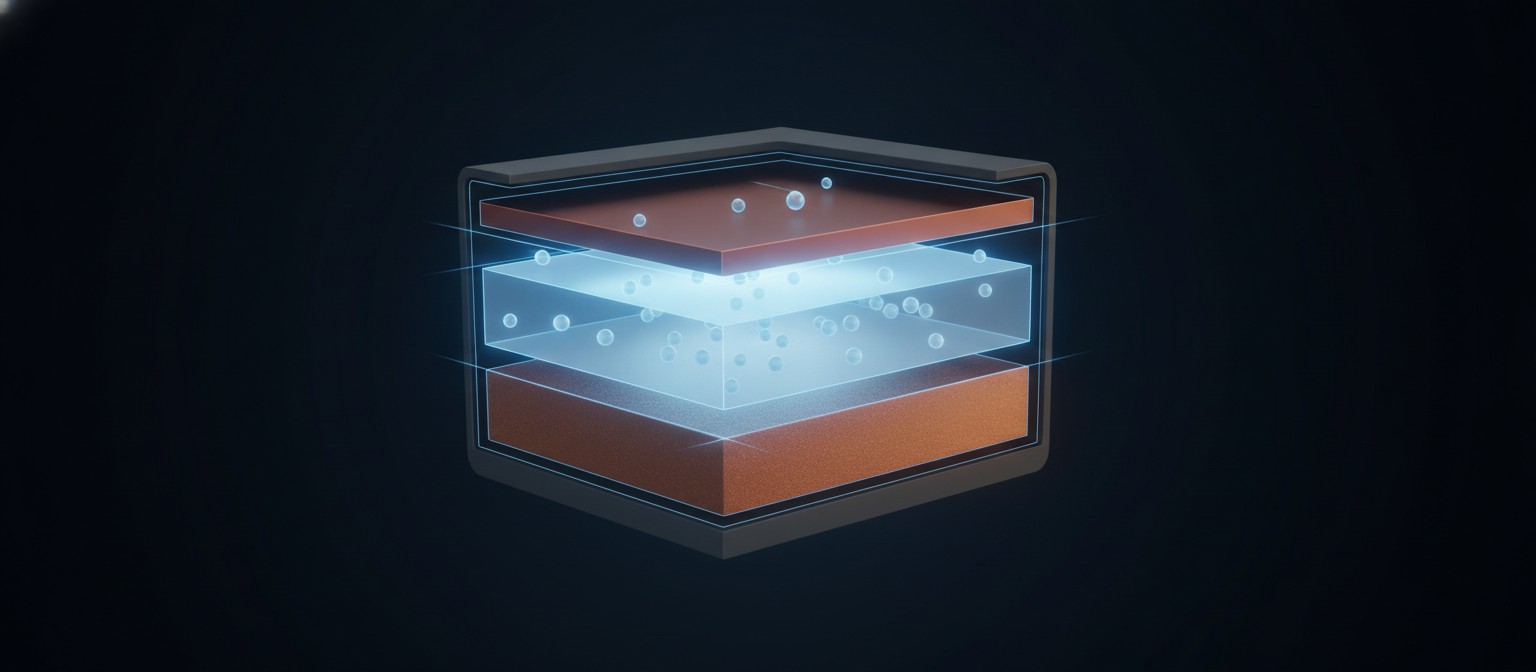
For the battery demonstration, the team asked for materials containing lithium ions with a high band gap for use as solid-state electrolytes. A solid-state electrolyte is the solid layer in a solid-state battery that must let lithium ions pass while blocking electrons. A wide band gap helps suppress electronic conductivity, which is one requirement among several.
The top 30 retrieved materials all contained lithium, with an average band gap of 3.23 eV, according to the paper in Nature Communications titled Scaling multimodal materials representation learning with synthetic narratives.
The paper itself appeared in Nature Communications on August 26, 2026, and MIT News covered it on October 18, so the October date is the announcement rather than the publication.
Two names stood out because separate studies had already noted them. Li6PClO5, ranked fourth, had been identified as a promising candidate in independent work, while Li4SiO4, ranked ninth, had previously been synthesized as a thin film for use as a stable solid electrolyte.
That overlap is validation of the shortlist, not proof that either material will succeed in a commercial cell. The screen ranked by band gap alone because ionic conductivity data were not included in the synthetic narrative dataset, so the authors excluded that criterion. A real electrolyte must also conduct ions quickly, remain stable against both electrodes, survive processing and cycle for years, a mechanical side of the same problem that an earlier MIT honeycomb electrode design tackled by giving expanding lithium room to move. Those tests were outside this study.
This distinction is why the result belongs early in the discovery pipeline. Finding candidates that merit lab time is valuable precisely because synthesis and testing are slow and expensive. It does not replace them. Readers who want the downstream part of that story, what a solid layer must do inside a working cell, can see how interface contact and conductivity trade off in a softer solid electrolyte designed to hold contact with swelling electrodes and in our broader solid-state battery comparison with lithium-ion.
What CLaC Still Gets Wrong
The paper and release are unusually clear about limits, and those limits shape what CLaC can be used for next.
- Fine geometry is still hard. The 34.0 percent crystal-system accuracy shows the model reads composition far better than symmetry, which limits claims about deep geometric understanding.
- Instruction following is limited. The authors describe flexible, instruction-driven reasoning as the goal and state that realizing instruction-based discovery with this model remains a challenge for future work.
- Only single crystals are covered. The current model applies to crystalline materials and cannot yet handle metal-organic frameworks, polycrystals, or materials with defects that affect properties in real devices.
- Language has known failure modes. The authors note risks of hallucination in generated text, inconsistent naming in inorganic materials science, and ambiguity when a formula alone cannot say whether the text means a bulk crystal, a nanoparticle or a non-crystalline form.
- Standard benchmarks are missing. The field lacks agreed tests for language-to-structure alignment, so the team designed its own zero-shot retrieval and screening tasks. That makes careful interpretation more important than a single score.
As Li put it, “We wanted to create an AI model that works broadly across materials. That’s why we decided to synthesize narratives rather than rely solely on existing papers. We found when we used that narrative dataset, the models are better at predicting the function.” The improvement is real, but the word broadly here means across many crystal types, not across every materials problem.
Why This Matters for Solid-State Batteries
Solid-state batteries need better ways to search because the design space is vast and the constraints pull in different directions. A candidate must move ions, block electrons while staying mechanically tough, resist chemical attack, and hold physical contact through swelling and shrinking. No single property predicts success.
A tool that accepts a sentence like “lithium-containing material with a wide band gap” and returns structurally grounded candidates lowers the cost of the first step. It widens the search beyond familiar chemistries without pretending that retrieval equals validation. The lab work of making films, measuring conductivity, testing stability, and building full cells still decides what matters.
Elsa Olivetti, the Jerry McAfee Professor in Engineering at MIT, framed that role as infrastructure rather than an endpoint: “There are sometimes these step changes within materials science around algorithmic integration toward useful tools, which the community uses to further advance the field. This approach helps us see more deeply into three-dimensional structures and link structures to property and processing. I hope this can be one of those step changes.”
The code and evaluation setup are public in the project’s CLaC repository, which should let other groups test the same retrieval workflow on their own candidate pools. That open sharing matters because, as our look at open-source AI infrastructure for materials discovery argues, reusable data and workflows are what turn a single model into cumulative progress. The next advances the authors name are broader structure types, better data synthesis with fewer hallucinations, and tighter links between scientists’ language and materials space.
Frequently Asked Questions
What is CLaC?
CLaC is a Contrastive Language-Crystal model from MIT that aligns 3D crystal structures with natural language descriptions in a shared representation space, so a text query can retrieve structurally relevant crystals. The work was reported in October 2026 with first author Yang Jeong Park and senior authors Ju Li and Elsa Olivetti.
Why do language models struggle with crystal structures?
A crystal is a periodic 3D arrangement, usually stored as a graph or geometric file, not as sentences. Text-only models learn from papers that underdescribe many crystals and overrepresent popular ones, so they lack direct geometric supervision.
What are synthetic narratives?
They are language-model-generated descriptions grounded in computed properties for specific crystals, covering structure, behavior, processing, and possible uses. In this study they supplied clearer supervision than raw paper paragraphs and covered a wider range of crystals.
What is contrastive learning?
Contrastive learning trains a model by comparing true pairs with mismatched pairs. For CLaC, a crystal graph encoder and a text encoder are trained so that a structure and its correct description end up close together, while incorrect pairings end up farther apart.
Did CLaC discover a new battery?
No. It retrieved a ranked shortlist for one electrolyte requirement, a high band gap, and two of its top picks had independent precedent in electrolyte research. Ionic conductivity was not part of that screen, and no cell was built or tested.
What are the main limitations?
Crystal-system accuracy was modest at 34.0 percent; instruction-driven discovery remains future work; the model covers single crystals rather than polycrystals; defects or metal-organic frameworks; and generated text can contain hallucinations.
The Bottom Line
CLaC does not replace experiments. It improves the search step that decides which experiments to run. By pairing crystal geometry with generated, property-grounded descriptions, it learned alignments that paper text alone did not provide, and that alignment produced a battery-electrolyte shortlist with independent support.
The honest scorecard stays attached to the claim. Strong on composition, weak on symmetry, with instruction-based discovery still unsolved. For solid-state batteries, where every candidate must still survive conductivity, stability, and lifetime testing, a better map of where to look is still a meaningful advance.

