
The human knee functions as a mechanical linkage. Bone, ligament, meniscal tissue, and cartilage interact constantly under large compressive forces every time we take a step. Knee biomechanics dictate that this joint must absorb shock while maintaining a near-frictionless gliding motion. The success of this system depends on the microscopic environment enclosed within the joint capsule. Healthy joints rely on a specialized liquid medium to keep the articulating surfaces protected and separated. A dramatic shift occurs in this environment when age or injury disrupts the biological equilibrium. Articular cartilage wear begins when mechanical shear forces overcome the biological protection. The structural integrity of the joint breaks down at a cellular level, and the result is a progressive mechanical failure of the knee.
The Physics of Fluid Dynamics in Human Movement
Fluid mechanics determine how the knee handles repetitive physical stress. The viscoelastic properties of synovial fluid are central to the health of a joint. This fluid acts as a non-Newtonian material. It behaves like a viscous, flowing liquid during slow movements and transforms into an elastic solid during rapid impacts. This dual nature provides shock absorption and load distribution during high-impact activities like running or jumping.
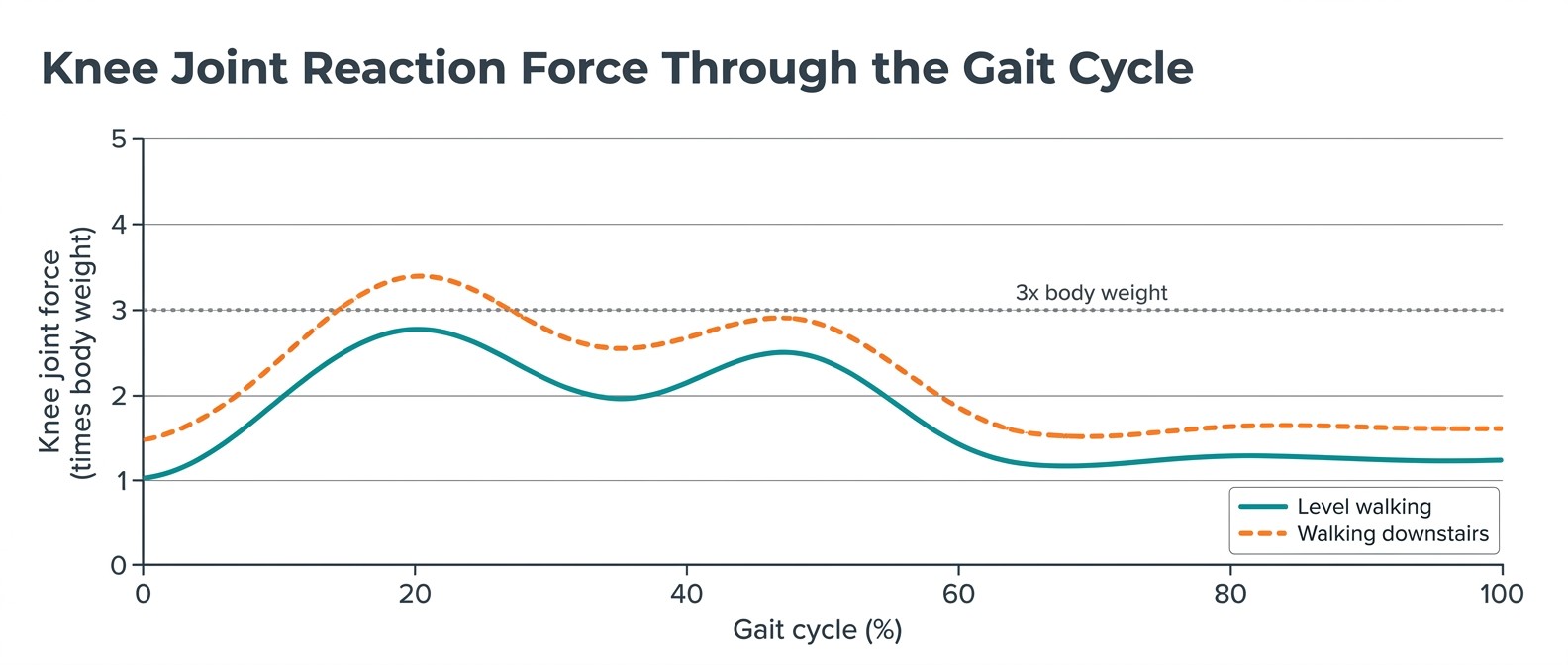
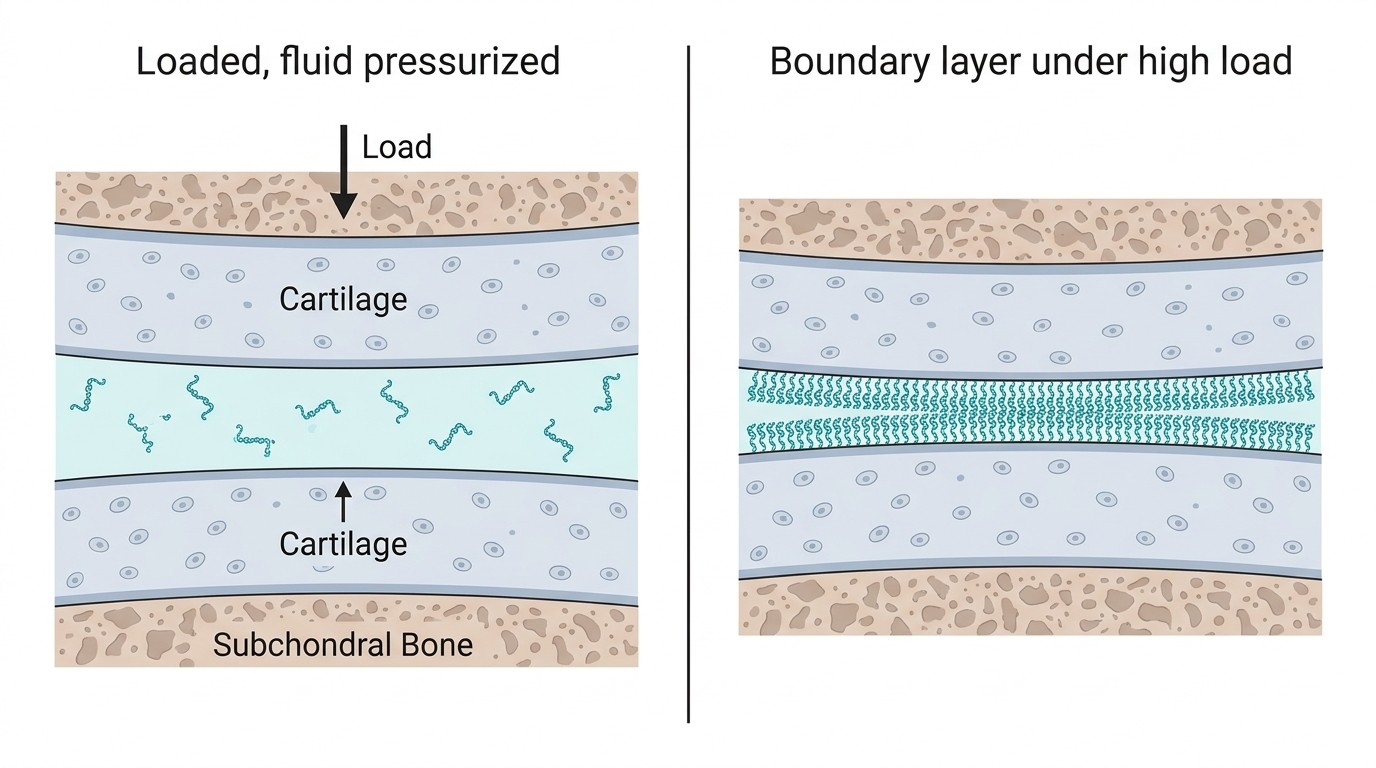
Joint loading and gait mechanics constantly test this fluid barrier. Published measurements of tibiofemoral contact force place typical loading during normal walking at roughly two to three times body weight, and cadaveric work has produced values up to around five times. The joint surfaces would grind against each other and degrade rapidly without an effective hydraulic cushion. The biological solution lies in a complex sugar molecule called hyaluronan. High concentrations of hyaluronan create a thick, protective gel that coats the cartilage matrix. Boundary lubrication occurs at the microscopic level where the opposing cartilage surfaces meet. In effect, the hyaluronan molecules act as a boundary layer that keeps the two surfaces from touching directly. Fluid and cartilage lubrication research published in the Journal of Orthopaedic Research in 2018 found that, in degraded cartilage, hyaluronic acid-based lubricants lose some of their ability to maintain the low-friction film that protects chondrocytes from friction and shear strain. In that laboratory model, inflammation-induced cartilage breakdown raised friction in both boundary and mixed lubrication modes, which weakens the friction-reducing effect the injected fluid can provide. The physical properties of the fluid are therefore non-negotiable for long-term structural health.
The Kinematics of Daily Activity
Normal human movement is needed to grasp the mechanical demand placed on this fluid. The knee does not operate as a simple hinge. It undergoes complex rolling and gliding motions simultaneously as the leg bends. A person walking downstairs loads the joint more heavily than level walking does. That difference has been measured directly: instrumented implants recorded peak forces of about 3.1 times body weight on stair descent against 2.8 times body weight on walking, while other computational models have estimated considerably higher values. The contact area between the femur and tibia is remarkably small, so that kinetic force concentrates on a small surface. The synovial fluid must increase its viscosity the moment the foot strikes the step. The fluid transforms into a stiff cushion in milliseconds to spread that force across a wider surface area. Cartilage cells can be damaged or killed when the fluid fails to perform this rapid physical transformation. Viscosupplementation aims to restore this millisecond response time to the joint capsule.
The Cascade of Mechanical Deterioration
The system eventually experiences mechanical failure in millions of patients. Clinicians classify this progressive deterioration as osteoarthritis. Synovial fluid viscosity decline in osteoarthritis fundamentally alters the internal joint environment. The concentration of hyaluronan molecules drops, and the average size of the remaining molecules shrinks. The fluid becomes thin and watery as a direct consequence. It loses its ability to absorb sudden impacts or provide adequate boundary lubrication, and the physical barrier between the bones wears thin.
Cartilage cells, known as chondrocytes, experience abnormal mechanical compression during this phase. They respond to this physical trauma by releasing inflammatory mediators that further degrade the extracellular matrix. The knee joint becomes stiff, painful, and persistently inflamed. The mechanical problem creates a destructive biological cascade. The friction coefficient inside the joint rises as the fluid thins, and the cartilage surface begins to fray, fibrillate, and eventually thin out to expose the underlying bone.
Engineering a Solution Through Viscosupplementation
Medical interventions focus on restoring the mechanical properties of the joint fluid to slow this downward spiral. Viscosupplementation is a direct physical approach to a mechanical problem. Hyaluronic acid injections aim to replace degraded, watery natural fluid with a high-viscosity substitute. One example in this category is Synvisc, a hylan G-F 20 formulation. Hylan G-F 20 is a high molecular weight fluid formulated to approximate the physical characteristics of healthy joint fluid.
Synvisc is derived from natural sources and undergoes a specialized chemical manufacturing process to create a cross-linked viscous gel. Some clinics and orthopedic practices that manage large volumes of joint preservation patients choose to order Synvisc knee injections in bulk, as they would any other consumable. Hylan G-F 20 products are supplied in pre-filled glass syringes to keep the gel sterile and viscous until the moment of application.
The Chemistry of Joint Cushioning
The science of molecular construction dictates the behavior of these orthopedic treatments. Native hyaluronan is a large, coiled molecule that takes up significant physical space within the fluid. The sheer size of the molecule creates resistance to flow, which is the property required in a biological shock absorber. The body naturally produces these long chains of sugars, but the inflammatory environment of an arthritic knee chops them into smaller, less effective fragments.
Pharmaceutical engineering steps in to address this chemical breakdown. Chemical synthesis involves creating artificial covalent bonds between individual hyaluronan chains. The high molecular weight and cross-linking of hyaluronan in this kind of formula allow the gel to resist breakdown and remain in the joint space longer than uncross-linked alternatives. These bonds tie the loose chains together into a dense, three-dimensional mesh, and this mesh resists the degrading enzymes present in the arthritic joint. The gel maintains its structural integrity and remains viscous long after simple molecules would have washed away. The physics of this mesh network provide the mechanical resistance needed to cushion heavy footsteps.
Restoring Frictionless Gliding
The physical structure of the injected fluid gives it specific, measurable mechanical advantages inside the knee. Extensive chemical cross-linking creates a dense, tangled molecular network, and this network provides greater elasticity and viscosity than lower molecular weight products. The clinical application requires precision. The procedure demands exact placement, as an intra-articular injection must be deposited entirely within the synovial capsule to be effective. The needle must bypass the fat pad and soft tissues to deliver the gel directly into the joint cavity.
The mechanical goals of viscosupplementation are specific:
- Restore the natural viscoelastic buffer to the joint capsule space.
- Decrease the coefficient of friction between opposing cartilage surfaces.
- Reduce the transmission of destructive mechanical forces to the subchondral bone.
The introduction of this viscous gel changes the local mechanical environment. Joint lubrication improves as the gel coats the degraded, rough cartilage surfaces. The thick fluid physically separates the frayed edges of the articular cartilage and acts as a mechanical buffer against compressive forces. The presence of the gel also reduces the activation of sensitive pain receptors located in the joint capsule lining, and several reviews link this physical buffering to the symptom relief and function patients report during daily activities. The gel additionally restores the shock-absorbing capacity of the knee linkage. Impact forces generated during walking are dispersed through the fluid rather than transferred directly downward into the subchondral bone. This mechanical offloading matters for preserving whatever native knee cartilage remains intact. The joint can once again move through its normal range of motion with reduced resistance and heat generation.
Clinical Evidence and Biological Realities
The scientific and orthopedic consensus on this intervention acknowledges its mechanical rationale rather than a settled clinical advantage. Molecular weight is widely assumed to matter: a 2015 consensus statement on viscosupplementation for osteoarthritis groups high molecular weight preparations together and treats their greater viscoelasticity as the basis for longer intra-articular residence. The clinical picture is less tidy. A 2015 review by Newberry and colleagues, cited in Medicare coverage guidance, found no significant differences among viscosupplementation formulations when high and low molecular weight products were compared directly. A thicker, more elastic fluid may function better as a shock absorber under load, but the trials do not consistently show that this translates into longer relief. The same gap appears in other interventions marketed for knee osteoarthritis, where plausible mechanical mechanisms have outrun the clinical data.
There are specific clinical realities to acknowledge when discussing these joint preservation treatments. Viscosupplementation does not reverse the biological damage already done to the cartilage matrix. It cannot grow new cartilage cells or reverse severe bone-on-bone joint destruction. It serves strictly as a mechanical bridge. It alters the physical forces acting on the joint to slow further degradation.
The knee can be viewed as an engine that requires clean, viscous oil to run smoothly. The native fluid loses its protective qualities through disease, trauma, or heavy lifetime use. The injection of an engineered substitute addresses the internal friction. The success of the procedure relies partly on the physical properties of the injected gel. Heavier, cross-linked molecules endure the internal environment of the knee longer than smaller, unlinked molecules, though the clinical consequences of that difference remain debated. Viscosupplementation manipulates the biomechanics in favor of preservation. The objective is to keep the joint moving smoothly to protect the underlying structure.

