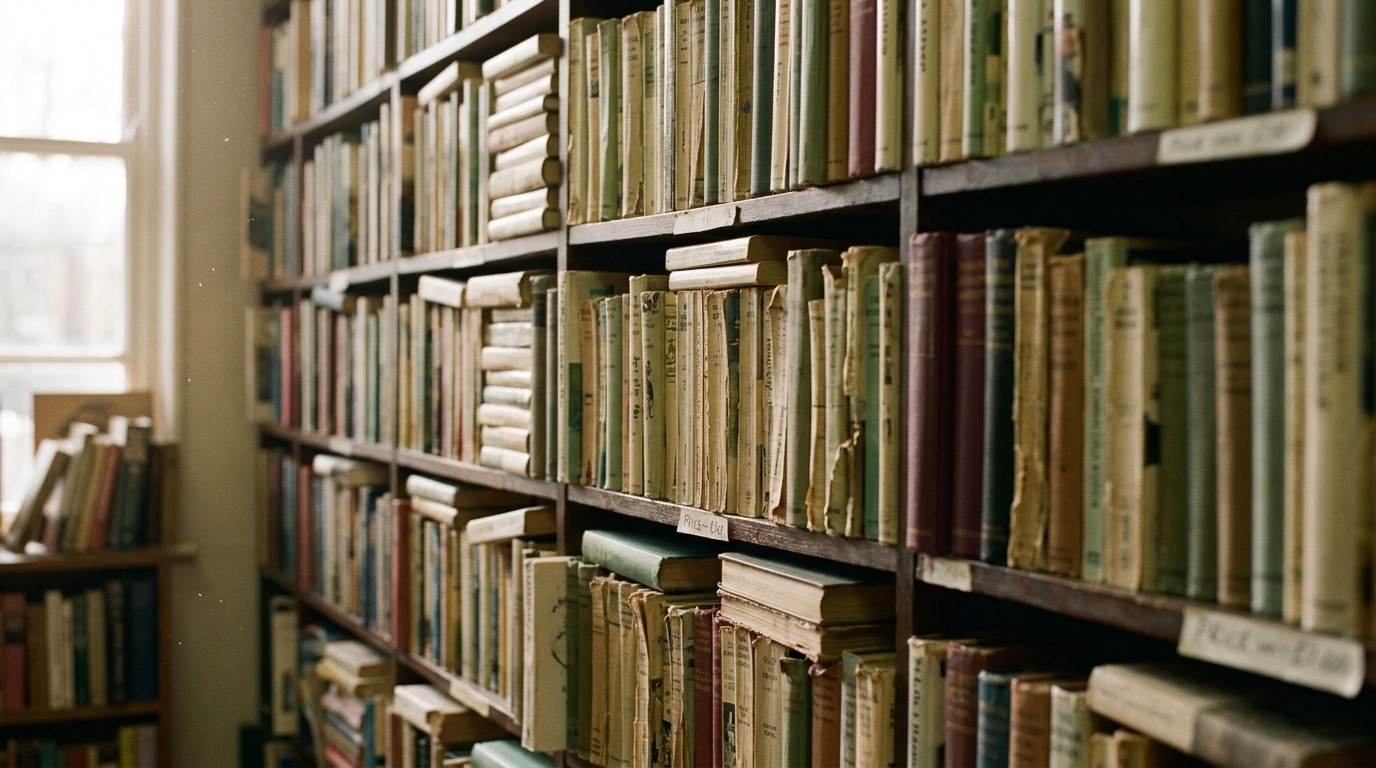
Every home with more than a dozen books eventually reaches the same impasse. The shelf has stopped being a library and become storage: paperbacks from a holiday ten years ago, a hardback someone gifted you, and a complete set inherited from a relative you loved but whose taste you do not share. You know they should not go in the bin. You are less certain what should happen instead.
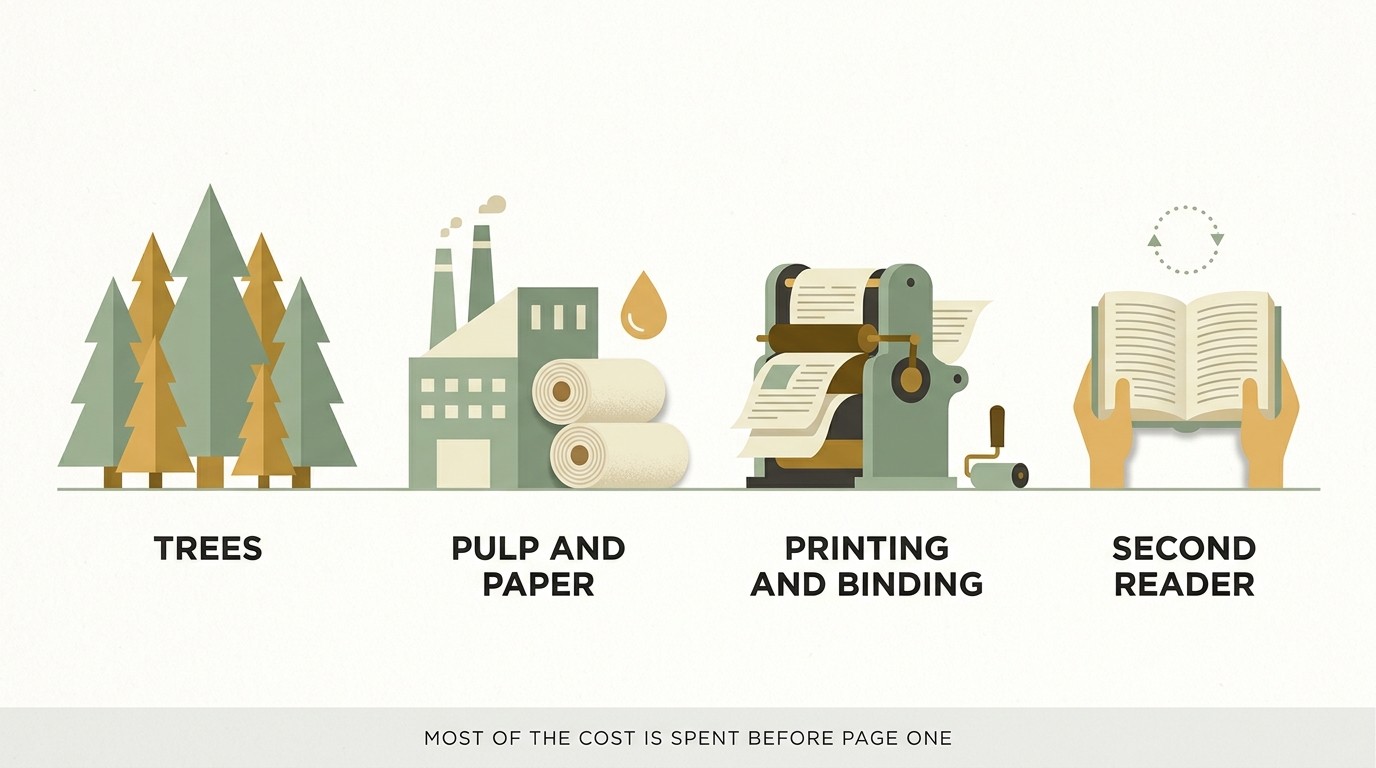
Here is the thing that reframes the decision. A book’s environmental cost is almost entirely spent before anyone turns a page. The trees were felled, the pulp was bleached, the ink was manufactured, the sheets were printed, bound, and trucked to a warehouse long before the book reached your hands. Every option below recovers a different fraction of that cost, and the highest-value one is almost always getting the book into the hands of another reader. If you want the shortest path to that outcome, you can sell books to a service that reads the barcode and quotes a price in seconds, which is worth ten minutes of your time before you reach for a bin bag.
What a book costs before anyone reads a word
Print publishing is not the heaviest industry on the planet, but within the pulp and paper sector it is a significant one. Print book publishing ranks as the third-largest greenhouse gas emitter inside that industry, according to 2023 figures from the research group WordsRated. The emissions concentrate upstream, in the forest and at the mill, rather than in the lorry that delivers the finished copy.
The raw numbers are more striking than most readers expect. Around 32 million trees are felled in the United States each year to make paper for books, and a single tree yields roughly 25 books. A widely cited 2006 study for the US Book Industry Study Group put the net footprint at about 8.85 pounds of CO2 equivalent per book sold, with tree harvesting alone accounting for nearly two-thirds of the sector’s climate impact. Later life-cycle work has produced comparable figures per title, with paper production and printing together responsible for the large majority of a book’s total emissions.
Water, bleaching chemicals, energy, and freight sit on top of that. None of it comes back when a book is pulped.
Option one: get it to another reader
Resale is the only option that recovers nearly everything. A second-hand copy bought for a few pounds displaces a new print run, which means the trees, water, and energy already embedded in that copy keep working instead of being written off. The reader saves money, the book stays in circulation, and no additional fibre is needed.
What makes an old book worth selling
Demand, condition and edition matter far more than age. Books that tend to hold value include recent hardbacks with intact dust jackets, university textbooks still on current reading lists, niche non-fiction with small print runs, children’s series, and anything with a collector’s market. Books that rarely sell include ex-library copies with stamps and laminated spines, outdated reference works, superseded computer manuals, book club editions, and anything with damp, mould or water damage.
Condition is judged harshly. A cracked spine, a sun-faded jacket or a previous owner’s notes can turn a sellable title into a donation. Check for mildew before boxing anything up, too, since mould spreads through a sealed box in a way it will not on an open shelf.
Selling without a car boot sale
The real obstacle for most people is not willingness; it is effort. Listing a hundred books individually, photographing each one, then packing and posting the dozen that sells is several evenings of unpaid work, which is why so many boxes end up back in the garage for another five years. Barcode scanning services such as WeBuyBooks cut that down considerably: you scan the ISBN, get an instant offer per title, and whatever the service does not want stays in your hands for the next option on this list. It is worth scanning even a modest pile, because resale value across a shelf is rarely evenly distributed, and two books worth £15 each pay for the whole exercise.
Option two: donate, but call first
Charity shops are the default destination for unwanted books, and they are genuinely overloaded. One manager at a west London shop told The Independent that around 30 per cent of all donations cannot be sold, with other local branches reporting rejection rates of 30 to 50 per cent. Unsellable stock is not free for a charity to handle. Emmaus reported spending £47,000 at one local group on disposing of donations that were not fit for purpose, and the British Heart Foundation has said council disposal fees for unsaleable items cost it up to hundreds of thousands of pounds a year.
Books that do not sell in the shop are not necessarily wasted, but the route is longer than most donors imagine. Bulk traders buy them by weight, try to resell through marketplaces, ship the remainder to English-speaking countries where there is demand for cheap educational material, and pulp whatever is left.
That makes a two-minute phone call worthwhile before you load the car. Ask what the shop can actually take, and keep in mind that most will refuse encyclopaedias, outdated textbooks, condensed editions and anything visibly damaged, because they cannot sell those either.
Where donations work better
Smaller, more specific recipients are often more grateful and far less overwhelmed than a high-street shop. School libraries, prison library schemes, hospital and hospice waiting rooms, care homes and community book boxes all take books that a charity shop might reject, though almost all of them prefer a phone call first. Public libraries increasingly decline donations, but some still run friends-of-the-library sales, and a local request is always worth making. The useful rule of thumb: donate only what you would be pleased to receive yourself.
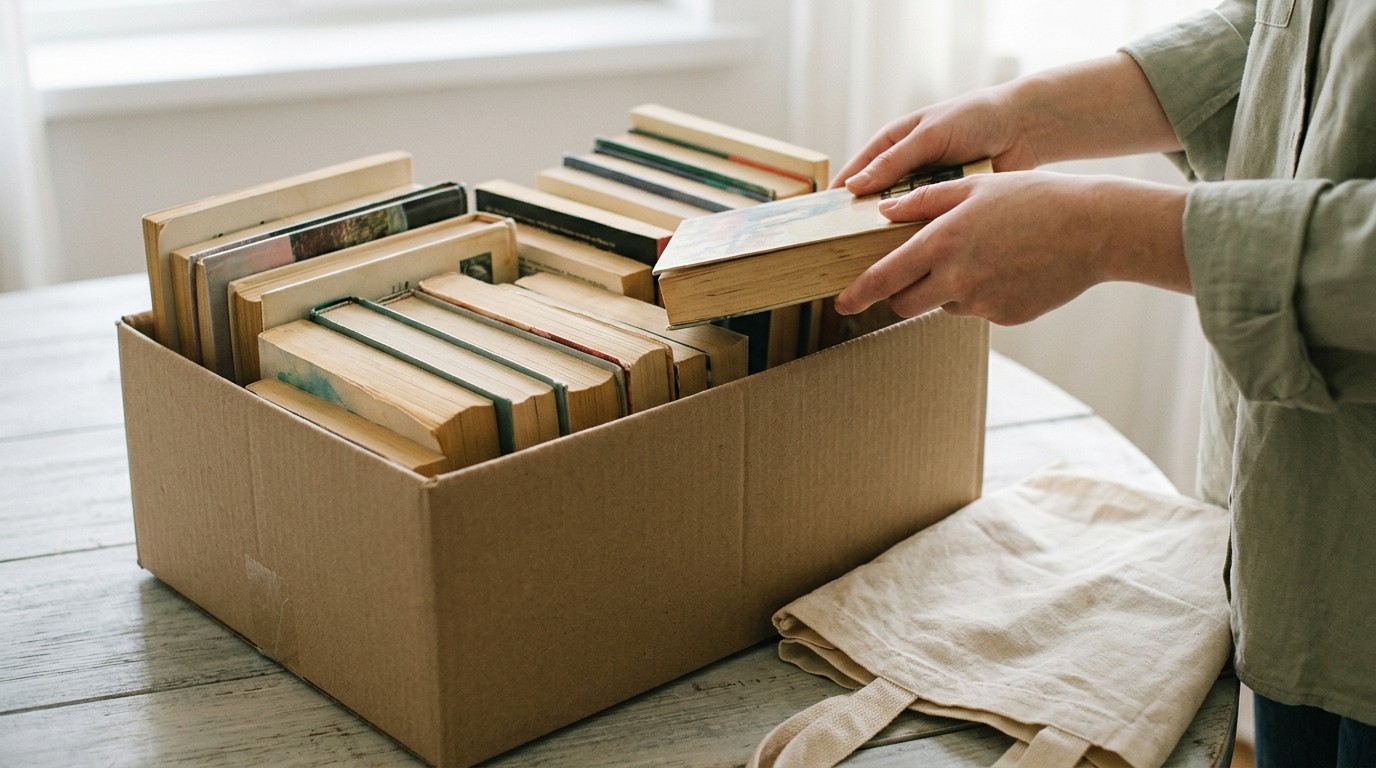
Option three: repurpose
Craft projects have a real but limited role. Folded book art, hollowed-out storage, framed illustrations, paper garlands and wallpaper made from pages all exist, and they are genuinely good fates for books that are damaged beyond reading. What they are not is a system. A shelf of forty books might furnish one or two projects, and the rest of the shelf still needs somewhere to go.
This is the right option for water-damaged, incomplete or heavily annotated copies that nobody will read again. For textbooks in particular there are more possibilities than most people realise, including eco-friendly ways to reuse old textbooks that keep them out of the waste stream entirely.
Composting is possible but narrow. Plain, uncoated paper pages can go into a home compost heap in small quantities as part of the browns, but glossy, laminated or plastic-coated paper cannot, and neither can hardback covers or glued spines.
Option four: recycle, which is messier than the label suggests
Recycling feels like the responsible default, and it is certainly better than the bin, but the rules are inconsistent in ways that catch people out. Many councils accept paperback books in kerbside paper collections while explicitly excluding hardbacks, because the board covers, the glue in the spine and the plastic coating on some jackets contaminate the paper stream. Glasgow’s blue bin guidance lists paperbacks as accepted and hardbacks as not. Dover’s kerbside service excludes hardback books for the same reason. Others, such as Rotherham, take books in the green recycling bin and accept them at household waste recycling centres.
Where kerbside collection will not take them, most household waste centres have a book bank or media container, and that is usually the better destination for hardbacks and for the paperbacks your council refuses. Glossy children’s board books, waterproof bath books and anything with plastic elements generally cannot be recycled at all.
The wider point matters more than the local detail. Recycling recovers fibre, and fibre is the cheapest component of a book. The forest, the water, the bleaching, the ink and the transport are gone the moment the cover is torn off, which is why recycling sits near the bottom of this list rather than the top. It remains a legitimate part of managing paper waste responsibly, just not the first move to reach for.
The option to avoid
Throwing books away is the only genuinely wasteful outcome. In the United States alone, roughly 640,000 tons of books are landfilled each year, the equivalent of about 320 million individual books. That figure accounts only for the loss of material. Paper decomposing in landfill without oxygen generates methane, a far more potent greenhouse gas than the CO2 that would have been released through recycling or, better still, avoided altogether by reuse.
It is also worth remembering that paper is not automatically the greener choice for every reader. The climate comparison between printed books and e-readers depends heavily on how many titles each device carries over its lifetime, as reporting on the carbon footprint of print books versus e-readers makes clear. What is not in dispute is that a book already printed should be read again rather than buried.
Clearing a whole shelf without adding to household waste
Most people are not dealing with one book; they are dealing with several boxes and a deadline. Sorting into four piles works better than working book by book: keep, sell, donate, and recycle. Be honest with the first pile, because the most common failure is keeping a book out of obligation and then paying to move it twice.
Scan ISBNs before anything leaves the house. Values are uneven, and a handful of titles often cover the entire clear-out once a buyer has priced them. Check the copyright page of older hardbacks as well, since a genuine first edition hiding in a box of paperbacks is not as rare as it sounds.
Then work through the rest in order: what a buyer will take, what a charity can use, what a school or library wants, what can be repurposed, and finally what can be recycled locally. If you are clearing the whole house rather than one room, the same logic applies when you set out to reduce waste at home more broadly: reuse first, recycle second, bin last.
The short version
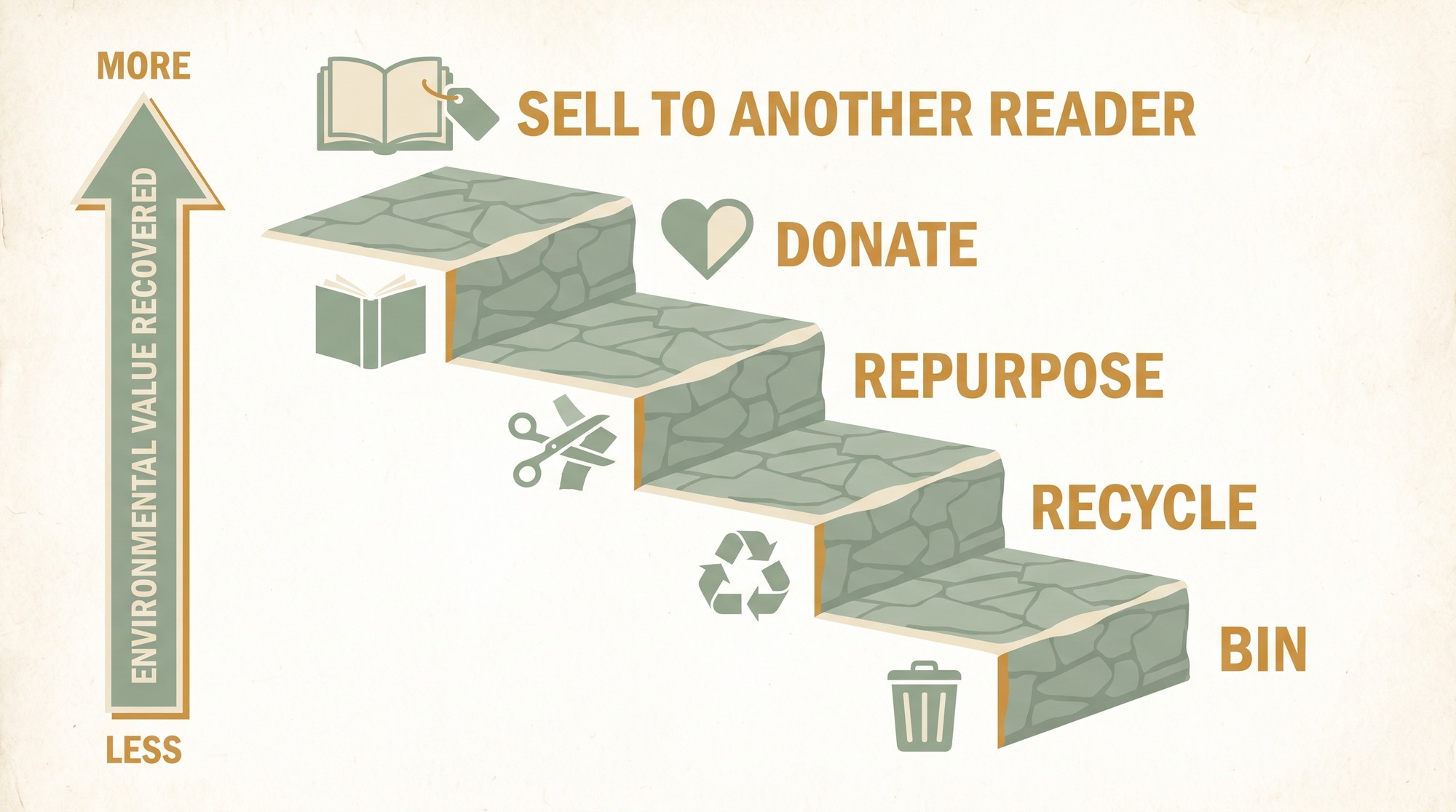
Ranked by how much of a book’s original environmental cost each option preserves:
- Sell it to another reader. Recovers nearly all of the embedded cost and displaces a new copy.
- Donate it to a specific recipient. Keeps the book in circulation, though the benefit is lost if the shop cannot sell it.
- Repurpose it. Preserves the object rather than the reading, which makes it a good fit for damaged copies.
- Recycle it. Recovers fibre only, and hardbacks often cannot go kerbside at all.
- Bin it. Recovers nothing and generates methane, so it should be reserved for books that are wet, mouldy or contaminated.
A book that reaches a second reader is doing exactly the job it was made for. The aim is not to dispose of old books elegantly. It is to make sure the trees, water and ink already invested in them get one more turn at being useful, and ideally several.