
The paddock at Portland International Raceway held more than two dozen electric trucks on 29 September: Class 8 tractors, yard dogs, refuse bodies, delivery vans, motorcoaches, and a John Deere tractor. Oregon fleet managers were handed the keys. It was the state’s first fleet-focused electric ride-and-drive, staged by the State of Oregon and Portland General Electric to launch a 24-member Oregon Electric Fleet Network.
PGE came to make an argument, and Karla Hendrickson made it. Heavy trucks and buses, said the utility’s transportation electrification manager, are “grid-ready assets,” able to help a utility ride out periods of high demand while keeping costs down. She called them “batteries on wheels.”
The arithmetic does look good. A Freightliner eCascadia carries up to 438 kilowatt-hours of usable battery, which is about 32 Tesla Powerwall 3s. The average American household gets through roughly 30 kilowatt-hours a day, so one regional tractor park holds close to two weeks of a home’s electricity.
What PGE did not announce was a truck program that does any of this. Vehicle-to-grid stays a potential capability in the utility’s telling, and the only dispatch testing it points to involves school buses. Battery capacity, it turns out, is the easy part. Getting a parked truck to earn money for the grid takes five things, and fleets rarely hold all five at once.
What PGE actually said and what it did not claim
The wording was careful, and the care is the story. PGE describes electric vehicles as potential “batteries on wheels.” With bidirectional charging, the local coverage reported, electricity “could flow into the vehicle when it needs to charge and, when conditions allow, from the vehicle back to the grid.”
Asked which vehicles interested her most, Hendrickson picked school buses. “Their schedules are predictable,” she said, “and they can spend long stretches parked.” The most enthusiastic quote in the story is about the vehicle with the gentlest duty cycle and the longest idle window.
PGE is testing dispatch from the school buses already running in the state. That is a real test, and it is not a truck fleet. Nearly 150,000 electric vehicles were registered in Oregon as of the event. Almost all of them sit in driveways, not depots.
“Grid ready asset” is not a property of a truck. It describes a system: a charger, an interconnection agreement, a schedule, a warranty, and somebody willing to pay. Take away any one of them and you have a vehicle that draws power and does nothing else.
Gerick Kransky of the Oregon Department of Environmental Quality made the simpler case for electrifying these vehicles. “These heavy trucks and buses represent a relatively small amount of the fleet of vehicles on the road in Oregon,” he said. “But they represent a disproportionate amount of the emissions that we deal with from transportation.” That argument holds whether or not V2G ever works. The grid argument does not.
Most fleets are already doing the easy half
Three different things get called bidirectional charging, and only the last of them asks anything of a utility.
- Managed charging. The charger decides when and how fast a truck draws power. Everything moves one way. This is what nearly every electric fleet actually runs today.
- Vehicle-to-building. The truck pushes power back into the site’s own wiring to cut a demand peak, without sending anything past the meter.
- Vehicle-to-grid. The truck exports past the meter into the distribution network, under an agreement with the utility or an aggregator.
PGE’s grid benefits come mostly from the first. The utility tells business customers to charge between 10 p.m. and 6 a.m., when demand is lowest. A depot that pulls a 20-truck charging session out of the evening peak has helped the grid already, using standard hardware, no export permission, and no extra cycling on the packs.
That is not a booby prize. Managed charging is where most of the money sits right now, because it goes after demand charges and time-of-use spreads instead of export revenue that only a handful of utilities offer. It also gives a fleet something diesel never could: a fuel bill it can predict.
So heavy-duty electric fleets are easing strain on the grid already by charging at better times. Exporting is a second capability, harder and worth more, layered on top. Treat the two as interchangeable, and fleets will buy hardware they cannot yet monetize.
What a truck battery actually holds
Which number you quote matters. Total pack capacity and usable capacity are not the same figure, and manufacturers hold some of the difference back to protect the cells. Usable capacity sets the ceiling on anything that could ever be exported.
| Vehicle | Total pack | Usable capacity | Battery capacity vs. a Powerwall 3 |
|---|---|---|---|
| Tesla Powerwall 3 (home battery) | 13.5 kWh | 13.5 kWh | 1x |
| Freightliner eCascadia | Usable only, per spec sheet | 291 kWh, 438 kWh | About 22x to 32x |
| Volvo VNR Electric (6 battery) | 565 kWh | 452 kWh | About 33x |
| Tesla Semi, Standard Range | 548 kWh | 548 kWh | About 41x |
| Tesla Semi, Long Range | 822 kWh | 822 kWh | About 61x |
Figures come from Volvo Trucks’ published VNR Electric specifications, Freightliner’s eCascadia specification sheet, the Tesla Semi figures in its CARB executive order, and Tesla’s Powerwall 3 datasheet.
The energy is enormous, and it arrives free with the vehicle. It is also not the constraint. Power is. A depot cleared to export 100 kilowatts needs more than four hours to move 400 kilowatt-hours, whatever the size of the packs, and those four hours have to fit between shifts.
You need a charger that can push power back
Bidirectional hardware exists and is certified in growing numbers. It is not yet ordinary. Price and interoperability are where that shows.
Incentive design gives the clearest read on cost. PGE’s electric school bus charging incentives run to $50,000 per bidirectional charger, capped at 90 percent of hardware cost and $500,000 per site, plus up to $10,000 per make-ready port to a maximum of $300,000. A cap is not a price list, but a utility does not build a $50,000 ceiling per unit for equipment it expects to cost a few thousand dollars, and it is the only published figure of its kind for this class of hardware.
Interoperability is the quieter problem. At CharIN’s test event in Arnhem in May 2026, only 13 of 23 DC charging systems and 7 of 11 AC systems supported bidirectional energy flow. The standards are moving quickly. ISO 15118-20 Amendment 1, published in July 2026, folded in megawatt charging services and grid-tied AC distributed energy resource applications, and IEC TS 63379 now defines the megawatt connector itself. A published standard and a truck that reliably negotiates a discharge session with a particular charger are still different things.

The proof points on heavy trucks are getting harder to wave away. In May 2026, Scania ran what it calls one of the world’s first V2G implementations for heavy commercial vehicles over the Megawatt Charging System, reaching 1,000 amps and 750 kilowatts, charging and discharging through the same interface. Yorben Muller, Scania’s charging product manager, made the right point about it: the interesting part is not reverse flow on its own, but reverse flow combined with intelligent energy management. Scania expects depot charging to be where this matters first, since that is where trucks sit long enough.
A 750-kilowatt demonstration is not a fleet procurement. It does establish that megawatt-scale reverse flow has been done at least once, which is a stronger claim than the one available in 2020, when most V2G talk still centered on passenger cars and the idea of vehicles as dual mobility and energy assets was largely conceptual. MAN’s SPIRIT-E project took a less dramatic route, running an eTGX with 480 kilowatt-hours of usable battery at a logistics depot near Regensburg in April 2026 and sending 325 kilowatts back out. The more useful finding was that using the truck’s energy on site cut electricity costs by around 10 to 20 percent. No export agreement, no market participation, real savings.
Then you need permission to export
A charging depot is designed, permitted, and metered as a load. The moment it pushes power back past the meter, it becomes something closer to a generator, and a utility has to treat it as one.
Three things follow. Some sites need equipment changes, because protection and switching built for one-way flow is not automatically good enough in reverse. Some need a study before approval, which hands your schedule to a queue. Nearly all need a signed agreement rather than a nod from an account manager.
IEEE 1547 is the technical baseline for how distributed resources interconnect and interoperate, and the same standard Tesla cites for the Powerwall 3. Federal reforms under FERC Order No. 2023 reshaped the bulk-power queue into first-ready, first-served clusters, but export approval at the distribution level is still a local utility process. The rules that decide a Portland depot’s fate are not the ones that get written about nationally.
Timelines are easier to document than export rules. PGE’s own Fleet Partner program tells applicants to plan on one to three months of planning and nine to eighteen months of construction, with make-ready incentives capped at $400,000, a ten-year energy use commitment, and a pro-rata clawback if the fleet undershoots. Those terms describe a site built to import. They already eat more than a year. Adding export is a second project, not a formality.
Which makes interconnection, not battery cost, the long pole. A fleet that wants export capability in 2029 should be filing in 2026, and it should expect the utility to ask what it plans to do with the energy rather than whether it can produce any.
The truck has to be parked at the right time
A truck can only give back energy it does not need for tomorrow’s route in hours when it is not needed and the grid wants it. Those windows rarely line up by accident. They get designed.
The best candidates have fixed, short duty cycles and long dwell at a single depot. MAN reached much the same conclusion from the field, naming regional operations with annual mileage below 100,000 kilometers as the segment where bidirectional charging is most relevant.
- School buses. Two runs a day, a long midday gap, whole summers parked, and summer cooling demand that lands exactly when the buses are idle. PGE picked them for structural reasons, not poetic ones.
- Refuse trucks. Early starts, quiet afternoons, one depot to come home to. Strong dwell, though the work is energy-hungry and electrifying a refuse fleet already strains a site’s power.
- Drayage and yard tractors. Short cycles, plenty of dwell, tight geography. Often the best ratio of available power to available hours.
- Last-mile vans. Reliable overnight dwell, but small packs, so you need a lot of vans to matter.
- Long-haul tractors. The worst case. High utilization, tight turnarounds, and layovers at public chargers the fleet does not control.
It is worth doing the arithmetic rather than the headline. Ten regional tractors at 438 kilowatt-hours each, parked for ten hours, releasing a third of capacity: 1,460 kilowatt-hours on paper. A site cleared to export 400 kilowatts needs nearly four hours to move it, and the local grid has to want those four hours. The second constraint usually bites first.

So the question for a fleet manager is not how big the battery is. It is how many hours a year a given vehicle sits plugged in, above the charge it needs tomorrow, inside a window somebody will pay for. Most fleets can answer the first three parts. Few can answer the last, because nobody has told them what the window is worth.
The warranty has to survive the cycles
Every export is a cycle, and the warranty was written around a duty cycle the manufacturer priced. Usually that means mileage plus a capacity retention threshold over a fixed term. Reverse flow adds throughput that was not in the model, and once the data is aggregated, it is hard to separate from driving.
Three things need to be true first. The manufacturer confirms in writing that this vehicle and this charger are approved together, since approval often attaches to specific hardware rather than to bidirectional charging in general. Charging and export throughput get logged separately from distance so that a claim can be defended. And the revenue gets measured against the cost of early degradation rather than against zero.
That last comparison is where business cases quietly die. A heavy truck pack is expensive to replace. V2G revenue from one vehicle is, for now, small. Shallow frequent discharge for frequency support is far gentler than deep daily cycling, and the gap between those two strategies is the gap between a revenue stream and an argument with a warranty department. As things stand, the fleet carries the degradation risk, and the utility takes most of the reliability benefit. That is not a durable deal.
Vehicle-to-building is the safer middle. Shaving a site’s demand peak without crossing the meter usually needs no export agreement, involves fewer parties, and is easier to defend against warranty terms because the energy never leaves the property.
Someone has to pay for it
A grid asset needs a product and a price. This is the condition PGE is best placed to answer and the one with the thinnest public paper trail.
What exists now is demand response. PGE’s Energy Partner On Demand pays reservation payments for committed load reduction and energy payments for delivery during events. It is built around using less, not exporting more, and PGE says most participants cut only 10 to 20 percent of their load. The Oregon Public Utility Commission confirms that the state’s three investor-owned utilities run a mix of incentive-based demand response and time-of-use pricing, with structures that differ by utility.
Oregon has no published tariff that pays a commercial fleet for kilowatt-hours pushed back through a charger. One exists elsewhere, and it is worth reading closely, because it shows what this condition looks like when it is satisfied. The Los Angeles Department of Water and Power’s Commercial Energy Storage to Grid pilot, running since 2023, is aimed at exactly this: large fleets of electric buses and trucks on high-voltage DC fast chargers. It pays about 17 cents per kilowatt-hour above the peak rate for dispatched energy, guarantees at least 50 call events a year, covers up to 75 percent of interconnection costs to a cap of $150,000 on the 4.8 kilovolt system or $400,000 at 34.5 kilovolts, and caps the whole program at 20 megawatts.
The 50-event guarantee is the part worth stealing. It turns an unpredictable revenue stream into something a finance director can put in a model. The interconnection sharing removes the barrier described above. The 20 megawatt cap is the tell: this is a demonstration with a published price, not a market, and it exists inside one municipal service territory.
One revenue stream already works, and it needs no bidirectional hardware at all. Fleets can generate credits under Oregon’s Clean Fuels Program from the electricity they charge, sold through a registered broker, and PGE notes that credits rise where charging is matched with on-site renewables or renewable energy credits. That is bookkeeping rather than engineering, and it is available now. For most Oregon fleets, credits plus managed charging plus demand response will beat V2G for several years yet.
What would have to be true
Put together, the five conditions form a test a fleet manager can run. A heavy-duty electric vehicle becomes a grid asset when all of these hold.
- A reverse-capable charger is installed, certified to the current standard, and confirmed to work with that specific truck.
- The site holds an interconnection approval for export, not just for import, with protection and metering rated for reverse flow.
- The duty cycle leaves energy genuinely surplus in hours the grid values, at a power level worth having.
- The warranty covers the cycles the export strategy creates, with throughput tracked separately from mileage.
- A published product and price exist through which a utility pays for the service.
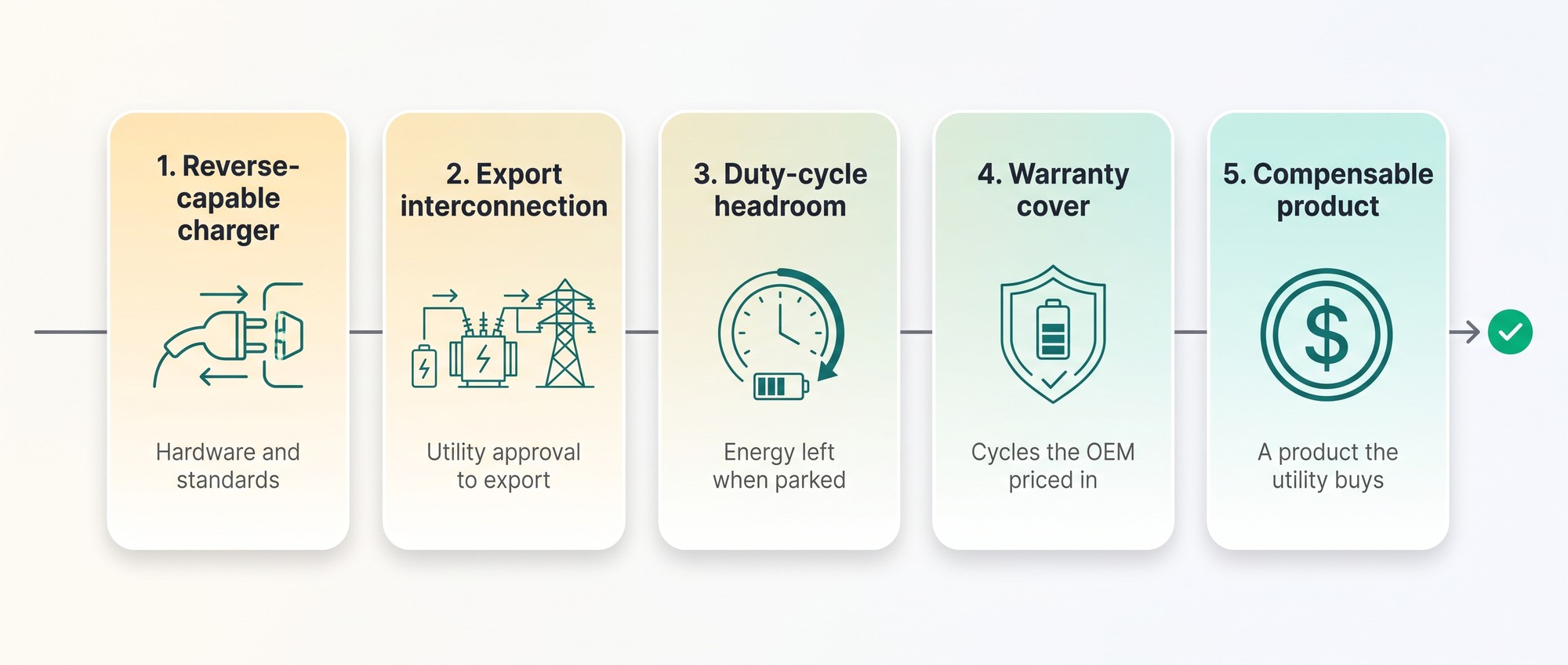
Applied to Oregon, the test explains why the emphasis fell where it did. PGE’s school buses clear the duty-cycle condition easily, which is why the utility’s own incentives are written around bidirectional school bus chargers and not trucks. Long-haul tractors will not be grid assets in volume this decade, and pretending otherwise is how fleets end up owning capability they cannot use.
Which fleets get there first
The order follows idle time, not vehicle size.
School buses are already going. Yard tractors, drayage trucks, and refuse fleets come next, because they combine short cycles with single-depot return and an owner who controls the whole site. Regional distribution follows once interconnection stops being bespoke. Long-haul tractors come last and may not arrive until public charging sites rather than depots become the place where energy services get sold.
The bus precedent is old, only smaller. London ran a trial that used parked electric buses to feed the grid, an early demonstration that a depot of idle buses can act as storage. What changed is the hardware standard, the megawatt connector, and trucks with packs big enough to matter. What did not change is the organizing. Somebody still has to negotiate export permission and a payment.
Forecasts of heavy-duty electric truck volumes have run ahead of delivery before. Earlier projections of 54,000 electric trucks on US roads are a decent reminder to treat fleet-count optimism carefully. The grid-asset question scales with the number of vehicles that are parked, plugged in and permitted, and that number is small.
Frequently asked questions
Is bidirectional charging the same thing as vehicle-to-grid?
No. Bidirectional charging is a hardware capability: power can move either way. Vehicle-to-grid is one use of it, where power crosses the meter into the distribution network under a utility agreement. Vehicle-to-building is another use, and it stays behind the meter. Plenty of bidirectional chargers are bought purely to manage a site’s own load.
Can a Class 8 electric truck actually power a building?
Physically, yes. Published usable capacities run from 291 kilowatt-hours in a small eCascadia pack to 822 in a long-haul Tesla Semi. Power and permission are the limits rather than energy: how fast the charger can discharge, whether the building’s switchgear will take it, and whether anyone has approved and documented the arrangement.
How much can a fleet earn from vehicle-to-grid today?
In Los Angeles, about 17 cents per kilowatt-hour above the peak rate, through a program capped at 20 megawatts. Almost everywhere else, nothing per kilowatt-hour. The money available today is demand response and clean fuel credits, and both work without reverse flow. Treat any business case that leans on V2G revenue in the near term with suspicion.
Which utilities actually run a V2G program for fleets?
Fewer than the press releases suggest, and the shape matters more than the count. Some utilities pay for the hardware and keep the grid value, which is a real subsidy but not a per-kilowatt-hour payment. Others run pilots at a handful of sites. LADWP publishes an export rate and confines it to its own service territory. For an Oregon fleet, none of it applies yet.
Do electric trucks overload the grid?
Not if charging is scheduled. A depot’s peak is set by how many trucks charge at once and at what power, and both are controllable. PGE’s argument at the event was that the worry is misplaced and that a fleet charging to a schedule and eventually dispatchable is easier to accommodate than an equivalent diesel fleet is to fuel. The real risk is a site that adds load with no load management, which is an engineering choice rather than something inherent in the vehicle.
What is the difference between V2G and managed charging?
Direction of flow, and more importantly, direction of payment. Managed charging pulls power in at times the utility prefers, and the saving turns up on the fleet’s bill rather than arriving as a payment from anyone. V2G pushes power out, which needs a separate product, a separate agreement, and usually separate equipment. Most fleets describing themselves as doing V2G are doing managed charging.
The asset is real. The paperwork is not finished.
The fair reading of the Oregon event is narrower than the headlines and more interesting than them. A utility used a ride-and-drive to argue that the load everyone fears is a resource, and on physics it is right.
Four of the five conditions are being built. The fifth is the one to watch, because a market only exists once somebody publishes a tariff and a fleet can see the number. Los Angeles has published one. Oregon has not.
Until then, the accurate description of a heavy-duty electric fleet is a well-managed load with a large battery attached, delivering real grid benefits by timing rather than by export. That is a genuine achievement and a smaller claim than “grid-ready asset.” Closing the gap is procurement, regulation, and standards work, and it runs on a schedule measured in years.


