Erythropoietin, usually shortened to EPO, is best known as the hormone that drives red blood cell production. Researchers have also spent years examining a second, quieter role: in cell culture and animal models, EPO signaling has been linked to survival pathways in tissues far from the bone marrow. That finding created a design problem. A laboratory interested in the tissue-facing activity of EPO has to work around the red blood cell activity, which acts as a confounding variable in many experiments.
One response was to build a far smaller molecule. ARA-290, also called cibinetide, is a synthetic peptide of eleven amino acids derived from the helix-B surface of EPO. It was engineered to retain the receptor signaling that interests tissue-biology researchers while omitting the erythropoietic activity. This article reviews what that design means, what preclinical models have examined, and which questions remain open.
VivePeptides, a US-based supplier of research-grade peptides, lists a purity specification of at least 99% by HPLC. Its compounds are sold strictly for laboratory and research use only and carry no approval for human consumption.
What is the ARA-290 research peptide?
The ARA-290 research peptide is a synthetic, eleven-amino-acid peptide, also known as cibinetide, designed to engage the innate repair receptor without the red blood cell activity of EPO. It is classed as a non-erythropoietic agonist of that receptor. In plain terms, the molecule is built to activate the repair-associated receptor complex and not the one tied to red cell production. Whether that selectivity holds in any given experimental system is a question for the data, and it is one reason published work reports its assays in detail.
What is the innate repair receptor?
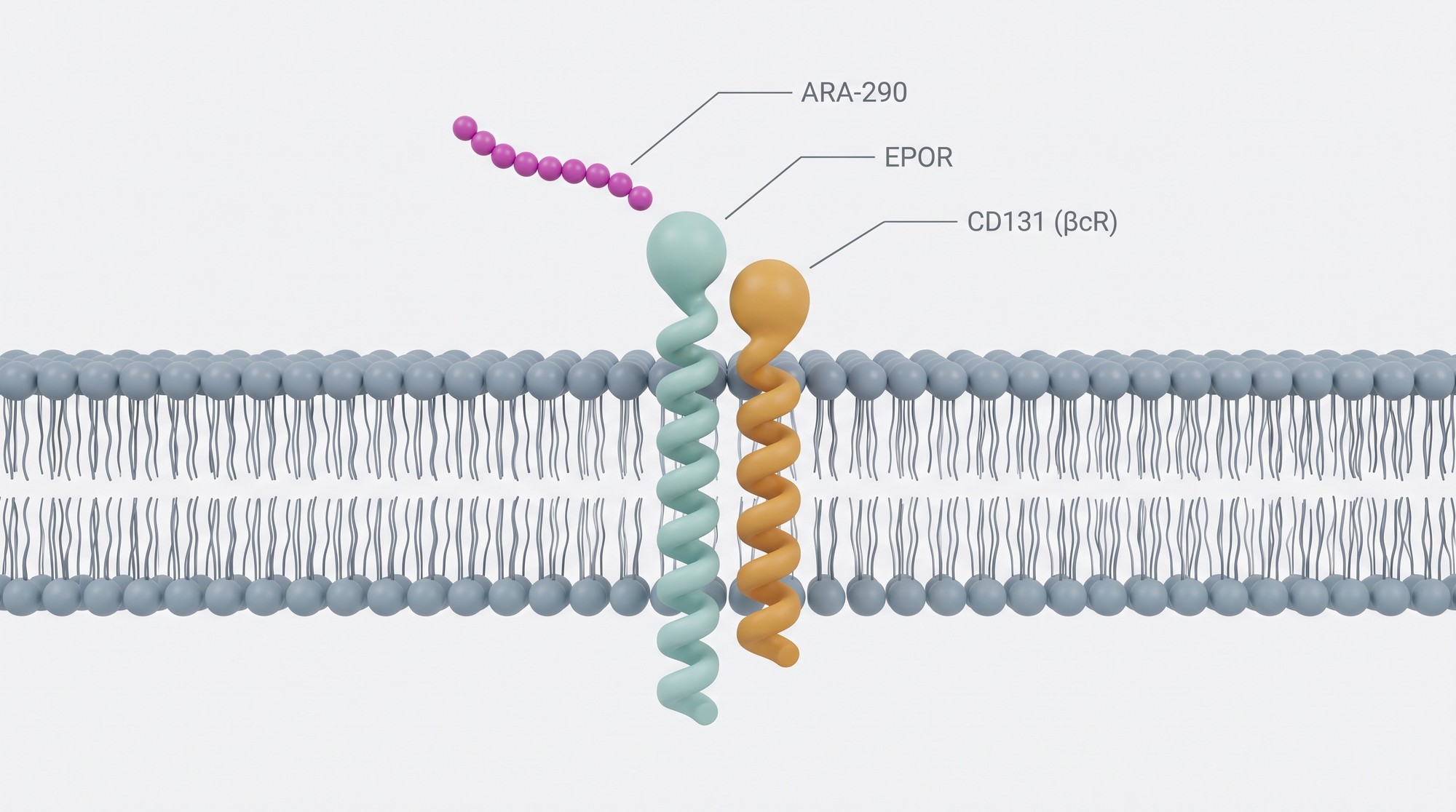
The innate repair receptor (IRR) is described as a heterodimeric complex built from the EPO receptor (EPOR) and the beta common receptor, also known as CD131 or βcR. This pairing differs from the EPOR homodimer associated with red blood cell production. In the IRR model, signaling has been associated with cellular stress responses rather than with the formation of new red blood cells. Compounds that engage the IRR without engaging the classic EPOR homodimer therefore give investigators a way to separate two behaviors that natural EPO bundles together.
Who designed ARA-290, and from what?
ARA-290 was described in a 2008 paper in the Proceedings of the National Academy of Sciences by Michael Brines and colleagues, who engineered an eleven-amino-acid peptide from the helix-B surface of EPO. The design logic was to keep the part of the protein that touches the tissue-protective receptor and leave out the part that drives red blood cell production. Brines and Anthony Cerami described the tissue-protective receptor complex, in which the EPO receptor pairs with the beta common receptor (CD131), as the innate repair receptor.
PubChem, the open chemistry database run by the US National Center for Biotechnology Information (NCBI), indexes cibinetide, the nonproprietary name for ARA-290, under CAS registry number 1208243-50-8, the same number the product page gives.
The receptor has also reached anti-doping policy. The World Anti-Doping Agency (WADA) Prohibited List, in force since 1 January 2026, carries a class in section S2.1.5 called innate repair receptor agonists, with asialo EPO and carbamylated EPO as its examples. The entry covers a class of receptor agonists rather than naming ARA-290, showing that the receptor itself has drawn attention from sport’s anti-doping authorities.
Why design a peptide from only part of a protein?
A short fragment is attractive because a full-length protein carries many activities at once, while an eleven-residue peptide is a much simpler object to characterize. Its formula, C51H84N16O21, and its mass are figures analytical chemists can confirm by mass spectrometry.
The size difference matters for reproducibility. Small synthetic peptides are made by chemical synthesis rather than by expression in living cells, so their identity and purity can be checked against a defined sequence. A recombinant protein produced in cell culture, by contrast, often varies in its sugar chains from batch to batch.
The table below collects the identifying facts for the compound.
| Property | Value |
|---|---|
| Common name | ARA-290 (cibinetide) |
| Length | 11 amino acids, derived from the helix-B surface of EPO |
| CAS registry number | 1208243-50-8 |
| Molecular weight | 1257.3 g/mol |
| Physical form | White to off-white lyophilized powder |
Laboratories studying the ARA-290 peptide as a research reagent work with a lyophilized powder. VivePeptides lists the compound with an HPLC purity specification of 99% or higher and offers it strictly for laboratory and research use only.
What have preclinical models examined so far?
Published research on ARA-290 spans neuroprotection, neuropathy and tissue repair models, a broad range for an eleven-residue molecule. Studies of this kind generally share an experimental logic: investigators apply a defined stressor to cultured cells or to an animal model, then compare tissue outcomes with and without the compound present.
The model families can be summarized briefly:
- Neuroprotection models, in which cultured neurons or nervous tissue face a defined stressor.
- Neuropathy models, which follow nerve-related readouts after a defined insult.
- Tissue repair models, which compare tissue outcomes after injury with and without the compound.
The quality of any such comparison depends on controls: a vehicle-only group and a second reference compound where one exists. Because each model uses its own stressor, species and readout, results rarely line up neatly. A finding in an animal model and a finding in a cell stress assay answer different questions, and reviewing them side by side requires care about what each one actually measured.
Readers should also be cautious about extrapolation. Results in cultured cells or rodents describe those systems only. They do not establish how the molecule behaves anywhere else, and this article makes no claim that they do.
What questions about ARA-290 remain open?
Several questions remain open, and most concern how far a result from one model carries to another. Receptor expression differs between cell types and tissues, so the same compound may engage the innate repair receptor strongly in one system and weakly in another. Whether the EPOR and CD131 partners are present at comparable levels is something each study has to establish for itself.
Duration is another gap. Short experiments can show an early response that later measurements do not sustain, so the time points chosen in a study shape what it can conclude. Replication across laboratories would help, and it is easier when methods are described in enough detail to repeat.
The field is also still working out which readouts best capture protection. Cell survival counts, tissue histology and functional measures can point in different directions, and a single assay seldom settles the matter.
Reading the research with care
ARA-290 sits at an interesting junction in receptor biology. It was built from a fragment of a familiar protein, it is selective by design for a receptor complex distinct from the one tied to red blood cell production, and it has been examined across several preclinical model types. What the published work supports is a set of mechanistic questions, not settled answers, and certainly not claims about any use outside the laboratory.
Tissue-protective peptides will keep drawing interest because they let researchers pull apart signals that nature packaged together. The value of that work depends on careful controls, transparent reporting and restraint in interpreting what the results can and cannot show.