
Anaphylaxis is one of the few emergencies where the drug is already in the patient’s pocket. Epinephrine works, it works fast, and millions of people at risk carry it. Yet the same failure keeps showing up in the data: the injection comes late, or it never comes at all.
A team at Purdue University is trying to remove the human step. Led by Muhammad Hussain, a professor in the Elmore Family School of Electrical and Computer Engineering, the group has disclosed a patent-pending wearable that monitors several physiological signals, learns the wearer’s normal state and, if it becomes confident enough, delivers epinephrine automatically.
The idea is easy to state and very hard to make safe. A false alarm means an unnecessary injection. A missed event means the window closes. Almost every design decision follows from that asymmetry.
The gap is not the drug, it is the decision
Confirmed anaphylaxis deaths in the United States run at roughly 186 to 225 a year, according to a clinical review of anaphylaxis recognition and management. The more revealing number sits beside it. Around half of patients who reach an emergency department meeting diagnostic criteria for anaphylaxis have not received epinephrine.
The bottleneck is practical. Research on auto-injector use finds that patients carry the device only 44% to 57% of the time. Administration by the patient or a caregiver before emergency services arrive happens in fewer than 9% of reactions.
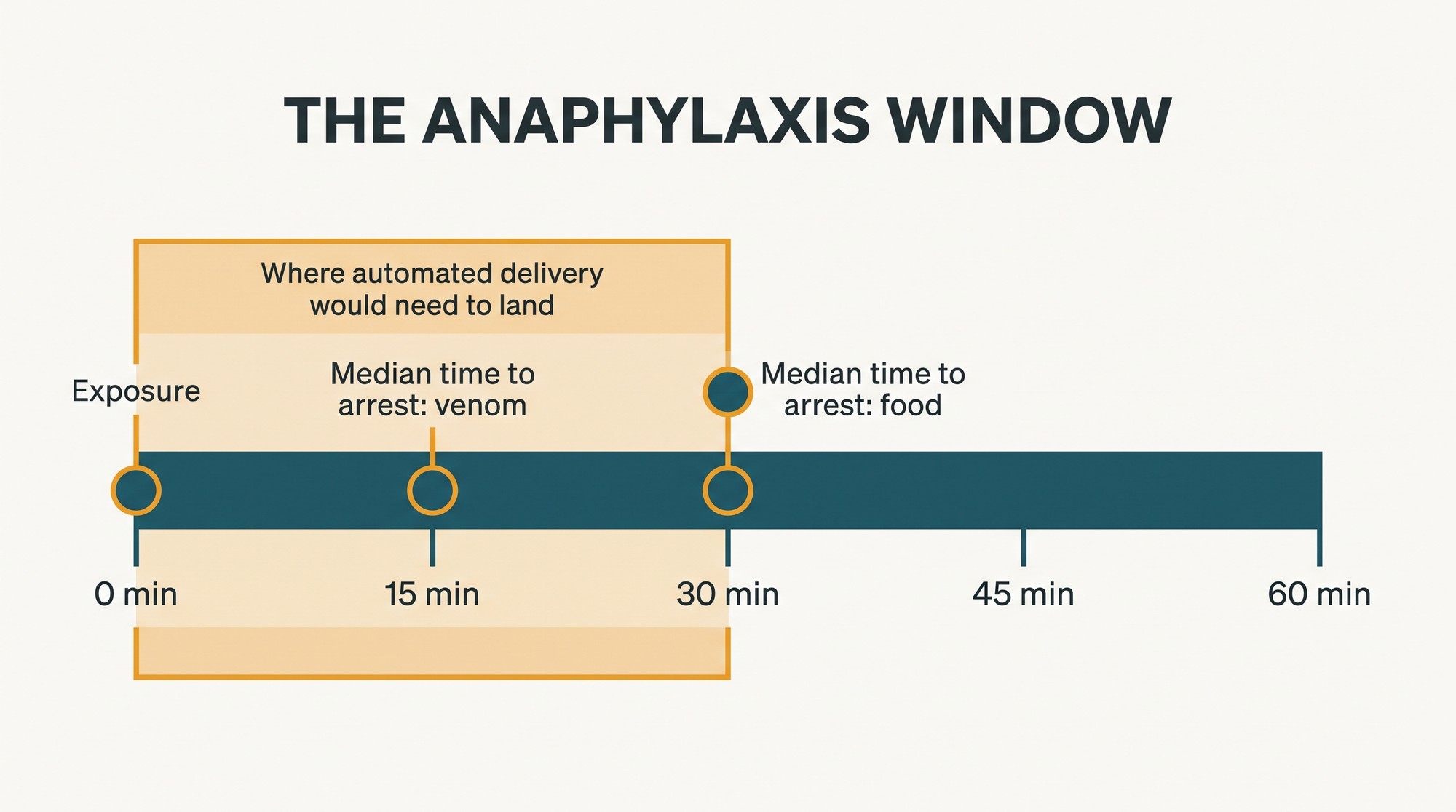
Time makes those numbers dangerous. A review of anaphylaxis management puts the median time to respiratory or cardiac arrest at about 30 minutes for food-triggered reactions and about 15 minutes for venom. That is not much room to notice a symptom, find a device, decide to use it and manage the injection.
Hussain describes that sequence as a chain of small failures that compound. “Epinephrine is effective in treating the event, but the patient or someone nearby must recognize that anaphylaxis is occurring, locate the injector, correctly decide to use it, and physically administer it,” he said. “A person experiencing a severe reaction may be alone, confused, physically impaired, unconscious or simply unable to act quickly enough.”
How the device is meant to work
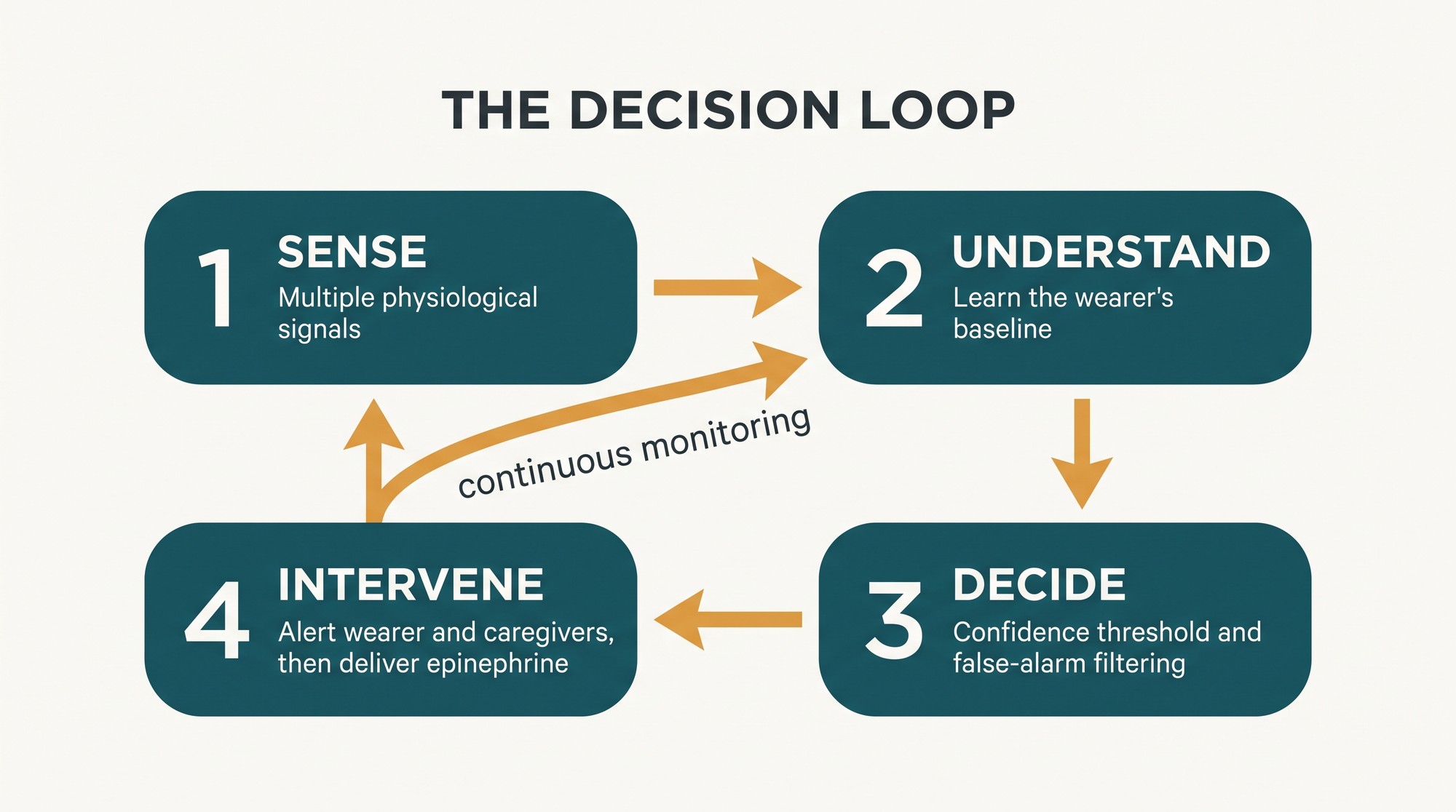
Purdue describes the system in four stages. It is less a better auto-injector than a wearable that takes over the judgment call.
- 1. Sense: The device monitors multiple physiological indicators associated with anaphylaxis. Purdue has not disclosed which sensors it uses.
- 2. Understand: The AI learns the wearer’s physiological baseline, so it can compare an emerging pattern against that person’s normal range rather than a population average.
- 3. Decide: It looks for abnormal combinations consistent with anaphylaxis and tries to separate a true emergency from ordinary fluctuations or a faulty reading. The decision runs on the device itself, not in the cloud.
- 4. Intervene: Once confidence is high enough, the system alerts the wearer and caregivers and, if safeguards are satisfied, triggers the injection.
“Because no single physiological signal necessarily provides sufficient information, multimodal sensing is important,” Hussain said. “Once sufficient confidence is established, the system could alert the wearer and caregivers and ultimately initiate automated epinephrine delivery if appropriate safeguards are satisfied.”
Why one signal is never enough
Anaphylaxis is a whole-body event. It can appear as hives or flushing, swelling of the throat, wheezing, vomiting, a sudden drop in blood pressure, or a racing pulse. Different people present differently, and the same person can present differently on different days.
The signals are also noisy. Heart rate climbs with exercise, heat, fear, and fever. Blood oxygen can dip because of cold hands or poor sensor contact. Skin conductance changes with sweat, stress, and temperature. Any one of those readings could look alarming without meaning anaphylaxis, which is why the design leans on combinations and a personal baseline.
That baseline requirement is also a weakness. A device that has known you for a week has a thin reference point, and the reference itself shifts with illness, medication, alcohol, pregnancy, altitude, and age. A wearable that performs well in a lab may behave differently on a hot day, during a workout or on a restless night.
The real engineering problem: deciding to inject
The hard part is not detecting a reaction. It is being right often enough to justify acting without a human in the loop.
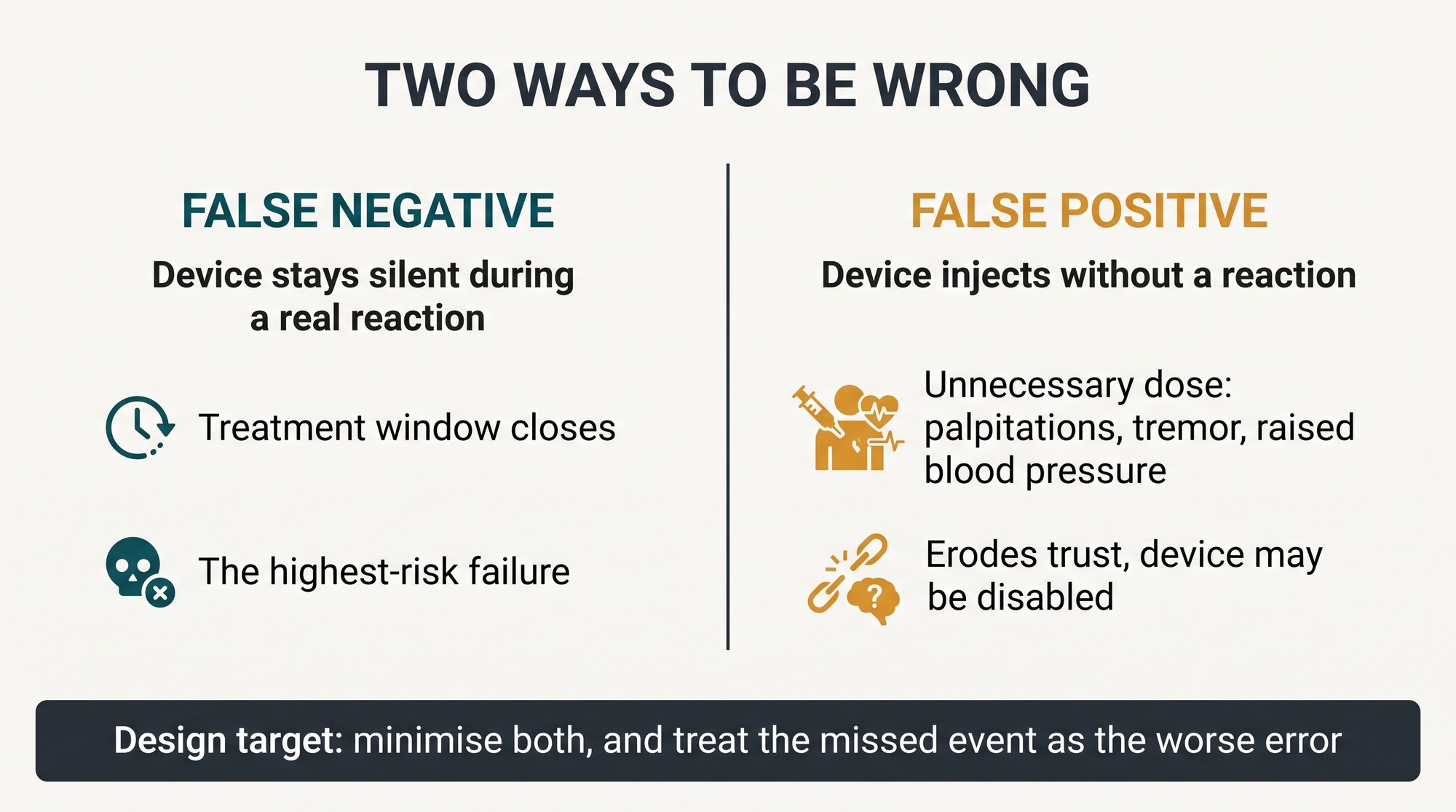
The two errors are not symmetrical. A false negative means the device stays quiet while a real reaction escalates. That is the failure mode the whole project exists to prevent. A false positive means an unnecessary injection. That is not a neutral event. Epinephrine commonly causes palpitations, tremors, anxiety, and a temporary rise in blood pressure. Current guidance still directs anyone who receives a dose to seek emergency care. Repeated false alarms would also train users to distrust or disable the device, which quietly recreates the original problem.
The design responses are familiar from other safety-critical systems:
- A confidence threshold that must be crossed before any action.
- A staged escalation that alerts the wearer and caregivers before it injects.
- A manual override for the wearer or a bystander.
- Encrypted communication between the device and any paired phone or caregiver.
- A logging trail that records what the sensors saw and why the device acted.
Purdue has not published those safeguards.
Consent is the quieter issue. A wearer can agree in advance to be injected, but the decision is made at the moment they may be least able to object. The device, not a clinician, is choosing. That moves the product from monitoring into treatment, with the liability questions that follow.
What has actually been built
The team has been prototyping the mechanical injection system and its electronics. Hussain said the work involves testing “microfluidic and spring-based injection systems, integrated power-efficient components,” and encrypted communication networks, with functionality, reliability, and safety assessed through simulations and industry collaboration.
The next challenge is integration. The physiological sensors, signal-conditioning electronics, the edge-AI decision system, power management, and the injection mechanism all have to come together in progressively more integrated prototypes. Purdue has filed a nonprovisional patent application. Its licensing listing through the university’s technology commercialization office under track code 70551 adds that the design uses flexible CMOS electronics and microfluidics and frames cost, comfort, and accessibility as the problems it is meant to solve.
What does not exist yet matters just as much. There are no published clinical results, no measured error rates, no peer-reviewed performance data, and no timeline. The university describes the work as validation and prototyping, not a finished product.
What stands between this and a pharmacy shelf
Purdue names the remaining steps directly: validate reliability, settle the regulatory and clinical validation pathway, and produce the performance data that regulators will demand. Each of those is substantial on its own.
A device that senses, decides, and delivers a drug is a closed-loop drug-device combination, not a monitor and not a conventional auto-injector. That status raises the evidence bar considerably. Regulators and clinicians will want answers on:
- False-negative and false-positive rates in real-world conditions, not simulations.
- Performance across skin tones, body types, ages, and activity levels.
- Behavior during sensor failure, poor contact, or a depleted battery.
- How a wearer or bystander confirms, cancels, or overrides a dose.
- How the device is secured against tampering and unauthorized activation.
- Whether outcomes improve compared with a manual injector and good training.
Automated insulin delivery offers a useful precedent and a caution. Closed-loop insulin systems took years to move from research into routine use, and even now many require the user to announce meals and confirm doses. The technology succeeded because the failure modes were studied obsessively and the systems were designed to hand control back to the user. An epinephrine device faces a harder version of the same problem. The event is sudden, the wearer may be incapacitated, and there is no time for a second opinion.
| Feature | Standard epinephrine auto-injector | Purdue’s proposed wearable |
|---|---|---|
| Detection | None. Relies on a person recognizing symptoms | Multiple physiological sensors |
| Decision | Patient or bystander decides | On-device AI with a confidence threshold |
| Action | Manual injection into the outer thigh | Automated injection if safeguards are met |
| Alerting | None beyond the person acting | Alerts the wearer and caregivers |
| Evidence base | Decades of clinical use | Prototype, no published clinical data |
| Status | Prescription products available | Research prototype, not for sale |
The bigger claim: wearables that act
The epinephrine project is a test case for a broader argument Hussain is making about where wearables go next. “Most wearable healthcare devices today primarily sense and report,” he said. “We are asking whether future wearables can sense, understand, decide and intervene.”
He frames the shift as the difference between awareness and agency. “A sensor gives a system awareness. Artificial intelligence can give it the ability to interpret and decide. But actuation gives it the ability to interact with the physical world.” He calls that last step “the next frontier.” “After sensing what is happening and intelligently determining what it means, the system should be capable of safely doing something about it,” he said.
That direction already has precedents. Wearable systems that both monitor a condition and deliver treatment have been designed for diabetes, sweat sensors are being paired with drug pumps for Parkinson’s, and skin-attached devices that sense and stimulate are moving through early trials. Purdue’s contribution is to push the same logic into an emergency where the stakes are immediate.
The ethical line matters. A monitor that is wrong produces a bad alert. A device that acts on a wrong conclusion produces a physical intervention. As wearables gain the ability to act, the quality of the decision becomes the product, and the error rate becomes the specification that matters most.
Frequently Asked Questions
What is the purpose of an epinephrine auto-injector?
It delivers a fixed dose of epinephrine into the muscle, usually the outer thigh, to reverse a severe allergic reaction. Epinephrine is the first-line treatment for anaphylaxis because it opens the airways, supports blood pressure and reduces swelling. It is a rescue treatment, not a substitute for emergency care.
Can auto-injectors deliver epinephrine through clothing?
Yes. Device labeling generally allows injection into the outer thigh through clothing when speed matters, though exposed skin is preferred if it can be done without delay. Thick seams, pockets, and items in pockets can interfere, so the device should be pressed firmly against the thigh.
Is an epinephrine auto-injector a medical device?
It is a drug-device combination product. The epinephrine is the drug, and the pen is the delivery mechanism, and regulators review them together rather than as separate products. That distinction matters for Purdue’s wearable, which adds software that makes decisions and therefore faces a higher bar than a passive injector.
How quickly must epinephrine be given during anaphylaxis?
As soon as anaphylaxis is suspected. Delays are linked to worse outcomes, and the median time to respiratory or cardiac arrest is about 30 minutes for food triggers and about 15 minutes for venom. Guidance is consistent on this point: do not wait to see whether symptoms improve on their own.
Can I buy the Purdue device yet?
No. It is still at the research stage. Purdue has not announced a product, a price or a release date, and the team is still working on integration, reliability testing, and the regulatory pathway. Anyone at risk of anaphylaxis should continue to carry a prescribed auto-injector.
Where can I get an epinephrine auto-injector for a baby?
Through a prescription. Pediatric dosing is based on body weight, and several branded and authorized generic devices are available in different strengths. A pediatrician or allergist can match the device to the child’s weight and provide a training device, and schools usually require their own supply and paperwork. Needle-free nasal epinephrine products have also reached the market for some age groups, so the options are broader than they were a few years ago.
What to watch
The number that will decide whether this device matters is not its size, its battery life, or its sensor count. It is the false-negative rate, published in a peer-reviewed study, measured in real conditions rather than in a simulation.
If Purdue or a licensing partner can show that the device reliably catches anaphylaxis without generating a stream of false alarms, the conversation changes from concept to clinical candidate. Until then, the honest summary is that the engineering direction is sound and the evidence is not yet there.
For anyone at risk, the practical advice has not changed: carry the injector, know how to use it, and use it early.


