
For 145 years the idea has been stubbornly out of reach: run a power plant on nothing more than the temperature difference between the ocean’s warm surface and its near-freezing depths. In April 2026 it took its most concrete step yet, when the UK company Global OTEC installed the first purpose-built offshore platform built to generate electricity from seawater temperature differences.
The milestone is part of a wider push. In the Lakshadweep islands off India’s west coast, engineers are building a plant designed to generate 65 kilowatts and 100,000 litres of drinking water a day. Projects in China, Japan, Taiwan, and Hawaii are moving from the drawing board into the water. In short: the technology works, but only at the kilowatt scale so far. Its selling point, round-the-clock baseload power for islands that burn diesel, is rare among renewables. Its obstacles are just as stubborn.
What Is Ocean Thermal Energy Conversion?
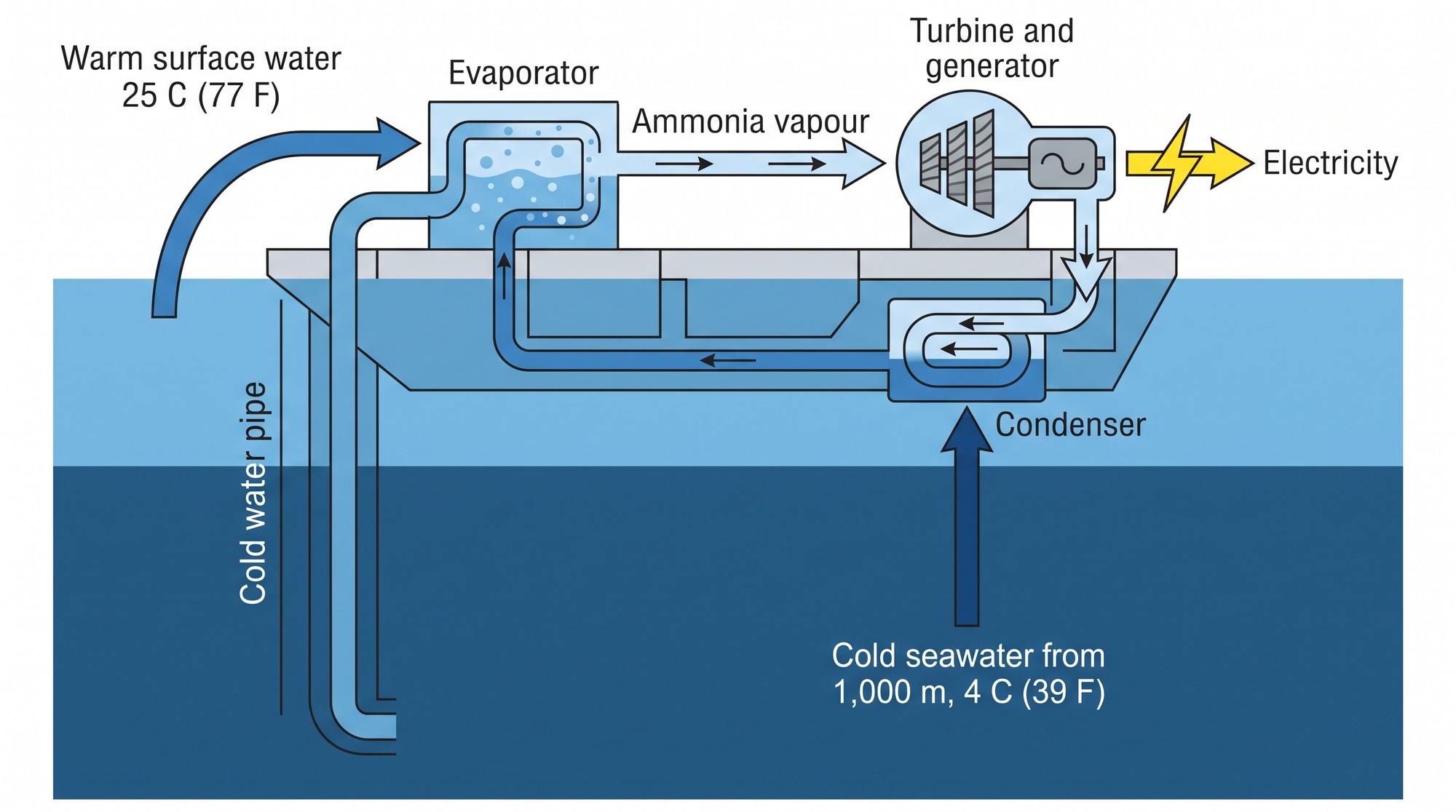
OTEC uses the ocean as a solar battery. In the tropics, surface water sits at roughly 25 to 28 degrees Celsius (77 to 82 degrees Fahrenheit) while water 1,000 metres down stays near 4 degrees Celsius (39 degrees Fahrenheit). That gap of more than 20 degrees Celsius (36 degrees Fahrenheit) is enough to drive a heat engine, provided the working fluid boils at a low temperature.
In the most common design, the closed cycle, warm surface water passes through a heat exchanger that vapourises a fluid such as ammonia. The vapour spins a turbine linked to a generator, and cold water drawn from the deep condenses it back into liquid. The loop repeats continuously, with no fuel and no combustion. Because the thermal gradient ignores weather, OTEC can, in principle, supply baseload power, the steady output that solar and wind need batteries to imitate.
The 20 Degree Rule and Why Depth Matters
OTEC only makes sense where the temperature difference is large enough. The practical threshold is a temperature difference of about 20 degrees Celsius (36 degrees Fahrenheit), which limits the technology to tropical and subtropical waters, and the cold water has to be reachable. That combination is rarer than it sounds, because continental shelves hold warm, shallow water for kilometres offshore. Test sites such as PLOCAN in the Canary Islands exist precisely because deep water lies close to land.
The physics is unforgiving. Engineering reviews of the technology put the theoretical maximum efficiency at about 7 percent, with the real net figure nearer 2.5 to 3 percent. A change of just 1 degree Celsius (1.8 degrees Fahrenheit) in the temperature difference shifts net power by roughly 15 percent.
Closed, Open and Hybrid Cycles
Three designs dominate the field.
- Closed cycle: a working fluid such as ammonia circulates in a sealed loop and never touches seawater.
- Open cycle: warm seawater is flash evaporated in a low-pressure chamber, and the steam drives the turbine. The condensate is fresh water, so these plants also produce drinking water. India’s project at Kavaratti uses this route.
- Hybrid: combines the two, generating power with a closed loop while using the seawater for desalination or other by-products.
OTEC carries a useful side effect. If you are already pumping cold water up from the deep, you can use it for air conditioning, refrigeration, or aquaculture. The cold-water pipe from the Hawaii demonstration plant still supports a commercial lobster and fish farm.
A 145-Year Timeline: From a French Physicist to Floating Platforms
The concept predates the modern grid. In 1881 the French physicist Arsène d’Arsonval published the idea of generating electricity from warm and cold seawater. In 1930 his former student Georges Claude, who made his fortune selling neon lights, built the first working plant at Matanzas Bay in Cuba. It generated about 22 kilowatts but consumed roughly four times more power than it produced, and a storm destroyed it. The Century-Old Renewable You’ve Never Heard Of tells that story in full.
| Year | Project and location | Milestone |
|---|---|---|
| 1881 | Concept, France | Arsène d’Arsonval publishes the idea of generating power from ocean temperature differences |
| 1930 | Matanzas Bay, Cuba | Georges Claude builds the first OTEC plant; a storm destroys it soon afterwards |
| 1979 | Mini-OTEC, Kona, Hawaii | First OTEC system to produce net power, at about 50 kW gross and roughly 10 kW net |
| 1981 | Nauru | Tokyo Electric Power Company runs a 100 kW closed-cycle plant for about a year |
| 2010s | Natural Energy Laboratory, Hawaii | Makai Ocean Engineering builds the first US OTEC facility to feed the grid, at about 100 kW |
| 2026 | Canary Islands, Spain | Global OTEC installs the first purpose-built offshore OTEC platform at PLOCAN |
| 2026 | Lakshadweep, India | NIOT’s 65 kW OTEC and desalination plant advances toward completion |
Progress then stalled. The United States poured money into OTEC research in the late 1970s and early 1980s, as a US government report to Congress records, before federal funding was withdrawn. Cheap oil, and later cheap solar, kept interest low for decades. What changed in the 2020s was a shift in approach: instead of onshore plants that need long pipes to reach deep water, engineers began putting the whole plant offshore.
The 2026 Breakthrough: The Canary Islands Platform
Global OTEC’s platform is the product of PLOTEC, a 3.5 million euro programme funded by the European Union’s Horizon Europe initiative and led by the company with a pan-European consortium, according to the EU project record. The prototype was installed at PLOCAN, a pre-consented marine test site off Gran Canaria that offers something rare: deep ocean water close to shore, so engineers can validate performance and environmental impact under realistic conditions.
The hard part was the cold-water pipe. PLOTEC’s milestone was the deployment and connection of a vertical intake riser, a 50-metre pipe of high-density polyethylene that must survive the swell, salt and strain of the open Atlantic. Global OTEC’s announcement calls the riser the most complex step in establishing an offshore OTEC system, and history agrees: lost and damaged pipes have sunk previous attempts.

Going offshore changes the economics. Onshore OTEC can only use existing deep-water intake facilities, which are low capacity and expensive; moving the plant into deep water cuts pipe length by up to 80 percent and opens a route to modular scaling. “This is the moment where OTEC moves away from controlled environments into the real world,” said Dan Grech, founder and chief executive of Global OTEC.
The company estimates that more than 25 gigawatts of island fossil fuel capacity could eventually be replaced by OTEC. That figure is a company projection rather than an industry consensus, but it points to the market: islands that ship in diesel and have little land to spare for solar farms. PLOTEC closed on 30 June 2026 with offshore validation under way, and Global OTEC’s next step is to deploy a power module in Hawaii.
India’s Island Bet: 65 Kilowatts and 100,000 Litres of Water a Day
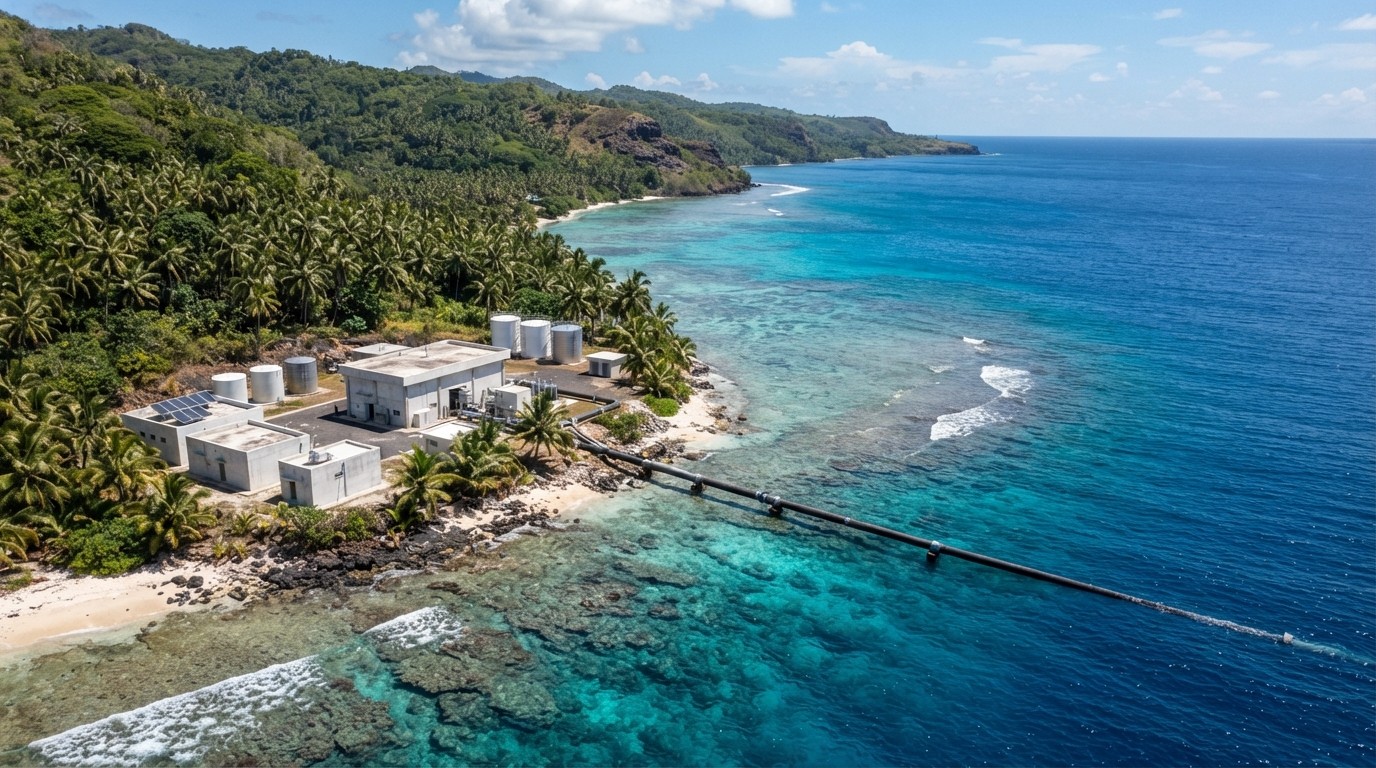
On Kavaratti, in the Lakshadweep archipelago, India’s National Institute of Ocean Technology is building an open-cycle plant designed to generate about 65 kilowatts and power a desalination unit producing 100,000 litres of fresh water a day, with no connection to an external grid. India’s government confirmed in March 2026 that construction was still under way, and IEEE Spectrum reported in September 2026 that the project remains a small but significant step toward commercial viability. NIOT is also preparing a tender for a larger floating system of about 165 kilowatts.
“What we are doing is scalable in numbers for islands and remote communities,” said Purnima Jalihal, who led the project at NIOT before retiring. “This can be a market strategy.”
The logic is simple. Islands pay some of the world’s highest electricity prices because fuel arrives by ship, and many are short of fresh water as well. A plant that makes power and water from the same seawater flow attacks both problems at once. Solar-powered desalination in Kenya is already proving the model, and China’s Rizhao seawater refinery shows how many products one intake can supply.
Beyond the Two Flagships: China, Japan, Taiwan and Hawaii
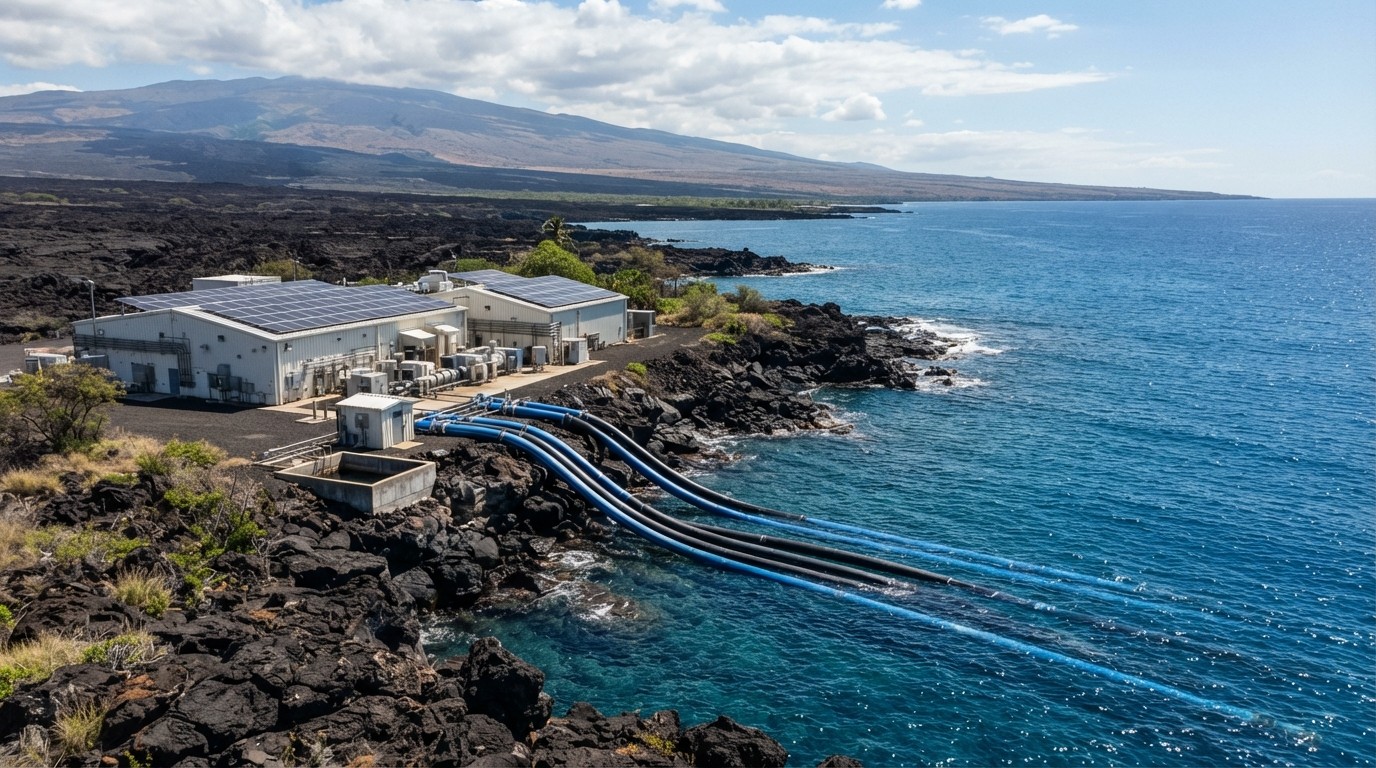
IEEE Spectrum’s September 2026 survey notes kilowatt-scale OTEC projects recently completed in China, with more planned for Hawaii, Taiwan and Japan. Japan has the deepest bench of experience, with Saga University running pilot plants for years, while Mongabay’s reporting on OTEC for islands found the same pattern of small floating devices proving what larger plants might do and puts the theoretical global resource at up to 3 terawatts. In Hawaii, Makai Ocean Engineering’s facility at the Natural Energy Laboratory remains the only operating OTEC plant in the United States. Global OTEC has also run technical studies in the Bahamas on using OTEC for data centre cooling and water supply. Across marine energy more broadly, developers are testing hybrid platforms that combine wave, wind and solar power, floating tidal turbines are feeding mainland grids, and ocean energy coalitions are pushing the sector’s policy agenda.
Why OTEC Is So Hard: The Honest Limitations
If OTEC is so attractive, why has it never scaled? The obstacles are engineering and economic rather than conceptual.
- Low net efficiency. The ocean’s temperature gap is small, so much of the electricity produced is spent pumping water through the plant.
- Enormous water flows. A plant needs roughly 7 cubic metres of seawater per second for every net megawatt, which inflates the size and cost of every component.
- The cold-water pipe. It can account for up to half of a project’s capital cost, and deploying a long riser in open ocean remains a genuine engineering frontier.
- Limited sites. OTEC needs deep, cold water close to tropical shores, and few coastlines offer both.
- Unproven economics. No commercial-scale plant has been built, so every cost figure is still a projection rather than a track record.
- Environmental uncertainty. Large intakes can draw in plankton and fish larvae, and cold, nutrient-rich discharge changes local conditions in ways that are not fully understood.
The economics are not hopeless. A 2025 techno-economic analysis of 32 small island states put the average cost of OTEC electricity at $0.16 per kilowatt-hour, roughly two-thirds below the $0.46 average for the diesel generation it would replace, with published estimates across studies ranging from about $0.15 to $0.45 depending on site conditions. That analysis and IRENA’s 2014 cost assessment point the same way: the technology becomes attractive where island electricity already costs around $0.30 per kilowatt-hour, provided the upfront capital, which IRENA puts at $5,000 to $15,000 per kilowatt for large plants, can be financed cheaply.
Counterbalancing all that: no fuel, no land use, and a capacity factor that wind and solar cannot match.
How OTEC Compares With Other Renewables
| Technology | Output pattern | Land use | Maturity | Fits best |
|---|---|---|---|---|
| OTEC | Continuous, 24/7 | None on land | Demonstration, kilowatt scale | Tropical islands with deep water nearby |
| Solar PV | Daytime only, weather dependent | High per megawatt | Mature, global | Almost everywhere, with storage |
| Offshore wind | Variable | None on land | Mature and scaling fast | Temperate, windy coastlines |
| Wave and tidal | Intermittent, predictable in places | None on land | Early commercial | Exposed coasts and strong currents |
That explains the niche. OTEC is not competing to be the cheapest kilowatt-hour. It is competing for islands where land is scarce, diesel is expensive, and a steady supply matters more than a low headline price.
What Happens Next
The next few years will decide whether OTEC stays a demonstration or becomes a product. Global OTEC’s Hawaii module, India’s 165 kilowatt tender and the engineering lessons from PLOTEC will shape the designs that follow. Watch the cost numbers rather than the announcements: the evidence that OTEC can ride a wind-and-solar-style learning curve will be verified costs from a plant that is actually operating, and the first long-term power purchase agreement signed by an island government.
Frequently Asked Questions
What is ocean thermal energy conversion in simple terms?
A way of making electricity from the temperature difference between warm surface seawater and cold deep seawater. Warm water boils a low-temperature fluid, the vapour drives a turbine, and cold water from about 1,000 metres turns it back into liquid so the cycle repeats. Because the temperature gap exists day and night, output is continuous.
Which US state has an OTEC facility?
Hawaii. Makai Ocean Engineering’s plant at the Natural Energy Laboratory on the Kona coast of the Big Island was the first US OTEC facility to feed the grid.
What are the disadvantages of OTEC?
Low net efficiency, heavy capital costs, the difficulty of installing a cold-water pipe down to the deep ocean, few suitable sites, and uncertainty about the environmental effects of large seawater intakes and the discharge of cold, nutrient-rich water.
Does OTEC produce fresh water?
Open-cycle and hybrid plants can. India’s project in Lakshadweep is designed to produce about 100,000 litres of drinking water a day at the same time as it generates power.
Why has OTEC taken so long to develop?
Every attempt since the 1930s ran into the same three walls: weak thermal efficiency, the volume of water involved, and the difficulty of reaching cold water. Fossil fuels also set a price that OTEC could not beat. Moving the plant offshore is what finally made a scale-up path look possible.
The Bottom Line
OTEC spent 145 years as a brilliant idea with bad economics. In 2026 that changed just enough to matter: two credible projects are in the water, one offshore platform is already gathering data, and a further wave is planned in Hawaii, Taiwan and Japan.
Expect kilowatts rather than gigawatts, and expect scepticism, which the technology has earned. But for islands burning shipped diesel at punishing prices, the first real offshore OTEC hardware is a genuinely new option.


