
On a winter evening in Oslo, a group of volunteers climbs into wooden huts moored on the harbour, settles onto the benches, and sits in dry heat for two rounds. They are not only relaxing. They are participants in one of the first randomised controlled trials built to answer a question that wellness culture has quietly assumed for years: can deliberate heat exposure treat depression?
The trial, run by cognitive neuroscientist Eva Hilland at Oslo Metropolitan University, is part of a small but fast-growing body of research that treats heat less like a spa amenity and more like a physiological intervention. Several of the most striking findings come from trials small enough to demand caution, yet the results have surprised the clinicians running them.
Here is what the trials have actually found about sauna for depression, why heat might work on the brain, and what remains genuinely unproven.

Why Researchers Are Looking at Heat and Mood
When Hilland combed the scientific literature for evidence strong enough to recommend heat as a mental health intervention, she found very little. The cardiovascular case for sauna bathing is comparatively well established, supported by decades of Finnish cohort data and summarised in our look at the health case for regular sauna sessions. The mental health question was, by contrast, wide open.
Her trial, funded by a local municipality, is recruiting 50 participants who take two sauna sessions a week at one of the floating sauna villages that have transformed Oslo’s inner harbour.
The team is tracking stress, well-being and sleep, and pairing the heat with a short set of mental health habits.
What makes the question plausible rather than wishful is a physiological quirk that keeps turning up in the data. People with depression tend to run hotter.
“What we know from a whole bunch of literature is that depressed people seem to run hot,” said Ashley Mason, a researcher at the University of California, San Francisco, who has published two studies on the pattern, the largest tracking more than 20,000 people across 106 countries. Her work, summarised by Medical News Today, also found that people with depression regulate temperature less well in general: their bodies do not cool down as efficiently, particularly at night.
If elevated body temperature tracks with depression, the logic goes, then interventions that trigger the body’s cooling response might help. That idea, known as the thermoregulation hypothesis, is the thread running through most of this research.

What the Clinical Trials Have Found So Far
The evidence base is small and mostly preliminary, but it is more substantial than the wellness aisle suggests. Four strands stand out.
The Whole-Body Hyperthermia Trial at UCSF
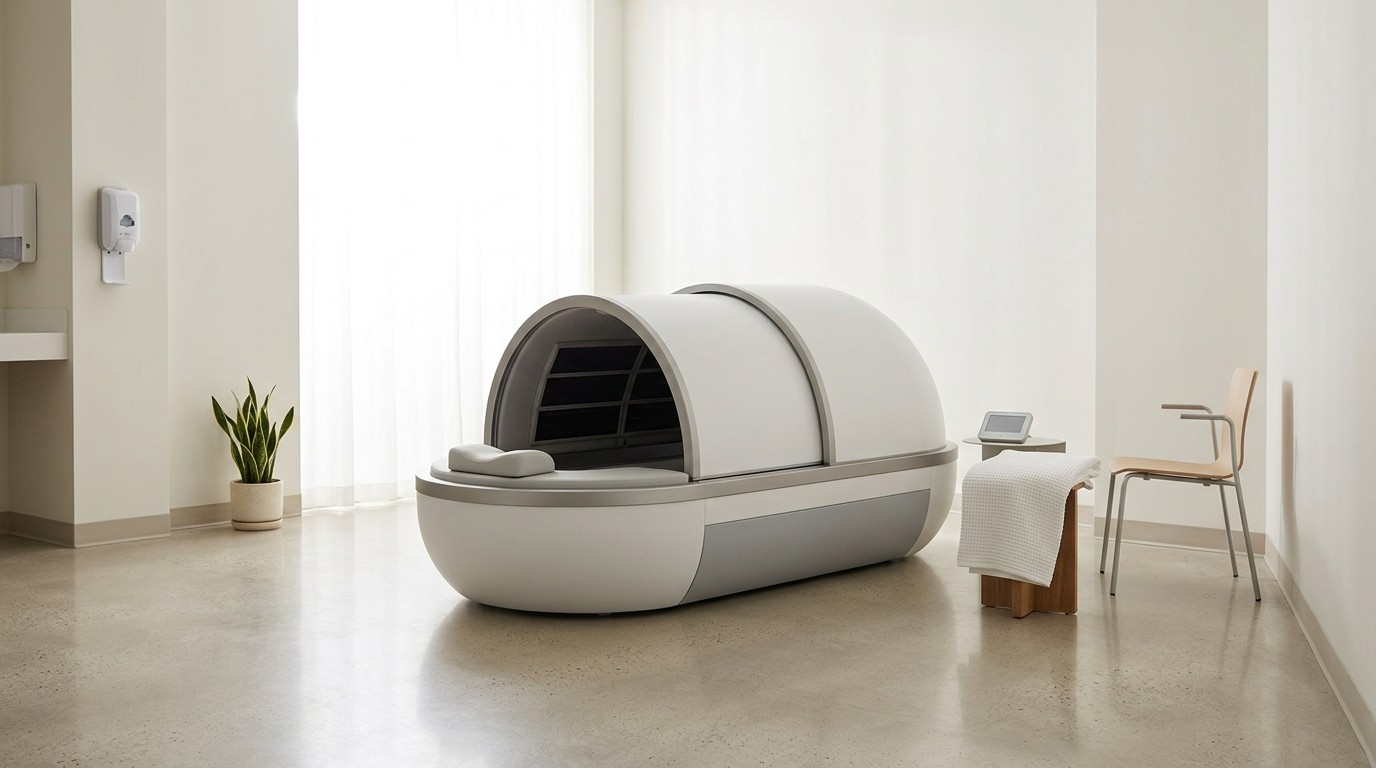
Mason’s team tested something more controlled than a sauna: whole-body hyperthermia, delivered in an infrared dome that encloses the body up to the neck and leaves the head free. Participants with major depressive disorder received eight weekly cognitive behavioural therapy sessions alongside at least four heat sessions, each running up to 140 minutes or until core temperature reached about 38.5°C.
Of the 12 people who completed the study, 11 no longer met the diagnostic criteria for major depressive disorder afterwards, and average depression scores fell by 15.8 points, according to the UCSF Osher Center’s summary. It was a small single-arm feasibility study, meaning every participant received the treatment and there was no placebo group, so the numbers must be read with care, as Wired’s report on the trial also noted.
The team described the reductions as clinically meaningful and is now running a second pilot ahead of larger trials.
The Infrared Session That Lifted Mood for Six Weeks
A separate line of work, reported in detail by NPR in October 2026, produced one of the more striking single-session findings. Chris Lowry, an integrative physiologist at the University of Colorado Boulder, was part of a team that found one session in an infrared heating machine meaningfully improved depression symptoms within a week, with the improvement persisting for up to six weeks. A UCLA Health review of the hyperthermia evidence describes similar outcomes in other small trials.
“The weight of the evidence suggests that heat as a physiological stimulus is really powerful in terms of promoting mental health,” Lowry told NPR.
At the University of Wisconsin-Madison, psychiatrist Charles Raison has pushed the heat dose higher, using a specialised hyperthermia machine to reach a core temperature of about 101.3°F, or 38.5°C. His read on the literature is blunt: “High heat administered for a time-limited period is an antidepressant, and a pretty good one.” His group and others have reported a dose-like pattern in which larger increases in core temperature line up with larger reductions in depression over the following days and weeks.
Population Data From Finland and Sweden
The longest-running evidence is observational. A 2015 study in JAMA Internal Medicine followed more than 2,300 Finnish men for roughly two decades and found that those who used a sauna four to seven times a week had a far lower risk of cardiovascular disease and death than those who went once a week, as NPR’s earlier reporting on sauna’s cardiovascular evidence set out. That study measured hearts, not moods.
For mood, the more relevant dataset is Swedish. In a 2024 analysis of the MONICA study, 971 sauna bathers reported better general and mental health, more energy, greater happiness, more satisfying sleep, and fewer symptoms of anxiety than people who rarely bathed.
Notably, the benefits plateaued: bathing one to four times a month was associated with the best self-reported mental health.
The Result That Didn’t Fit
Not every trial has been encouraging. A 2025 pilot study gave 10 veterans with chronic spinal cord injuries eight weeks of supervised passive heat therapy, raising oral temperature by about 1°C per session. Pain intensity improved significantly. Self-reported mental health and sleep did not improve at all.
That null result is a useful corrective. It suggests any mood benefit is not automatic, and that the outcome may depend on who is being heated, how hot they get, and how long the intervention lasts.
How Heat Might Change the Brain
There is no settled mechanism, but three broad explanations recur in the research.
Thermoregulation and the Cooling Response
The thermoregulation hypothesis is the most concrete. If depression is associated with elevated body temperature and sluggish cooling, heat exposure may work partly by provoking a compensatory dip.
Mason’s group has reported that decreases in body temperature in the days after a single heat treatment correlated with simultaneous decreases in depression symptoms, a pattern that fits the thermoregulation story.
The Skin-to-Brain Mood Circuit
Heat is detected by specialised sensors in the skin, and the signals travel to evolutionarily old regions of the brain that also help govern mood and reward. Lowry points to this overlap as one reason a hot environment can feel pleasant rather than merely uncomfortable, and as a plausible route by which a purely physical stimulus could nudge emotional state.
What Remains Unknown
Researchers are careful to flag the gaps. It is unclear how much of the benefit comes from the biology of heat versus the ritual around it, including the quiet, the time away from screens, the social contact and the time outdoors. Effects on sleep and inflammation are plausible but not established, and nobody knows yet whether the effect holds for treatment-resistant depression or for people already taking antidepressants.
There is also the possibility that heat acts through several routes at once. Exposure to high temperatures triggers a cascade of cellular stress responses and shifts in blood flow, while depression research increasingly points to immune and inflammatory processes. Untangling which of these, if any, drives a mood change will require measurements that most sauna studies have not yet collected.
Sauna, Infrared, or Whole-Body Hyperthermia: What’s the Difference?
These terms are often used interchangeably by people researching sauna for depression, but the trials involve meaningfully different interventions.
- Traditional sauna: a hot room, typically 70 to 90°C, heated by a stove and stones. Sessions are short, often 10 to 20 minutes, repeated with cooling breaks.
- Infrared sauna: radiant panels warm the body more directly, usually at lower air temperatures. This is the format used in the single-session mood studies and the type most often installed at home.
- Whole-body hyperthermia: a clinical procedure rather than a wellness practice. Body temperature is driven toward a defined target and monitored throughout, in sessions that can run far longer than a typical sauna round. It is the approach used in the UCSF trials.
In other words, sitting in a hotel sauna and lying in a monitored hyperthermia dome are not the same treatment, and results from one should not be assumed to apply to the other. Direct comparisons are still rare, and researchers are now testing whether adding cold exposure improves on heat alone. If contrast routines interest you, our guide to heat and cold therapies covers how the two are generally combined.

Safety: What to Know Before Using Heat for Mood
Saunas are generally safe for healthy adults when used sensibly, but heat is a genuine physiological stressor, and nothing in the research supports self-prescribing it as a depression treatment. Cleveland Clinic’s sauna guidance offers a useful baseline.
- Drink water before and after a session, and treat thirst, headache, muscle cramps or confusion as signals to stop and cool down.
- Avoid sauna after drinking alcohol, which impairs temperature regulation and raises the risk of fainting or an irregular heartbeat.
- Check with a clinician first if you are pregnant, over 65, or living with a heart condition, and after a recent heart attack or stroke.
- Some medications affect sweating, blood pressure or temperature regulation, so review them with a doctor before making heat a regular habit.
- Treat heat as an addition to evidence-based care, not a replacement. If you are struggling, this belongs alongside treatment rather than instead of it, whether that is therapy, medication or approaches such as the microbiome-based treatments now being studied for depression, or everyday factors that shape risk, from sleep and activity to social connection.
If you want to make the habit practical at home, our guide to planning a home sauna walks through the space, power and ventilation questions worth settling before you buy, while our look at home recovery rooms covers the wider trend of designing a house around rest and recovery.
The Trials Still Running
The next few years should clarify a great deal. Hilland’s Oslo trial is testing whether two sessions a week change stress, well-being and sleep across 50 participants. Mason’s group is running a second pilot and preparing larger trials with control groups, the design that will determine whether heat genuinely outperforms a convincing placebo. Raison’s team continues to test higher-dose hyperthermia against depression. Heat is not the only physical route under investigation either: researchers have reported symptom improvements from targeted brain stimulation, another hint that depression can respond to physiological interventions rather than talk-based ones alone.
Two newly registered trials show where the field is heading: one is comparing twelve weeks of heated yoga with infrared sauna sessions against a mindfulness app, while CHILL’D is randomising 112 adults to a single whole-body heat session or heat followed by a cold plunge.
What would count as proof? A randomised trial in which a comparison group receives a convincingly similar but therapeutically inert intervention, sustained improvements beyond a few weeks, and replication across more than one laboratory.
Key Takeaways
- Heat exposure is being studied as a genuine mental health intervention, not just a relaxation aid.
- Small trials of whole-body hyperthermia and infrared heating have shown measurable improvements in depression symptoms, including one session whose effects lasted up to six weeks.
- Swedish population data links regular sauna use with better mental health, though the benefits plateau at one to four sessions a month.
- A null trial in veterans with spinal cord injuries shows the effect is not automatic.
- The leading hypothesis involves thermoregulation: people with depression tend to run hotter and cool less efficiently, and heat may work by triggering the body’s cooling response.
- The evidence is still preliminary. Heat is not a substitute for treatment, and safety precautions matter.
Frequently Asked Questions
Does sauna help depression?
Early trials suggest it can, at least for some people. Infrared heating and whole-body hyperthermia have produced measurable symptom improvements in small studies, but no large placebo-controlled trial has confirmed the effect yet.
How hot should a sauna be for mood benefits?
There is no settled protocol. The clinical trials targeted core body temperature rather than room temperature. Whole-body hyperthermia aimed for around 38.5°C core, while traditional saunas run at 70 to 90°C air temperature for short sessions. Hotter or longer is not automatically better.
Is infrared better than a traditional sauna for depression?
Most mood research so far used infrared heating or controlled hyperthermia, so the direct evidence is stronger there. That reflects which studies have been run, not proof that infrared is inherently superior.
Can a sauna replace antidepressants?
No. Nothing in the current evidence supports stopping or replacing prescribed treatment. Heat exposure is being studied as a complementary intervention, and any change to medication should be made with a clinician.
Is a hot bath as effective as a sauna?
Possibly, in principle, since both raise core temperature. But the trials described here used sauna and infrared heating specifically, so it is too early to treat the different forms of heat as interchangeable.

