
On October 1, 2026, a small satellite carrying four of Google’s AI chips rode a SpaceX Falcon 9 into low Earth orbit. Hours later, Google’s team confirmed contact and reported that the spacecraft was working as expected. It is not a data center, and it is not close to being one. It is the first piece of hardware for Project Suncatcher, Google’s research moonshot to run machine learning on solar-powered satellites, and it turns a long-running thought experiment about moving AI infrastructure into orbit into a mission engineers can actually measure.
The timing is not accidental. AI’s appetite for electricity is colliding with grid limits, land constraints, and growing public resistance to data centers. This guide covers what Project Suncatcher is, what Google launched, the hurdles that stand between a four-chip prototype and a working orbital data center, and why getting answers back down to Earth may be the hardest problem of all.
What Is Project Suncatcher?
Google Research announced Project Suncatcher on November 4, 2025, alongside a preprint describing a scalable system design for machine learning in space. The concept is deceptively simple: instead of building ever larger terrestrial campuses, fly compact constellations of solar-powered satellites carrying Google’s Tensor Processing Units (TPUs), wired together with free-space optical links, the laser equivalent of a fiber connection between spacecraft.
The energy argument comes first. In the right orbit, a solar panel can be up to eight times more productive than one on the ground and can generate power almost continuously, sharply reducing the battery mass a satellite has to carry.
Google frames the project as another long-horizon moonshot, in the spirit of its quantum computing program and Waymo.
The reference design in the paper is specific. The satellites would fly in a dawn-dusk sun-synchronous low Earth orbit, where they stay in sunlight for nearly the entire orbit.
An illustrative configuration places 81 satellites in a cluster only one kilometer across at a mean altitude of about 650 kilometers, with next-nearest neighbors oscillating between roughly 100 and 200 meters apart as Earth’s gravity tugs at the formation. Many small, interconnected satellites are the point: the design is meant to scale by adding units rather than by making each one enormous.

What Google Actually Launched on October 1
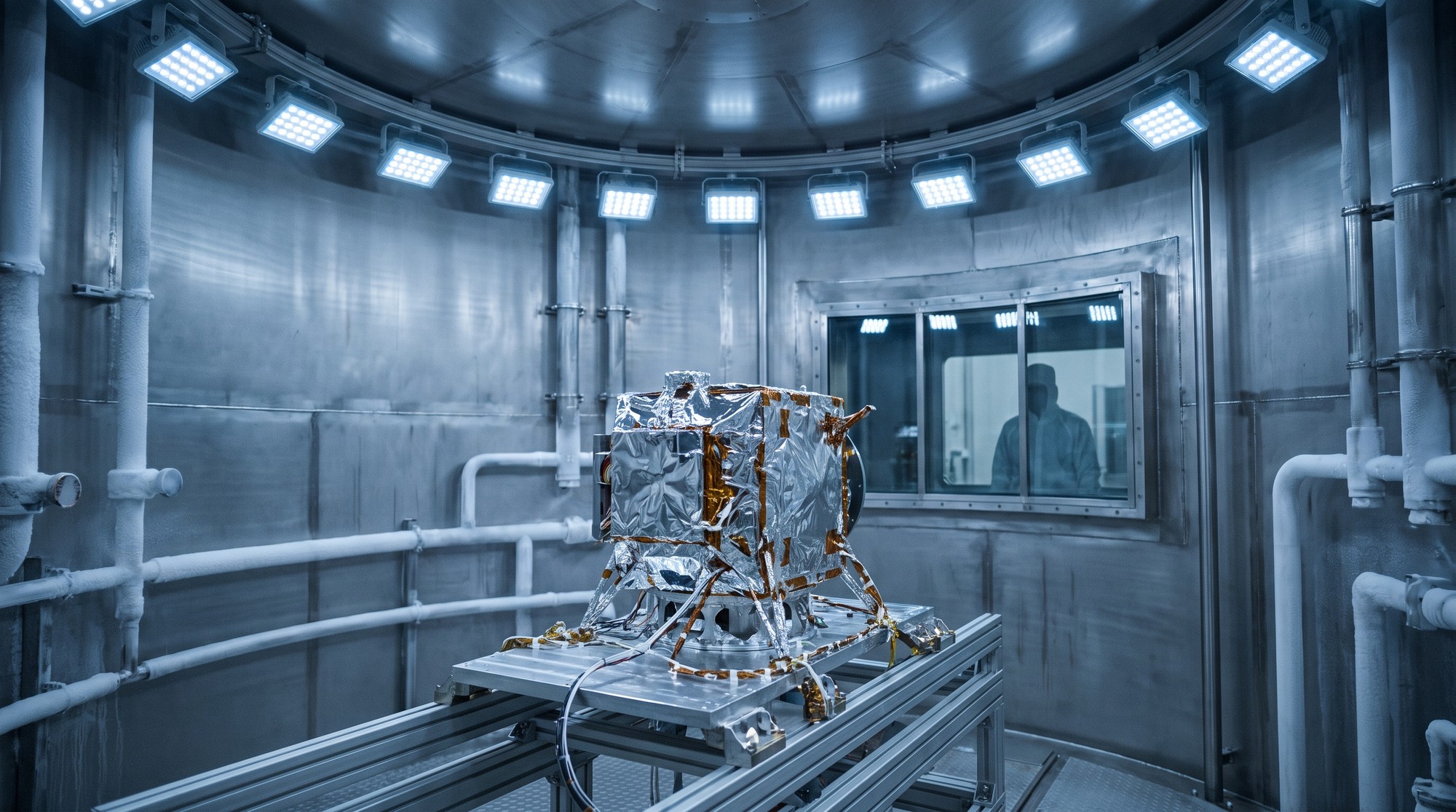
The prototype that reached orbit is a learning mission, not an early data center. Nicknamed MVP and about the size of a refrigerator, it was built in partnership with the Earth-imaging company Planet, flew as part of SpaceX’s Transporter-18 rideshare from Vandenberg Space Force Base in California, and Google confirmed shortly afterwards that the satellite was operating as expected. The research behind it is now published as a peer-reviewed paper in Joule.
The flight also arrived months ahead of schedule. Google originally planned to send two purpose-built satellites up in early 2027; instead, it fit its chips into a spacecraft Planet had already built, a shortcut that meant accepting added risk to reach orbit sooner, according to Eric Stevens, a director of systems engineering at Planet, as reported by The New York Times.
What is on board is modest by design: four Trillium TPUs, Google’s v6e generation of AI accelerators, drawing on roughly one kilowatt of solar power. As Scientific American reported ahead of the launch, the chips run Gemini models in stretches of about 15 minutes before they must shut down and cool, a direct consequence of how badly a vacuum sheds heat.
Google has been blunt about the purpose. The flight is designed to show how TPUs cope with the physical stress of launch, which the company describes as about ten minutes of intense vibration and sustained acceleration of up to 10 g, and with the radiation and thermal extremes of low Earth orbit.
Three points are worth keeping straight:
- What it does test: whether the hardware survives launch, radiation, and thermal extremes.
- What it does not test: the laser links between satellites, which wait for the 2027 mission.
- What it is not: a data center. The mission is a hardware test, not a compute service.
Why Space? The Energy Math Behind the Moonshot
The push into orbit is really a response to what is getting harder on the ground. According to the International Energy Agency, data centers could consume roughly 3 percent of the world’s electricity by 2030, about double their share today. Connection queues for new capacity in some markets now stretch years. Those pressures are already reshaping the way the world’s largest supercomputers are situated and powered.
In orbit, the constraints change shape. Sunlight is continuous, there is no permitting queue, and there is no neighbor to object to the hum of a substation. The catch is that nobody has built anything like this at scale.
“It’s going from arrays that are several meters on a side to arrays that are a couple of kilometers on a side,” Kerri Cahoy, a professor of astronautics at MIT, told Scientific American. “Launching enough mass to generate the power is huge.”
The solar advantage behind all of this is simple to state:
Put the numbers side by side, and the distance between a test flight and a real data center becomes clear.
| System | What exists or is planned | Scale |
|---|---|---|
| Suncatcher prototype (flew October 2026) | One satellite with four Trillium TPUs and about 1 kW of solar power | Roughly the compute of a single cloud TPU slice |
| Suncatcher’s 2027 milestone | Two satellites, first optical inter-satellite link test | Still a research experiment |
| Illustrative design in Google’s paper | 81 satellites in a 1 km cluster at 650 km altitude | A modeled formation, not a built system |
| Today’s largest terrestrial AI data centers | Hundreds of thousands of chips | Up to about 1 gigawatt of power |
For comparison, the International Space Station’s solar arrays generate a fraction of one percent of a single gigawatt, which is why Google’s researchers describe the gap as several orders of magnitude.
Google’s economic case rests on launch costs. The paper’s analysis of historical and projected pricing suggests that with a sustained learning rate, launch to low Earth orbit could fall below about $200 per kilogram by the mid-2030s.
At that point, the cost of launching and operating a space-based data center could become broadly comparable to the energy costs of an equivalent ground-based facility. That “could” is doing a lot of work, and it is the assumption most likely to decide whether Suncatcher stays a research project.
The Hurdles Between a Prototype and a Data Center
Google’s paper sets out four problems that have to be solved for the concept to work.
1. Inter-satellite links fast enough to act like one machine
Serving and training large models means spreading work across many accelerators with high bandwidth and low latency. Matching a terrestrial data center requires links supporting tens of terabits per second between satellites.
Google’s analysis suggests dense wavelength-division multiplexing plus spatial multiplexing can get there, but only if the satellites fly extremely close together: received power falls with the square of distance, so closing that gap means separations of a kilometer or less. The team has demonstrated 800 Gbps in each direction, 1.6 Tbps in total, between a single pair of transceivers on a bench-scale rig.
2. Flying in a formation tighter than anything in orbit
The proposed cluster is far more compact than any existing constellation. Using physics models derived from the Hill-Clohessy-Wiltshire equations and refined with a JAX-based differentiable model, Google found that only modest station-keeping maneuvers should be needed to hold the formation together, despite the non-spherical pull of Earth’s gravity and the drag of the upper atmosphere.

3. Surviving radiation
Space is hostile to silicon. Google tested a Trillium TPU, its v6e cloud chip, in a 67 MeV proton beam. The results were better than expected. The high-bandwidth memory subsystems proved the most sensitive part, showing irregularities only after a cumulative dose of 2 krad(Si), almost three times the 750 rad(Si) a shielded five-year mission is expected to accumulate. No hard failures appeared up to the maximum dose tested, 15 krad(Si), on a single chip.
4. Heat and the cost of getting hardware up there
Cooling is the counterintuitive problem. Space is cold, but a vacuum cannot convect heat away, so waste heat has to be radiated from large surfaces. That is why the prototype computes only in short bursts and why Google lists thermal management among the challenges that remain unsolved, alongside high-bandwidth ground communications and on-orbit reliability.
Launch economics complete the picture: every chip and panel has to be lifted to orbit, and worn-out satellites have to be replaced.
The Hardest Problem: Getting Answers Back Down
Even a perfect orbital data center has to send its results somewhere, and satellites can only downlink so much. “We don’t have the convenient, easy way to get that data back to the ground,” Alan George, a professor of electrical and computer engineering at the University of Pittsburgh who leads a National Science Foundation center focused on space computing, told Scientific American. His framing of the workaround is memorable: “I like to tell my students the best data compression is answers.”
The Cold War version of this problem was solved by dropping film canisters out of spy satellites. Modern spacecraft use lasers, and Google’s design leans on them, but the bottleneck between orbit and ground remains.
It is one reason the company argues compute should happen in space in the first place so that only conclusions travel down. The same constraint sits at the center of the three real bottlenecks analysts have identified in orbital data centers: radiation, thermal management, and the economics of moving data between Earth and space.
Two constraints sit on top of that physics:
- Maintenance and replacement: satellites wear out, and every replacement satellite means another launch.
- Error correction: cosmic radiation can scramble calculations, forcing systems to catch and fix mistakes on the fly.
The economics still have to close. Scientific American’s assessment is blunt: the cost of launching and replacing satellites, combined with limited downlink bandwidth, may consume whatever free sunshine saves.
“It’s usually the late entrants who finally figured out how to do it effectively,” Cahoy said, noting that SpaceX itself reached orbit half a century after Sputnik.
Google’s engineers say they started from the same skepticism. “As a first step, we tried to find reasons that it was impossible,” Travis Beals, the senior director who leads Project Suncatcher, told Scientific American, “but we gradually became convinced that it might actually work.”
Google Is Not Alone: The Orbital Compute Race
Suncatcher is one entry in a crowded field. China’s StarDetect already has 37 GPUs operating in orbit as part of its Fuyao orbital data center plans, and startups such as Starcloud have been flying GPU-class machines to test the idea. SpaceX, meanwhile, has made space data centers a headline part of its pitch to investors since its June 2026 listing.
AI is already woven into orbit in quieter ways. Google’s own WeatherNext models turn enormous observational datasets into hourly global forecasts, and Earth-imaging fleets increasingly run machine learning on board to decide what is worth sending home.
| Player | What is flying | Next step |
|---|---|---|
| Google with Planet (Project Suncatcher) | One prototype satellite, four Trillium TPUs, about 1 kW of solar power | Two-satellite optical link test planned for 2027 |
| StarDetect, China | 37 GPUs operating in orbit for its Fuyao orbital data center plan | Expanding into a larger orbital compute constellation |
| Starcloud | Early GPU-class satellite computing experiments | Scaling orbital compute services |
| SpaceX | No orbital compute hardware of its own yet | Pitching space data centers to investors after its June 2026 listing |
The approaches differ in emphasis. Google’s bet is on many small satellites sharing a single workload over laser links, effectively rebuilding a supercomputer’s internal fabric in orbit. Skeptics counter that the same limits on power and land simply reappear in a different form.
What Happens Next, and What Would Count as Success
Over the coming weeks, Google will gather in-orbit data on how its TPUs handle launch stress, radiation, and the temperature swings of space. The roadmap after that is deliberately modest:
- Now: confirm the hardware survives and characterize how the chips behave in orbit.
- 2027: fly two satellites with Planet to demonstrate optical inter-satellite links and distributed machine learning tasks, the part of the architecture the first flight skipped.
- Mid-2030s: reach launch costs near $200 per kilogram, the threshold for competing with ground-based energy costs.
- Beyond that: a more radical design for gigawatt-scale systems, with solar collection, computation, and thermal management integrated into the same panels.
Google’s leadership has been careful not to oversell the work. James Manyika, the company’s senior vice president for research, told The New York Times that the project is in its early stages: “We don’t expect, to be perfectly frank, that we’ll have anything usefully operational in the next few years.”
What success looks like for now is unglamorous: hardware that survives, links that hold, and models that run. “Some things can only be tested in space,” Beals wrote when the satellite reached orbit. The milestone to watch is not a data center in the sky; it is whether two satellites in 2027 can pass a workload between them.
Frequently Asked Questions
What is Project Suncatcher?
Project Suncatcher is a Google Research moonshot to run machine learning on constellations of solar-powered satellites carrying Google TPUs and connected by free-space optical links. It was announced in November 2025, and its first prototype satellite launched on October 1, 2026.
Is Project Suncatcher a data center?
No. It carries four TPUs and about one kilowatt of solar power, and Google describes it as a learning mission rather than a commercial system.
Does Google have any data centers underwater?
No. Google’s unconventional data center experiments are on land, such as seawater cooling in Finland, and now in orbit. Underwater server racks have been trialed by other companies and are a separate idea from Suncatcher.
Which companies are known for building satellites?
The Suncatcher prototype was built in partnership with Planet, the Earth-imaging company, while SpaceX provided the ride as part of its Transporter-18 rideshare. Established manufacturers also include Airbus, Lockheed Martin, Boeing, Thales Alenia Space and Rocket Lab, alongside a wave of smaller builders.
What is the oldest artificial satellite still in orbit?
Vanguard 1, launched by the United States on March 17, 1958. It stopped transmitting in 1964 but remains in orbit and is expected to stay there for centuries, making it the oldest human-made object still circling Earth.
When will Google have a data center in space?
Google has not put a date on it, and the company has been careful to call Suncatcher research. The next milestone is a two-satellite optical link demonstration planned for 2027, and any gigawatt-scale orbital data center would depend on the launch costs the paper projects only for the mid-2030s.
Conclusion
Project Suncatcher is best understood as a bet on a constraint rather than a product launch. AI’s power demand is running into the limits of the grid, the land, and public patience, and space offers continuous sunlight and no neighbors. Whether that advantage survives contact with radiation, radiators, bandwidth limits, and launch costs is exactly what the next few years of Google’s research program and the work of its rivals will establish.
For now, the company has four AI chips in orbit, a kilometer-scale formation design on paper, and expectations that it is deliberately keeping low.


