
AMD introduced Helion at the Open Compute Project Summit in San Jose on October 12. It is a rack-scale reference design built for a kind of work that barely existed in data centers a few years ago: AI agents. Agents plan, run code, call tools, and coordinate long chains of tasks. They rarely just answer one question.
Helion is not a faster chip. It is an argument about where the next bottleneck in AI actually sits. It is also about who gets to define the hardware underneath it. The design is an open blueprint built on an Open Compute Project (OCP) specification.
This guide explains what Helion is. It also covers how it differs from the Helios racks AMD launched earlier this year, what the two reference configurations contain, and what the design reveals about the direction of AI infrastructure.
What AMD Helion Actually Is
Helion is a rack blueprint, not a fixed machine. AMD calls it an agentic AI rack because it is designed around the loop that agents run. That loop decides what to do next, fetches context, executes code, checks the result, and asks a model for another judgment.
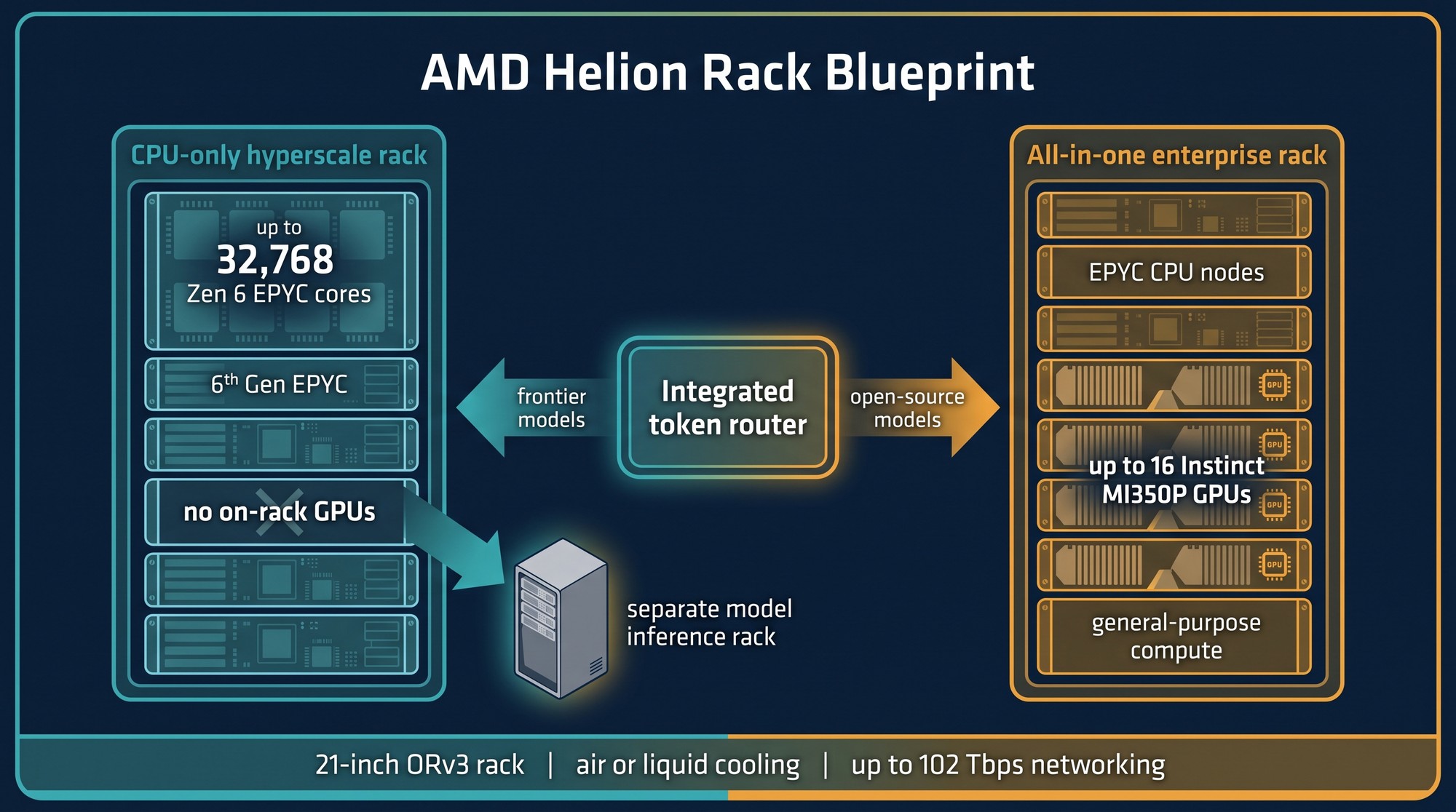
The reference design sits in a 21-inch ORv3 44OU rack. It supports both air cooling and direct liquid cooling, with up to 102 Tbps of programmable networking. Those choices are not decorative. Dense CPU racks generate heat in different places than GPU racks. Operators also care about power per rack as much as performance per chip.
Two configurations anchor the blueprint. The first is a CPU-only rack for hyperscale operators, and it leaves model inference to separate infrastructure. The second is an all-in-one enterprise rack that mixes processor nodes, GPU accelerators, and general-purpose compute in a single system.
AMD says it will contribute the Helion specification to the Open Compute Project, the standards body that turned open rack designs into the default for large data centers. Cisco, Dell, HPE, Lenovo, QCT, Supermicro, Wiwynn, and Hon Hai (Foxconn) are named as ecosystem partners. Partner-built systems are planned for November 2026.
Why AI Agents Need a Different Kind of Rack
Training a large model is a predictable grind. Data flows through the network, gradients are computed, and the loop repeats until the loss curve flattens. Running an AI agent is far messier. An agent writes and executes code, queries databases, browses, and checks results against a goal. It then asks a model for another decision. Most of that work is coordination, not token generation.
AMD’s framing is blunt. “Agentic AI is not a single workload,” said Dan McNamara, senior vice president and general manager of Compute and Enterprise AI at AMD. “It spans personal agents, enterprise applications, code execution and complex workflows, each with different compute requirements.”
Those workloads already come in several distinct shapes:
- Personal agents that schedule, summarize, and answer questions on a phone or laptop.
- Enterprise agents wired into customer service, ticketing, and back-office systems.
- Coding agents that write, run, and test software.
- Technical agents that iterate on simulations, data pipelines, or research tasks.
That mix is why rack design is changing. Most model-serving systems today are built the other way around, with a small number of processors feeding shelves of GPUs. In an agentic rack, the processors take on the orchestration layer, including tool calls, database queries, and security checks, while the GPUs stay focused on inference.
That is the case for putting serious processor capacity in the rack. It also explains why AMD does not treat CPUs as support staff for GPUs. To match different agent classes, the company offers three types of processor blade:
- Dense nodes with 256-core EPYC chips rated at 400 watts, aimed at large fleets of lightweight personal agents.
- Balanced nodes with 256-core chips at 600 watts, aimed at enterprise agents that mix logic and inference calls.
- Performance nodes with 96 cores clocked at 5 GHz, aimed at technical agents that need speed on fewer, harder threads.
The practical result for buyers is a rack that can be rebalanced as agent workloads change, rather than one that is tuned once for a single job.

Helion vs. Helios: One Letter, Two Very Different Racks
The names are uncomfortably close, and AMD knows it. Helios, launched earlier this year, is the company’s rack-scale platform for frontier training and large-scale inference. It is built around Instinct GPUs, EPYC processors, Pensando networking, and the open ROCm software stack. One year after its 2025 OCP debut, Helios is moving into customer deliveries and workload validation.
Helion targets the layer above inference: agent execution. The two are meant to work as a pair. AMD’s own diagram shows a hyperscale Helion CPU rack sitting beside a separate Helios GPU rack. Agents run on one, and models run on the other. That division of labor says something about the direction of the industry. It implies that not every AI task deserves an accelerator.
Readers who want the background on AMD’s wider rack play can start with our earlier analysis of the HPE Helios and Blackwell infrastructure strategy. That piece covers the training-side systems Helion now complements.

The Two Reference Configurations
The two versions differ mainly in where the compute goes: to agents, to models, or to both.
| Configuration | Compute | GPU accelerators | Best for |
|---|---|---|---|
| CPU-only hyperscale rack | Up to 32,768 6th Gen EPYC (Zen 6) cores across dense, balanced, or high-frequency blades | None inside the rack; inference runs on separate infrastructure such as an AMD Helios GPU rack | Hyperscalers running large fleets of agents |
| All-in-one enterprise rack | EPYC processor nodes plus general-purpose compute blades, using the same three blade classes | Up to 16 Instinct MI350P GPUs, added in pairs of eight-GPU 5U servers | Enterprises that want agent execution and inference in one system |
The numbers behind the ceiling are worth reading closely. Because 6th Gen EPYC tops out at 256 cores per socket, a 32,768-core rack works out to 128 processors. In the enterprise version, the 16 Instinct MI350P accelerators add up to 74 petaflops of FP4 compute. AMD also splits the enterprise rack into three node roles: agentic sandbox nodes for running code and tools, inference nodes that carry the GPUs, and general-purpose nodes for database, storage, and technical work.
The Token Router and the Open-Model Bet
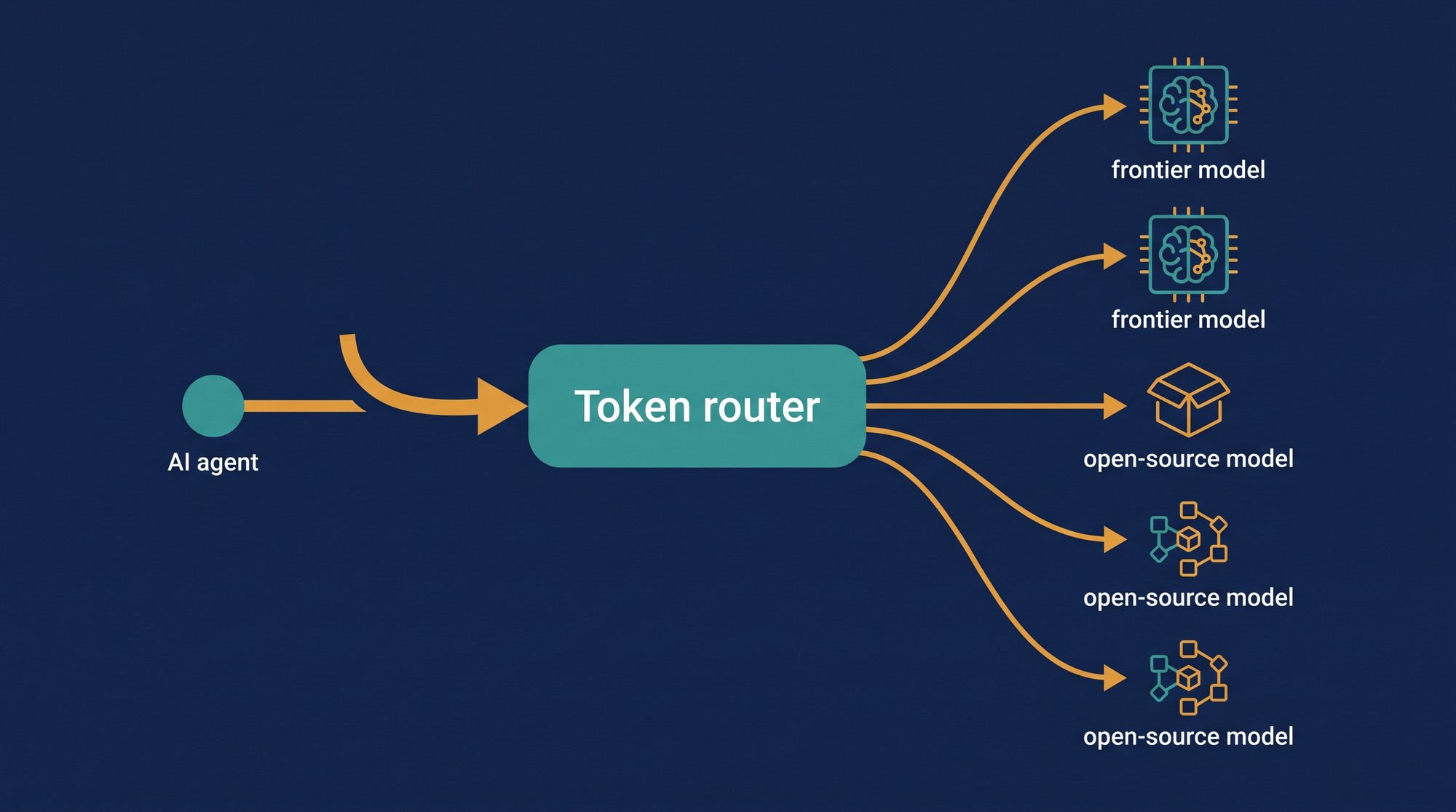
The least flashy and most consequential part of Helion is a software feature. An integrated token router directs an agent’s model calls across both frontier and open-source models.
In plain terms, the rack does not assume that an agent will only talk to one vendor’s flagship model. A routing layer decides which model answers which request. Routine tasks can go to cheaper open-weight models. Expensive frontier models get reserved for hard problems. For enterprises worried about lock-in, that flexibility is the point.
The design matches the message AMD chair and CEO Lisa Su brought to the OCP keynote. She framed open, full-stack infrastructure as the way to support agentic AI at every scale, rather than one vendor’s stack at one price. AMD’s keynote takeaways lay out how Helion sits alongside Helios and the wider EPYC and Instinct lineup. There is also a dedicated product page for the blueprint itself.
What This Means for the AI Infrastructure Race
For three years, AI infrastructure has been framed as a chip race measured in floating-point throughput. Helion reflects a visible shift toward system-level thinking. Power delivery, cooling, rack density, and interconnect now matter as much as peak compute.
Nvidia’s counterargument remains formidable. Tightly integrated racks and a mature software ecosystem are hard to beat on time to value. AMD is betting that buyers will accept some integration work. In return, they get supply diversity and the ability to match compute to each job.
Two physical constraints hang over all of it. Memory supply is tight, and the memory inside a rack can decide what an operator is able to deploy. Our coverage of the Samsung and AMD HBM4 partnership explored that pressure from the bandwidth side. Power is also finite. That is exactly why a design that trades some GPU count for CPU-led agent fleets counts as a strategic choice, not a downgrade.
The demand side matters just as much. As agents move from demos into production, the machines that host them start to look less like training clusters and more like orchestration platforms. The same shift shows up in miniature. Personal AI systems such as the DGX Spark and Strix Halo mini supercomputers exist because individuals want to run models and agents locally rather than rent them.
Signals worth watching over the next two quarters:
- Whether partner systems actually ship on schedule, and in which configurations.
- Independent performance benchmarks, because AMD published none with the announcement.
- Pricing, which will surface through the OEM partners rather than as a single list price.
- Per-rack power, memory, and node-count figures, none of which appeared in the launch materials.
- The token router’s design, since AMD has not published its protocol, supported model list, or latency targets.
- Whether the OCP community extends the Helion specification, because the promised OCP document has not been published yet.
Frequently Asked Questions
What is AMD Helion?
AMD Helion is an open, OCP-based rack blueprint for agentic AI infrastructure. It comes in a CPU-only hyperscale version with up to 32,768 EPYC cores and an all-in-one enterprise version that pairs EPYC processors with up to 16 Instinct MI350P GPUs.
Is AMD Helion the same as AMD Helios?
No. Helios is AMD’s rackscale platform for frontier AI training and large-scale inference, built around Instinct GPUs. Helion is newer and focuses on running AI agents through CPU-led execution and, in the enterprise version, on-rack inference. The two designs are intended to be deployed together.
When will AMD Helion systems be available?
AMD says partner-built Helion configurations are planned to be available in November 2026. The partner roster includes MiTAC, Inventec, ASUS, ASRock Rack, and GIGABYTE alongside the better-known server brands.
How much does AMD Helion cost?
AMD has not published pricing for Helion, and its earlier Helios platform does not carry a public list price either. Cost will depend on the configuration a customer chooses, especially the balance of CPU blades and optional GPU nodes. Expect figures to come from partners rather than from a single published number.
What is a token router in AMD Helion?
It is an integrated routing layer that directs an AI agent’s model calls across both frontier and open-source models. A deployment can send simple requests to cheaper models and reserve premium models for harder tasks.
The Bigger Picture
AMD Helion is a small naming story with a large implication. The company is betting that the agent era will reward systems built around flexible, open racks tuned for coordination work rather than raw training throughput. Nvidia, Intel, and a long list of hyperscalers are placing their own wagers on the same question.
For now, the honest verdict is architectural. The specifications are public, the partners are signed up, and the launch window is set. Whether CPU-led agent racks become the default or remain a niche alongside GPU-dense systems is a question that only shipping hardware and real benchmarks can answer.


