
Most electric cargo bikes solve one problem: carrying more than a backpack. The Hopper cargo bike tries to solve two at once, hauling a load while keeping its rider dry.
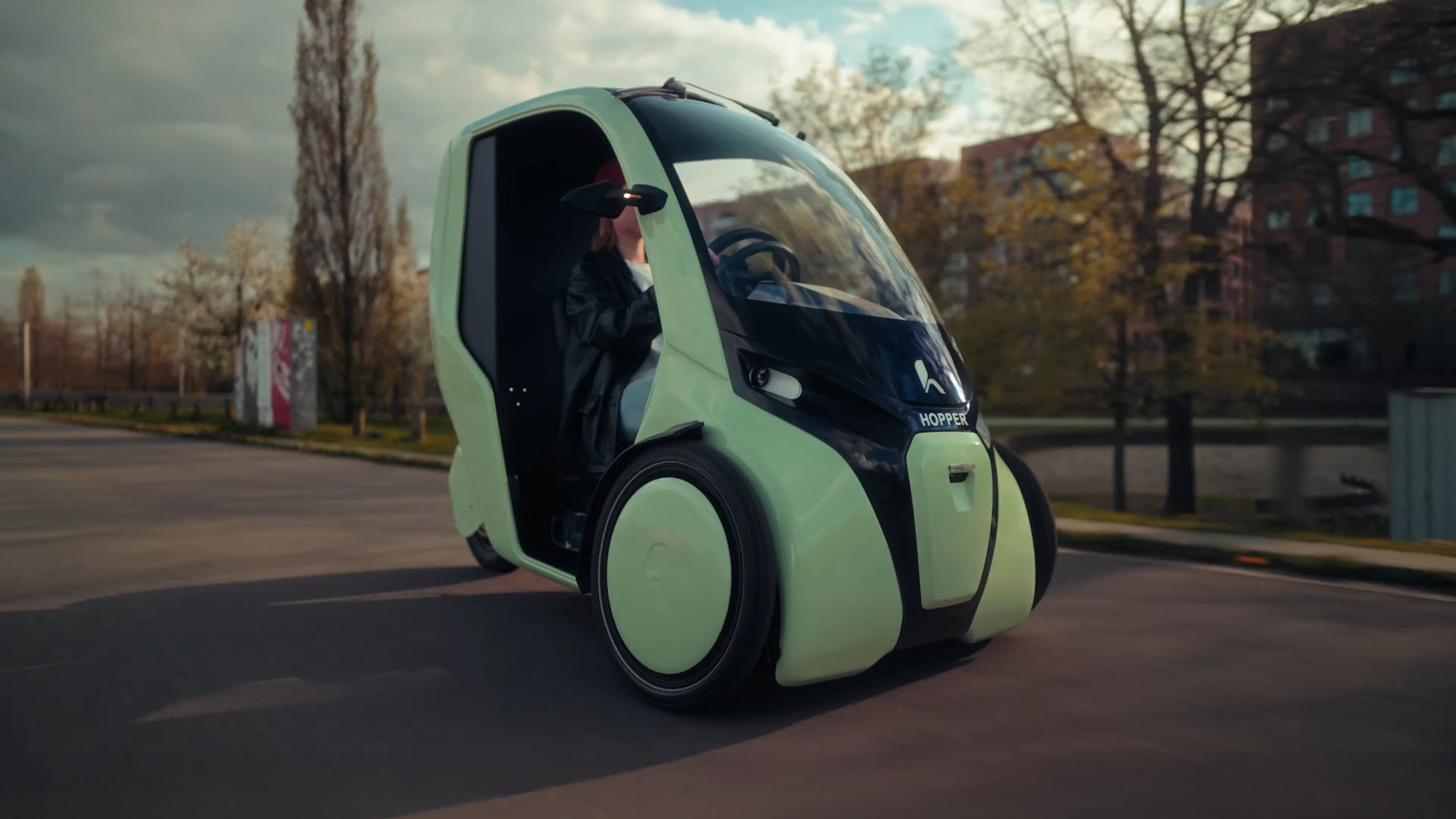
The HOPPER is built by Hopper Mobility, a German startup that assembles it in Hamburg. It is a three-wheeled pedelec with a rigid roof, a windshield, a steering wheel, and a lockable trunk. It looks like a miniature car, but in Germany the law treats it as a bicycle, which is the trick that makes the whole idea work.
That legal classification is the heart of the pitch, and it explains why the HOPPER is one of the more interesting small vehicles on European roads. Here is what it costs, how it works, and where the compromises are.
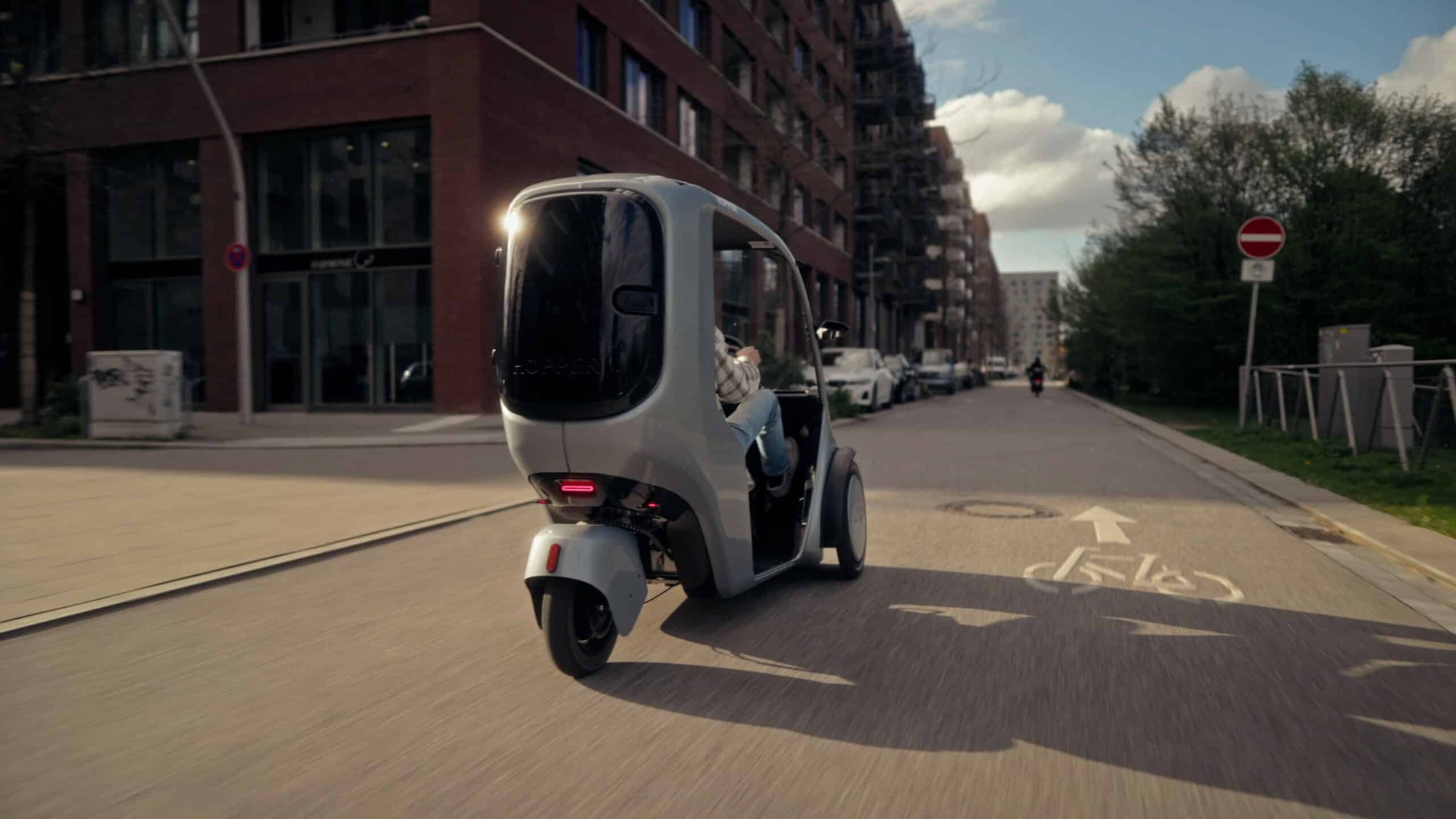
What the HOPPER Actually Is
The HOPPER sits in the narrow gap between a cargo bike and a microcar. Intelligent Living has tracked this category before, from innovative urban mobility designs with more than two wheels to the CityQ, a four-wheeled fusion of a car and an e-bike. The difference is that the HOPPER is actually in series production and on sale.
Covered pedelecs have been shown at trade fairs for more than a decade, and most of them stayed prototypes. What separates the HOPPER is not the concept but the execution: it is recognized as a pedelec, built in small numbers, and delivered to paying customers rather than displayed behind a rope.
Two 20-inch wheels sit at the front and a single 10-inch wheel at the rear. Rear-wheel steering, a rarity on bicycles, gives the HOPPER a turning circle of roughly two meters, so it can turn around in places a normal bike cannot manage.
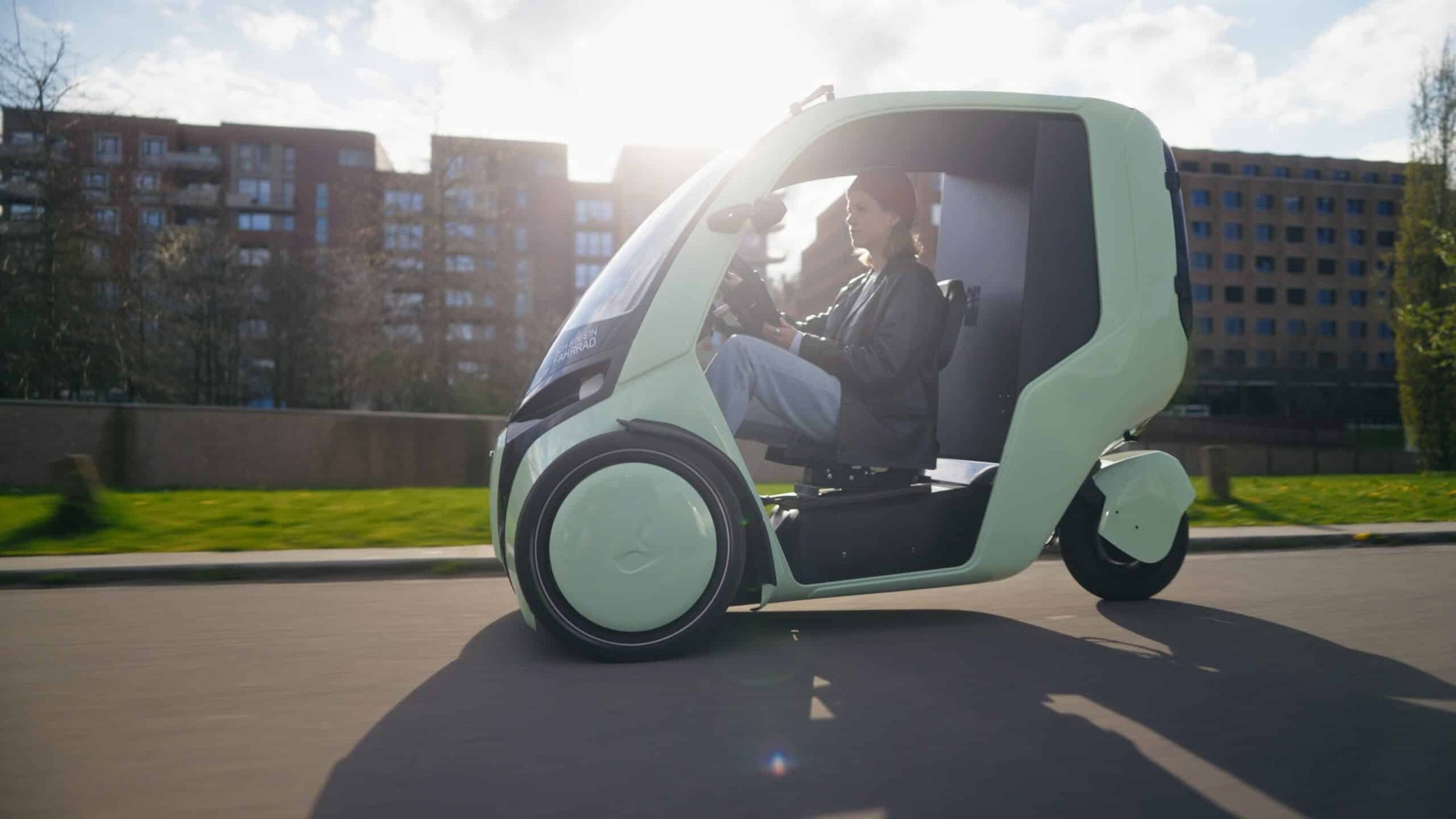
Pedal-by-wire instead of a chain
There is no chain or belt connecting the pedals to the rear wheel. Pedalling drives a generator, and sensors read cadence and torque before instructing the rear hub motor how much assistance to add. Pedalling backwards commands a slow powered reverse.
The Heinzmann hub motor is rated at 250 W continuously, with peaks around 1,350 W and up to 112 Nm of torque, and assistance cuts out at 25 km/h, the standard limit for a European pedelec.
The legal trick that makes it a bicycle
Because the HOPPER stays within pedelec rules, buyers in Germany need no license, no registration, and no insurance, and can ride on cycle paths and in parks. That is a real advantage over a moped or a small car, and it is the reason the HOPPER exists at all.
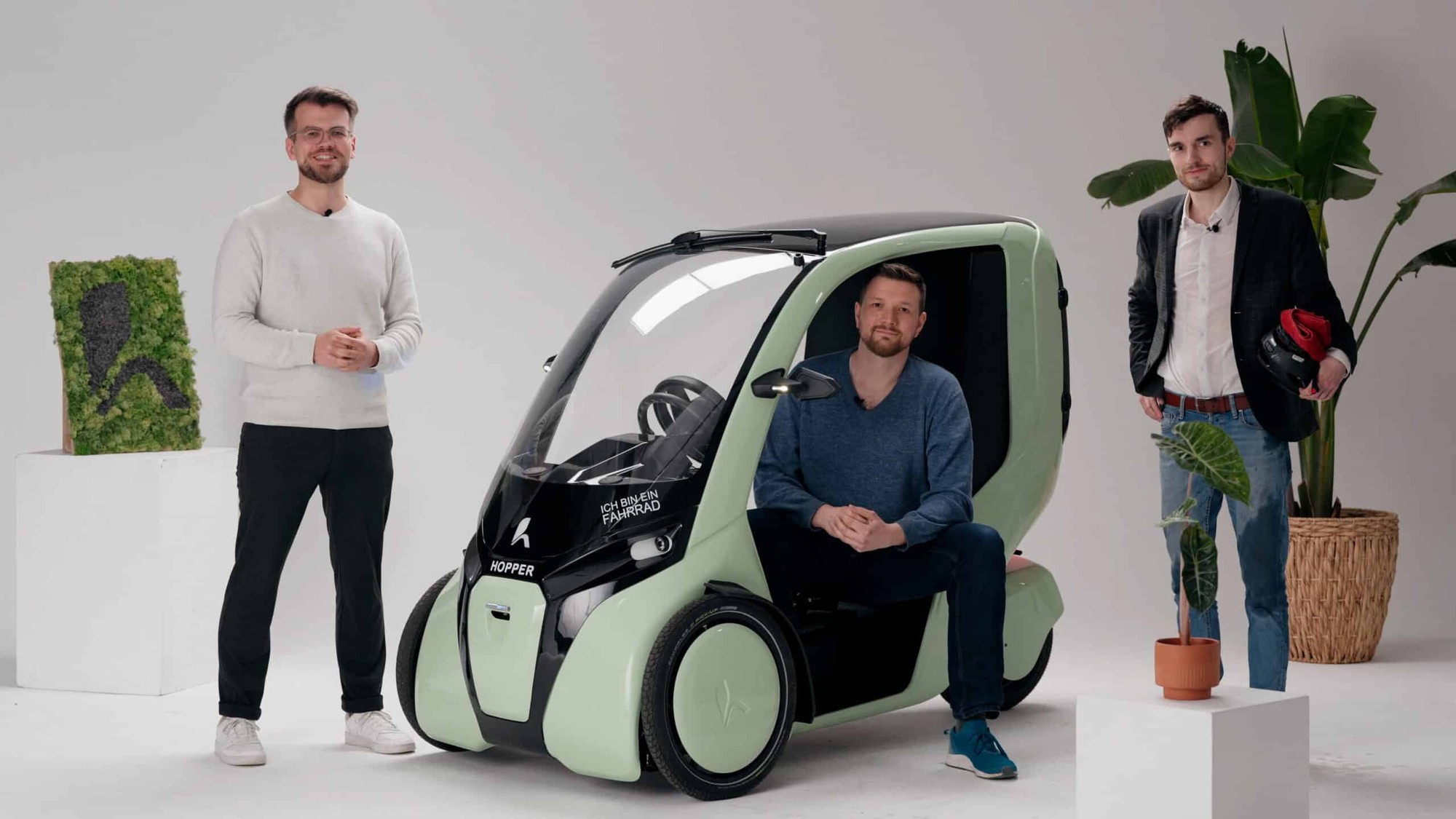
Hopper Cargo Bike Prices and Versions
| Version | Price from | Rear space | Made for |
|---|---|---|---|
| Passenger | €11,900 | Bench for one adult or two children, plus a 125-liter lockable trunk | Commuting with a passenger |
| Cargo | €12,300 | Around 280 liters of lockable storage, with a retrofit kit available | Shopping, deliveries, and tools |
| Dog | €12,900 | Padded compartment with a separating grille | Trips with a dog |
All prices include German VAT. Optional extras include removable side enclosures (€690), colored bodywork (€490), a GPS tracker from €249, a fast charger (€549), and a spare battery from €1,790. Hopper Mobility asks for a €3,500 deposit and quotes an estimated lead time of about ten months.
German buyers may be able to cut the price further. According to the company, the federal BAFA cargo-bike program covers 25 percent of the purchase price, up to €3,500, and several states and cities add their own subsidies on top.
Key specifications
- Battery: 48 V, 30 Ah (1,440 Wh), removable, using durable LFP (lithium iron phosphate) cells
- Range: up to 60 km on one battery, with a second battery roughly doubling that figure, according to the company
- Motor: Heinzmann rear hub, 250 W continuous, up to 112 Nm of torque
- Top assist speed: 25 km/h
- Weight: about 155 kg, with a permitted gross weight of 300 kg and roughly 145 kg for people and cargo
- Size: 212 cm long, 105 cm wide with the mirrors folded, 150 cm tall
- Charging: five to six hours on the standard charger, around three with the optional fast charger
- Efficiency: the company cites about 2 kWh per 100 km, roughly one-seventh of a small electric car
- Start-off assist: up to 6 km/h, with a powered reverse for maneuvering
- Lighting: Supernova LED headlight, visible turn signals, and a 550-lumen high beam
- Rider fit: the company recommends a height between 1.62 m and 1.98 m
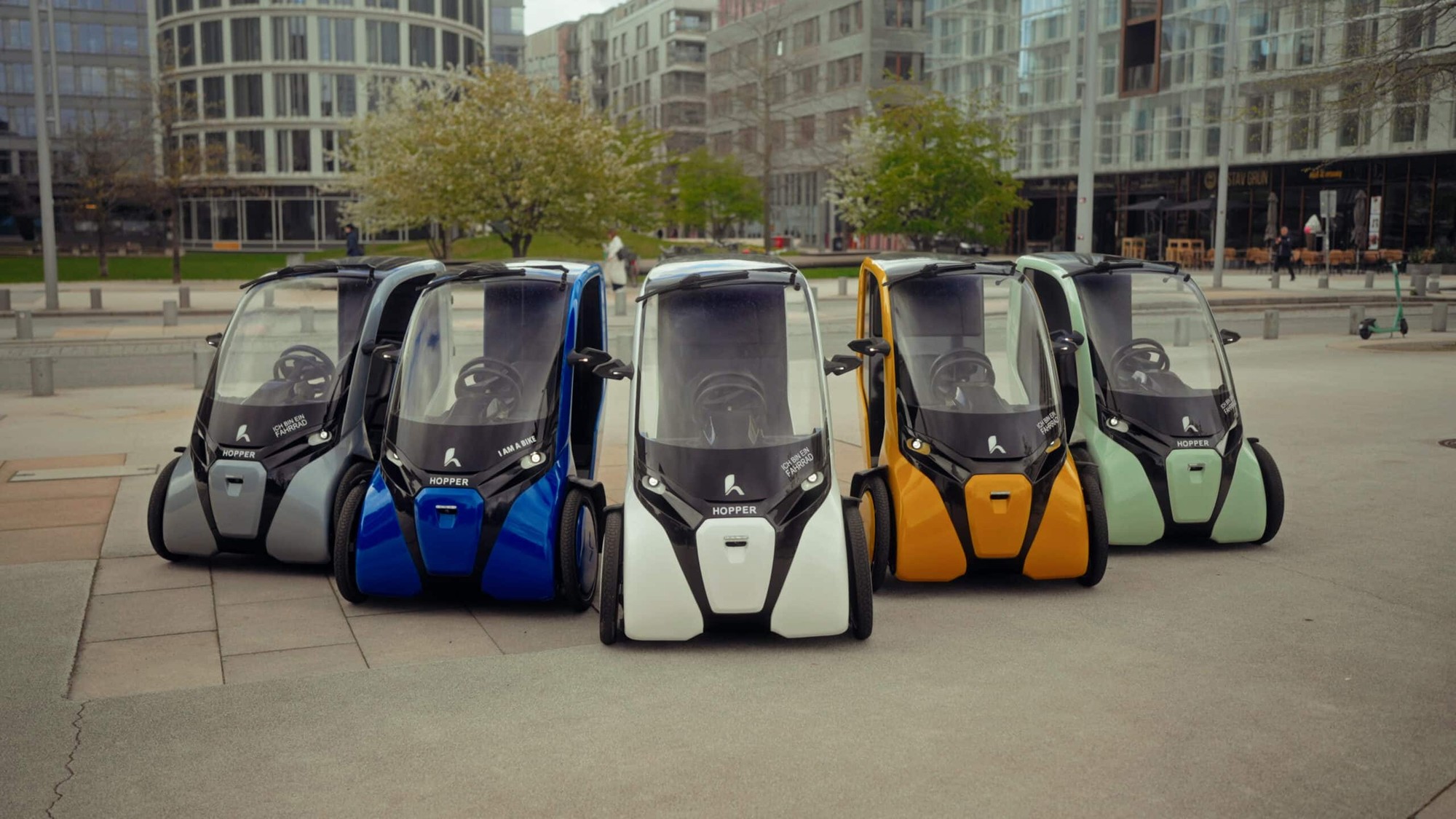
Weather Protection Without Becoming a Car
The rigid roof, windshield, manual wiper, windshield heating, and passive ventilation are standard. The sides stay open by default, and the optional side panels are flexible, zippered covers rather than solid doors. The listed heater warms the windshield, not the cabin. Hopper Mobility also fits a solar roof that trickle-charges the battery, alongside a patented braking system.
That setup keeps rain and wind off a rider far better than bicycle canopies, yet it never turns the HOPPER into a protected car. There is no airbag or crash cell, so the vehicle should be treated as what it is: a weather-protected bicycle.
Clever Engineering, Real Tradeoffs
Pedal-by-wire has a catch
Because nothing mechanically links the pedals to the rear wheel, the HOPPER cannot be pedaled home if the battery runs flat. The cut-out is total: no battery, no assistance, no movement under your own legs. That makes charge planning more important than on a conventional e-bike. The benefit is simpler packaging, fewer wearable parts, and a drivetrain that frees up space for the cabin and cargo area.
Rear-wheel steering rewards a calm rider
The layout delivers that tight turning circle, but it also changes how corners feel. Hopper Mobility recommends 10 to 12 km/h for ordinary corners and about 5 km/h for very tight turns. The cable-operated steering also contains two chains that the company says should be cleaned and lubricated roughly every 1,000 km.
Wider than a bike
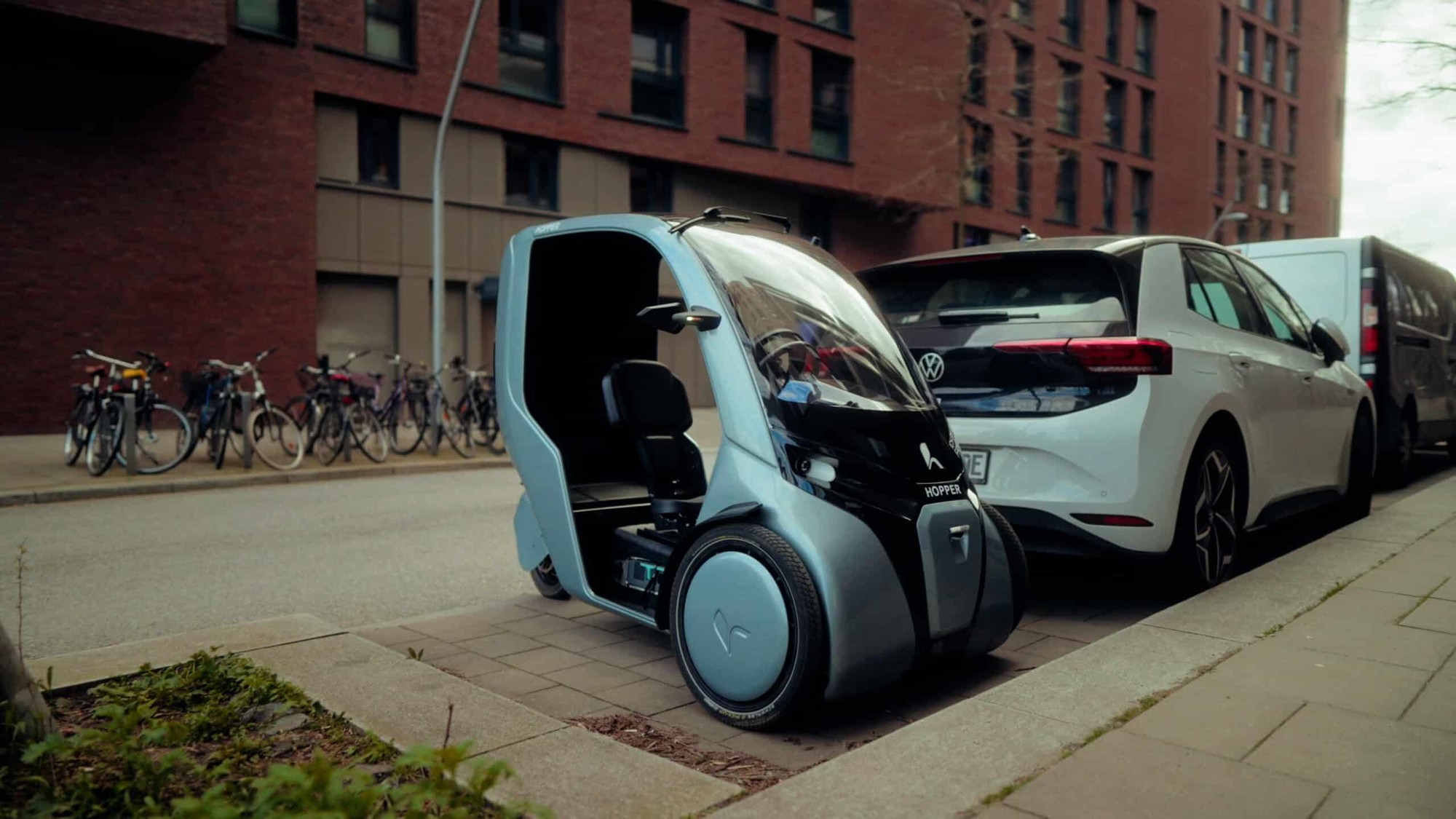
At 105 cm wide, or 115 cm with the mirrors out, the HOPPER occupies far more of a bike lane than a bicycle does, and a September 2026 road test in WELT found it bulky to thread through tight lanes. The width buys stability and cabin space, but it is the clearest sign that this is not simply a bicycle with a roof.
Battery life and upkeep
The battery is quoted at up to 3,000 charge cycles at 80 percent depth of discharge, which works out to roughly eight to ten years of typical use. Routine servicing can be handled by bicycle workshops with enough space, and in Germany the HOPPER can park where bicycles may park, including on sidewalks when at least 1.5 meters remain clear for pedestrians.
How it compares with a cargo bike and a small car
The HOPPER costs more than most electric cargo bikes and considerably less than a new small car, and it splits the difference in behavior. It is slower than a car and far more sheltered than a bike, and it parks where bicycles park. The trade is straightforward: bicycle speeds in exchange for a roof, a seat, and lockable cargo space.
Who the HOPPER Is For
The HOPPER makes the most sense for city trips that are too long to walk, too wet to enjoy on a normal bike, and too short to justify moving a car. The company targets private buyers, families, dog owners, delivery firms, and care services, as well as hotels and resorts that want a small, quiet shuttle.
It makes less sense for highway-speed commuting or for long, fast journeys. Set against the wider trend of micromobility trips replacing car journeys, though, it is a pointed answer to one question: what would get more people out of their cars in the rain?
Availability is the biggest catch. Hopper Mobility currently accepts orders only with German billing and delivery addresses, and routine servicing depends on bicycle workshops with sufficient space, so buyers elsewhere are largely limited to registering interest while the company builds out partners outside Germany.
The Company Behind the Hopper Cargo Bike
Hopper Mobility was founded in Augsburg in 2021, after two years of development, and moved its headquarters to Hamburg in 2024. Series production of the current model began in 2025, and the vehicle is assembled in Hamburg and Schleswig-Holstein using mostly German and European suppliers. The official Hopper Mobility site lists the current range and specifications.
Funding has arrived in stages: a pre-seed round in 2021, a €580,000 crowd round in 2023, and a €1.63 million round in 2024 through the Companisto network, as reported by Startup City Hamburg. A 2025 investment round secured financing through 2027, and the company says 2026 is focused on growing sales and production.
The HOPPER is no longer sold direct only. In 2026 Hopper Mobility began moving the series model into nationwide German retail through a partnership with the Little John Bikes chain, and at least one housing association, in the eastern city of Gera, has started putting HOPPERs into service for residents.
Hopper Cargo Bike FAQ
How much does the Hopper cargo bike cost?
Prices start at €11,900 for the Passenger version, €12,300 for the Cargo version and €12,900 for the Dog version, all including German VAT. The deposit and the options push the real total higher.
Do you need a license or insurance to ride the HOPPER?
In Germany, no. The HOPPER is classified as a pedelec, so it needs no driving license, registration, road tax, or insurance, and it can use cycle paths. Buyers should check local rules, because the classification differs from country to country.
How far can the HOPPER travel on a charge?
Up to 60 km on the standard 1,440 Wh battery, and roughly double that with a second battery, according to Hopper Mobility. Payload, terrain, temperature, and assistance level all affect the real-world figure.
Can two adults ride in a HOPPER?
The Passenger version seats two adults, or one adult and two children, with a separate lockable trunk behind the seat.
Is the HOPPER a replacement for a car?
Not entirely. It replaces short, weather-exposed car trips at bicycle speeds, but it cannot match a car on safety, range, or speed. Think of it as a rainproof upgrade to a cargo bike rather than a car substitute.
The Bottom Line
The Hopper cargo bike is a genuinely different answer to urban transport: part cargo bike, part microcar, and fully legal as a bicycle in its home market. Its tight turning circle, roofed cabin, and lockable cargo space solve real problems, while the pedal-by-wire drivetrain, long lead times, and a Germany-only sales footprint keep it a niche proposition for now. If the company’s growth plans land and sales spread beyond Germany, this is a format worth watching closely.


