
Cannabinol has quietly become one of the most prominent letters in the sleep aisle. Marketed almost exclusively as CBN, it now appears in gummies, tinctures, capsules, and vape pens, usually with a promise of gentler sleep and no prescription fog. Analysts expect CBD and CBN gummies to be the fastest-growing slice of the global gummy market, a category worth roughly $14.2 billion in 2026.
The science is narrower than the marketing. Two controlled trials found that a CBN sleep aid can modestly improve sleep quality, and the larger of the two matched 4 mg of melatonin rather than beating it. In October 2026, a University of Connecticut team published the first study to link repeated CBN exposure to signs of physical dependence in animals.
That finding does not make CBN dangerous for everyone, but it does complicate the idea that a plant-derived gummy is automatically harmless. Here is what CBN is, how it compares with THC, THCA, and CBD, and where the real risks sit.
What Is CBN?
CBN is short for cannabinol, the first phytocannabinoid scientists managed to isolate, back in the 1930s. Unlike THC and CBD, it is not built directly by the plant.
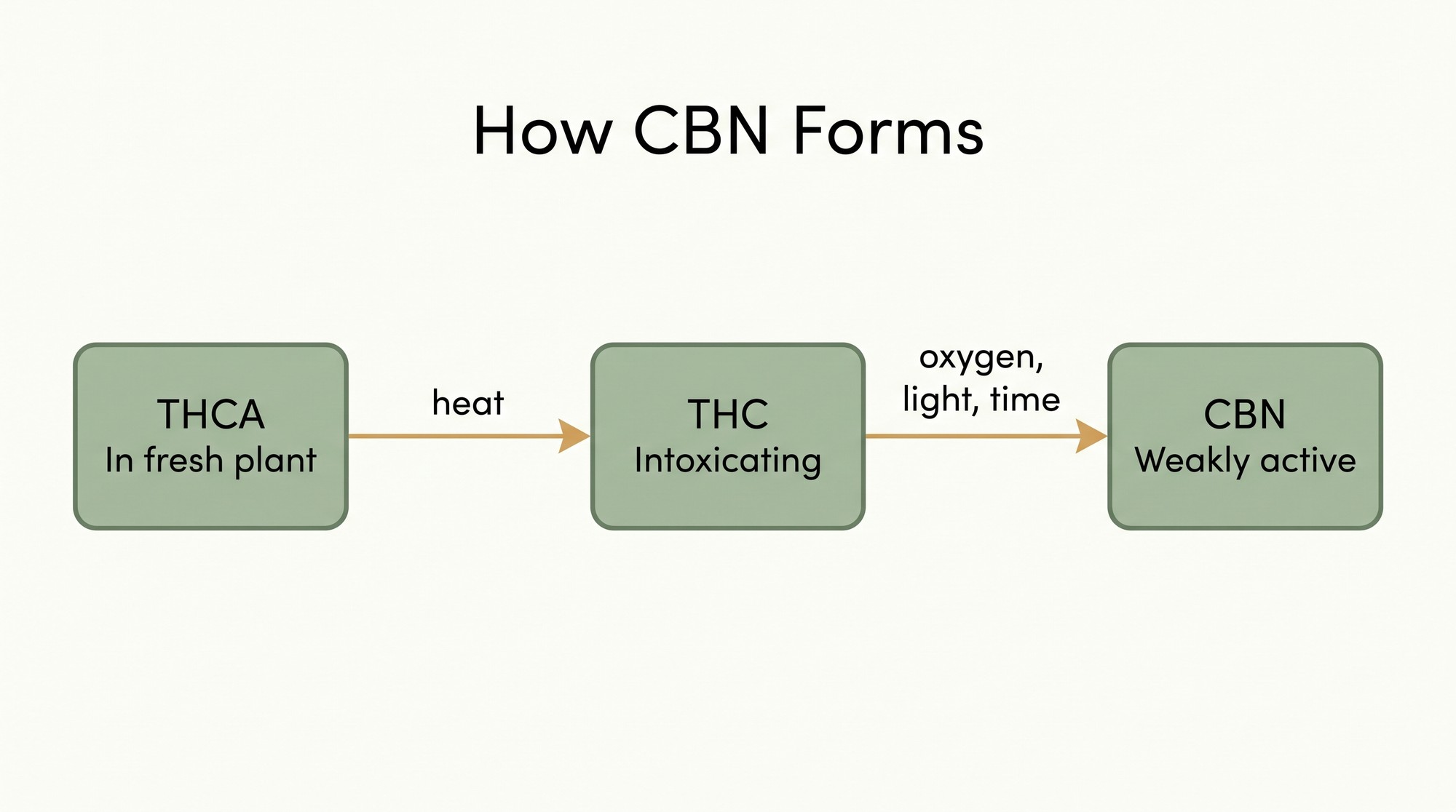
CBN forms when THC breaks down through oxidation, so cannabis stored for years or exposed to heat and light carries more of it. As THC ages, CBN rises, and that chemical backstory is where the compound’s modern reputation begins.
It is often called the sleep cannabinoid, a label that traces back to a small 1970s animal study and decades of repetition rather than to strong clinical data. A 2026 review of cannabinoid research concluded that the evidence for CBN remains too limited to support any clinical recommendation.
At the receptor level, CBN binds CB1 about ten times more weakly than THC, and it binds CB2, an immune-linked receptor, a little more readily. At the doses sold in stores it is not intoxicating; one small study found that a single 50 mg dose produced no more subjective effect than a placebo.
For a fuller comparison of the two best-known cannabinoids, see our guide to the differences between THC and CBD.
How CBN Differs From THC, THCA, CBD, and CBG
Cannabis contains more than a hundred cannabinoids, but a handful do most of the work in the products people buy. The table below compares the ones shoppers meet most often.
| Cannabinoid | Intoxicating? | Where it comes from | Best known for |
|---|---|---|---|
| THC | Yes, strongly | Abundant in cannabis flower | Pain, nausea, appetite, sleep |
| THCA | No, not on its own | Fresh, unheated plant material | Becoming THC once heated |
| CBD | No | Abundant in hemp | Anxiety, seizures, general wellness |
| CBG | No | Young plant tissue | Early research on gut and eye health |
| CBN | Very weakly | Forms as THC degrades | Sleep and inflammation |
THC is the intoxicating one, a partial agonist at CB1 that produces the high and, at higher doses, can flatten REM sleep and blunt dreaming.
THCA is its raw precursor. It is not intoxicating until heat converts it, which is why THCA turns into THC when it is heated and why raw flower and cooked edibles behave so differently.
CBD is non-intoxicating and works mostly indirectly, modulating the endocannabinoid system rather than binding CB1 tightly. CBG remains largely a research compound.
CBN sits at the weak end of that spectrum: gentle at typical doses and derived from THC rather than from the plant’s fresh chemistry.
What the Newest Research Shows About CBN and Sleep
Two threads of research now pull in different directions: human trials that support a modest sleep benefit and newer animal work that raises questions about repeated use.
The 2026 dependence finding
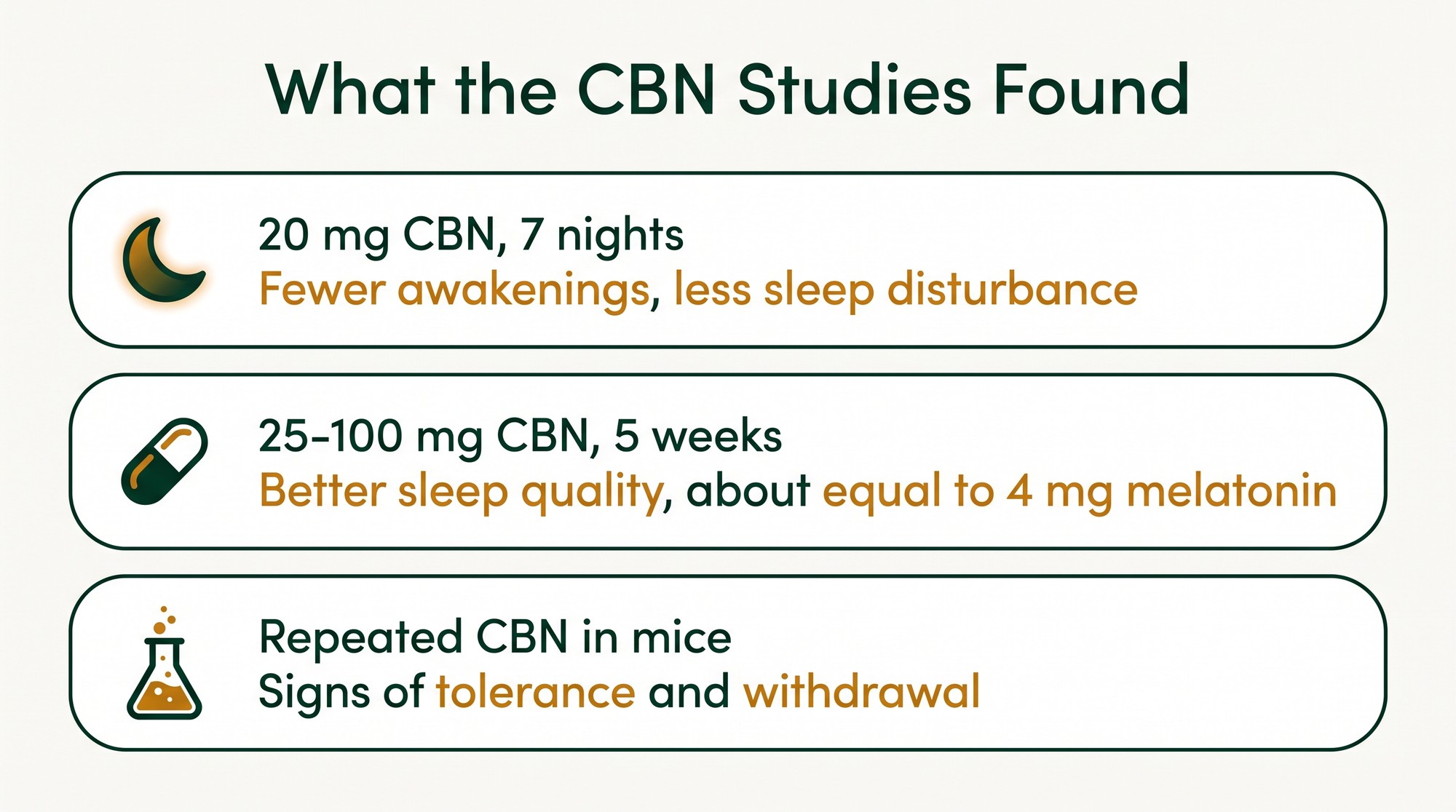
University of Connecticut researchers gave mice CBN twice a day for three days. The animals became tolerant, meaning the drug did less the more they received, and showed withdrawal signs when it stopped, including head twitches and fluttering paws.
In a separate test, mice trained to respond to THC responded the same way to CBN, a sign that the two compounds feel similar to the brain even though CBN is far weaker. The study appears in the November issue of Drug and Alcohol Dependence.
The same work found that CBN eased inflammation at lower, non-intoxicating doses and that it weakened the body’s antibacterial defense in a simulated infection. Lead author Olivia Vanegas pointed to a marketing gap: minor cannabinoids carry heavy therapeutic claims while little is known about their risks over time. Senior researcher Steven Kinsey put the guidance more bluntly: “Until we know more about dosing and long-term effects, the message for consumers is simple: buyer beware.”
The sleep trials: modest but real
The human evidence is small but unusually well designed for the supplement world. A double-blind, placebo-controlled trial of 293 adults found that 20 mg of CBN for seven nights significantly reduced nighttime awakenings and overall sleep disturbance, while the gain in overall sleep quality fell just short of statistical significance.
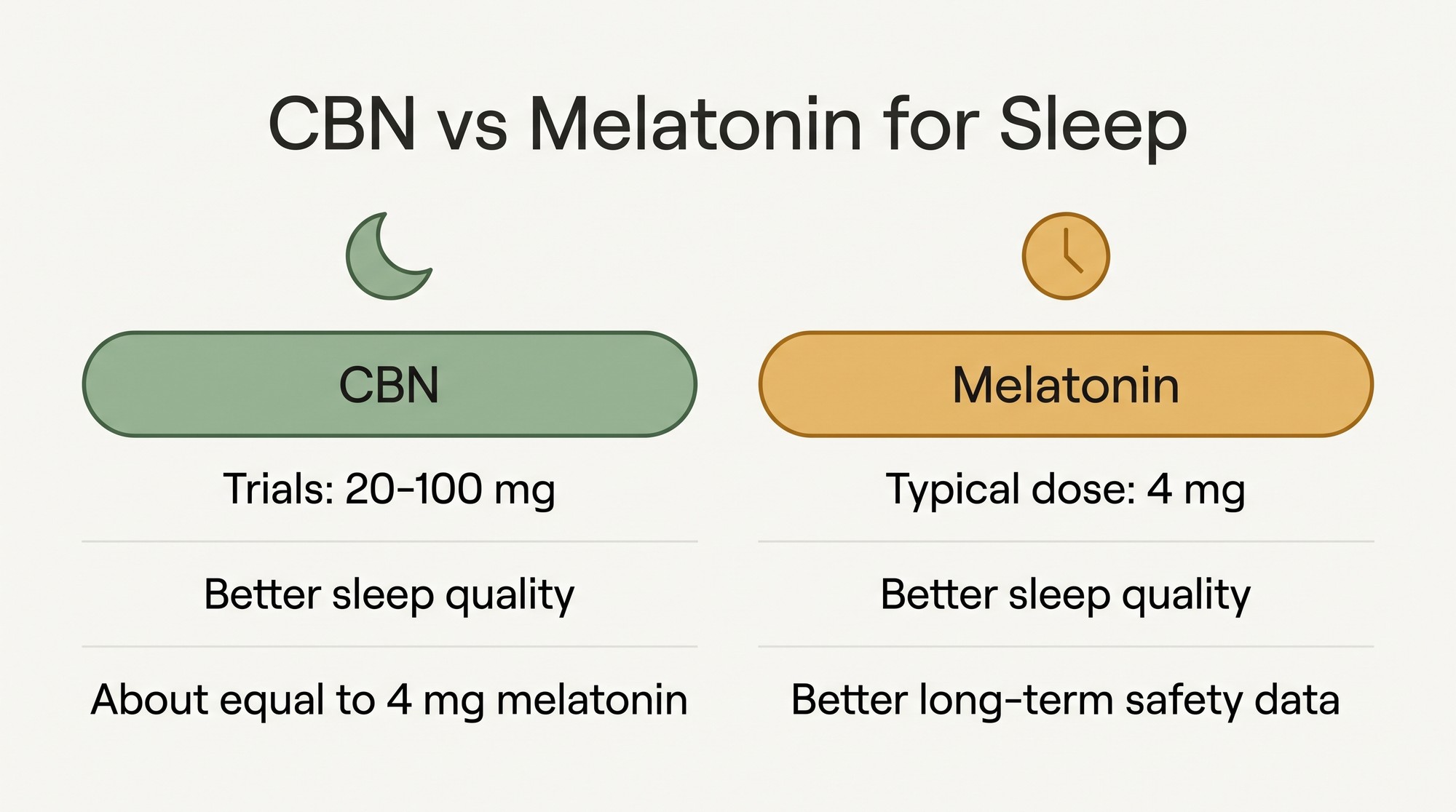
A larger trial of about 1,020 adults ran for five weeks and tested 25, 50, and 100 mg of CBN against both a placebo and 4 mg of melatonin. All three CBN doses improved sleep quality, and none differed meaningfully from melatonin.
The 100 mg group reported a larger drop in stress, and side effects were mild or moderate. A third study of 1,793 people found that CBD, CBN, and melatonin combinations all improved sleep disturbance by similar amounts, with no clear winner.
What did not improve
CBN did not reliably help people fall asleep faster. It did not reduce wake after sleep onset, and it did not reduce daytime fatigue.
The pattern suggests a sleep-maintenance aid rather than a knockout drop. This record was also thin until recently: a 2021 review found too little evidence for sleep claims and noted that most products at the time contained 5 mg or less, far below the doses used in trials.
CBN Benefits: What the Evidence Actually Supports
CBN has one reasonably supported benefit and several speculative ones.
- Sleep quality and maintenance. Two randomized trials found modest improvements in self-reported sleep quality, plus fewer awakenings at the doses tested.
- Inflammation. CB2 binding and laboratory studies of minor cannabinoids point to an anti-inflammatory effect, weaker than CBG or CBC, with no human trials yet.
- Pain and appetite. These claims rest on old or animal studies, without modern controlled trials.
- Bone and nerve health. Early animal findings exist, but nothing close to clinical guidance.
None of this makes CBN a treatment for insomnia. It makes it a mild, sedative-adjacent compound with a thin but growing evidence base. For comparison, see our overview of recent CBD research and our guide on CBD for sleep.
CBN Side Effects and Risks
Physical dependence is the risk that matters most here, and it is the newest one on the record.
Whether that happens in people at store-bought doses is unknown, and the researchers were careful to say so. The finding still matters because sleep aids are used nightly, sometimes for years, and that is exactly the pattern in which dependence grows.
Other reported effects are milder. WebMD lists altered taste, headache, and sleepiness and rates CBN as possibly safe only up to about 20 mg per day for up to seven days, with larger or longer use unstudied.
Because cannabis products are not held to drug-grade quality standards, the dose on a label may not match the dose in the bottle, and some products contain THC that is not clearly disclosed. Several common claims about CBD and minor-cannabinoid gummies deserve the same scrutiny.
Who should not take CBN
| Group | Why to be cautious |
|---|---|
| Pregnant or breastfeeding people | No reliable safety data exists, and standard guidance is to avoid use. |
| People on sedatives, opioids, or alcohol | Additive drowsiness and impaired coordination are plausible. |
| Anyone taking liver-metabolized medications | CBN interacts with CYP1A1, CYP2C9, and CYP3A4 pathways, which can change drug levels. |
| Workers subject to drug testing | Some immunoassays cross-react with CBN, and trace THC can accumulate. |
| People with weakened immune systems | Animal data showed a reduced antibacterial response. |
| Children and anyone under 21 | No safety data, and the endocannabinoid system is still developing. |
CBN and drug interactions
CBN is broken down by cytochrome P450 enzymes, the same family that clears a large share of prescription drugs. That creates two-way risk: medications can slow CBN’s clearance, and CBN can alter how quickly other drugs are cleared.
The clinical significance is unstudied, but the interaction is real enough that WebMD flags it as a moderate concern. If you take a medication that warns against grapefruit, CBN deserves similar caution.
CBN Sleep Aid Dosage and What Labels Do Not Tell You
There is no official CBN dose for sleep. The trials used 20 mg in one study and 25, 50, or 100 mg in another, while product makers tend to suggest starting around 2.5 to 20 mg taken 30 to 90 minutes before bed.
- Start at the low end and give it five to seven nights before adjusting, since the trials measured effects over days rather than hours.
- Treat a higher dose as an open question rather than an upgrade, because the evidence for a clear dose-response curve is weak.
- Look for a certificate of analysis that reports cannabinoid content and confirms whether THC is detectable.
For a sense of how dosing works across the wider category, see our guide to how many CBD gummies to take.
Will CBN Show Up on a Drug Test?
Possibly, depending on the test and the product. Standard urine screens use immunoassays built to detect THC-COOH, the metabolite the body makes from THC, and those antibodies are not perfectly selective.
Laboratory work shows that CBN can trigger a signal on these assays, though it takes roughly five times more CBN than THC metabolite to reach a cutoff on one common platform and about twenty times more on another. CBN also adds to the signal from any THC metabolite already present, so trace THC plus a large CBN dose is the riskiest combination.
Isolated, THC-free CBN is unlikely to cause a problem at typical doses, but buyers have no easy way to verify what is inside a gummy. If your job or sport involves testing, treat CBN products like full-spectrum CBD.
Do CBD and CBN Work Better Together?
The pairing is the most common format on shelves, usually on the theory that one quiets the mind while the other quiets the body. The direct test of that idea was disappointing.
In the 293-person trial, adding 10, 20, or 100 mg of CBD to 20 mg of CBN did not outperform CBN alone. The 1,793-person trial found CBD plus CBN no better than CBD by itself or melatonin. That does not rule out individual benefit, but the controlled data does not support a synergy claim yet.
Frequently Asked Questions
Will CBN help with sleep?
For some people, modestly. The trials show small gains in sleep quality and fewer awakenings. If your problem is falling asleep rather than staying asleep, the evidence is weaker.
Is CBN addictive?
Human trials have not shown a withdrawal syndrome. The animal findings make dependence possible in principle, so months of nightly use amount to an unstudied experiment.
How much CBN should I take for sleep?
There is no standard dose, and the trials used far more than most gummies contain, between 20 and 100 mg. A cautious start is 5 to 10 mg, 30 to 60 minutes before bed, held steady for about a week.
Is CBN legal?
Hemp-derived CBN is not federally controlled under the 2018 Farm Bill, provided the product stays under 0.3% delta-9 THC. CBN from cannabis remains a Schedule I substance. The FDA has not approved CBN for any use, and some states restrict intoxicating hemp products.
Does CBN get you high?
Not at store-bought doses. It binds CB1 about ten times more weakly than THC. Historical research found THC-like effects only at doses orders of magnitude higher than commercial products contain.
The Bottom Line
CBN is a real compound with a real, if modest, sleep signal. The two best human trials show small gains in sleep quality and fewer awakenings, and nothing close to a cure for insomnia. Its edge is gentleness; its weakness is the thinness of the evidence.
The 2026 mouse study is a reminder that natural and harmless are not synonyms. If you want to try a CBN sleep aid, start low, check the label for THC, keep your clinician informed, and judge how you feel after a week. If you want a sleep aid with decades of safety data and a similar effect size, melatonin remains the better-studied choice. For gentler options, see our roundup of herbs for a good night’s sleep.
This article is for general information only and is not medical advice. Talk to a qualified healthcare professional before using CBN or any cannabinoid product, especially if you take medication, are pregnant or breastfeeding, or are managing a health condition.


