
In August 2026, Tesla quietly stopped selling its Solar Roof. The product page now redirects to ordinary solar panels. There was no press release, no farewell blog post, just a decade-long experiment that Reuters confirmed had been shut down. Industry estimates put the total at roughly 3,000 US installations in seven years. Tesla had once targeted 1,000 installs per week and had claimed its tiles would be cheaper than a regular roof with solar panels. It missed the volume target by more than 95 percent.
So it is fair to ask why more roofs are not made of solar tiles. The honest answer has four parts, and none of them is “the technology is bad.” It is physics, trades, money, and policy.
Two of those four just changed, which is why the question looks different in 2026 than it did even two years ago. This guide works through all four, examines how the market for solar roof tiles, solar shingles, and building-integrated photovoltaics (BIPV) is developing across the United States, Europe, Asia, and Australia, and sets out the specific situations where the math genuinely works.
What Solar Roof Tiles Are, and Who Still Makes Them
Almost all rooftop solar today is what the industry calls BAPV: building-applied photovoltaics. The panels sit on top of an existing roof, held up by racking, wired together, and covered by a separate warranty from the roof itself.
Solar roof tiles invert that relationship. The tile or shingle is the roof covering, with photovoltaic cells laminated inside a component sized and shaped like the roofing material it replaces.
That single design decision explains most of the category’s advantages and nearly all of its problems, and it places solar tiles inside a wider move toward sustainable roofing solutions. Beautiful rooflines, no racking, no penetrations, and no “those panels look ugly” conversation with a spouse or a historic district board. The other benefits of solar roofs are less visible but real, from a cooler roof deck to one integrated system instead of two. Also: a product that must simultaneously satisfy roofing codes, electrical codes, structural loads, fire ratings, and waterproofing, in sizes that vary from roof to roof. Integration does not stop at tiles, either: the same logic produces solar facades, solar glazing, and flexible solar panels that adhere to any rooftop, all chasing the same goal of generation that disappears into the building.
The category is not empty. It is simply smaller and more specialized than the panels-plus-racking business.
The main systems sold in 2026 are GAF Energy’s Timberline Solar, CertainTeed’s Apollo II and Solstice shingles, LUMA Solar’s shingle, and the remaining Tesla roofs already on homes. GAF’s ES 2 energy shingle is the only solar shingle approved by Miami-Dade County, the toughest wind code in the United States, and it is assembled in Georgetown, Texas. In Europe, Switzerland’s Freesuns makes clay and slate tiles for heritage buildings and is weighing a move into the US market.
| System | Installed cost per sq ft | Power per unit | Active share of roof | Warranty |
|---|---|---|---|---|
| GAF Timberline Solar ES 2 | $21 to $24 | 57 W per energy shingle | 40 to 60% | 25 years product, 25 years power |
| Tesla Solar Roof V3.5 | $23 to $30 | 71.67 W per glass tile | 30 to 60% | 25 years product, 25 years power |
| CertainTeed Apollo II | $22 to $26 | 63 W per module | 30 to 50% | 25 years product, 25 years power |
Cost and power figures reflect 2026 installed pricing and manufacturer data sheets. GAF’s published specification for the ES 2 lists 57 watts per shingle, a 23 percent improvement over the 46-watt first generation, with about 30 energy shingles covering one roofing square, or roughly 1.7 kW per square. All three systems carry 25-year product and power coverage, although GAF’s product warranty is narrower and limited to leak-causing defects.
Why They Generate Less: Physics, Heat, and Roof Geometry
This is the first structural reason the category stays small, and it has nothing to do with engineering quality. A solar tile roof cannot use the whole roof.
Only the pitches that face the right direction, at the right angle, without shade, can generate power. In practice, only 30 to 60 percent of a typical roof is active.
Then there is the tile itself. Solar shingles top out at around 16 watts per square foot of active area, while a modern rack-mounted panel exceeds 20 watts per square foot and runs above 22 percent efficiency. The best solar shingle on the market, LUMA’s 100-watt unit, reaches 22.1 percent, but it carries a five-year product warranty, which tells you something about how hard the form factor is to guarantee.
Multiply the two effects, and the numbers get sobering. A Tesla Solar Roof produces roughly 7 to 9 watts per square foot of total roof area once inactive tiles are counted.
A rack-mounted array on the same roof can produce several times that in the usable zones, because panels can be placed only where the sun is good and left off the rest.
Heat compounds it. Panels sit a few inches above the roof deck, and air flows underneath, which keeps operating temperatures down. Tiles sit flat against the deck.
Less airflow means more heat, and heat costs solar output. Color matters too: dark tiles absorb better, so the terracotta and slate finishes that make the product attractive in the first place are the least efficient versions of it.
Why They Are Hard to Install and Harder to Repair
A conventional solar job has a clear division of labor. The roof already exists, so a solar crew mounts racking, bolts on panels, and an electrician makes the final connection.
A solar tile roof needs a roofer to tear off and rebuild the roof, a solar installer to lay out the array, and an electrician to commission it. Three trades, one schedule, more permits, and a much longer sales cycle.
The economics for the roofer are the sharpest part of the problem. Roofing is a volume business, and a solar tile quote can take many times longer to design and sell than a straightforward re-roof. Industry trainer Kate Collardson has described the practical consequence bluntly: a roofer looking at a solar tile job sees the dozens of ordinary roofing jobs they could have sold in the same time.
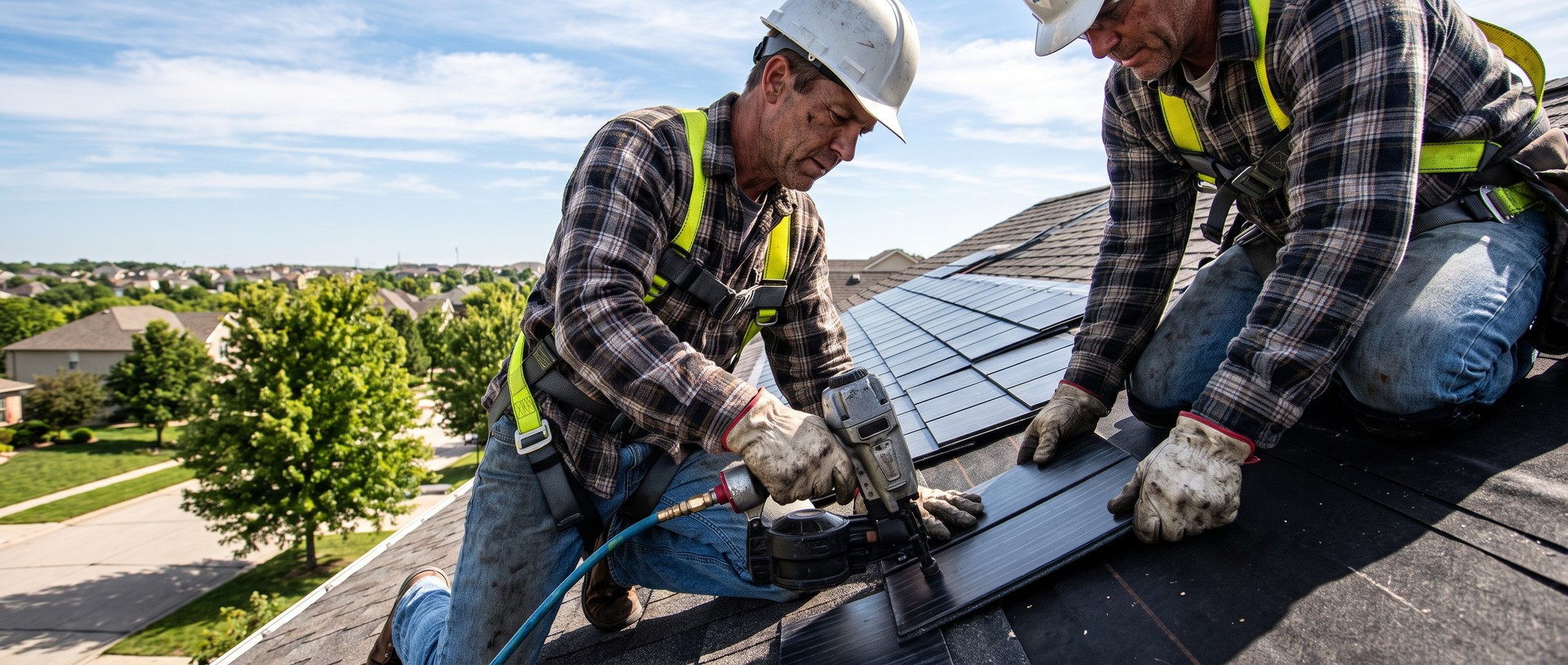
Repair is the second half of the trade problem, and it is worse than it first appears. A conventional array has electronics on each panel and a monitoring map that shows exactly how much every panel is producing, so a failure is easy to locate. A solar shingle array has no room for that per-shingle electronics, so faults get found with thermal cameras.
Then comes access: to reach a failed shingle in the middle of the array, a technician has to walk across the working shingles, and walking on them risks micro-fractures that create problems years later. That combination is why repair bills on solar shingle roofs run higher than on panel systems and why some installers simply will not service them.
Warranty structure adds friction. GAF’s shingle warranty covers the shingles, but the inverter and power electronics are only covered if the homeowner buys a paid add-on.
A roof and a solar system sold as one product can still end up with two warranty contacts, two failure modes and two sets of fine print. Some national insurers also apply a premium of 5 to 15 percent to Tesla Solar Roof installations because the replacement cost is higher, though GAF and CertainTeed systems generally insure at standard asphalt rates.
What They Cost: $2.50 a Watt Versus $6 to $8.50
Here is the number that decides most purchases.
Standard rack-mounted solar has fallen to a record low of about $2.49 to $2.50 per watt installed in the United States, working out to roughly $2.80 to $3.50 per watt after typical system design and electrical costs. Solar shingles run about $6.00 to $8.50 per effective watt. Depending on the system and the roof, integrated solar costs roughly 60 to 190 percent more than conventional solar for the same power output.
Put on one house, the gap becomes concrete. For a 2,500-square-foot roof, a solar shingle system costs between $52,500 and $62,500 to install. A conventional asphalt re-roof plus an 8 kW panel array on the same house comes in near $31,000.
The premium is therefore somewhere between $21,500 and $31,500, spent on aesthetics, roof integration, and a single warranty relationship rather than on kilowatt-hours.
Payback follows from that. Because the premium is real and there is no federal residential credit to offset it, a solar tile roof typically takes 18 to 35 years to pay for itself in the United States, against roughly 10 to 17 years for conventional panels.
The spread depends almost entirely on what electricity costs where you live, because the roof itself performs about the same everywhere.
The pattern is unmistakable. Solar tiles make the most sense where grid electricity is expensive and the sun is strong: coastal California, the Northeast, and islands with high rates. They make the least sense in cheap-power, high-heat markets, where a 30-year payback is longer than the warranty on the components doing the generating.
The Subsidy That Vanished, and What Replaced It
This is the part most guides have not caught up with. The 30 percent federal Residential Clean Energy Credit, the tax code’s Section 25D, no longer applies to solar installed in the United States.
The One Big Beautiful Bill Act, signed on July 4, 2025, terminated the credit for any expenditure made after December 31, 2025, and the IRS treats the expenditure as made when installation is completed. A solar roof finished in January 2026 gets nothing, even if it was paid for in 2025. A Congressional Research Service analysis confirms the timing rules in detail.
The credit never covered the whole roof anyway. Solar tiles and shingles that generate electricity qualified, but decking, rafters, and purely structural components did not. Anyone who still presents you with a 2026 quote in which a 30 percent federal credit has been subtracted to reach a net price should be treated with caution.
What remains is a patchwork. State and utility programs still exist, and the DSIRE database maintained by NC State is the canonical place to check what applies to a specific address.
New York’s NY-Sun program offers rebates of $0.20 to $0.40 per watt depending on utility territory. Massachusetts’s SMART program pays production incentives for ten years. California still has net metering, but the NEM 3.0 structure introduced in 2023 pays much less for exported power, which pushed California payback periods out by years. Texas has no statewide rebate, though Austin Energy and CPS Energy offer local ones.
The deeper shift is psychological. Solar tiles were designed for buyers who cared most about how a roof looks, and they are now being sold to buyers who care most about what it saves. When appearance stops being the deciding factor, a premium of $21,500 or more becomes very hard to justify.
How the Rest of the World Compares
The United States is not the whole market, and in some ways it is the least important one. The single biggest difference in the global picture is regulation, and Europe has just changed the rules in a way that could matter more than any consumer preference.
One number frames the whole discussion. Rooftop solar is still rare even in its most familiar and cheapest form: about 5.55 percent of US single-family roofs carry panels, and that national average hides enormous variation, from roughly one roof in four in California to under 3 percent in several states. Solar tiles are a rounding error inside that number.
Europe’s mandate is an attempt to bypass that slow consumer adoption curve entirely by making solar a design requirement rather than a purchase decision.
Under Article 10 of the revised Energy Performance of Buildings Directive, all new buildings in the European Union must be designed to optimize solar energy generation, a requirement that applies to permit applications filed after May 29, 2026, so that solar can be added later without structural changes. Deployment obligations phase in quickly: new public and non-residential buildings above 250 square meters by the end of 2026, existing ones of the same size by 2027, and all new residential buildings by the end of 2029. The EU is targeting at least 700 GW of installed solar by 2030, up from 406 GW in 2025.

That matters because mandated solar tends to be built in, not bolted on. When a new building has to be solar-ready from the design stage, the marginal cost of integrating generation into the roof or facade falls sharply, because no separate trades, no separate permits, and no structural retrofit are needed. This is the environment where BIPV has always made its strongest case, and it is not a coincidence that the global BIPV market is projected to grow from about $13.45 billion in 2025 to $47.02 billion by 2031.
Different countries are arriving at the same technology for different reasons. In Switzerland, Freesuns sells clay and slate tiles in heritage districts where conventional panels would fail planning review and reports steady growth since 2019 along with interest in the US market. In Germany, researchers at the Fraunhofer Institute for Solar Energy Systems argue the comparison itself is wrong-headed, proposing that solar roof tiles be judged as free electricity from a roof that would have been built anyway rather than head to head against the cheapest possible panel.
In the United Kingdom, affordability dominates. Ben Graves, co-founder of the UK solar company Sunsave, has said most people there simply do not have enough money to pay for it, and his company does not offer the product at all.
In China, manufacturing scale is the differentiator, with BIPV factories advertising gigawatt-level annual capacity and curved photovoltaic roof tiles appearing on large public buildings.
Australia, India, Canada, Ireland, South Africa, and New Zealand all show steady search interest in solar roof tiles, and the pattern is consistent: the product sells where roofs are expensive, electricity is expensive, or regulators insist on appearance. Where all three are absent, panels win.
When Solar Roof Tiles Actually Make Sense
None of this makes solar tile roofs irrational. It makes them narrower than the marketing implies. On the evidence, a solar tile roof is worth pricing seriously in these situations:
- You need a new roof anyway. If the roof has three years or less of life left, the solar tile decision and the roofing decision collapse into one project, and most of the premium is already committed. If the roof has five or more years left, conventional panels mounted on it are dramatically cheaper per watt, and the sensible move is to install panels now and revisit tiles at the next re-roof.
- Electricity where you live is expensive. Payback swings from roughly 12 years to more than 30 depending on local rates, so the same roof is a sound investment in one market and a poor one in another.
- Design rules constrain you. Historic districts, conservation areas, and homeowners associations with strict architectural standards are the single most defensible use case. Solar tiles often clear reviews that reject rack-mounted panels outright, and in some jurisdictions they are the only approved option.
- You are building or rebuilding rather than retrofitting. Integration costs less when the array and the roof are designed together rather than sequenced around each other.
- You value the warranty structure. Some buyers prefer one company and one warranty covering the whole roof rather than separate roofing and solar contracts. That is a legitimate benefit, though it should be verified rather than assumed, because inverter coverage often sits outside the base warranty.
The inverse list is shorter but firmer. Heavily shaded roofs, complex roofs with many dormers, hips, and valleys, low-pitch roofs that cannot shed water properly, and any house where the owner is optimizing purely for financial return should choose conventional panels.
There is a resale argument as well. Residential solar tends to increase a home’s value, and Zillow research puts the average premium at about 4.1 percent. That is real money, but it does not close a cost gap of $21,500 or more.
What Could Change the Math Next
Three developments could move solar roof tiles out of the premium niche, and one of them is already in production.
- Matrix shingling. Instead of wiring cells with visible metal ribbons in a fixed grid, cells are cut into narrow strips, overlapped like roof shingles, and joined with electrically conductive adhesive. Current can flow around shaded spots instead of stopping at them, the silver ribbons disappear from view, and unusual roof shapes can be filled more easily because the pattern size is no longer fixed. Freesuns is using the technique commercially, and it addresses shading and aesthetics at the same time.
- Automated design software. Every roof is subtly different, and today that difference is paid for in engineering hours. Software that produces an array layout automatically would cut the design cost that currently sits inside every quote, and it is the difference between a product that needs specialists and one a roofer can quote in an afternoon.
- Manufacturing scale. Solar tiles are still made in small batches, which limits both standardization and cost. The nailable shingle format is the most promising route to scale because it lets ordinary roofing crews and ordinary roofing supply chains do the work, and GAF’s decision to centralize production in Texas points in that direction.
A fourth factor is less technical. If the EU mandate does for integrated solar what building codes did for insulation, the volume will come from new construction rather than from homeowners comparing quotes. Once the category has that volume, the premium narrows for everyone else.
Frequently Asked Questions
Are solar roof tiles worth it?
For most homeowners optimizing for cost, no. With the US federal residential credit gone, a solar tile roof typically pays back in 18 to 35 years against roughly 10 to 17 years for conventional panels. They become financially defensible when the roof is being replaced anyway, when electricity rates are high, or when design rules leave no other option.
How much does a solar tile roof cost?
Between $21 and $30 per square foot installed in the United States in 2026, depending on the brand and the complexity of the roof. For a 2,500-square-foot roof that is roughly $52,500 to $62,500, which is about 1.7 to 2 times the cost of a conventional re-roof combined with rack-mounted solar panels of similar output.
Do solar roof tiles actually exist, or are they a concept?
They exist and are being installed today. GAF Energy’s Timberline Solar ES 2, CertainTeed’s Apollo II and Solstice, and LUMA Solar’s shingles are all in production, and the European manufacturer Freesuns supplies clay and slate tiles for heritage buildings. What the category lacks is scale, not product.
What happened to solar roof tiles?
Tesla, the most visible manufacturer, stopped selling its Solar Roof in August 2026 after roughly 3,000 US installations and a settlement over sudden price increases. The category itself continues: GAF, CertainTeed, and LUMA all sell solar shingles today, and European demand is being reinforced by solar mandates on new buildings.
Can solar roof tiles be installed on an existing roof?
Technically yes, but the economics rarely work unless the roof needs replacing. Installing tiles means removing the existing roof covering, so the sensible approach is to combine the two projects. Anyone with several years of roof life left is usually better served by conventional panels, with solar tiles considered at the next re-roof.
The Bottom Line
Solar roof tiles are rare for four compounding reasons: they can only generate on part of the roof, they are slower and more expensive to install and repair, they cost two to three times as much per watt as panels, and the policy environment that might have subsidized them has moved in the opposite direction in the United States. Tesla’s exit was the visible symptom, not the cause.
But the category is not dying. It is being re-founded on two more durable foundations: nailable shingles that roofing crews can install at scale and European rules that make built-in solar a design requirement rather than a luxury. The likely future of solar roof tiles is not the retrofit market that Tesla pursued. It is the new-build and heritage market, where the tiles are not competing against cheap panels at all, and where a roof that generates its own electricity stops being a premium product and starts being the default one.


