
3D creation is becoming more accessible as browser-based AI tools reduce the need for expensive hardware and advanced modeling skills at the beginning of a project. Designers, educators, students, makers, and small creative teams can move from a description or reference image to a draft model, then decide whether the idea deserves further development.
Accessibility does not mean that every output is finished or technically correct. It means more people can participate in early experimentation. Professional knowledge remains important when a model must be accurate, animated, manufactured, printed, or delivered in a demanding real-time environment.
Product Design and Concept Development
Product teams can use AI-assisted 3D to compare shapes, proportions, handles, decorative features, and presentation ideas before committing to detailed CAD or physical prototypes. A draft model helps people discuss a concept in three dimensions and identify questions that may be difficult to see in a sketch.
The distinction between visualization and engineering must remain clear. Generated geometry should not be treated as a manufacturing specification. Dimensions, tolerances, materials, safety, and mechanical behavior require proper design and engineering validation.
Education and Visual Learning
Teachers and students can use simple 3D models to explore historical objects, scientific structures, design principles, and storytelling. A class might rotate an object on screen, place it in an AR activity, or create a model that supports a presentation. The process can make abstract ideas more tangible and encourage students to think about shape, scale, and spatial relationships.
Schools still need to consider privacy, age requirements, copyright, and the terms of each service. Educators should also explain that AI output can be inaccurate. Reviewing and correcting a model can itself become part of the lesson.
Creative Work and Personalized Objects
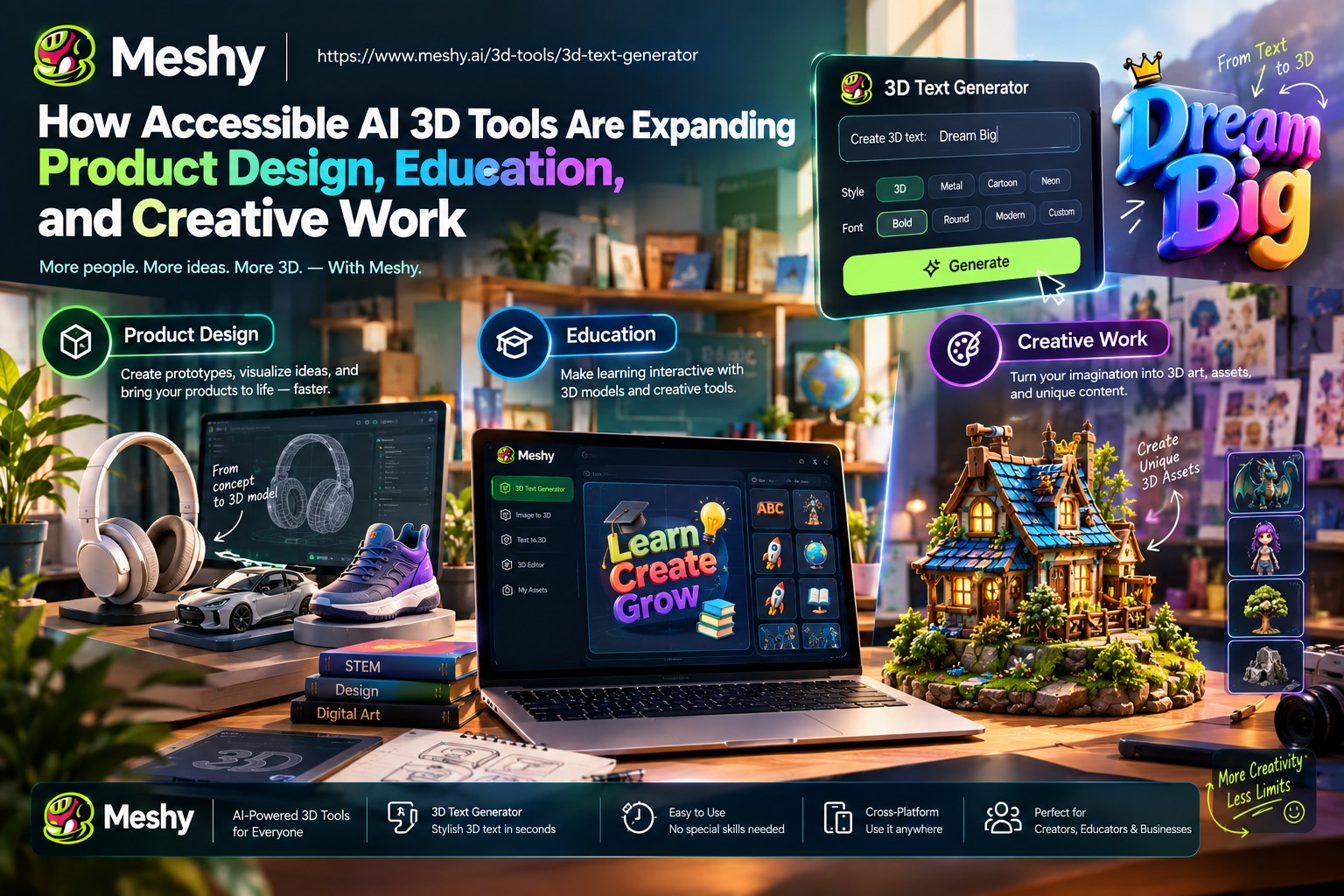
Artists and makers can use generated 3D drafts for collectibles, stage concepts, game prototypes, visual effects, and printable objects. A 3D text generator can turn words into dimensional lettering for signs, nameplates, displays, or personal projects without requiring the user to model every letter manually.
Before printing, the model needs practical checks: wall thickness, unsupported areas, watertight geometry, scale, and the capabilities of the selected printer. Before publishing or selling, the creator should also confirm commercial rights and avoid unauthorized logos, characters, or designs.
Why Browser-Based Tools Matter
When generation runs in the cloud, users can experiment from a modest laptop instead of maintaining a specialized workstation. This can widen participation in classrooms, community workshops, startups, and remote teams. A browser interface also reduces installation and setup barriers for occasional users.
Cloud processing is not automatically free or unlimited. Services may charge by subscription or generation credit, and large files still take time to upload and download. Users should compare cost, retention policies, export formats, and the amount of cleanup required.
Balancing Ease of Use with Quality
An accessible interface may produce an attractive result quickly, but quality should be evaluated in the context of the project. Important factors include geometry, surface detail, texture consistency, editability, scale, and compatibility with the next application.
A beginner may value a guided workflow and fast preview. A professional may prioritize topology control and predictable export. Neither set of priorities is wrong; the key is choosing a tool that matches the real objective rather than assuming the fastest result is the best one.

More People Can Participate in 3D
The biggest change is not simply faster modeling. It is that more people can communicate an idea in three dimensions before they have mastered a complex software package. That can support collaboration between designers and clients, teachers and students, or entrepreneurs and manufacturing specialists.
AI 3D tools are most valuable when they invite participation without hiding their limitations. Used with clear expectations and appropriate expert review, they can make product exploration, visual learning, and creative experimentation more approachable while preserving the care required for final production.


