
Conventional solar parks face a basic geometric tension: panels tilted toward the midday sun capture high annual kilowatt-hours, but their low, slanted racks cover wide strips of soil and send power onto the grid at noon when electricity prices frequently fall. Farmers and grid engineers are bypassing both constraints with solar fences, which stand double-sided photovoltaic modules completely upright in wide north-south rows. By catching low-angle sunlight at dawn and dusk while leaving open lanes for tractors and crops, vertical solar arrays turn the physical footprint of a fence into a utility-grade power generator.
What a Solar Fence Actually Is
Because the phrase shows up in three very different hardware catalogs, it helps to separate the engineering definitions first. In power-grid and agricultural systems, a solar fence is a vertical row of glass-on-glass photovoltaic modules mounted perpendicular to the ground at a 90-degree angle to feed electricity into a local load or the utility grid. That architecture differs entirely from a solar-powered electric livestock fence, which uses a tiny battery-charging panel to pulse high-voltage shock wires, and from DIY fence-mounted panels bolted to a backyard wooden boundary.
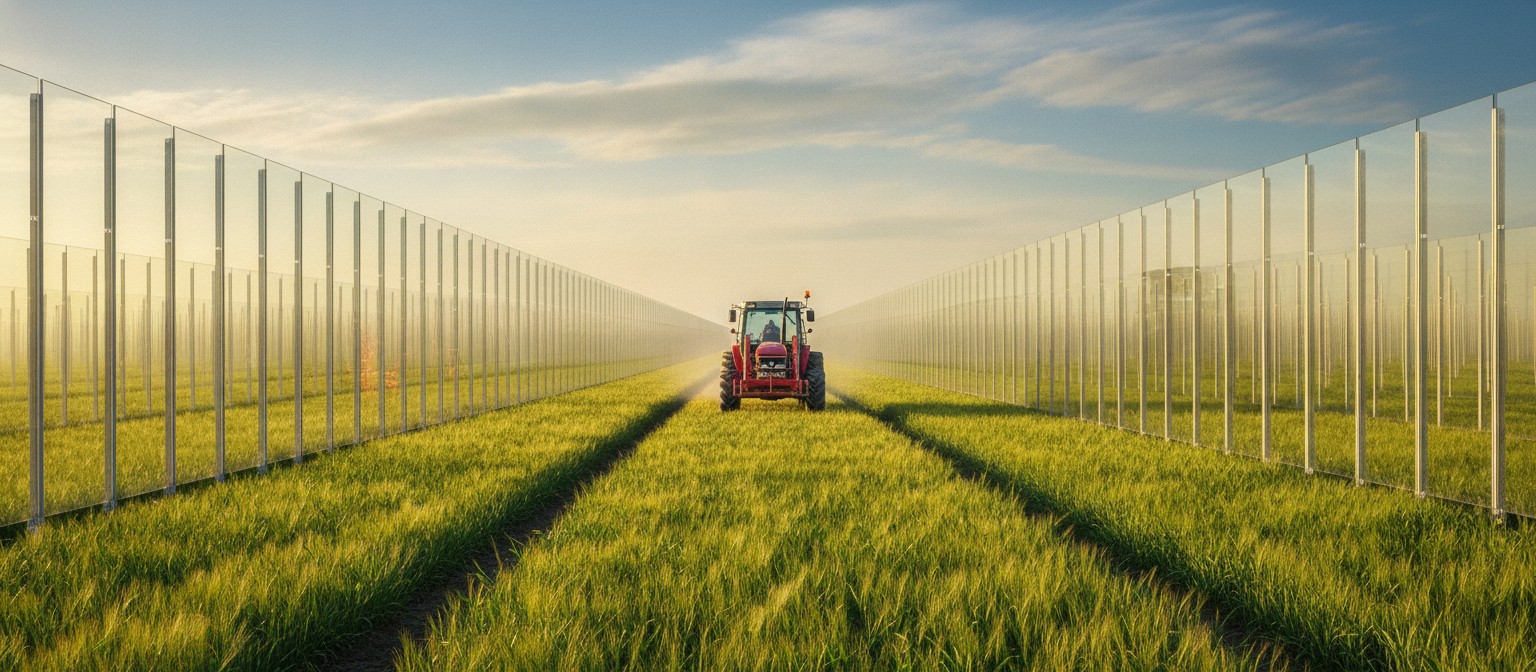
In a field installation, engineers drive steel posts along a strict north-south axis so that one glass face of the module points directly east and the opposite face points directly west. At the Colorado State University Agricultural Research, Development and Education Center South (ARDEC-S) test site in Fort Collins, for example, installers spaced north-south rows 10.7 meters apart using modules measuring 1,001 millimeters by 2,031 millimeters with a 0.6-meter ground clearance underneath. Across European and North American farms, row spacing typically spans 8 to 14 meters, leaving open alleys wide enough for standard seeding, spraying, and harvesting machinery while understanding how agrivoltaics works across different crop layouts.
| Type | Orientation | Generation pattern | Land use | Best use |
|---|---|---|---|---|
| Solar fence (vertical bifacial) | Upright, north-south line, faces east and west | Twin peaks morning and evening, stronger winter and low-sun | Rows 8-14 m apart, about 10% footprint, 90% farmable | Wheat, forage, grazing alleys, boundary fences |
| Tilted south field array | Tilted south | Midday peak, higher annual kWh | Denser, tractor gaps limited | Max kWh where land is spare |
| Solar-powered electric fence | Energizer and wire, not PV modules | No generation, tiny consumption | Single wire line | Livestock containment only |
How Upright Double-Sided Panels Make Power
A vertical wall of single-sided solar cells would waste half the day waiting for the sun to cross the sky. Solar fences overcome that bottleneck because bifacial panels generate from both sides of a single silicon wafer encapsulated between two sheets of tempered glass. Because both faces are active, the east-facing side absorbs direct beam radiation right after sunrise while the west-facing side picks up diffuse sky radiation, and the two sides trade roles after solar noon.
This east-west orientation shifts the daily electrical output curve away from midday congestion. Instead of a single noon spike that aggravates the grid’s duck curve, vertical bifacial solar panels produce twin generation peaks between roughly 7:00 AM and 9:00 AM and again between 4:00 PM and 6:00 PM. Field measurements at the Indian Institute of Technology (IIT) Bhilai across 19 clear and cloudy days between May 2022 and April 2023 confirmed that east-west vertical bifacial modules deliver distinct morning and evening peaks compared with the single midday peak of a south-facing monofacial unit, averaging 0.91 times the output of a south-north vertical setup and 1.02 times that of a south-facing vertical monofacial module between 7:15 AM and 4:45 PM.
At higher latitudes, the total annual energy penalty of standing a module upright shrinks while the timing value rises. In an 89-kilowatt pilot at Aarhus University’s Foulum research center in Denmark (latitude 56.5 degrees North), an Energy Nexus study found that vertical east-west panels produced slightly less total annual electricity than south-tilted bifacial panels, but delivered more power during morning and late-afternoon hours when grid demand and wholesale electricity prices are higher.
Why Winter Mornings Favor Vertical Panels
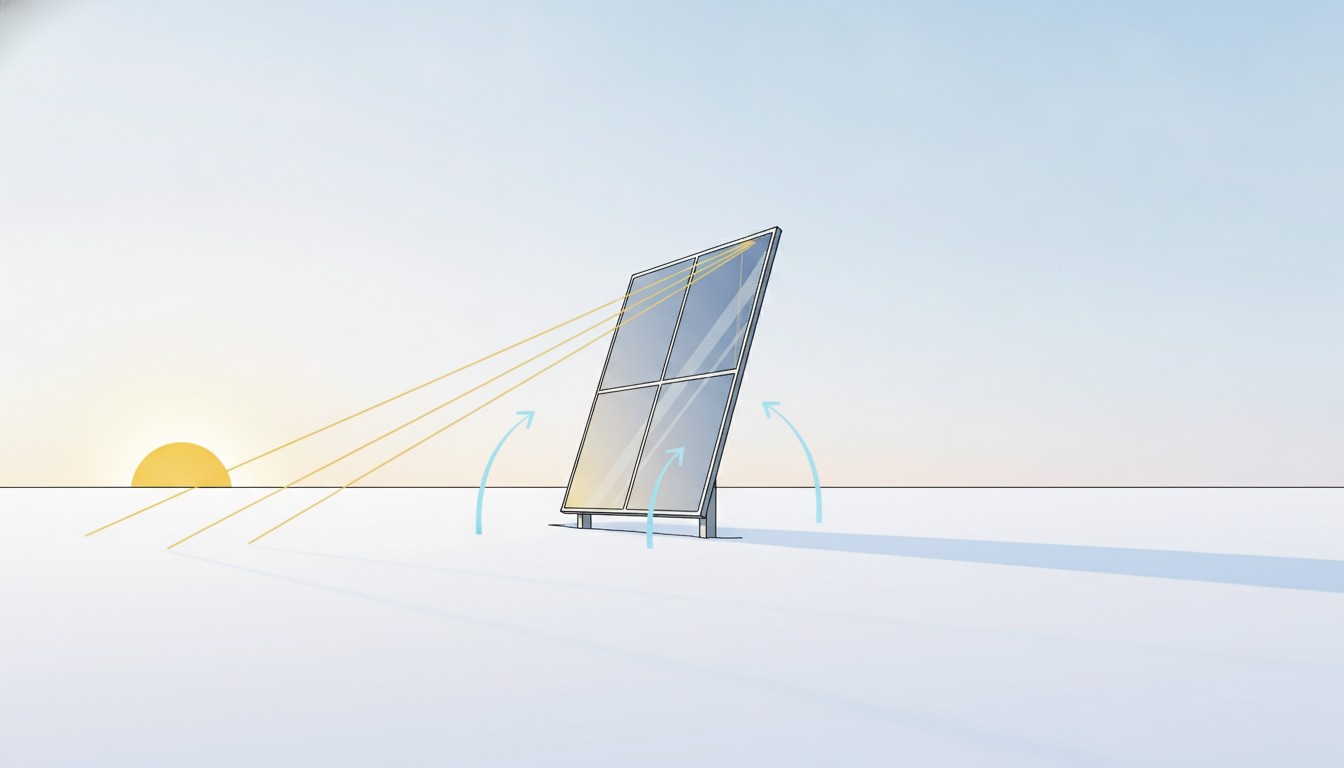
Winter geometry penalizes conventional flat or low-tilt arrays in three compounding ways: the sun arcs low across the horizon, snow blankets the glass face, and cold frames trap sliding ice at the bottom lip. A 90-degree vertical surface flips all three physics variables in favor of winter generation:
- Low-angle incidence: When the winter sun sits low in the sky, its rays strike an upright face at a more direct angle during early morning and late afternoon hours than they do on a shallow roof or ground rack.
- Snow albedo amplification: Fresh snow acts as a bright diffuse mirror, raising ground reflectivity (albedo) from roughly 0.05 on bare dark soil up to 0.80 on clean snow, as documented in high-latitude tests in Linkoping, Sweden (latitude 58.4 degrees North). That reflected light bounces into both the front and rear glass faces of a vertical bifacial module.
- Gravity shedding and reduced frame blockage: Snow slides off a vertical glass plane instead of accumulating on the surface, and landscape or frameless mounting keeps bottom edges clear of drifting banks.
Controlled measurements quantify how much energy these winter mechanics recover. In a year-round UK field study in York, vertical bifacial panels outperformed vertical monofacial panels by 7.12% to 10.12% on a daily basis, delivering seasonal gains in every season, strongest in winter (see chart), while posting gains of 22.88% to 26.91% during early morning and late afternoon windows, and up to a 24.52% gain during winter.
In regions with deep snowpack, the mechanical durability is equally pronounced. During a two-winter heavy-snow test in Japan where snow depth exceeded 1 meter, vertically mounted modules suffered zero panel damage or cell breakage. During the snowy period, snow reflection boosted the generation ratio relative to global horizontal irradiance by 55%, while partial shading of the lower panel row by snowbanks reduced output by 17%, prompting the researchers to recommend split maximum power point tracking (MPPT) electronics so unshaded upper strings run unrestricted. Across a separate winter snow-loss comparison presented with Sandia National Laboratories, conventional tilted ground-mount arrays lost 29% of winter output to snow cover, whereas a vertical agrivoltaic array held snow losses to 18%.
Do Crops Still Grow Between the Fences
For farm operators, power curves only matter if the soil between the posts continues to produce commercial yields. Because vertical rows cast moving shadows mainly right after dawn and right before sunset, plants in the 8-to-14-meter alleys still receive unobstructed midday sunlight when photosynthetic demand peaks, and the upright glass walls double as windbreaks that slow surface evaporation.
At the 89-kilowatt Aarhus University pilot in Foulum, researchers grew wheat and a grass-clover forage mixture for a full year between vertical east-west panels, between south-tilted panels, and in an open reference field. In the university’s September 2025 trial report, the vertical panels occupied roughly 10% of the field area, yet crops between the vertical rows showed no yield decline compared with the open field. Producing the same volume of food and electricity separately on dedicated parcels would require 18% to 26% more total land.
“Our measurements show that wheat and grass-clover mixtures grow just as well between vertical solar panels as in open fields. At the same time, the panels produce electricity in a daily pattern that better matches energy demand. It is a win-win,” said Marta Victoria, Associate Professor of Mechanical and Production Engineering at Aarhus University.
Uffe Jorgensen, Professor of Agroecology at Aarhus University, pointed to the microclimate effect between the rows: “Even with some shade, the yield per square meter is almost the same. The crops do not seem to mind the presence of solar panels and they like the wind protection that they provide.”
Multi-year agronomic tracking adds important weather nuance. In a follow-up Danish assessment across 2023 and 2024, grass-clover biomass grew higher between vertical panels (5.8 and 14.8 metric tons per hectare in 2023 and 2024) than between south-tilted panels (4.3 and 14.0 metric tons per hectare). Wheat yields matched the open reference field during the dry 2023 season (3.7 to 4.7 metric tons per hectare), but during the wet 2024 season wheat between the panels yielded slightly less (6.0 to 6.2 metric tons per hectare) than the open reference plot (7.0 to 7.1 metric tons per hectare). While researchers in other dual-use configurations have tested shade-tolerant crops like saffron under roof-mounted modules, row crops between vertical fences depend heavily on row width and seasonal rainfall.
In the United States, researchers at Colorado State University tested a taller row crop by planting silage corn (hybrid 195-51STXRIB) on May 8, 2024, inside a 30-panel Sunzaun vertical array at Fort Collins. Published in the AgriVoltaics Conference Proceedings in March 2026, the trial planted 13 corn rows spaced 76 centimeters apart inside each 10.7-meter alley under weekly flood irrigation. Morning measurements confirmed higher photosynthetically active radiation (PAR) and net photosynthesis (Pn) on the east side of the alley (PAR of 268 and Pn of 4.2 on the east vs. PAR of 145 and Pn of 3.2 in the control plot, and PAR of 53 and Pn of 1.1 on the west). At harvest, statistical analysis found no significant difference (p greater than 0.05) in silage biomass or grain yield at 15% moisture: grain reached 8,963 kilograms per hectare in the alley center, 9,523 on the west side, and 7,283 on the east side, compared with 9,399 kilograms per hectare in the open control plot (with silage per 12 plants weighing 9.4 kilograms in the center, 10.1 west, 8.7 east, and 8.8 in the control).
Visual acceptance also shifts when panels stand upright like boundary hedges. In a virtual-reality study with more than 100 participants conducted alongside the Aarhus trial, viewers rated vertical rows more positively than conventional tilted solar parks and perceived them as modern hedgerows that remain innovative and environmentally friendly. “Participants liked the vertical panels better, especially up close, when they saw the land was still farmed,” noted Gabriele Torma, Assistant Professor in the Department of Management at Aarhus University.
From Airports to Working Farms: Scale Proof
Vertical bifacial installations have scaled rapidly from university test plots into multi-megawatt utility and agricultural infrastructure across Europe:
- 1. Frankfurt Airport Runway West (17.4 MWp, Germany): Commissioned on October 22, 2025, along a 2.8-kilometer grassy strip beside Runway West, this installation mounts roughly 37,000 vertical modules built by system supplier and plant constructor Next2Sun. As detailed in Frankfurt Airport project reporting, the plant generates up to 17.4 million kilowatt-hours per year to power terminal air conditioning and the airport’s growing electric vehicle fleet under operator Fraport’s plan to reach Net Zero by 2045 at the latest. Construction was scheduled outside bird breeding and nesting seasons to protect runway grassland wildlife.
- 2. Loffingen Agri-Solar Park (4.3 MWp, Germany): Put into commercial operation in May 2025 across 11 hectares, this Loffingen vertical agri-solar system combines 3.3 megawatts-peak of vertical east-west racks with roughly 1 megawatt-peak of fixed south-facing units to feed about 4,800 megawatt-hours per year into the grid. With a 13.5-meter row distance and active agricultural stewardship running since late 2024, the parcel supports cattle pasture alongside arable rotations of spelt, oats, and buckwheat.
- 3. Donaueschingen-Aasen (4.1 MW, Germany): Operating since July 2020 as Europe’s largest vertical agrivoltaic plant at the time of construction, this facility mounts roughly 11,000 n-type PERT bifacial modules on 5,800 racks across a 12-hectare module field (14 hectares total) with 10-meter row gaps. Operated by Burgersolarkraftwerke Donaueschingen-Aasen, it generates 4,850 megawatt-hours per year for 1,400 households while the previous farmer continues cultivating hay, silage, and arable trial crops.
- 4. Kilmeaden Farm dairy fence (27 kW, Ireland): Installed in 2019 as a 150-meter north-south fence, this Irish dairy solar fence aligns generation with twice-daily milking at about 7 AM and 5 PM. The farmer covered about €20,000 after a 30% grant and recouped that share ahead of a 7-year plan as energy prices rose, with the supplier reporting about 1,200 kWh per kW and a 30-60% cost premium over roof mounts offset by self-installation.
“This project demonstrates the scalability of our vertical photovoltaic technology,” said Heiko Hildebrand, CEO of Next2Sun, at the Frankfurt commissioning. “It can be flexibly integrated into various infrastructures, including transport corridors and agricultural land.”
Fraport AG CEO Stefan Schulte emphasized the operational role of the runway array: “The international attention this innovative system has received reinforces our commitment to exploring new approaches that will help guide global aviation toward a sustainable future.”
| Site | Capacity / scale | Layout | Crop/use | Measured result |
|---|---|---|---|---|
| Foulum Denmark (Aarhus, 89 kW, lat 56.5N) | 89 kW vertical and tilted comparison | Vertical east-west | Wheat, grass-clover | No yield decline vs open field; 18-26% less land for same food and power; wind shelter |
| Fort Collins USA (CSU ARDEC-S, 2024) | 30 panels, 3×10 rows, 10.7 m spacing, 0.6 m clearance | North-south fence rows | Silage corn 195-51STXRIB | No significant silage or grain difference p greater than 0.05; grain 7283-9523 vs 9399 control kg per ha |
| Loffingen Germany (May 2025) | 4.3 MWp (3.3 vertical and 1 south), 11 ha | 13.5 m rows | Spelt, oats, buckwheat, cattle pasture | About 4800 MWh per yr and farming from end 2024 |
| Donaueschingen-Aasen Germany (July 2020) | 4.1 MW, 11,000 modules, 12 ha field | 10 m rows | Hay and silage, arable trials | 4850 MWh per yr, 1400 homes, 88% forage vs control (10% area loss) |
| Frankfurt Airport Germany (Oct 2025) | 17.4 MWp, 37,000 modules, 2.8 km | Runway West vertical | Grass verge dual-use | Up to 17.4M kWh per yr for terminals and EVs |
Costs, Limits, and Are They Worth It
Evaluating whether solar fences are worth it requires weighing land efficiency and grid timing against structural costs and crop compatibility. Unlike dense south-facing solar parks that lock up most of a parcel, vertical fence rows occupy about 10% of the field surface, leaving roughly 90% of the ground accessible to tractors, seed drills, and harvesters. That dual use avoids land-use conflict while shifting electricity generation into higher-value morning and evening hours.
At the same time, four engineering and biological constraints govern where vertical arrays make financial sense:
- Wind-load foundation and racking costs: Because an upright 2-meter-tall panel acts like a rigid sail in crosswinds, posts must be driven deeper and built with heavier steel racking than compact ground-mount tables. Commercial pricing for a solar fencing system varies substantially by megawatt scale, row spacing, steel foundation depth, and local grid interconnection distance rather than a flat per-foot retail rate.
- Crop-specific shade response: Multi-year field notes from the Donaueschingen-Aasen site reported in agricultural trade press show that available sunlight across the field drops by about 15%. Overall forage yields in 2022 and 2023 reached 88% of a control plot (with most of the reduction coming from the 10% land area occupied by the post buffers). Wheat showed improved autumn germination between the rows, whereas peas reacted poorly to the partial shading.
- Tall-crop self-shading and equipment clearance: As the Colorado State University corn trial noted, tall crops like mature silage corn can begin shading the lower edge of modules with a 0.6-meter ground clearance, and wide tractor implements carry a risk of mechanical contact with glass panels during seeding or spraying if operators veer off center.
- Slightly lower annual kilowatt-hours: Where land has zero agricultural value and grid connections pay a flat rate per kilowatt-hour regardless of time of day, a south-tilted array still generates slightly higher total annual volume per panel.
Frequently Asked Questions
Are solar fences worth it?
Solar fences pay off where keeping the field farmable matters more than squeezing maximum noon kilowatt-hours: working cropland, pasture, and infrastructure verges. They preserve most of the ground for machinery and shift output into higher-value morning and evening hours, at the cost of heavier wind-rated racking and slightly lower total annual volume than tilted south arrays.
How much does a solar fencing system cost?
Commercial solar fencing costs depend on system capacity in kilowatts or megawatts, row spacing (typically 8 to 14 meters), wind-rated steel post foundations, and grid transformer distance rather than a simple per-foot fence price. Because vertical racks resist lateral wind loads and span wider land areas with longer underground cabling, structural hardware costs more per panel than compact ground mounts, though ongoing crop revenue offsets land lease expenses.
Will a vertical panel run a fridge or farm load?
Running a continuous appliance like a refrigerator or an irrigation pump depends on total system wattage and battery storage rather than panel tilt alone. Because a vertical east-west panel peaks between 7:00 AM and 9:00 AM and again between 4:00 PM and 6:00 PM with lower midday output, off-grid farm loads pair the panels with an inverter and battery bank sized to store morning and afternoon generation for 24-hour use.
Do vertical panels work in snow?
Yes, in heavy-snow regions especially. Shedding plus bright ground reflection gives vertical bifacial rows their winter edge, with the Japan and Sandia field results described above.
Can cattle graze between solar fences?
Yes, cattle can graze between vertical solar fence rows when racks and wiring are built for livestock clearance and durable post protection. At the 11-hectare, 4.3-megawatt-peak Loffingen Agri-Solar Park in Germany, which entered operation in May 2025 with 13.5-meter row spacing, the parcel combines grassland pasture for cattle with arable rotations of spelt, oats, and buckwheat.
As grid operators confront steeper midday solar surpluses and rural counties tighten rules on converting prime soil into single-use power plants, vertical bifacial rows offer a tested mechanical compromise. By turning the vertical airspace above fence lines into morning, evening, and winter generating capacity, working farms can harvest kilowatt-hours and grain from the exact same acreage.

