
Standard large language models suffer from a structural bottleneck: they must predict and emit one token at a time from left to right. Every new word waits for the full transformer stack to finish calculating the word before it, throttling generation speed even when a high-end GPU has plenty of parallel compute sitting idle.
On November 20, 2026, NVIDIA released Nemotron-Labs-Sigma, an open family of 14 checkpoints at 3-billion and 8-billion parameter scales designed to bypass that sequential queue. Rather than picking discrete vocabulary tokens one by one or flipping blank mask tokens in place, the Nvidia Sigma diffusion language model generates text in parallel blocks by removing Gaussian noise inside a compact, continuous 16-dimensional embedding space.
Built by researchers from NVIDIA, Cornell University, and Georgia Tech and detailed in their 2026 technical paper, Sigma expands the broader Nemotron family into continuous text diffusion. By keeping intermediate token representations along a smooth mathematical trajectory, the architecture unlocks inference-time steering, few-step distillation, and self-speculative decoding while remaining competitive with established autoregressive and masked diffusion baselines on coding and reasoning tasks.
What Sigma Changes About Text Generation
To understand why a continuous diffusion LM operates differently from familiar chatbots, it helps to look at the physical unit of work each generation paradigm sends through the GPU.
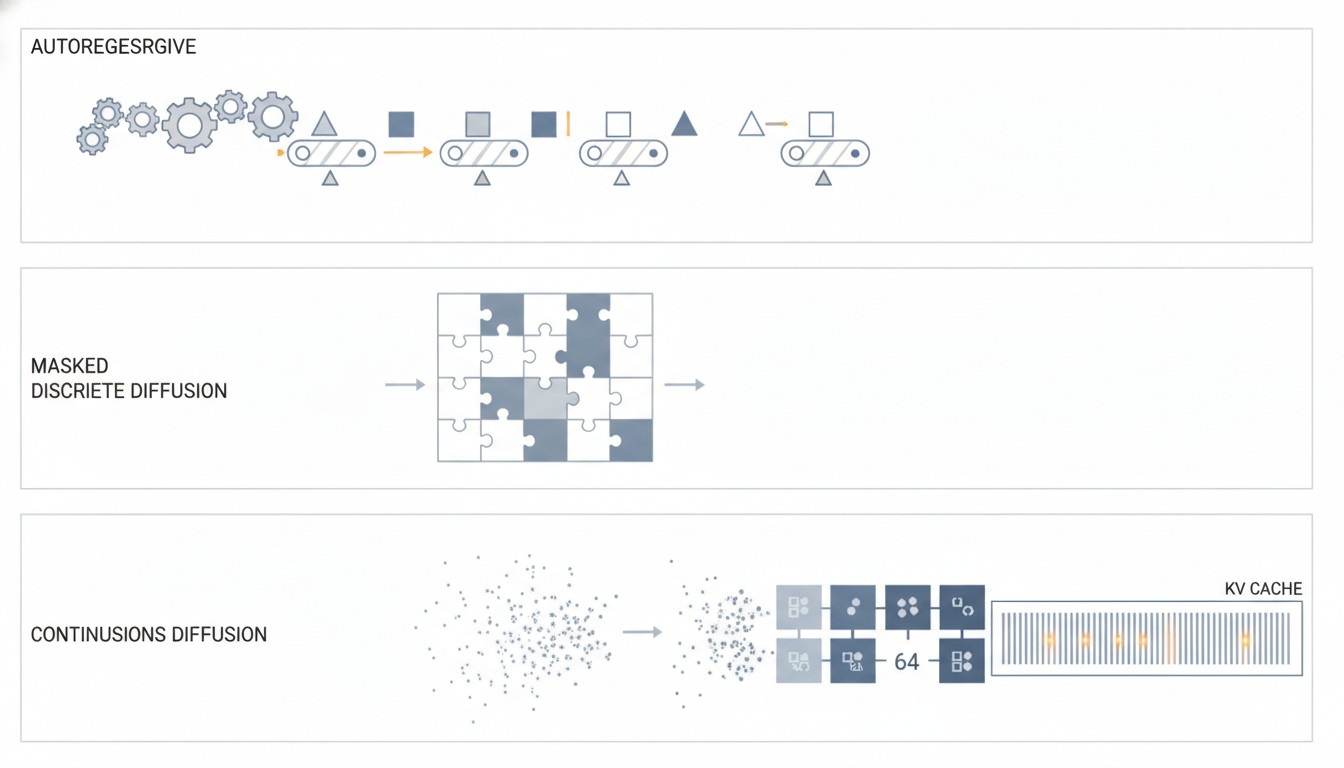
An autoregressive model treats language as a strict assembly line. If a user asks for a 256-token Python function, the model runs at least 256 sequential forward passes. Each pass computes attention over past tokens stored in the key-value (KV) cache and appends a single discrete token to the end of the sequence. This design makes greedy decoding straightforward and keeps serving frameworks mature, but memory bandwidth limits how fast a chip can step through hundreds of single-token passes.
First-generation text diffusion systems, often called masked or discrete diffusion language models, broke that single-token bottleneck by treating a paragraph like a crossword puzzle. Models such as LLaDA, Dream, and NVIDIA’s own discrete sibling, Nemotron-Labs-Diffusion (NLD), start with a block of blank mask tokens and unmask several discrete words per step. Parallel refinement speeds up drafting, yet jumping abruptly between discrete vocabulary IDs creates a jagged trajectory that is harder to steer or compress into two or four steps without losing coherence.
Nemotron Labs Sigma takes a third route: blockwise continuous diffusion. Instead of jumping between fixed word IDs, Sigma represents every token as a coordinate inside a learned 16-dimensional vector space. At inference time, the model works on parallel blocks of text (64 tokens per block by default). A block begins as pure Gaussian noise in 16-D space and is progressively refined over a configurable number of denoising steps using standard DDPM or DDIM samplers with self-conditioning.
Once a 64-token block finishes denoising and snaps into final vocabulary words, Sigma commits those clean tokens to a standard KV cache. The next 64-token block can then attend to the committed prefix without recalculating it. Builders get a tunable latency-versus-quality knob: running more denoising steps refines complex reasoning, while cutting the step count trades a modest dip in accuracy for significant throughput gains.
| Architecture Paradigm | How It Writes | Unit of Work | Primary Strength | Engineering Tradeoff |
|---|---|---|---|---|
| Autoregressive (AR) | Predicts left to right, one token at a time | Single discrete token | Simple greedy decoding and mature serving stack | Strict sequential latency bottleneck |
| Masked / Discrete Diffusion (LLaDA, Dream, NLD) | Unmasks discrete blank tokens over multiple steps | Masked token positions | Parallel token refinement across a sequence | Discrete jumps are harder to steer or distill into few steps |
| Sigma Continuous Diffusion | Denoises 16-D embeddings blockwise and commits to KV cache | 64-token continuous embedding block | Smooth trajectory enables steering, few-step distillation, and self-speculative drafting | Adds sampler parameters and requires bfloat16 GPU execution |
Inside the 16-D Embedding Engine
Early experiments with continuous text diffusion struggled because standard transformer token embeddings are huge, often spanning 3,072 or 4,096 dimensions. Diffusing Gaussian noise across thousands of dimensions per token burns memory bandwidth and forces the denoiser to search an unnecessarily vast geometric space.
According to the Sigma-8B model card, NVIDIA solves this footprint problem by mapping every vocabulary token to a point inside a compact 16-dimensional embedding space. That 16-D geometry is not frozen beforehand.
The embedding coordinates are learned jointly alongside the neural network denoiser during training, allowing the model to arrange related tokens along smooth trajectories that are easier to reconstruct from Gaussian noise.
Under the hood, Sigma builds on a Ministral-style decoder-only Transformer architecture equipped with grouped-query attention, SwiGLU activation layers, rotary position embeddings, and a specialized continuous-diffusion generation head. In the 8B release, the safetensors weights total approximately 8.49 billion parameters.
Rather than training a diffusion model from scratch, the researchers initialized Sigma from pretrained autoregressive weights and trained an autoregressive stream alongside a diffusion stream on the same shared Transformer backbone. During training, clean prefix tokens flow through the autoregressive pathway while noisy 16-D embeddings flow through the diffusion pathway, attending both to the clean prefix and within their current block. Combining an autoregressive loss with the continuous denoising objective preserves left-to-right language fluency while teaching the same weights to resolve whole blocks in parallel.
The total training pipeline processed approximately 1.3 trillion tokens: roughly 1 trillion tokens during the autoregressive initialization stage followed by around 0.3 trillion tokens of continuous-diffusion training. NVIDIA used the same curated English corpus that powered Nemotron-Labs-Diffusion, spanning webpages, articles, dialogue, source code, mathematics, science, legal text, and finance. The underlying training dataset itself is not publicly distributed.
The 14 Checkpoints, Mapped
Instead of dropping a single research checkpoint, NVIDIA structured the 14-model Hugging Face collection so engineers can test raw multi-step denoising, instruction following, low-step distillation, and exact autoregressive verification on the same underlying weights.
- Base foundation checkpoints (2 models): Sigma-3B and Sigma-8B provide the core continuous-diffusion generators for custom fine-tuning and multi-step sampling research.
- Instruction-tuned checkpoints (2 models): Sigma-3B-instruct and Sigma-8B-instruct apply supervised fine-tuning for direct chat, math reasoning, and code generation prompts.
- Few-step distilled checkpoints (8 models): Distribution matching compresses the denoising trajectory into fixed Number of Function Evaluations variants. Both distill-3B and distill-8B ship with dedicated checkpoints for NFE 2, NFE 4, NFE 8, and NFE 16.
- Self-speculative checkpoints (2 models): distill-spec-3B and distill-spec-8B pair the fast distilled diffusion drafter with the shared autoregressive stream for verified acceleration.
Deployment hardware constraints are strict and worth reading carefully before provisioning servers. As Nov 20, 2026 release coverage notes alongside the model cards, most checkpoints support a maximum context length of 4,096 tokens (prompt plus generated output combined), while Sigma-8B-instruct extends that window to 8,192 tokens. Every model runs on a single CUDA-enabled NVIDIA GPU in bfloat16 precision across Ampere, Lovelace, Hopper, and Blackwell generations. CPU inference is explicitly unsupported and produces unusable output, and no official quantized variants are included in the release.
Speed and Accuracy, Carefully Read
Evaluating a diffusion language model vs autoregressive alternatives requires separating raw baseline sampling from distilled and speculative execution modes. Running a full 32-step denoising loop per 64-token block does not automatically break speed records, because 32 forward passes for 64 tokens still averages two tokens per forward pass.
In its baseline configuration, generating 256 tokens with the DDPM sampler at 32 denoising steps per 64-token block, Sigma-8B delivers roughly 120 to 140 tokens per second on a single NVIDIA Hopper H100 GPU running in bfloat16. That baseline establishes a clean reference curve before applying the two acceleration mechanisms of this continuous diffusion LM.
The first accelerator is few-step distillation. Because continuous embeddings follow a smooth path rather than discrete token hops, NVIDIA uses distribution matching to train the NFE 2, 4, 8, and 16 checkpoints. According to the project benchmark summary, these distilled models generate 8 tokens per forward pass on math workloads and 4 tokens per forward pass on coding tasks with negligible accuracy loss and preserved output diversity.
The second accelerator is self-speculative decoding. In standard speculative decoding, a separate small draft model guesses upcoming tokens and a larger target model verifies them, forcing operators to hold two distinct models in VRAM. Because Sigma trains both a continuous diffusion stream and an autoregressive stream on one shared backbone, distill-spec-8B uses its distilled diffusion head to draft candidate blocks rapidly and uses its own autoregressive stream to verify them in a single pass. This setup reproduces greedy autoregressive output while achieving an average throughput speedup of 3.46 times over standard autoregressive decoding on an NVIDIA GB200 system running SGLang, reaching a peak speedup of up to 4.20 times.
On accuracy, NVIDIA characterizes the family qualitatively as competitive with leading masked diffusion and autoregressive baselines, superior on code completion, and on par with its discrete sibling Nemotron-Labs-Diffusion at both 3B and 8B scales after supervised fine-tuning. Looking at the specific figures that NVIDIA reports, Sigma-8B base records an average score of 71.16 across NVIDIA’s 6-task evaluation suite, compared with 70.22 for discrete NLD-8B, 68.91 for autoregressive Qwen3-8B, 58.74 for Dream-7B, and 41.78 for LLaDA-8B. On HumanEval code completion, NVIDIA reports 65.12 for Sigma-8B versus 62.80 for NLD-8B, and notes that Sigma-8B-instruct reaches 91.96 on GSM8K math reasoning.
However, builders should note an important parity caveat in those same NVIDIA-reported numbers: across the full instruction-tuned suite, Sigma-8B-instruct posts an average score of 59.14, slightly trailing the discrete NLD-8B instruct average of 59.92. Continuous diffusion gives Sigma clear leverage in few-step distillation, code completion, and self-speculative drafting, rather than an across-the-board sweep on every post-SFT benchmark.
Steering and Serving in Production
One benefit of working in a continuous 16-D vector space is that inference behaves like a continuous control system. Just as image diffusion models use guidance scales to sharpen adherence to a prompt, Sigma exposes three continuous inference-time knobs: classifier-free guidance, score temperature, and self-conditioning across DDPM or DDIM samplers. Adjusting score temperature and guidance scales lets developers tune the balance between deterministic precision for syntax-heavy coding and broader exploration for math problem solving without retraining weights.
For local testing and deployment, NVIDIA removed the custom CUDA kernel compilation hurdles that often stall experimental architectures. Sigma runs in plain PyTorch (version 2.4 or newer) with Hugging Face Transformers (version 4.55 or newer) using the standard trust_remote_code flag. For higher-throughput production serving and batching, the checkpoints integrate with vLLM, SGLang, and Docker Model Runner.
All 14 checkpoints are released under the NVIDIA Nemotron Open Model License, which permits both commercial and non-commercial use. At the same time, the documentation frames the English-only release as a research starting point for builders exploring non-autoregressive inference, rather than a drop-in long-context replacement for massive frontier chatbots.
Frequently Asked Questions
What is a diffusion model used for?
Diffusion models are generative neural networks trained to create structured data by iteratively removing random noise. First popularized for images, video, and molecular structures, they are now used for text generation, code completion, and mathematical reasoning by refining blocks of tokens in parallel rather than predicting one word after another.
Can diffusion models be used for text?
Yes. Language diffusion models adapt the denoising process to text in two ways: masked discrete models start with blank placeholder tokens and fill several words in per step, while continuous models like Nemotron Labs Sigma map words into a compact 16-dimensional vector space and denoise 64-token blocks of continuous embeddings before converting them back into readable text.
How is diffusion connected to language?
In continuous language diffusion, every word in a vocabulary is assigned a coordinate inside a learned embedding geometry. During training, Gaussian noise is added to those coordinates until the text signal blurs out, and a Transformer learns to reverse that trajectory. At generation time, the model starts from random noise and follows a smooth path back to coherent sentences.
What is the masked diffusion language model?
A masked diffusion language model (such as LLaDA, Dream, or Nemotron-Labs-Diffusion) operates directly on discrete vocabulary tokens. It initializes a response as a sequence of masked slots and repeatedly predicts which discrete words belong in those slots over several refinement steps, contrasting with continuous diffusion models that denoise smooth vector representations before snapping to discrete words.
For teams choosing inference infrastructure today, Sigma is best viewed as an open laboratory for faster parallel decoding: try the distilled and self-speculative checkpoints for latency-sensitive coding and math workflows, and treat the NVIDIA-reported gains as directions to verify on your own serving stack.


