
When latency disappears, the friction between machine computation and human intuition effectively dissolves, creating a unified cognitive workflow. Performance isn’t about bragging rights; it’s about perceived immediacy—the same threshold for instantaneous AI responses currently redefining real-time inference. Parallel refinement shifts away from sequential decoding, enabling dLLM architectures to deliver fluidity that traditional autoregressive models struggle to match.
Mercury 2 and Mercury Edit 2 land right in that moment. Inception is betting that diffusion reasoning, built on a diffusion-based language generation research arc, can make production AI feel fast enough for complex agent loops, voice interaction, and coding tools. Accelerated throughput suggests a future where high tokens per second (TPS) serves as a prerequisite for professional workflows.
High-speed inference serves as the backbone for next-generation digital assistants that need to reason and act simultaneously. Shaving milliseconds off a single turn allows developers to build deeper planning cycles into their products without sacrificing the ‘snappy’ feel users expect. This evolution suggests a future where high tokens per second (TPS) isn’t just a benchmark but a prerequisite for any tool sitting inside a professional workflow.
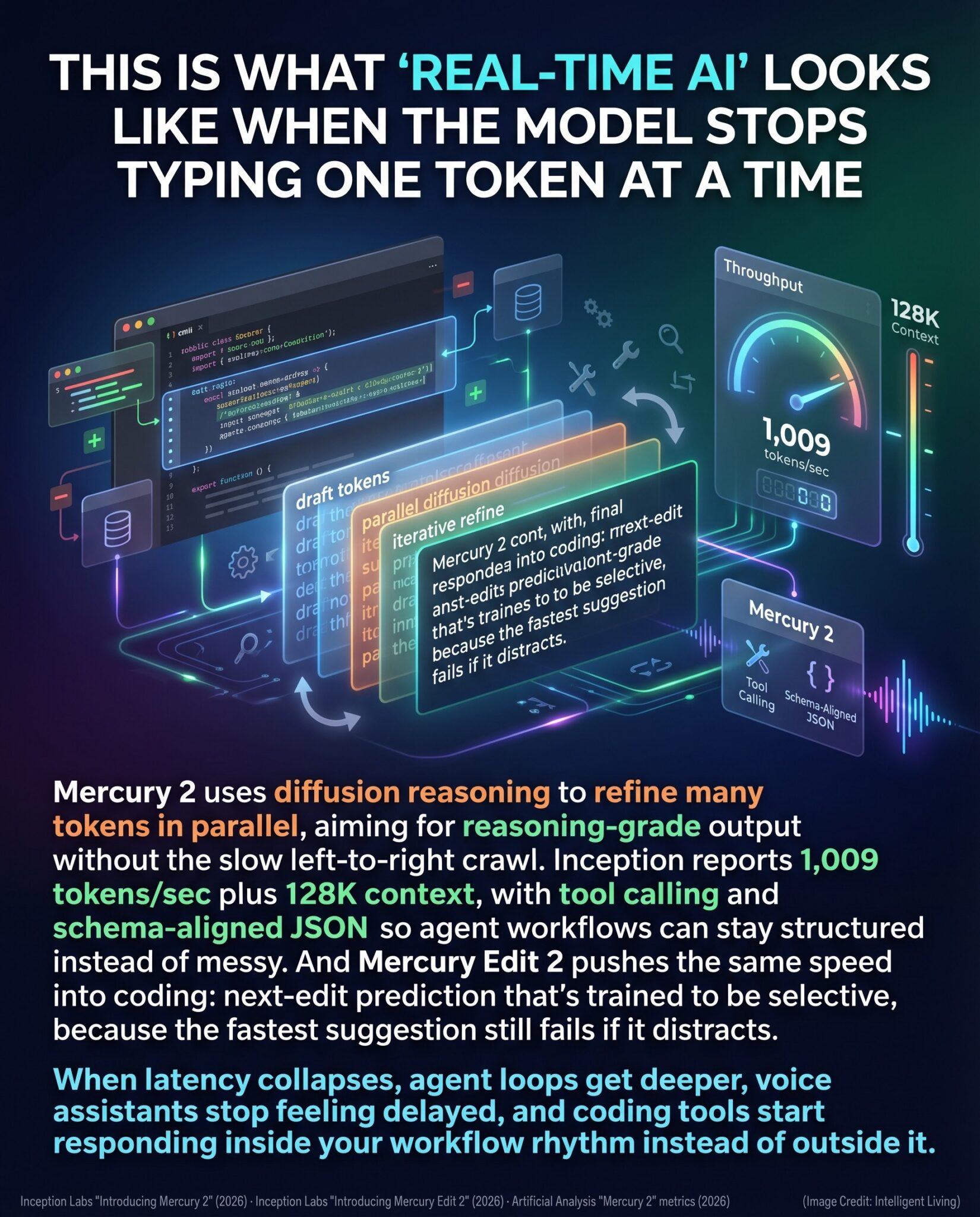
Mercury 2 Performance Snapshot: Technical Specifications and Launch Insights
Mercury 2 and Mercury Edit 2: The Arrival of High-Throughput dLLM Architectures
Inception’s launch of Mercury 2 introduced the “dLLM”—a diffusion-based architecture engineered to bypass traditional sequential decoding bottlenecks.
Initial benchmarks confirm Mercury 2 generates approximately 1,009 tokens per second on NVIDIA Blackwell GPUs, while supporting a 128K context window, tunable reasoning, native tool use, and schema-aligned JSON output. Inception followed with Mercury Edit 2 in the next-edit prediction release, aimed at the most latency-sensitive part of developer workflows: predicting the next edit rather than just completing the next line.
The post ties that design to alignment using Kahneman-Tversky Optimization, a reinforcement learning objective built around binary feedback; this approach resonates with developers because identifying flawed output is often more intuitive than ranking two high-quality alternatives.
Mercury 2 Technical Core: Specifications, Benchmark Metrics, and Pricing
- Architecture: The diffusion LLM technical report defines these dLLMs as Transformer-based architectures that refine multiple tokens simultaneously through a multi-pass process rather than sequential generation.
- Independent benchmark snapshot: The Artificial Analysis model snapshot lists Mercury 2 with an Intelligence Index of 33, output prices of $0.25 per 1M input tokens and $0.75 per 1M output tokens, and an output throughput figure above 1,000 tokens per second in its speed metric.
- Context and output caps in a real config: The OpenClaw provider configuration shows a 128,000-token context window and a maxTokens value of 16,384 in a concrete OpenAI-compatible provider configuration, while the model control parameters list the request-side controls that shape output length and responsiveness.
- Schema-aligned JSON: The JSON schema structured outputs for enforcing predictable machine-readable responses, which helps when a tool chain expects strict types and keys.
- Tool calling loop: A cookbook-style automated SQL agent workflow demonstrates end-to-end orchestration, with natural language to SQL generation, execution, and summarization timing framed as a real workflow, not a demo screenshot.
- Throughput under service constraints: The published platform rate limits make the hidden point obvious, because even a very fast model can feel slow if requests get throttled or queued under high concurrency.
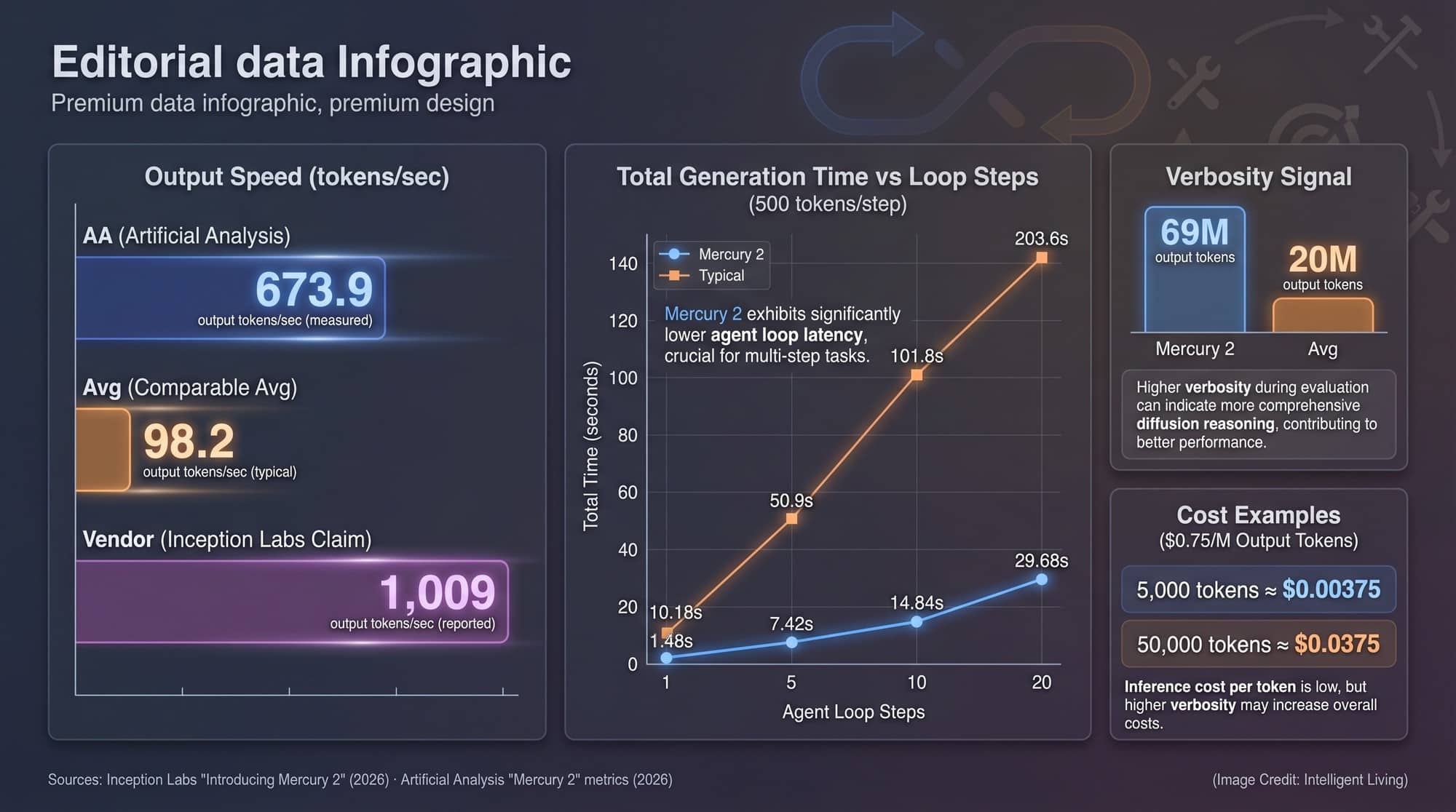
Strategic Impact of Diffusion Reasoning: Optimizing Agent Loops and Throughput
Managing the Agentic Thinking Tax: Cumulative Latency in Complex Workflows
Throughput Efficiency and Latency Compounding in Multi-Turn Loops
Modern AI development has moved beyond single-turn interactions. Production-grade systems now rely on a continuous cycle that manages complex state transitions:
- Context Retrieval: Pulling relevant data from vector databases or external APIs.
- Tool Invocation: Executing specific functions to interact with software environments.
- Result Validation: Checking output accuracy against predefined schemas.
- Error Recovery: Retrying failed calls or adjusting prompts midstream.
Cycles persist until objectives are fulfilled, with each iterative step accumulating a latency penalty that dictates total user experience—a dynamic captured by the agentic computational overhead model, where processing delays convert directly into significant operational costs. High-speed inference remains vulnerable to retrieval bottlenecks and tool-execution timeouts that disrupt continuous processing.
TPS Influence on Human-AI Interaction and User Experience Thresholds
When a workflow necessitates six sequential model calls, a single-second reduction per turn generates significant cumulative efficiency. These gains propagate through daily operations, especially when incorporating retry logic, logging overhead, and final validation cycles. Shaving seconds saves a full minute across a workday, ensuring customer support agents don’t face awkward pauses between tool calls.
Throughput transcends vanity when latency accumulates across complex workflows. The ReAct reasoning-and-acting pattern illustrates this compounding effect perfectly.
Reducing Developer Friction and Establishing Continuous Workflow Rhythm
These performance dynamics manifest during critical transition points. During active code review, high latency creates a cognitive disconnect, forcing developers to break their rhythm and manually input logic while waiting for a suggestion. With faster systems, the suggestion arrives while the intention is still fresh, which is one reason agentic code engineering workflows are shifting from novelty demos into daily usage. The more a tool stays in rhythm, the more people tolerate verification steps because those checks feel like part of the flow, not a speed bump.
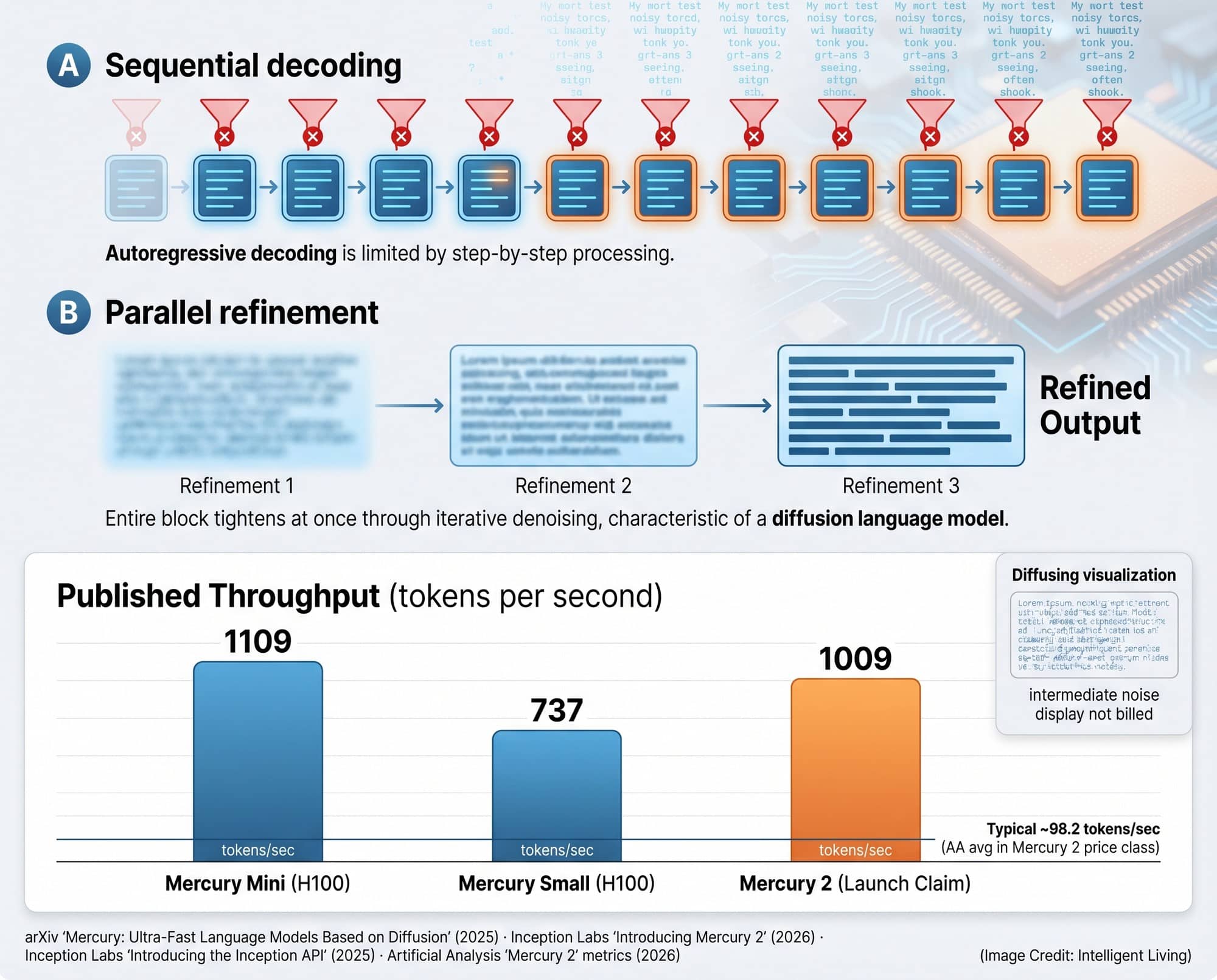
Executing Parallel Refinement via dLLM Architectural Logic
Sequential Autoregressive Decoding vs. Parallel Diffusion Refinement
Traditional large language models utilize the standard Transformer architecture, predicated on sequential token generation. Sequential generation explains why long responses resemble real-time typing; each token remains dependent on its predecessor.
Diffusion Generation as Parallel Refinement
Diffusion language models treat generation more like revision. Inception’s diffusion architectural overview explains the core intuition: the model starts with a rough draft and improves the whole draft through parallel refinement steps, adjusting multiple tokens at once instead of marching forward one token at a time. The easiest way to picture it is an editor sketching the whole paragraph quickly, then tightening phrasing across the entire paragraph in a few rapid passes.
Evidence-Based Capabilities: Scaling Reasoning in Diffusion Environments
Current research evaluates how multi-step reasoning scales within the diffusion paradigm. Evidence suggests that diffusion reasoning represents a viable research direction rather than a branding strategy, though individual product efficacy still requires verification. The d1 diffusion reasoning paper outlines a post-training approach that combines supervised fine-tuning with reinforcement learning, offering a concrete explanation for how a diffusion model can be pushed toward stronger multi-step reasoning without relying on classic left-to-right decoding.
Throughput Acceleration Protocols within the Diffusion Ecosystem
The speculative diffusion decoding study proposes ways to accelerate language generation by parallelizing drafting and verification, which helps explain why the broader diffusion-to-text ecosystem keeps reappearing in performance-focused releases. In practice, these methods still need careful evaluation, because faster drafting can magnify mistakes if verification is treated as optional.

Where Mercury 2 Shows Up First: Real-Time RAG, Voice, and Agentic Coding
Immediate Use Cases: Low-Latency RAG and Human-Centric Voice Agents
High-Throughput RAG Performance and Context Window Optimization
Retrieval-augmented generation, usually shortened to RAG, is a system design where the model pulls relevant documents first and then writes using that evidence, instead of guessing from memory. Production-grade RAG, exemplified by local retrieval-augmented learning, prioritizes retrieval precision over sheer model scale to ensure high-fidelity explanations.
Utilizing a 128K context window allows more retrieved passages and tool outputs to reside within a single request. Context consolidation eliminates the frequent back-and-forth calls that introduce friction into RAG architectures.
Optimizing Spoken Cadence and Social Latency in Voice Interfaces
Architectures emphasizing ‘meaning first’ logic underpin speech-to-retrieval voice search requirements. High-speed reasoning models facilitate natural clarification cycles rather than generating verbose speculative output after a significant delay. A fluid vocal interaction cycle shows how fast generation and streaming output can keep the spoken cadence tight enough to feel conversational, especially when time to first token is treated as a first-class metric.
Ensuring Production Reliability in High-Concurrency Tool Workflows
Reliability in production deployments hinges on predictable interface design. For interactions requiring sub-second responsiveness, the real-time mode option prioritizes immediate delivery for latency-sensitive applications. The progressive output methods facilitate block-by-block output delivery, ensuring the user experience matches model speed and minimizes perceived computational idle time.
Tool access is also where risk becomes real. When a model can touch files, databases, or production services, guardrails matter more than clever prompting, which is why tool-gated OpenClaw permission boundaries emphasize explicit tool scopes and constrained execution.
Mercury Edit 2: Evaluating Next-Edit Prediction for Intuitive Coding Loops
Shifting from Sequential Autocomplete to Predictive Next-Edit Logic
Autocomplete predicts subsequent tokens. In contrast, next-edit prediction infers intended structural changes like renames or refactors across multiple lines.
Developers experience throughput through cognitive rhythm rather than raw numbers. Efficiency is measured by the suggestion’s arrival before the train of thought is interrupted.
Anatomy of a Next-Edit Prompt: Managing Contextual Intent Payloads
Missing context often leads high-speed models to generate confident yet inaccurate edits. The next-edit prompt format shows why this can feel so different in practice, because the prompt carries recently viewed snippets, the editable region, and an ordered edit history that gives the model a better read on intent than a single cursor line. Professional tooling prioritizes selective accuracy over verbosity to avoid disrupting developer intent.
Integration Hurdles: API Compatibility and Project Style Adherence
Integration friction also matters. Inception presents an OpenAI-compatible API endpoint, which can reduce the cost of testing because teams can wire it into existing clients instead of rebuilding a stack for a single model. In day-to-day usage, the difference between “it works” and “it sticks” is often the boring stuff, like whether the tool respects project style, returns structured edits, and fails quietly when context is incomplete.

Production Reality Checks: Evaluating Accuracy and Long-Term Ecosystem Impact
Critical Limitations: Throughput Speed vs. Reasoning Accuracy
Speed does not guarantee correctness. It changes how quickly a system can take a step, which means verification has to be designed into the loop rather than bolted on later. That draft-first verification mindset overlaps with the test-time diffusion deep research loop, where iterative revision is treated as an evidence-seeking process instead of a single polished output. Benchmarks can also hide tradeoffs, because a model can be both fast and verbose, so output caps and stopping rules still matter for production budgets.
Production-level challenges remain a factor for high-speed systems. Timeouts, overloads, and throttling are not theoretical when an app is shipped, which is why the platform’s API error codes read like a quiet map of what can go wrong at scale. For teams building on chat interfaces, the chat completions request shape is where the practical knobs live, including token limits, streaming, and tool payloads that can quietly decide whether a system feels instant or fragile.
Strategic Shifts: 7 Projections for the High-Throughput AI Ecosystem
The emergence of 1,000+ TPS architectures like Mercury 2 signals a fundamental realignment in product design. As throughput scales, several strategic shifts will dictate the next phase of AI deployment:
- Agent Loops Become Practical at Scale: Accelerated inner loops facilitate comprehensive planning and verification within a single user interaction, which can turn brittle automations into systems that recover gracefully when a tool call fails.
- Voice Interfaces Start Feeling Less Like a Delay: When the model can keep pace with a person’s cadence, voice assistants can ask clarifying questions instead of guessing, which lowers error rates in real-time tasks.
- Coding Tools Shift From Completion to Collaboration: Next-edit prediction pushes IDEs toward suggestion systems that anticipate intent, not just syntax, which changes how refactors, renames, and repetitive edits get handled.
- Tool-First Architectures Get Cleaner: Structured outputs and tighter tool contracts reduce the need for fragile parsing, and JSON Schema validation makes it easier to build workflows that behave like software instead of improvisation.
- Tokens-Per-Watt Becomes a Competitive KPI: As inference scales, throughput economics start to look like energy economics, a transition explained well by sustainable throughput infrastructure metrics that reframe speed as usable output per unit of power.
- Memory Bandwidth Becomes the Quiet Bottleneck: Even fast models can stall when memory and packaging supply limits constrain deployment, which is why memory bandwidth supply bottlenecks keep showing up in the background of real-time AI roadmaps.
- Local and Hybrid Expectations Rise: Instant responsiveness is quickly becoming the global standard. This pressure accelerates development of specialized local inference hardware, where VRAM and unified memory define modern performance baselines.
Industry leaders must adapt to these shifting performance baselines to remain competitive. As these capabilities migrate from research labs to production environments, the focus will move from simple generation to complex, high-speed collaboration.

The New Baseline for High-Speed Reasoning: Mercury 2 and dLLM Evolution
Mercury 2 represents more than a speed headline; it signals a shift where responsiveness becomes a core requirement for reasoning-grade systems.
For builders, the takeaway involves redesigning workflows around tight agent loops and strict tool boundaries that keep pace with 1,000+ tokens per second. As dLLM technology matures, the friction between complex reasoning and real-time execution will likely continue to dissolve, favoring systems that prioritize immediate feedback.
Redefining the baseline for AI interaction means moving toward a model where waiting is no longer part of the user experience. Architectural evolution feeds into rising hybrid expectations, where local and cloud systems must deliver near-instant results. Adopting these high-throughput architectures today allows teams to prepare for a production environment where speed and intelligence are no longer a zero-sum trade-off.
FAQ: Technical Deployment Insights for Mercury 2 and dLLM Architectures
What is a diffusion LLM (dLLM) in simple terms?
A dLLM generates a rough draft and refines it through parallel refinement steps rather than producing text one token at a time.
How does Mercury 2 achieve 1,000+ tokens per second?
It utilizes diffusion reasoning to bypass sequential decoding bottlenecks, allowing multiple tokens to be processed simultaneously on high-performance GPUs.
Why is high throughput critical for agent loops?
Agentic workflows require multiple model calls; high speed ensures that planning, tool selection, and verification happen without stalling the user experience.
Can Mercury 2 be used for real-time voice and RAG?
Yes, its low-latency design makes it ideal for voice assistants and retrieval-augmented generation where immediate evidence-based answers are required.
What is the difference between autocomplete and next-edit prediction?
Autocomplete suggests subsequent tokens, while next-edit prediction infers complex structural changes or refactors based on developer intent and history.


