
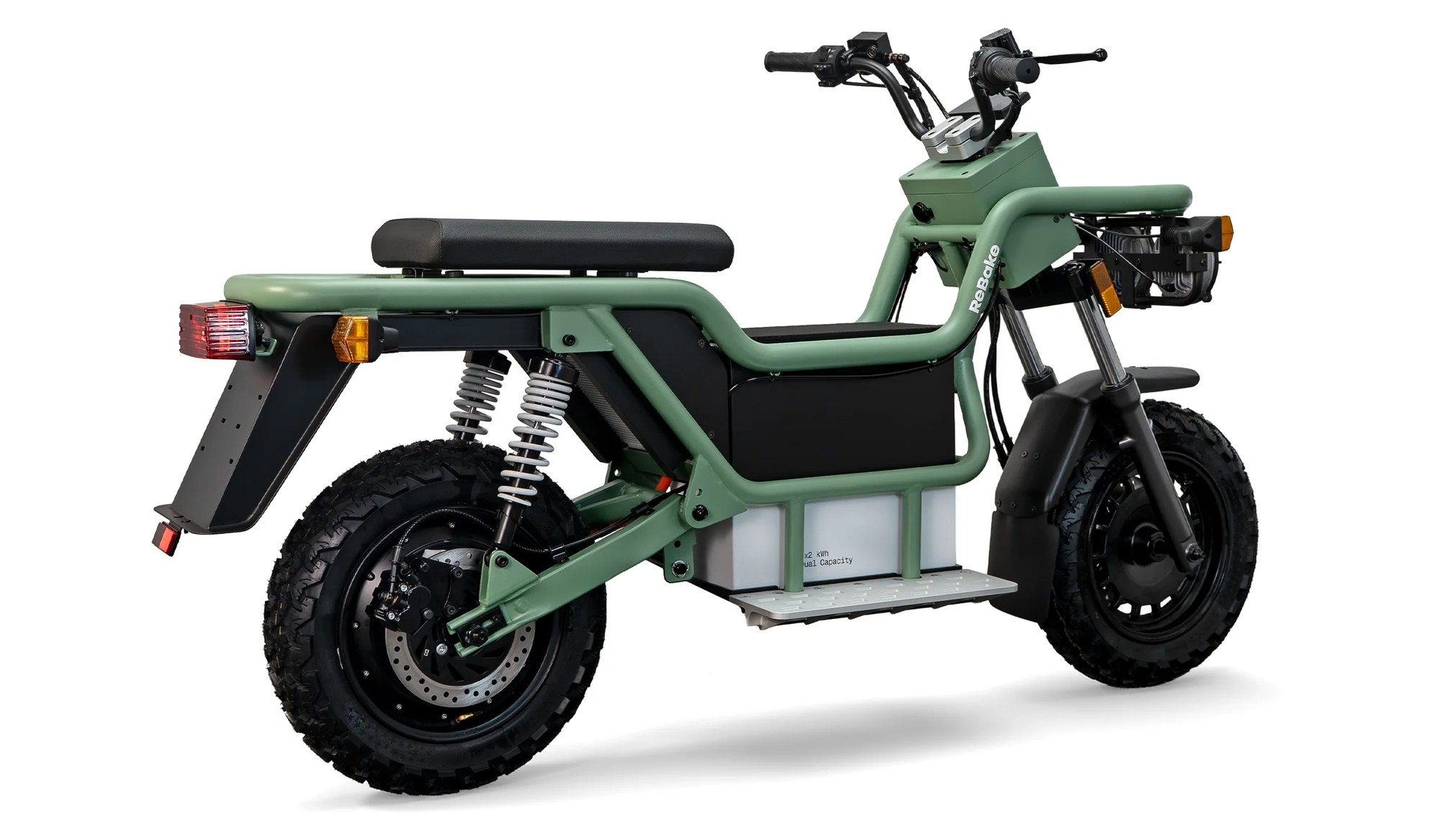
ReBake Motors unveiled its first machine at EICMA in Milan on 3 November 2026. The ReBake Abler is a modular, utility-focused electric motorcycle: a moped-flavoured town machine built around one idea, a fat aluminium tube that doubles as a cargo rack.
Behind the Swedish company sits founder and chief executive Karl Ytterborn. He spent eight years at CAKE, from its founding in 2016 through 2024. ReBake says it wants to apply lessons from that period while removing cost and complexity. All figures below are launch claims, cross-checked against ReBake’s own published spec sheet, as first described by Electrek’s first report from the show.
The tube is the bike
Start with the frame and the rest makes sense. The Abler uses a chunky 42mm aluminium tube as its backbone. It is not trim. It is the mounting system.
ReBake designed the tube with multiple fixing points along its length. Clamp on a grocery carrier. Clamp on a passenger seat. Clamp on boxes and work gear. The pitch is simple: one solid rail, many layouts, no bespoke subframe for each job.
One strong rail beats a scatter of weak brackets. It is easier to inspect, easier to tighten, and easier to replace.
Vespa builders worked this out in the 1960s and never stopped. Good utility frames have always been their own accessories catalogue.
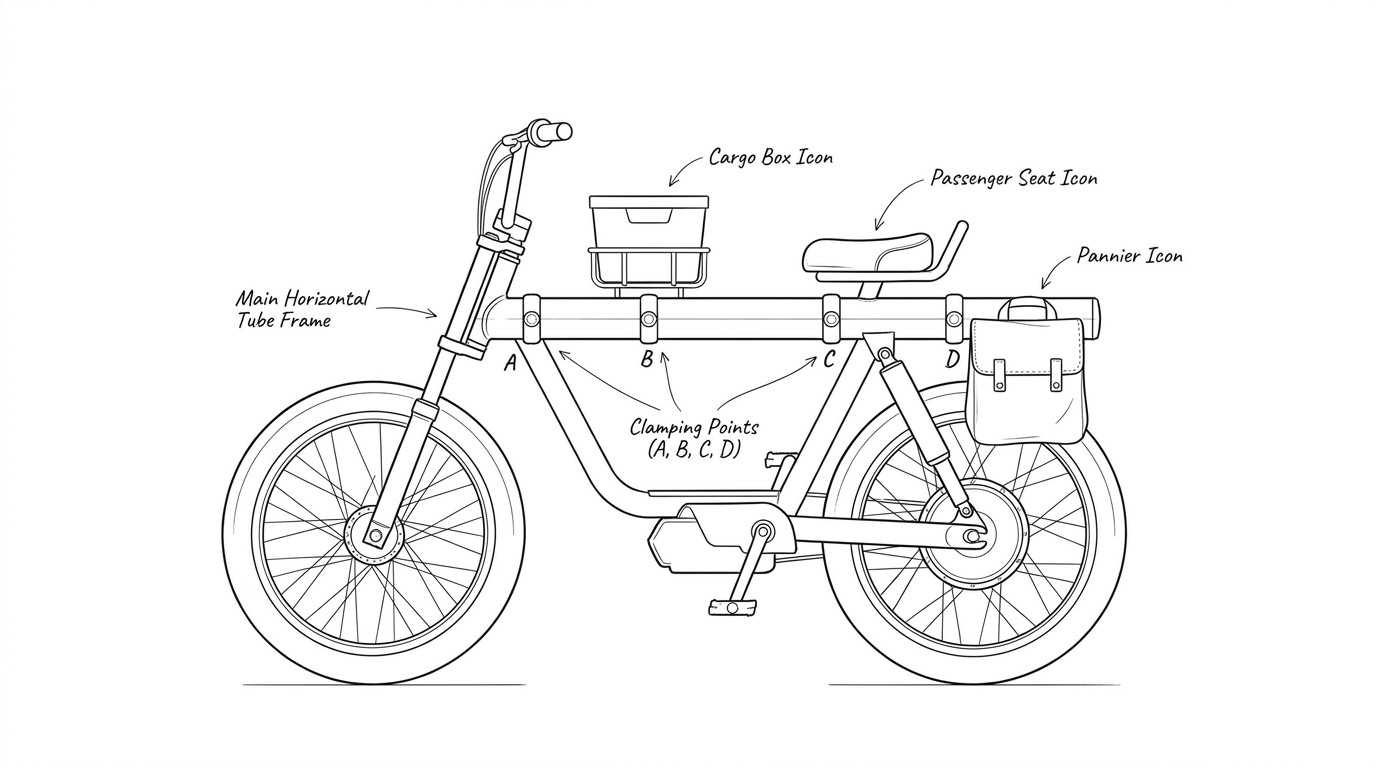
ReBake has not yet published a full accessory list with rated loads. Treat the system as promising but unproven until those numbers and mounting standards appear. The concept is sound. The detail work will decide it.
Two versions, two licences: Abler45 vs Abler80
ReBake offers the same basic bike in two homologation flavours. Pick by licence and speed needs, not by paint.
The Abler45 is an EU L1e-B machine. That is the European two-wheel moped class, limited to 45 km/h and to 4 kW maximum continuous rated power. It suits riders on a moped entitlement who want town pace and lower running costs.
The Abler80 steps into the L3e-A1 class. That is the entry motorcycle category, the A1 tier, which in Europe covers small machines up to 11 kW with a 125cc petrol equivalent. ReBake claims over 80 km/h for this version, which moves it into short arterial-road work rather than back streets only.
Both use a direct-drive rear hub motor. That means no chain or belt. Fewer wear parts. Less routine adjustment. The trade is unsprung mass at the wheel, which the suspension must manage.
| Claimed spec (subject to change) | Abler45 | Abler80 |
|---|---|---|
| EU class | L1e-B moped | L3e-A1 light motorcycle |
| Top speed | 45 km/h (28 mph) | Over 80 km/h (50 mph) |
| Nominal motor power | 4 kW | 6.14 kW |
| Peak motor power | 5.12 kW | 7.68 kW |
| Standard batteries | 1 x 2 kWh, space for 2 | 2 x 2 kWh |
| Claimed range, two batteries | 160 km inner city / 120 km faster pace | 114 km inner city / 98 km faster pace |
| Claimed range, one battery | 80 km inner city / 60 km faster pace | 57 km inner city / 49 km faster pace |
| Dry weight, without batteries | 88.7 kg | 88.7 kg |
| Price including VAT | From 3,990 EUR | 4,990 EUR |
Nominal power is the continuous rating the motor can sustain. Peak power is the short burst available for pull-away and hills. The EU type-approval rules cap an L1e-B moped at 4 kW continuous power and 45 km/h design speed, which explains the Abler45 rating. Irish transport guidance summarises the L1e-B licensing position in plain terms for riders new to the class.
If you ride mainly in a 30 km/h zone, the slower bike will do. If your commute includes a 70 or 80 km/h ring road, the faster homologation matters more than the extra kilowatt on paper. This is also where European buyers should be careful. Unlike the looser US moped-style ebike rules where looks do not decide legality, an L1e-B and an A1 machine carry different registration, helmet and licence duties.
Batteries and range, with the conditions attached
Energy comes from removable 2 kWh blocks using LFP chemistry. That is lithium iron phosphate, a cell type that tends to be heavier than nickel-based cells but offers long cycle life and stable behaviour. Each pack weighs a claimed 17 kg and runs at 51.2 V nominal. ReBake rates the cells for 2,000 full cycles before they drop to 80 per cent capacity. That is about five years at one full cycle a day per pack, and twice that if two packs alternate.
The Abler45 ships with one battery and has room for two. The Abler80 ships with two packs for 4 kWh total. ReBake’s claim grid runs on pack count and pace. Inner city, one battery: up to 80 km on the Abler45, up to 57 km on the Abler80. Two batteries: up to 160 km and up to 114 km. Faster city pace trims that to 60 and 49 km single, 120 and 98 km dual. The fine print matters. Those cells assume the original tyres, the stated battery count and the stated pace, and ReBake notes a street tyre option raises them. Real life subtracts.
Read that grid twice. Pack count and pace decide most of it. Temperature, load and hills do the rest. Expect less in winter with a passenger and a box on the tube.
Charging is straightforward. Each battery can charge on or off the bike from a normal 230 V outlet. ReBake claims four hours from empty, or three hours to 80 per cent. The firm’s own note lands the practical point: you rarely start from zero. A removable pack helps riders without a garage socket. Carry one block upstairs. Leave the bike locked below.
Seventeen kilograms is a proper lift. It is manageable for most adults over a short carry, but not light. Check handle placement and wheeled options if stairs are part of your daily route. ReBake’s sheet lists dry weight too: 88.7 kg without batteries, roughly 106 kg ready to ride for the Abler45 and about 123 kg with both packs fitted. The bike itself stays parked. The packs are what you carry.
Running gear: simple where it counts
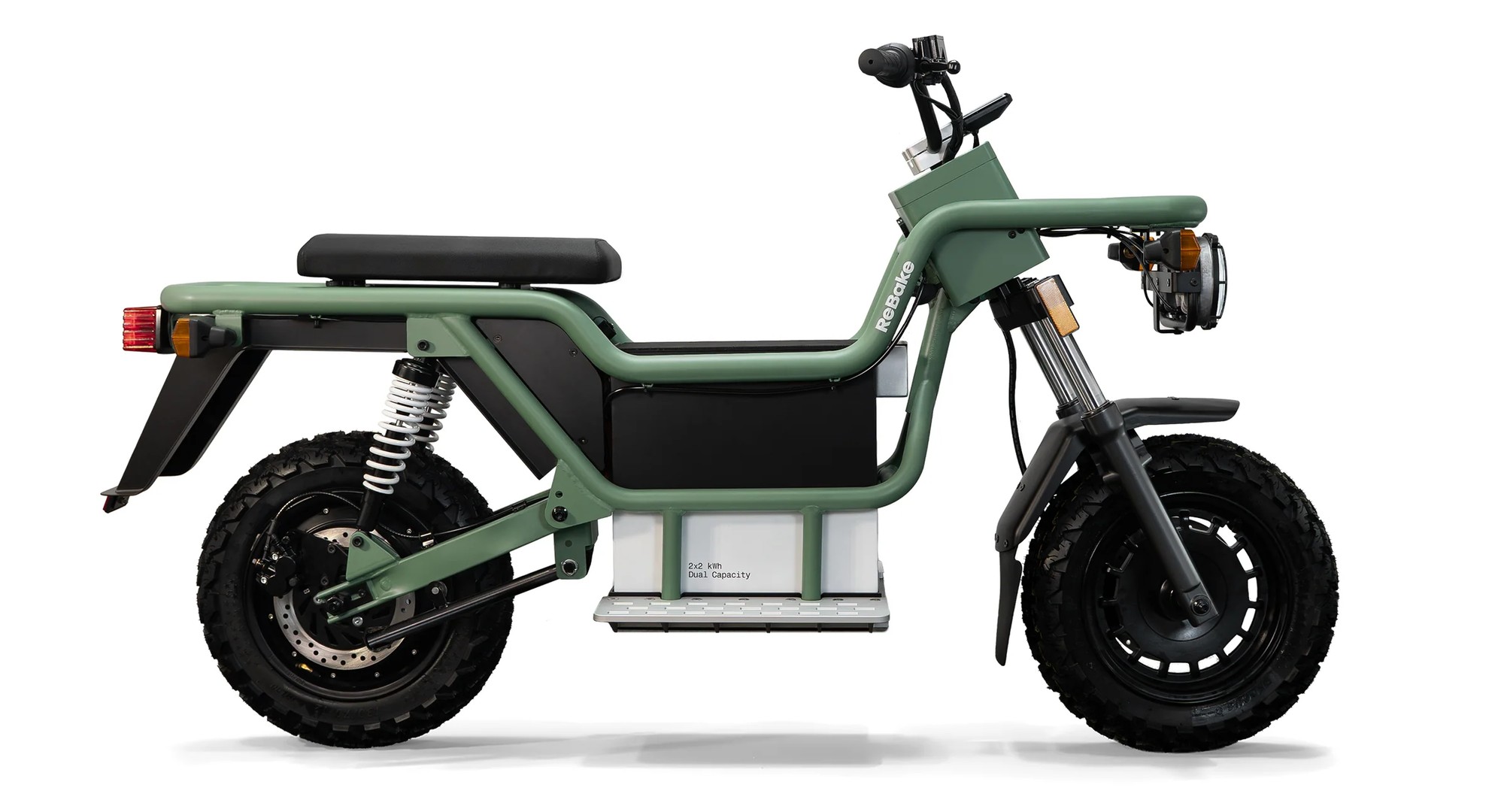
The chassis spec reads like a list chosen for serviceability. Fourteen-inch cast wheels. A front fork with 140mm of travel. Dual rear shocks. Front and rear disc brakes with combined braking. Regenerative braking. Full LED lighting.
Combined braking links front and rear when you pull one lever, which steadies novice stops in the wet. Regenerative braking feeds a little energy back on deceleration and reduces pad wear. Neither replaces good tyres and road sense.
Small wheels help step-over height and low-speed agility. They drop into potholes more readily than large wheels, so the fork’s numbers matter: 140mm up front, a mere 62mm at the rear. At 1,894mm long with a 1,267mm wheelbase, the footprint is half a motorcycle, with room left over for the rack. Seat height, ground clearance and rated payload remain unpublished. Those three numbers will tell us more about real utility than any studio photo.
The direct-drive hub keeps the driveline quiet and clean. The open question is heat management on long climbs with load. ReBake will need to show thermal behaviour and hill-climb data before courier buyers commit.
Who it suits, and the CAKE lesson
This is not a weekend toy. It is a town tool. Think shops, school runs, rental fleets, campus maintenance, or light deliveries. If your day is short hops with parcels, the tube layout lets one bike cover several roles.
The cargo ebike sector already shows how much frame strength and battery capacity shape real range. The Abler applies the same logic to a registered moped. Strong rail. Swappable energy. Modest speed.
The CAKE link is worth stating plainly. CAKE built sharp, light electric bikes and earned real affection. It still failed after funding dried up. Ytterborn says ReBake will cut cost and complexity learned over those eight years.
That shows in the spec. Hub motor instead of an exotic drive. Cast wheels. One frame for two classes. Removable commodity-style LFP blocks. Nothing here chases lap times. For contrast, look at how different the brief was for BMW’s CE 04 electric scooter with its 8.9 kWh pack and higher-output drive. ReBake is aiming at a lower price and a simpler workshop life.
ReBake marks its own sheet “all specs are subject to change”, which is fair for a young firm. What remains unproven is everything around the bike. Dealer cover. Spare parts. Accessory prices. Warranty handling. Type-approval timing by country. A sensible unveiling price only holds if those support costs stay sane.
Before you put down a deposit, ask the dealer:
- How many batteries are included at the quoted price, and what does a second pack plus charger cost?
- What are the rated load limits for each tube mounting point and the rear carrier?
- Which accessories ship at launch, and which are still renders?
- Where is the nearest service point, and how long do common spares take?
- When does type approval land in your country, and what does insurance cost for your class?
- What is covered under the battery warranty, and how is capacity loss measured?
Frequently Asked Questions
How much does the ReBake Abler cost?
ReBake claims from 3,990 EUR including VAT for the Abler45 and 4,990 EUR for the Abler80. Those were unveiling prices at EICMA 2026. Confirm what is included before ordering, especially the number of batteries with the Abler45.
Do I need a motorcycle licence for the Abler?
It depends on the version and your country. The Abler45 is an L1e-B moped, which in most European states needs at least an AM moped entitlement, registration, insurance and a helmet. The Abler80 is an A1 light motorcycle and needs the matching A1 entitlement. Check your national rules.
Are the batteries removable?
Yes, as claimed at launch. Each 2 kWh LFP pack lifts out for charging on or off the bike. Each weighs a claimed 17 kg with a 51.2 V nominal rating, and ReBake rates them for 2,000 full cycles to 80 per cent capacity. The Abler45 takes up to two packs but ships with one. The Abler80 ships with two.
What is the real range?
ReBake’s dual-battery inner-city claims are up to 160 km for the Abler45 and up to 114 km for the Abler80. One battery, inner city: 80 and 57 km. Faster city pace: 60 and 49 km single, 120 and 98 km dual. Treat every cell as a best-case launch figure, calculated on the original tyres. Load, speed, temperature and terrain will reduce them. Independent tests are still needed.
How long does charging take?
ReBake claims four hours from empty, or three hours to 80 per cent, from a normal 230 V outlet, per battery. Charging works with the pack on or off the bike. Ask the dealer whether a second charger is included if you plan to charge two packs overnight.
The workshop verdict
Judge the Abler as a rack with a motor attached. The 42mm tube is the product. Everything else hangs off it.
If ReBake publishes load ratings, accessory prices and service parts quickly, this could become a tidy fleet and family hack. If those details lag, it stays a neat show bike. Cost discipline, not nostalgia, will decide which one it becomes.


