
This design gives concrete its own repair crew. The crew sleeps. It waits inside the set concrete for years. Water from a new crack wakes it up.
That crew is a population of bacterial spores. A spore is a dormant cell form that resists heat, drying, and alkali. Calcium lactate is a calcium salt of lactic acid that serves as bacterial food in the mix. Calcite precipitation is the growth of calcium carbonate crystals, the same mineral in limestone, inside a crack. Together, self-healing concrete bacteria turn a leak into a trigger for stone growth.
What This Concrete Actually Is
Bacterial self-healing concrete is ordinary concrete with two extras. It contains alkali-tolerant spores, usually from the Bacillus group, and a calcium-based nutrient. Both sit quietly during mixing and service.
Nothing happens until a crack lets water in. That trigger and the six-step chain below are the full mechanism.
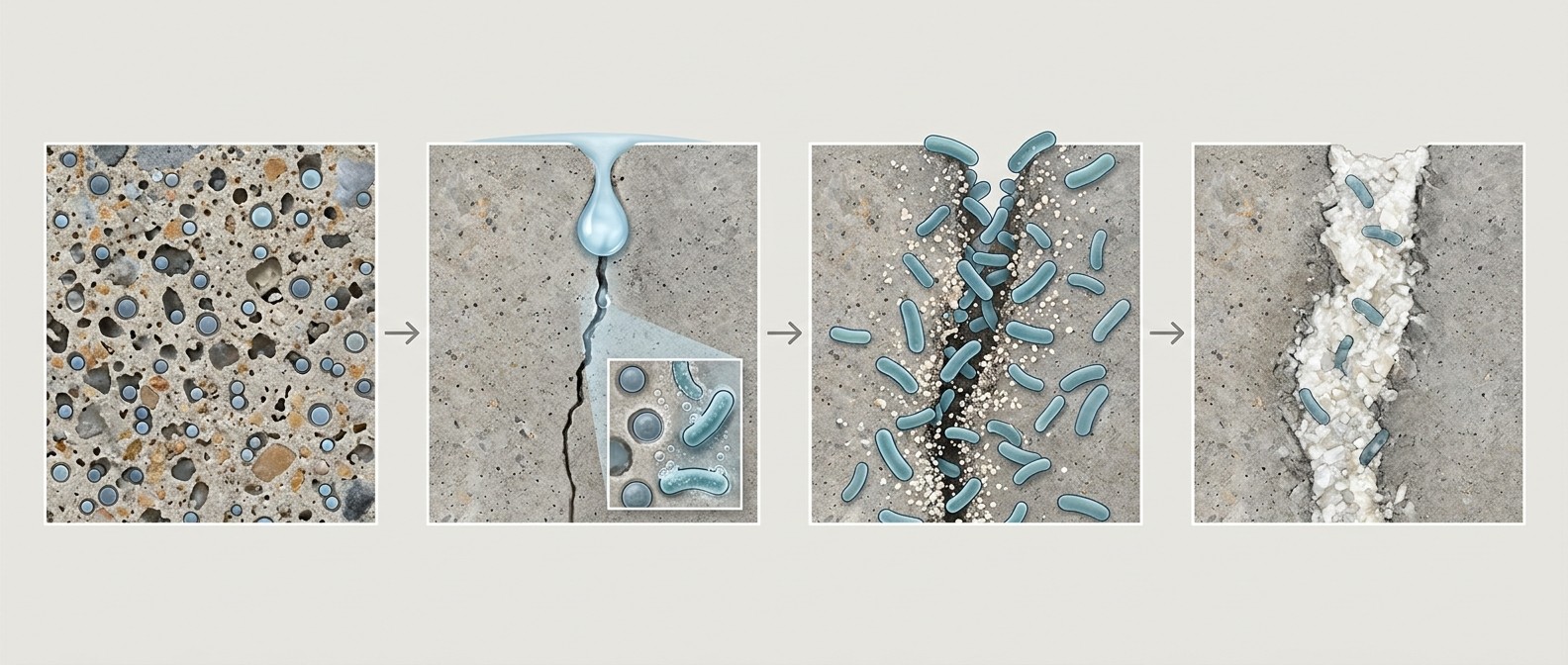
The result is a mineral plug, not living tissue. The bacteria do not knit concrete like skin. They change local chemistry so stone grows where water flows. That distinction matters for what you should expect.
Researchers first demonstrated this approach with Bacillus species protected in porous carriers. The field has roots in work by microbiologist Henk Jonkers and colleagues at Delft University of Technology. The 2026 studies build on that base with better strain screening and better carriers.
How Sleeping Spores Make Limestone, Step by Step
The process is called microbially induced calcium carbonate precipitation. MICP is the abbreviation the field uses for it. It follows a short chain.
- Mixing: spores and calcium lactate are added with cement, water, and aggregate. Spores stay dormant because free water soon disappears.
- Dormancy: concrete pore fluid reaches about pH 12 to 13. Vegetative cells would die. Spores persist because their coats and low metabolism resist alkali and pressure.
- Cracking: shrinkage, load, or freeze and thaw opens a microcrack. Rain or groundwater enters.
- Germination: water plus nutrients revives spores at the crack wall. Cells become active for days to weeks while moisture lasts.
- Chemistry: cells oxidize calcium lactate or split urea, depending on strain. Both routes raise carbonate concentration and pH near the cell.
- Sealing: carbonate meets calcium and forms calcite on crack walls and bacterial surfaces. Crystals grow inward until flow slows.
Water is the switch. No water means no germination. That is why lab tests cure cracked samples in water or high humidity for 21 to 28 days. Dry indoor cracks heal slowly or not at all.
One dose heals one place once. The nutrient near that crack gets used. A second crack in the same spot has less food left. Limit 4 in the disadvantages section below restates this as the one-shot nutrient rule.
Why Bacillus Survives Concrete and How Labs Now Pick Strains
Fresh concrete is hostile. High pH dissolves cell membranes. Mixing shears cells. Pores shrink as cement hydrates. Most microbes die fast.
Bacillus species cope by forming spores. The spore core holds DNA in a dehydrated state. A thick cortex and protein coats block chemicals. The spore can wait for years and revive in hours when water and food return.
Even spores need help. Labs now load them into protective carriers. Examples include lightweight expanded clay aggregate, known as LECA, and natural sisal fibers. The carrier creates a small shelter with space and nutrients.
Two 2026 frameworks change that. One team screened more than 200 soil isolates and kept strains that retained at least 70% of enzyme activity after exposure to pH 13.5 and precipitated up to 89% more calcium carbonate than controls during lab screening, as reported in the abstract of the dual-enzyme screening study of indigenous alkaliphilic bacteria, which I read via its PubMed abstract. A related framework for selecting strains by urease and carbonic anhydrase activity, read via its abstract, tested nine candidates and advanced only those with strong enzyme scores and at least 0.6% survival in simulated pore solution into 50 mm mortar cubes cured for 28 days.
The practical lesson is simple. High mineral output in a flask means little if the strain dies at pH 13. Survival plus enzyme activity predicts crack closure. An August 2026 biosafety review of bacterial self-healing concrete adds that effective healing needs sporulation, germination, reactivation, and biofilm-linked mineral growth in sequence, and favors well-characterized spore formers such as Bacillus subtilis over poorly tracked isolates.
Bacterial Healing Compared With Other Self-Healing Types
Bacteria are one option among several. Each suits a different crack size and trigger.
| Method | How it seals | Reliable crack width in labs | Needs |
|---|---|---|---|
| Autogenous healing | Unhydrated cement hydrates; dissolved calcium forms calcite | Below about 0.2 mm | Water, young concrete |
| Bacterial MICP | Spores germinate and deposit calcite | Often 0.2 to 0.5 mm; up to about 0.97 mm in best reports | Water for days to weeks |
| Capsule or vascular | Cracked capsules release glue or minerals | Varies by capsule; often narrow cracks | Crack must hit capsule |
| Roman lime-clast route | Quicklime fragments dissolve and recrystallize as calcite | Small cracks in ancient walls | Lime-rich mix, moisture |
Autogenous healing is free and automatic, but limited to hairline cracks in moist, young concrete. Capsules can act fast, but each capsule works once, and their placement in a pour is uneven. Vascular networks can refill, but they add complexity.
Roman concrete is often cited here. MIT-led work published in 2023 found that ancient Roman mixes held lime clasts, small reactive lime fragments from hot mixing with quicklime, that dissolve when water enters and then recrystallize to seal cracks. Modern bacterial concrete copies the outcome with a different tool. It copies the mineral chemistry, not the Roman recipe.
A related enzyme route uses carbonic anhydrase to speed carbonate formation. Worcester researchers showed millimeter-scale cracks sealing within 24 hours in lab tests, as covered in earlier Intelligent Living reporting on self-healing concrete that consumes CO2 to fill its own cracks. Bacteria are slower. They typically need weeks, but they bring dormancy and longer shelf life.
What 2026 Studies Found, With Curing Time Attached
The surge of 2026 work gives fresh numbers. Read each result with its curing and healing time, because time is part of the claim.
A September 2026 study of bio-enhanced lightweight concrete treated LECA with Bacillus subtilis and Bacillus pasteurii. The figures in this paragraph come from the reported abstract and publisher summary, which is all that is publicly accessible. Treatment cut LECA water absorption by up to 51.9% and raised dry aggregate mass by 1.5 to 2.0% in lab preparation. In undamaged lightweight concrete, the bacterial mix measured 6 to 10% above the reduced-strength control in compression, with the peak at 14 days of curing.
After cracking and then 21 days of water healing, the same bacterial concrete reached 24.94 MPa in compression and 3.24 MPa in flexure. Those values were 23% and 35% above healed bacteria-free specimens tested after the same 21-day healing period. Microscopy showed calcite-compatible deposits and partial filling at an approximately 2-micrometer crack in the matched healed sample. The bacterial mix also raised air content from 2.0 to 5.5% and slump from 10 to 13 cm to 13 to 16 cm, which designers must account for in freeze-thaw and workability specs.
An April 2026 study of Ferrock blends with immobilized Bacillus tropicus is likewise reported here from its abstract and publisher summary. The program tested M40 concrete, a standard Indian structural grade, at a 1:1.46:2.84 mix with a 0.34 water to cement ratio after 28 days of curing. The best mix combined Ferrock, a cement alternative made from iron-rich steel byproducts, with sisal fibers and fiber-immobilized bacteria, plus a dual nutrient of artificial nutrients and watermelon seed powder. It reached 60.75 MPa in compression with a density of 2,521 kg per cubic meter after 28 days. Flexural strength rose by factors of about 1.40 and 1.58 in two bacterial variants versus control after 28 days. Crack widths in the program ranged from 0.31 to 0.92 mm. The top bacterial mix showed 90.22% healing efficiency and more than 16% higher regain in compressive strength than the bacterial control without Ferrock and immobilization.
A 2026 limestone calcined clay program in Iran, also read via its abstract, found a similar optimum at modest dose. The best mix used 8% limestone calcined clay replacement with 20 mL of Bacillus sphaericus solution per mix. It reached 60.30 MPa at 28 days, about 11.7% above control tested at the same 28-day age. Response modeling pointed to 8.2% clay and 19.5 mL bacteria as the predicted sweet spot. Higher doses did not help.
Take these as lab strengths under wet healing, not field guarantees. Wet curing, small samples, and controlled crack widths favor healing. Outdoor slabs face drying, frost, chlorides, and wider movement.
Where It Pays and Where Patching Still Wins
The value lies where water gets in and repairs are costly. Think tunnels, basements, bridge piers, dams, marine walls, wastewater tanks, and buried pipe. In those settings, sealing a 0.3 mm crack early can slow chloride ingress and steel corrosion. For a homeowner this is not yet an option, which is why the section below and the FAQ both say the same thing: keep the sealant gun for the patio and driveway.
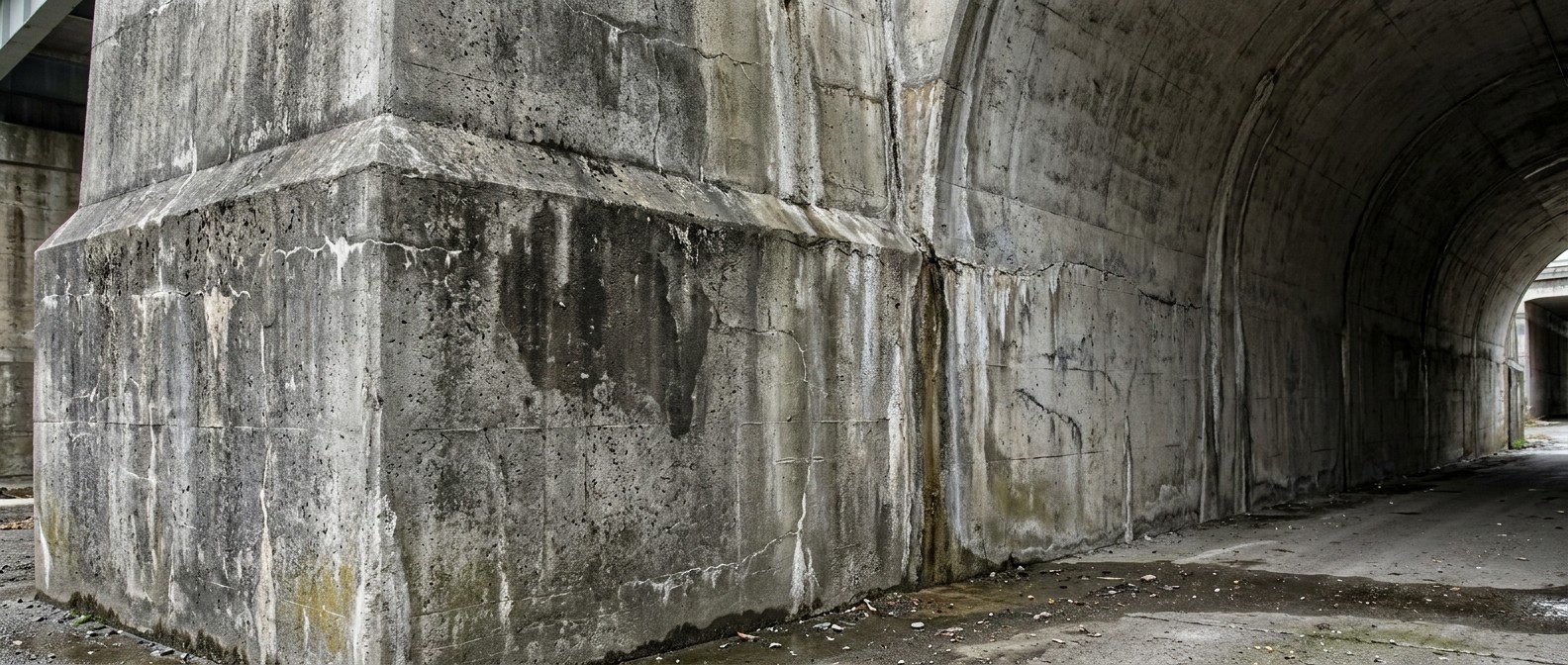
It pays poorly where cracks stay dry. A living-room slab crack in a heated house may never see enough moisture to germinate spores. A driveway crack wider than about 1 mm will likely need routing and sealant. Duct tape belongs in a kitchen drawer, not on a load path. A structural shear crack needs an engineer, not microbes.
Price questions rank high in search. There is no stable retail bag price for bacterial concrete. Cost sits in cultivation, encapsulation, quality control, and nutrients. Watermelon seed powder and similar dual nutrients are being tested to cut media cost, but field pricing remains project based. For a homeowner, a tube of polyurethane sealant remains cheaper and faster in 2026.
For an owner of a water-retaining structure, the math differs. If bacterial dosing adds upfront cost but delays one major repair cycle, a payback period is more useful than a sticker price. A payback period is more useful than a sticker price. Bacterial dosing can add upfront cost, yet one delayed major repair cycle can erase it. The sensible comparison is lifetime repair cost per meter of crack kept sealed, not price per cubic meter.
The CO2 Math, Honestly
Cement production drives most of concrete emissions. Industry analyses place concrete near 8% of global carbon dioxide emissions, largely from clinker production and fuel. Healing does not erase that.
The direct uptake is small. Calcite formed in a crack absorbs some CO2, but the mass is grams per crack. That does not offset kilograms from cement manufacture. Earlier coverage of enzyme concrete made the same point. The climate benefit comes from longevity, if longer intervals between repair and replacement cut total cement demand.
Two material swaps could add savings. Ferrock uses iron-rich byproducts to replace part of the cement. Limestone calcined clay, known as LC3, also trims clinker. Both showed strengths above 60 MPa at 28 days in the 2026 bacterial programs noted above. Those gains came in lab mixes, yet they point to a useful pairing. Lower-clinker binder plus crack sealing attacks both upfront carbon and repair carbon.
Do not count avoided repairs until field data confirm them. Healing cuts permeability in labs. Field proof of lower chlorides, freeze damage, and rebar corrosion over decades does not exist yet.
Limits and Disadvantages
This is where skeptical readers should linger. Bacteria help within bounds.
- Water dependence: healing needs sustained moisture. Lab healing often means 21 to 28 days wet. Field concrete dries between rains.
- Crack width cap: reliable sealing centers on hairline to moderate cracks. Best lab reports reach near 1 mm. Wider or moving cracks reopen.
- Cell survival: mixing, high pH, and pore shrinkage kill many cells. Carriers help, but dosing and shelf life remain sensitive.
- One-shot nutrients: lactate, urea, or seed powder near a crack gets consumed. Repeat healing at the same spot weakens.
- Strength tradeoffs: carriers and air can alter workability and freeze resistance. The LECA bacterial mix raised air from 2.0 to 5.5%, which needs mix review.
- Time: weeks, not hours. Enzyme systems sealed millimeter cracks in 24 hours in lab tests. Bacteria often need a month.
- Oversight: use of live microbes in infrastructure needs biosafety review. The 2026 reviews favor known spore formers with low pathogenic potential and contained use, not exotic strains.
Small, wet cracks are fair game. Large, dry, or structural cracks are not. That is the honest limit, and the 2026 literature honors it too.
Frequently Asked Questions
Quick answers, with the limits kept in.
What made Roman concrete self-healing?
Reactive lime fragments. Hot mixing left lime clasts that release calcium when water enters, then recrystallize as calcite. It is mineral chemistry, not bacteria.
Is self-healing concrete hype?
No. Published tests show real calcite sealing real cracks. The honest caveat is scope: it works on hairline to moderate cracks with sustained moisture, and it is slow. Critics also point out that some fill can be ordinary autogenous healing rather than bacteria, so good studies include bacteria-free controls. The 2026 papers all used them.
What are the different types of self-healing concrete?
Autogenous healing from unhydrated cement, bacterial mineral growth, capsule release of binders, vascular networks that pump sealant, and shape-memory or fiber systems. Bacteria suit damp microcracks. Capsules suit local fast seals.
How is self-healing concrete made?
Spores and a calcium nutrient are added during batching, often inside porous aggregate or fibers. Concrete is placed and cured normally. Healing starts later, only if a crack admits water.
What are the disadvantages of self-healing concrete?
Higher upfront cost, need for water, crack-width limits near 1 mm, nutrient supply per healing event, and shifts in air content and workability. Dry or structural cracks still need conventional repair.
Is self-healing concrete being used?
You cannot buy this for a residential driveway. No major producer sells bagged bacterial concrete at a home-improvement store. The one commercial product with a public track record is Basilisk Self-Healing Concrete, a TU Delft spin-off operating in the Netherlands and used in pilot infrastructure and precast elements in Western Europe. Beyond that, use is pilots and test slabs in Belgium, the UK, and the Netherlands. Broad commercial use awaits cost, code, and long-term field proof. No reliable public per-cubic-meter price exists, and this page will not invent one.
What to Watch Next
Watch for field slabs with metered leakage, not just lab cubes. Good trials will report crack widths, rainfall or ponding time, healing days, regain strength at matched age, and chloride ingress. They will name the strain, carrier, nutrient dose, and pH survival data.
Watch strain screening too. The 2026 dual-enzyme approach gives buyers a checklist. Ask for urease and carbonic anhydrase scores plus survival data in simulated pore solution. A vendor with only flask carbonate data is selling an incomplete story.
Concrete that carries a quiet repair crew is real. It is also narrow in scope. It seals small cracks where water lingers. It does not make buildings maintain themselves. For tunnels, tanks, and piers, that narrow skill may be enough to matter. For a dry patio crack, keep the sealant gun. Broader living-material visions, from cellulose blocks to other self-healing material innovations, remain research projects rather than building specs.

