
Data center heat greenhouses promise a neat trade. Servers make heat all year, and plants want heat in winter, so why not pipe one to the other?
The catch is grade. Most data centers reject heat at 25–40°C (77–104°F), which is warm air, not heating water. Greenhouses can use it, but only with the right setup, and the limits show up in the same sentence as every success.
Why Low-Grade Heat Is the Whole Story
Waste-heat grade means how useful heat is, and it depends on temperature. Server halls cooled by air typically exhaust at 30–40°C (86–104°F). That range is confirmed in metering from Meta’s Odense center, where recovered air sat at 30–40°C (86–104°F) before upgrade. A greenhouse held at 18–20°C (64–68°F) can accept that warmth directly on mild days. A district network needing 70–80°C (158–176°F) water cannot, which is why operators add a heat pump.
A heat pump lift means boosting low temperatures to a useful level by spending electricity. The Scottish review of data center heat reuse puts typical data center heat at 20–40°C (68–104°F) and states it must be upgraded with heat pumps for network use. The lift works, but it consumes power and cuts net savings. Any claim that skips the lift is skipping the bill.
What Real Projects Actually Measured
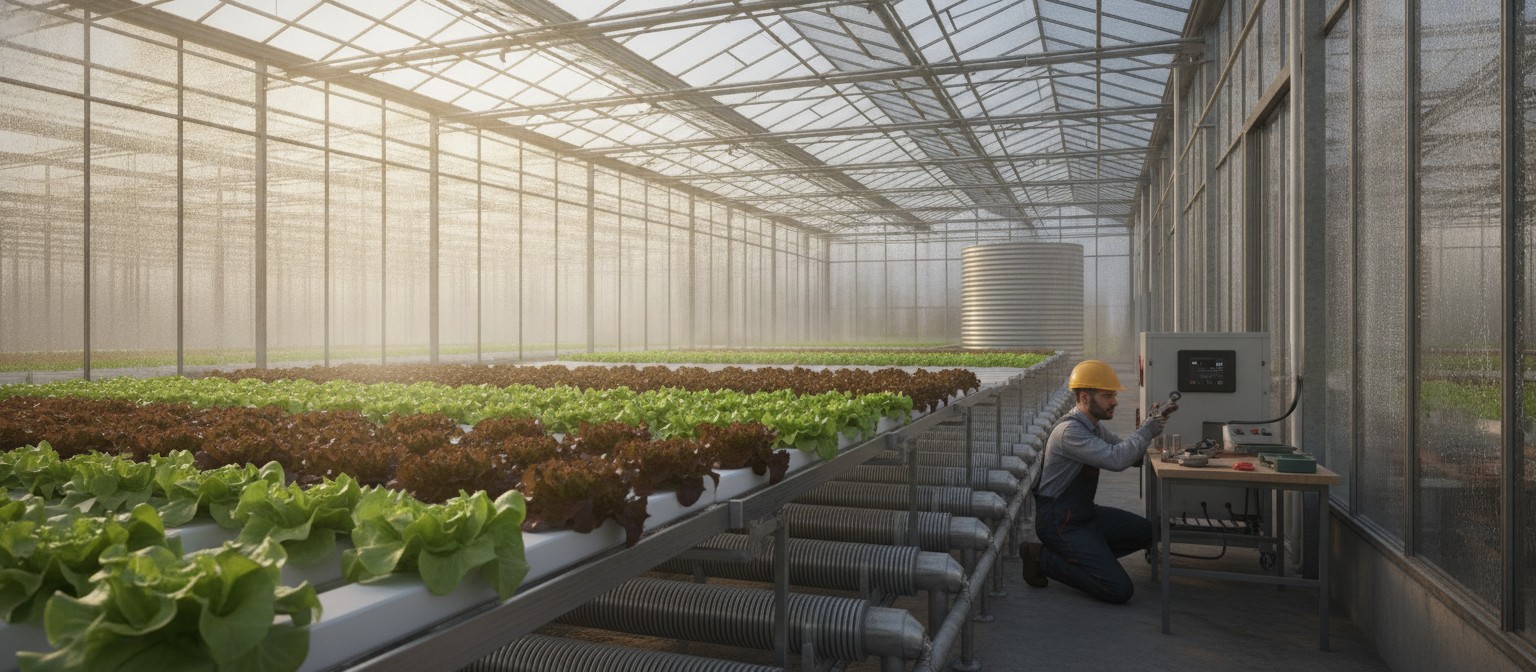
The strongest built example is small. Equinix opened a 430 sq m rooftop greenhouse on its PA10 data center in Saint-Denis, Paris, warmed with heat exchangers tied to the site’s chilled water system plus sensors, shades, irrigation, and ventilation. It grows seasonal fruit and vegetables hydroponically. Equinix itself treats the larger heat export, including warming more than 1,000 nearby homes and the Olympic aquatic center network, as the main heat story. The greenhouse is the visible proof, not the volume user.
The detailed engineering numbers come from simulation models using real weather data, not from metered commercial houses. In Baie-Comeau, Quebec, researchers modeled a 153 sq m fabric greenhouse beside a 1 MW server room. That is demonstration scale, roughly the footprint of a large house, and not a template for a commercial glasshouse. A water-to-water heat pump raised recovered heat to 60°C (140°F) for storage and finned-pipe heating, with a propane heater kept as backup for peaks below minus 15°C (5°F) and for grid load-shedding hours. The Quebec heat recovery study cut modeled energy use by 66% and cut modeled greenhouse emissions from 348 to 31 kg CO2 equivalent per sq m, a 91% drop, but only because Quebec electricity is very low carbon and backup heat still existed. The study also notes the recovery plant needs its own capital spent on exchangers, heat pumps, storage tanks, and pipework, plus a full backup heater, and it omits a full financial and life-cycle analysis.
Swedish work sets the sizing rule, again from simulation rather than commercial metering. A modeled study of a 1 MW data center feeding 2,000 and 10,000 sq m greenhouses found only 5.5 to 30.5% of electrical input could be recovered as useful heat, and the small greenhouse met 89.7 to 97.9% of demand from excess heat, while the large one met only 50.0 to 61.5%. A later Swedish optimization put the design need at 0.40 to 10 kW of data center power per sq m of greenhouse, with warmer climates and matched humidity needing far smaller data centers. Oversize the glass, and the same server hall covers half the load. None of these are measured commercial outcomes.
What the Headline Bill Actually Contains
Four costs decide whether the trade pays. First, heat pump capital and running cost. Exchangers, a water-to-water heat pump, a storage tank, and greenhouse pipework must be bought and powered, and the pump electricity trims net savings. Second, seasonal balance. Steady server heat in July is worthless to a greenhouse that needs nothing, so a project without a summer heat user wastes half the year. Third, distance. Heat degrades with every meter of pipe, and Microsoft and NYSERDA both note many data centers sit too far from heat users to connect economically. Co-location or a heat network must already exist. Fourth, cold snaps. At minus 15°C (5°F), the Quebec model sheds the data center load and fires propane backup, so the fossil heater is sized and paid for anyway. A reader promised free heat should see these four lines on the same bill.
Seasonal Mismatch: Steady Supply, Seasonal Demand
Seasonal mismatch means steady supply meets seasonal demand. Data centers reject heat at a near-constant rate all year. Greenhouses need most heat on cold, dark winter nights and little in summer, exactly when light limits growth anyway. Quebec researchers flagged this directly. Heating in deep winter is pointless without enough light for photosynthesis, so artificial lighting energy can erase heating gains. Surplus summer heat simply has nowhere to go unless a second user takes it.
Humidity is the second mismatch. Pumping warm moist server air into glass raises humidity, and Swedish modeling found poor temperature and humidity matches could add over 1,000 kWh per sq m per year in extra demand from dehumidification. That is why the Paris roof project uses sensors, shades, and ventilation, not just a hot pipe.
When Data Center Heat Greenhouses Actually Make Sense
The pattern from the evidence is narrow but real:
- Cold regions with clean electricity, where a heat pump lift still cuts emissions sharply, as in Quebec.
- Small glass area relative to server power, roughly a 1 MW hall for a 2,000 sq m house, not a 10,000 sq m one.
- A backup heater retained for the coldest peaks, because servers alone do not cover minus 15°C mornings plus grid curtailment.
- Crops matched to the available grade, such as lettuce at 18–20°C (64–68°F), rather than heat-hungry winter tomatoes under lights.
Where those hold, recovered heat displaces fossil propane or gas, and the carbon math improves. Where they do not, a greenhouse becomes an expensive way to dump low-grade warmth. The NYSERDA waste heat review lists greenhouses as a valid low-temperature user alongside buildings and aquaculture, but only where contracts, distance, and delivery temperature align.
For wider context on how operators cool halls before any heat is exported, see our look at why data centers need HVAC ventilation systems and where data centers hide to stay cool. A related reuse path is covered in turning data center waste heat into clean water.
Frequently Asked Questions
How hot is data center waste heat?
Usually 25–40°C (77–104°F) for air-cooled halls, and about 30–40°C (86–104°F) measured at Meta Odense. Some liquid-cooled systems return higher temperatures, but the exact return must be checked against the user.
Can a data center heat a greenhouse in winter alone?
Only a small one relative to server size, and not on the coldest peaks. The modeled Swedish 1 MW case covered nearly all heat for 2,000 sq m but only half to three-fifths for 10,000 sq m, and the Quebec demonstration kept propane backup for temperatures below minus 15 °C (5 °F).
Does it cut emissions?
It can, strongly, where electricity is clean. The Quebec model cut modeled emissions 91% versus propane because grid power was low carbon. On a fossil-heavy grid, the heat pump electricity erodes the benefit, so the grid factor decides.
What grows best on server heat?
Cool-tolerant leafy crops at 18–20°C (64–68°F) with modest light needs, such as lettuce. Fruiting crops demanding high heat plus winter lighting are a harder economic fit.
The Bottom Line
Data center heat greenhouses work when treated as engineering, not magic. Match a small, well-ventilated house to a steady server hall, add a heat pump and backup, grow suitable crops, and winter emissions fall. Skip any of those steps, and low-grade heat stays what it started as. Warm air looking for a user.


