
Tardigrades are tiny animals that survive being dried out completely. This tardigrade protein cold chain research borrows one of their proteins to keep medicines stable without refrigeration. The work is in the lab stage, not clinic ready, but the results point to a future where vaccines and blood treatments survive heat and dry storage. That matters for any clinic without a reliable fridge.
Why the Cold Chain Fails So Many Clinics
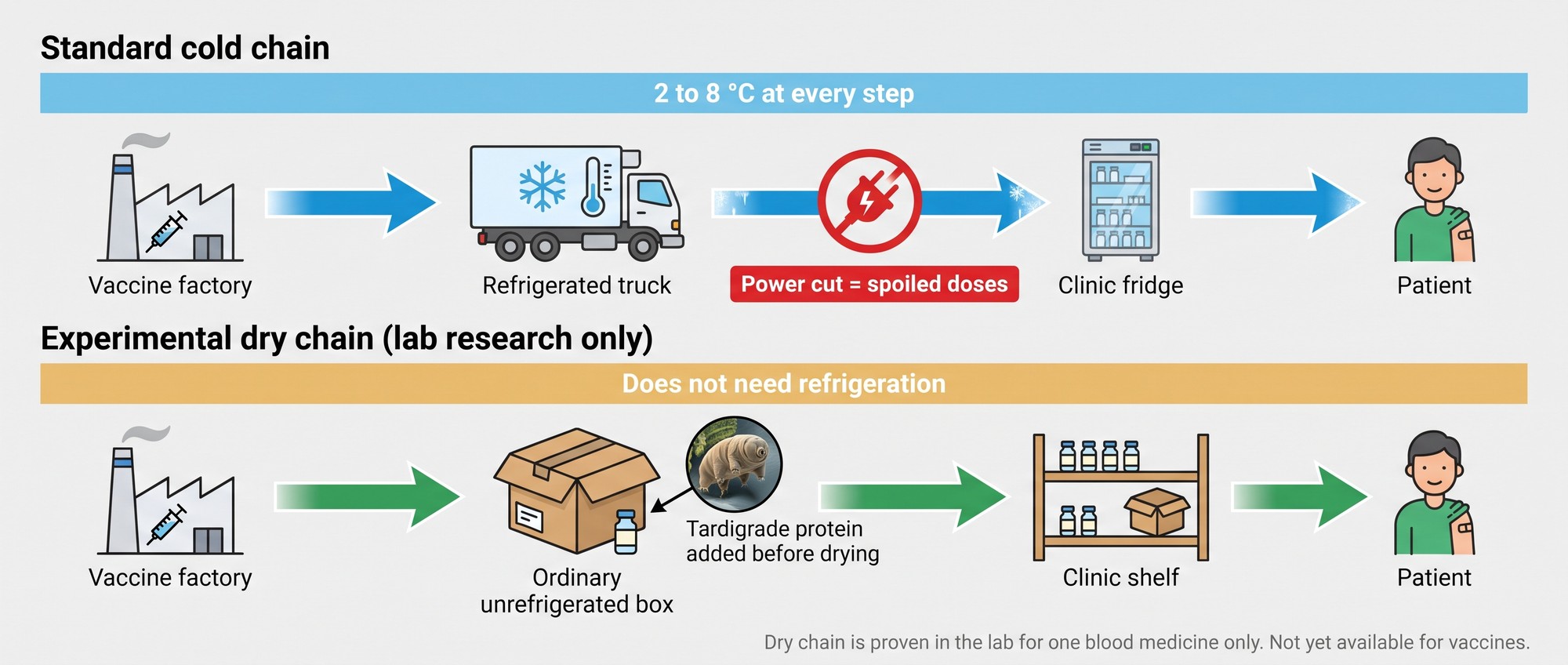
The cold chain is the temperature-controlled supply line that carries vaccines and other heat-sensitive medicines from factory to patient. Many vaccines must stay between about 2 and 8 degrees Celsius. Freeze-dried vaccines still need cool storage. When power cuts out or a fridge breaks, doses spoil.
The World Health Organization has long flagged that broken refrigeration wastes vaccines and limits coverage in remote areas. Solar fridges help, as seen in projects like off-grid solar refrigeration for small businesses and clinics, but equipment still costs money and needs maintenance. A medicine that tolerates room temperature drying would ease that burden. This is lab research with that goal in mind, not a product yet.
Meet the Tardigrade and Its Survival Proteins
Tardigrades, also called water bears, are microscopic eight-legged animals under half a millimeter long. When their ponds dry up, they curl into a ball called a “tun” and enter anhydrobiosis. That word means life without water, a reversible shutdown where metabolism nearly stops until water returns.
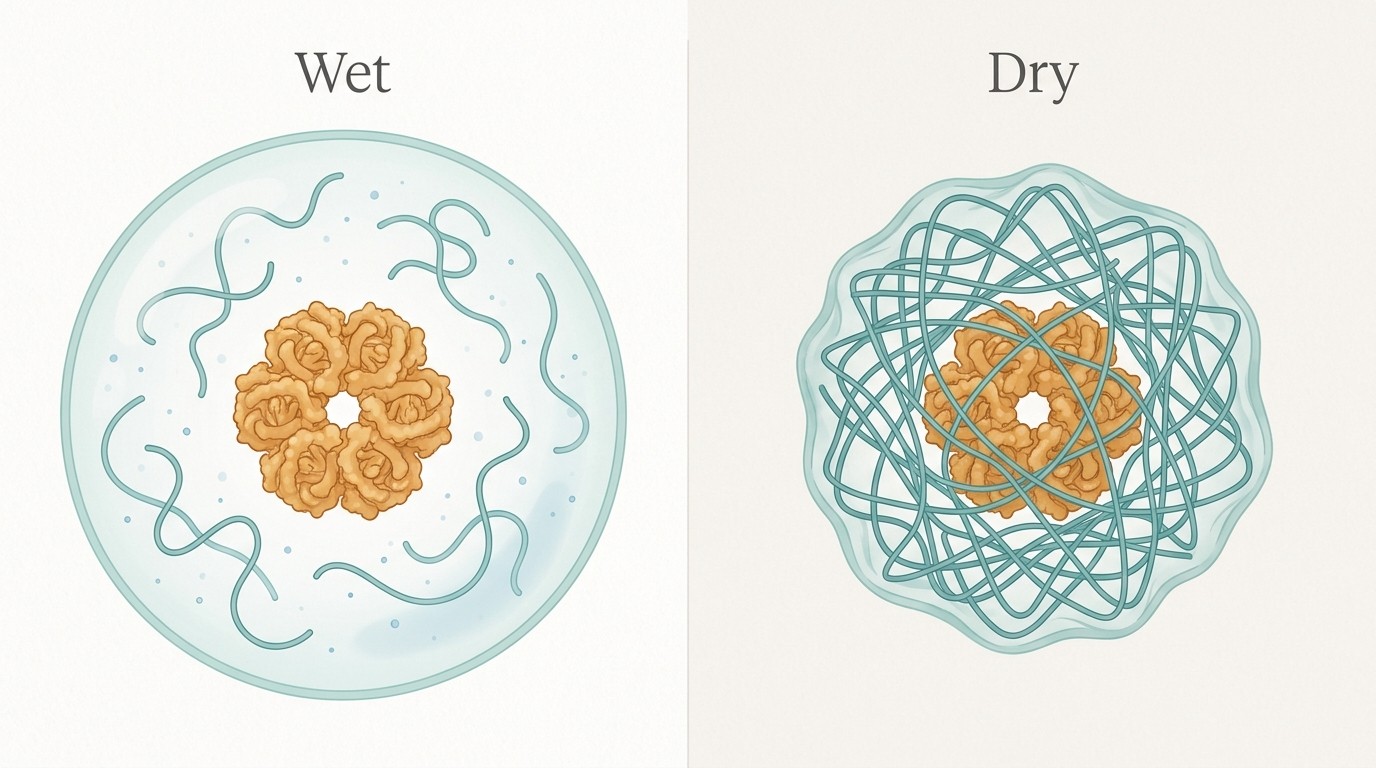
Two protein families do much of the protective work. CAHS proteins, short for cytosolic abundant heat-soluble proteins, are found only in tardigrades. Dsup, short for damage suppressor protein, is a separate tardigrade protein that shields DNA from radiation. Both belong to a class called intrinsically disordered proteins, which means they have no fixed 3D shape when wet and bend flexibly, then stiffen into a protective gel or glass when dry.
As water leaves the cell, CAHS proteins link into a spider web network. That mesh holds other proteins in place and stops them from unfolding or clumping. The result is a kind of bioglass inside the cell. Add water back, and the glass melts, so normal activity resumes. Intelligent Living has covered related tardigrade biology before, including how the Dsup protein helped human DNA withstand radiation.
From Dried Water Bears to Dried Medicines
“Biologics” is the umbrella term for medicines made from or containing living material, including vaccines, antibodies, blood clotting factors, and cell products. Most biologics are proteins. Proteins unfold and lose function when heated, frozen and thawed, or dried. That is why they need the cold chain.
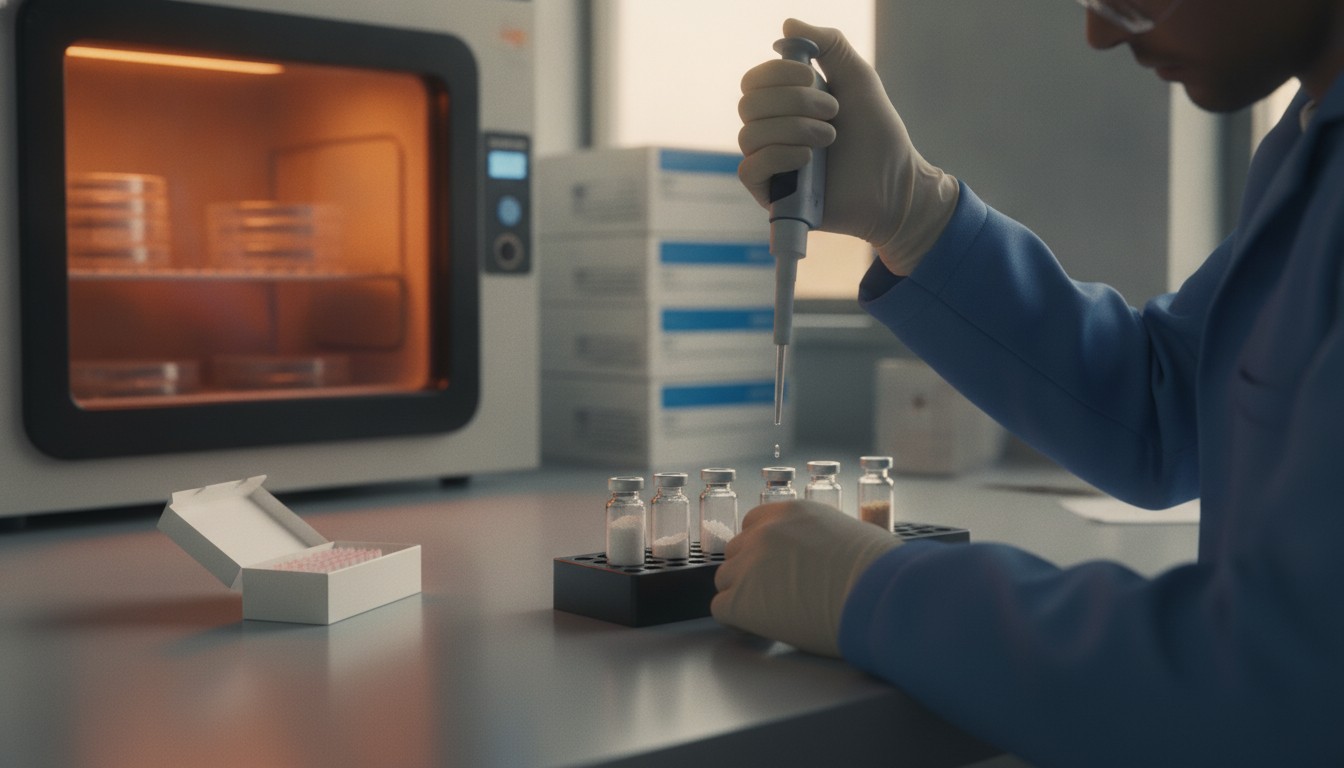
Thomas Boothby’s group at the University of Wyoming asked a plain question. If CAHS proteins protect tardigrade proteins during drying, can they protect human medicines the same way? The team mixed purified CAHS D, one well-studied member of the CAHS family, with the medicine, then dried the mixture and stored it warm. Later they added water and tested whether the medicine still worked.
The approach builds on earlier safety work. An Appalachian State team led by Michael Menze and Thomas Boothby tested CAHS D in mice and published results in Frontiers in Pharmacology, finding no toxic response and no inflammatory response at the tested doses. That study did not test whether a stabilized vaccine still protects against disease. It only addressed early safety in animals, which is one step on a long path.
What the Lab Results Show So Far
The headline experiment used human blood clotting Factor VIII, a biologic used to treat hemophilia and severe bleeding. Factor VIII is famously fragile outside a narrow temperature range. The results, published in Scientific Reports in 2023, showed:
- Dried with CAHS D or the sugar trehalose, Factor VIII kept function through repeated drying and rehydration cycles. Unprotected samples degraded.
- Protected samples stayed active after drying at room temperature and under dry heat. Which protectant worked best depended on the stress, and engineered variants let researchers tune for each one.
- Protein-based protectants proved easier to tune than sugars.
Two of the lab results have solid numbers. Factor VIII dried with the non-gelling CAHS D variant kept full function over ten weeks of shelf storage, while unprotected dried samples degraded within the same window. Under heat, plain CAHS D showed little protection during 48 hours at 95 degrees Celsius, but the gelling engineered variant and the sugars both preserved function in that same test. Lab stage only, not transport proven.
For a clinic without a fridge, that stability translates into simple terms. A dose that survives drying and heat could be stored as a powder on a shelf, then rehydrated before injection. No ice packs, no freezer alarms, no spoiled stock after a blackout. That outcome has been shown for Factor VIII in the lab only. Vaccines are a hoped-for next target, not a proven one.
| Protectant tested | What it is | Lab result with Factor VIII |
|---|---|---|
| CAHS D (natural) | Tardigrade disordered protein | Preserved function through repeated drying cycles, but not heat alone |
| CAHS D (engineered) | Tuned versions with altered gel behavior | Gelling variant won against heat, non-gelling against drying |
| Trehalose | Protective sugar tardigrades also make | Worked, but harder to engineer |
| No protectant | Control | Activity lost after drying and heat |
Vaccines Are the Goal, Not the Proof Yet
No published study has yet shown a tardigrade protein stabilized vaccine protecting immunized animals from infection. That distinction matters. Factor VIII activity can be measured in a test tube, but a vaccine must also trigger a correct immune response, which is harder to preserve.
Early steps toward vaccines exist. The mouse safety study suggests CAHS D itself does not provoke strong inflammation, which is encouraging for a vaccine additive, but safety in mice is not safety in people. A 2026 University of Wyoming project with Sigma Genetics is now applying the same drying logic to RNA lipid nanoparticle formulations, the delivery system used in many RNA medicines, with the stated aim of room temperature dry storage. Results have not yet been published. A student iGEM project likewise tested tardigrade proteins against mRNA heat damage as a design starting point, not a finished formulation.
The range of targets keeps widening. In May 2026, researchers at the University of Michigan and the University of Chicago showed in a Nature Communications study that a CAHS protein can preserve whole synthetic cells through drying and rehydration, by forming a gel that supports the cell membrane. Synthetic cells are engineered bubbles that act as tiny factories for medicines. The work suggests dry storage might one day cover cell-based therapies too, though that remains an experimental idea. Separately, a 2026 American Chemical Society report describes combining CAHS proteins with trehalose to help human blood cells survive freezing. Bluntly: no tardigrade protein product has reached a clinic or a transport trial yet.
So the honest status reads like this. Proven in the lab: CAHS proteins stabilize a fragile blood protein through drying, heat, and ten weeks of shelf storage. Promising but unproven: the same trick for vaccines, antibodies, and RNA medicines. Field tested in clinics: none yet.
What Comes Next for Fridge-Free Medicine
The European Union-funded research featured in Horizon Magazine frames the next questions well. Before any fridge-free medicine ships, researchers must clear four hurdles:
- Shelf life: dried and rehydrated biologics must stay potent for months, not weeks.
- Safety: the added tardigrade protein must prove safe in people at real doses.
- Manufacturing: the protectant must be produced at scale under sterile conditions.
- Humidity: a powder that survives dry heat may still suffer in damp heat, and regulators will want data across the full range.
If those hurdles clear, the payoff is practical rather than dramatic. Fewer spoiled doses. Cheaper transport without ice boxes. Stockpiles that survive disasters and power cuts. Remote clinics that order less often and waste less. None of that needs hype. It needs careful formulation work, one biologic at a time, with each claim tested before it reaches patients.
Frequently Asked Questions
What is a tardigrade?
A microscopic eight-legged animal under half a millimeter long, famous for surviving drying, freezing, heating, radiation, and even space vacuum by shutting down into a dry tun state.
What are CAHS proteins?
Tardigrade only proteins that float flexibly in wet cells and form a protective gel or glass as cells dry, holding other proteins in shape. CAHS stands for cytosolic abundant heat soluble.
What is the cold chain?
The refrigerated supply system that keeps vaccines and other biologics cool from factory to clinic, usually 2 to 8 degrees Celsius. Breaks in that chain spoil doses.
Has any tardigrade protein vaccine been tested in people?
No. Published work covers Factor VIII stabilization in the lab and early CAHS D safety in mice. Human trials of a tardigrade stabilized vaccine have not happened.
Why not just use better fridges?
Better fridges help, including solar models, but they cost money, need power and servicing, and still fail. Heat stable formulations would complement fridges rather than replace them.
The Bottom Line for Clinics Without Reliable Power
The toughest animal on Earth survives drying with a protein trick. Lab teams have copied that trick to keep a fragile blood medicine working after drying and heat. Vaccines are the next hoped-for use, still unproven. If researchers repeat the Factor VIII result across vaccines and prove safety in people, the most boring problem in medicine could get a surprising biological fix.

