
A currency chart tells a story about two economies competing through changing market expectations. When the British pound is measured against the Japanese yen, every movement reflects a balance between economic data, monetary policy, investor confidence, and global financial conditions. Understanding GBP/JPY requires more than watching prices rise and fall. Traders need to examine why those movements occur, how market signals develop, and what risks can emerge when volatility increases.
The Meaning Behind the Currency Pair
The British pound is the base currency, while the Japanese yen is the quote currency. The exchange rate indicates how many yen are needed to purchase one pound. If the rate increases, the pound is gaining value against the yen. If it decreases, the yen is strengthening relative to the pound.
This relationship makes the pair useful for studying differences between the United Kingdom and Japan. A positive economic development in one country does not automatically guarantee currency appreciation, because exchange rates also depend on expectations and developments affecting the other currency.
Two Economies With Different Priorities
The United Kingdom and Japan have distinct economic structures, inflation patterns, and monetary policy objectives. The British economy is influenced by consumer spending, services, employment, and business investment. Japan’s economy is shaped by manufacturing, exports, domestic consumption, and changing price conditions.
These differences influence how investors assess each currency. Stronger British economic growth may support the pound if it improves expectations for interest rates or investment returns, while the UK’s long-term economic growth shapes how investors view the currency over longer horizons. Similarly, improving Japanese economic conditions may support the yen if investors expect changes in monetary policy.
However, markets frequently react to the difference between actual results and previous expectations rather than to the headline figures alone.
Interest Rates Influence Currency Demand
Interest rates are among the most important factors affecting currency movements. The Bank of England and the Bank of Japan establish monetary policies according to their respective economic conditions. The Bank of England does not set the exchange rate itself, although its decisions on interest rates can influence the pound indirectly.
When investors expect British interest rates to remain relatively high compared with Japanese rates, pound-denominated assets may appear more attractive to some market participants. This can increase demand for the pound relative to the yen, influencing the GBP/JPY exchange rate.
The opposite may happen when Japanese rates rise or British rates are expected to fall. Nevertheless, interest rate differences do not determine exchange rates on their own. Inflation expectations, future policy guidance, bond yields, and investor positioning can all change the market’s response.
Global Confidence Can Change the Direction
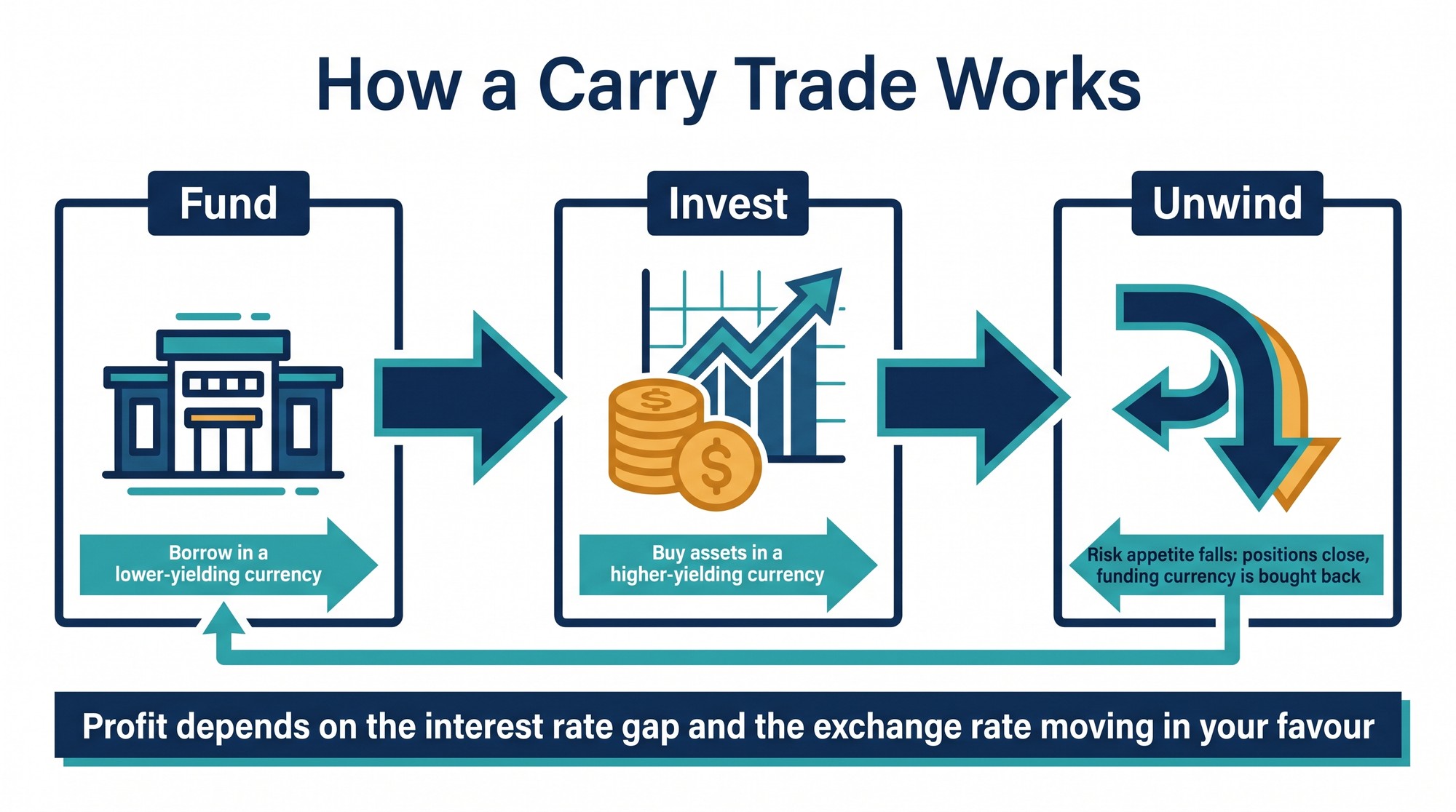
Currency movements are closely connected to investor sentiment. During periods of economic confidence, investors may seek opportunities offering higher potential returns, including strategies that involve borrowing in a lower-yielding currency to invest in higher-yielding assets.
The yen has historically played a role in these carry trades. When investors become concerned about economic uncertainty or financial instability, they may reduce risky positions and buy back yen to close their trades. This process can contribute to sharp movements in the pound-yen exchange rate.
Such reactions are not guaranteed during every period of uncertainty. Currency movements depend on the source of the concern, existing market positions, and the broader financial environment.
Reading Price Charts With Greater Context
A price chart helps traders observe how market participants respond to changing information. Candlestick charts display opening, closing, high, and low prices for a selected period. These details help reveal whether buying or selling pressure dominated a particular session.
Trend lines can illustrate the general direction of price movement, while support and resistance levels highlight areas where prices have previously struggled to move lower or higher. Moving averages can help identify broader trends by smoothing short-term fluctuations.
No indicator can reliably predict every market movement. Technical signals are more useful when interpreted alongside economic developments, trading costs, and the timeframe being analysed.
Volatility Creates Opportunities and Risks
The pound-yen pair is known for potentially large price swings. Greater volatility can create more opportunities for short-term price movement, but it also increases the possibility of substantial losses. Traders analysing GBP/JPY should recognise that price fluctuations can intensify around major economic announcements and changes in market sentiment.
A sudden announcement may cause prices to move beyond expected levels or trigger stop-loss orders at less favourable prices. Trading costs can also rise during periods of reduced liquidity or heightened uncertainty.
Traders should therefore consider position size, account exposure, and the distance between entry and exit levels before taking a position. Using leverage increases the effect of price changes on account equity, making disciplined risk management particularly important.
Combining Technical and Fundamental Analysis
Fundamental analysis examines the economic and political forces that may influence exchange rates. Technical analysis focuses on price behaviour, market structure, and indicators. Combining the two approaches can provide a more complete view of the market.
For example, a trader might identify an upward trend on a daily chart while monitoring an upcoming Bank of England announcement. The chart provides information about the existing price structure, while the announcement introduces a potential catalyst for a change in direction.
Confirmation is still necessary, and neither approach guarantees a successful trade. A clear plan should establish the conditions for entering a position, the circumstances that invalidate the idea, and the acceptable level of financial risk.
Building a Consistent Market Routine
Effective currency analysis depends on a repeatable process rather than isolated predictions. Reviewing higher-timeframe charts first can help establish the broader trend before examining shorter intervals for potential setups.
Traders can then assess economic announcements, identify relevant support and resistance zones, and calculate whether a possible trade offers an acceptable balance between potential reward and risk. Recording the reasoning behind each decision also helps reveal recurring mistakes and improve consistency over time.
The objective is not to anticipate every price change. It is to make informed decisions using available evidence while remaining prepared for unexpected developments.

Conclusion
The pound-yen exchange rate brings together economic forces from two different parts of the world. Interest rate expectations, inflation, investor confidence, technical patterns, and geopolitical events can all influence its direction. Understanding these connections allows traders to interpret price changes with greater perspective instead of reacting to every fluctuation.
A careful approach to GBP/JPY analysis combines chart observation with economic awareness and practical risk controls. By maintaining a structured routine and recognising the limits of market predictions, traders can evaluate opportunities more objectively and make decisions that align with their financial circumstances.

