
In an industrial park in Irvine, California, a 20-foot-tall machine encased in metal sits in a parking lot and quietly pulls drinking water out of the air. It is not plugged into the grid. It uses no electricity to capture that water and none to release it. It runs on heat, and not much of it.
The machine belongs to Atoco, a California startup founded in 2020 by chemist Omar Yaghi, who shared the 2025 Nobel Prize in Chemistry for inventing the materials that make the process possible. The technology is a refined form of atmospheric water harvesting, the decades-old idea of extracting moisture from ambient air. What sets this version apart is where the energy comes from: low-grade waste heat, the very byproduct that AI data centers spend heavily to disperse.
That overlap has turned a long-running research project into a commercial pitch aimed at one of the fastest-growing sources of industrial heat and water demand on Earth. It is also a useful, and slightly sobering, test of how far harvesting water from air can realistically stretch.
The Problem: AI’s Enormous Appetite for Water
Data centers are thirsty. A single large facility can consume as much as 5 million gallons of water a day, and a typical site uses roughly 530,000 gallons daily, enough for a town of tens of thousands of people. In the United States, data centers directly drew about 17.4 billion gallons of water in 2023, a figure projected to climb to between 38 and 73 billion gallons by 2028 as AI workloads expand.
The direct number understates the true footprint. Power plants supplying those data centers consumed an estimated 211 billion gallons, roughly twelve times the on-site total. And because data centers are concentrated in specific communities, the strain is local rather than national: although they account for only about 0.2 percent of U.S. water use, roughly 40 percent sit in areas of high water stress.
Big tech has responded with pledges. Microsoft, Google, and Amazon Web Services have all committed to being “water positive,” meaning they aim to return more water to communities than they use by 2030. Meeting that bar is difficult when a single facility can pump out as much heat as tens of thousands of homes.
That heat, however, is exactly what Atoco wants.
How Atmospheric Water Harvesting Works
Atmospheric water harvesting is the practice of pulling water vapor out of the air and condensing it. The most common commercial approach, used by compressor-based atmospheric water generators, cools air below its dew point, the way a cold glass beads with condensation on a humid day. It works well in muggy climates, but it struggles in dry ones and tends to be energy-hungry because the compressor runs constantly.
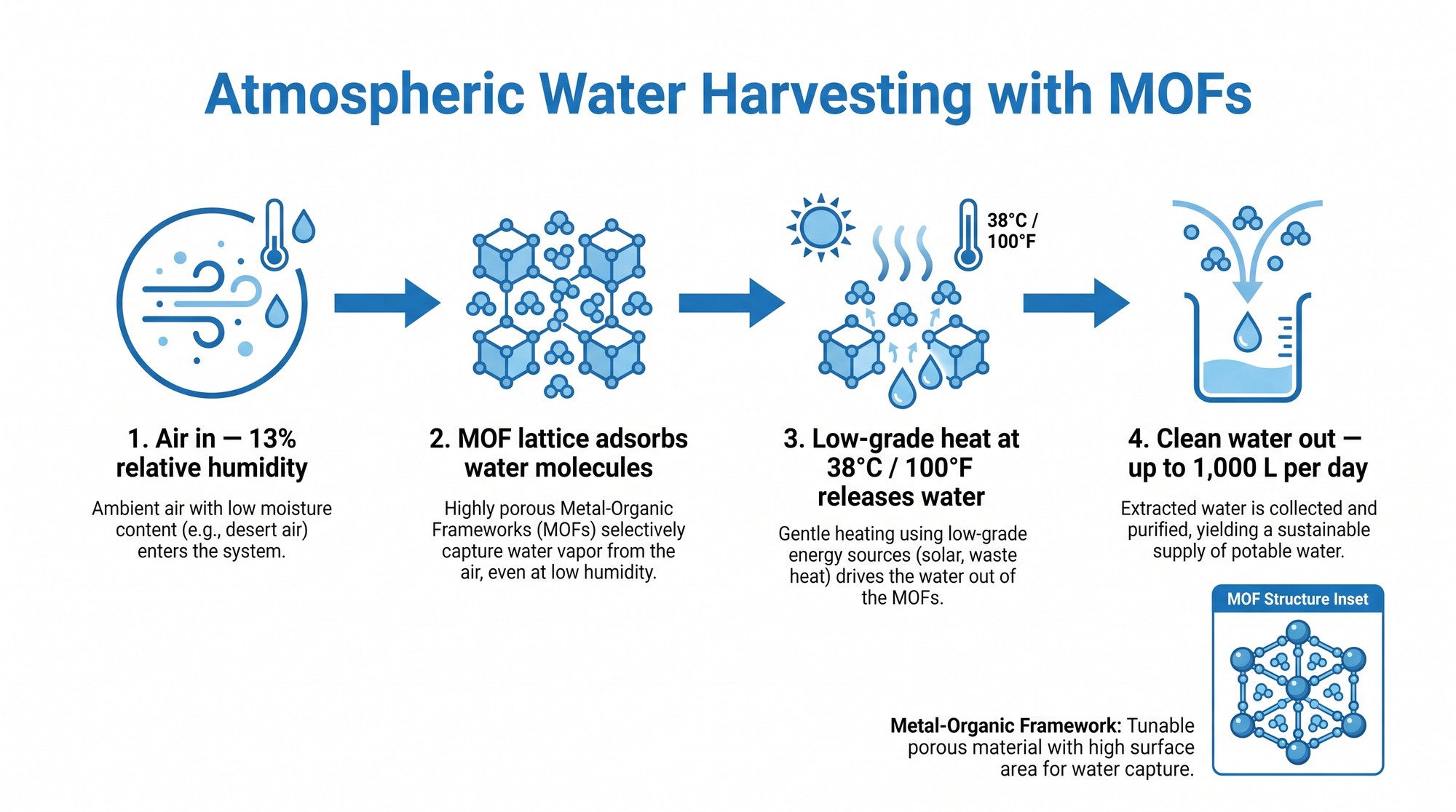
Sorbent-based systems take a different route: a material captures water molecules directly, and heat drives them back out. Atoco sits in this camp, and its pitch is that its MOFs outperform traditional desiccants such as silica gel, which hold less water and need far higher temperatures to regenerate. That advantage matters most where water is scarcest, since compressor-based units lose efficiency as the air dries out.
MOFs: Molecular Sponges
The material at the center of the process is a metal-organic framework, or MOF. Developed over two decades by Yaghi, MOFs link metal ions with organic molecules into a rigid, repeating lattice. The result is a structure that looks, as one chemist put it, like a jungle gym on a playground, riddled with microscopic pores.
Those pores give MOFs an astonishing amount of internal surface area. According to Yaghi, a single gram of the material can hold the equivalent of roughly two soccer fields of surface. That interior space can be engineered at atomic precision to attract specific molecules. The same family of materials can be tuned to capture hydrogen for clean energy, carbon dioxide for cleaner air, or, in this case, water.
Atoco describes its versions as “precision materials,” designed to like water without loving it. The material adsorbs moisture from passing air yet feels bone dry to the touch even when saturated, and squeezing it releases nothing. Only heat coaxes the water back out.

Releasing the Water With Almost No Heat
That last point is the key to the whole system. Atoco says its MOFs can both capture and release water with heat as low as about 100 degrees Fahrenheit (38 degrees Celsius) and can operate when relative humidity is only in the teens.
The energy needed is modest enough that waste heat will do. Roughly 70 percent of industrial waste heat is low-grade and simply vented or dumped, according to Atoco CEO Samer Taha. Capturing even a fraction of it to make water, he argues, amounts to trillions of liters of clean supply.
Turning Data Center Waste Heat Into a Circular Water Loop
The match with data centers is almost elegant. A facility pays to remove heat and often pays again in water to cool itself. Atoco’s system absorbs part of that waste heat to drive water out of its MOFs, which both lightens the cooling load and produces ultrapure water on site for cooling, industrial processes, or other uses.
“We actually want it; we need it,” Taha says of the waste heat. “We give you back water, the same product that is causing the issue.”
The concept also fits a tightening regulatory picture. The European Union’s Energy Efficiency Directive requires data centers with a total rated energy input above 1 megawatt to capture and reuse their waste heat unless they can show it is not technically feasible, part of an effort to triple data center capacity by 2035 without abandoning climate goals. Approaches that convert that obligation into an operational asset, rather than a compliance cost, are likely to draw attention.
Water-efficient cooling is already a live debate in the industry, from innovative strategies for sustainable data centers to facilities that have begun swapping water for PFAS-based cooling. Atmospheric water harvesting adds a third option: making the water on site, from the air, using heat that was going to be discarded anyway.

What Atoco’s Machine Can Do Today
Atoco is careful to frame its technology as early but real. The company has demonstrated an off-grid unit in its Irvine parking lot and deployed five on-grid prototype trials with partners in the United States and the Gulf Cooperation Council, as WIRED reported and Atoco describes in its own materials. The current figures are modest next to hyperscale demand:
- The parking-lot demonstration unit can produce up to 300 liters of water per day.
- The company is developing a commercial unit targeting up to 1,000 liters per day, roughly the size of a shipping container.
- The prototype runs on the equivalent heat of a 20-kilowatt data center, a fraction of a hyperscale facility’s output.
- Earlier on-grid demonstrations have been cited at up to 4,000 liters per day.
- Atoco says it hopes to begin taking orders for its first product by the end of 2026.
To serve a hyperscale campus, Atoco envisions banks of units working together, each harvesting from the same airflow and drawing on shared waste heat, as detailed in reporting by WIRED. That is a volume game, and it has not yet been proven at scale.
Those numbers describe the near term. Atoco executives have sketched a far larger ambition, describing off-grid systems that could one day produce hundreds of thousands of liters of water a day in desert conditions. Bridging the gap between a 300-liter demonstration and that future is the company’s central engineering challenge, which is why it is starting where the heat is already free and water is already expensive.
The Catch: Cost, Scale, and Skeptics
The technology’s promise comes with real caveats, and the company is candid about several of them. Atoco says it can currently produce water at a levelized cost of about $5 per metric ton, which is competitive with older desalination plants. But newer desalination facilities can deliver water at $2 per ton or less, a target Taha says Atoco is still three to five years away from matching.
Scale is the other hurdle. MOFs remain a cutting-edge material that has not been manufactured or deployed at industrial volumes, and building commercial units fast enough to matter will take time. Independent experts urge caution too. Seth Cohen, dean of the School of Physical Sciences at UC Irvine, who has worked on MOF projects, notes that without an outside heat source even the best MOFs still need energy to release their water. That makes remote rural deployment harder, since the places most short on water are often also short on heat infrastructure.
There is also the question of water quality. Atoco says its MOFs are not designed to capture air pollution, and the water it produces is effectively distilled. That is reassuring for the intended deployments, but as atmospheric water harvesting spreads, ensuring that harvested water stays genuinely clean in polluted urban air will remain a question worth watching.
Beyond Data Centers: Drought Regions and Green Hydrogen
Data centers are the beachhead, not the ceiling. Atoco is also targeting green hydrogen plants, which need large volumes of pure water, and communities in drought-afflicted regions where utilities sometimes truck in water because no reliable infrastructure exists.
The stakes are not abstract. About half the world’s population experiences water scarcity, and a quarter faces extremely high water stress, according to the United Nations. Even in California, the world’s fourth-largest economy, close to a million residents lack access to clean drinking water.
Yaghi’s own motivation is personal. As a child, he grew up as a Palestinian refugee in Jordan and was responsible for filling every container he could when the water delivery truck arrived once every two weeks. That experience, he says, makes you appreciate scarcity. His hope for MOFs is to move the world from scarcity toward abundance.
Frequently Asked Questions
What are the disadvantages of an atmospheric water generator?
The main drawbacks are energy and cost. Water must still be released from the capture material, which requires heat, and without a cheap or free heat source the process can be expensive. Output per unit is small compared with conventional water sources, hardware costs remain high, and performance drops in very dry air, which is precisely where water is often scarcest.
How do you harvest water from air?
There are two broad methods. Condensation chills air below its dew point so vapor turns to liquid, and sorption uses a material to capture water that heat then releases. Sorption tends to work better in dry conditions and can run on waste heat.
Will we have drinkable water in 2050?
Supply is under pressure, but the outlook is not fixed. Climate change, population growth, and industrial demand are intensifying water stress, while desalination, recycling, and atmospheric water harvesting are expanding the options. Technologies like MOF-based harvesting are unlikely to replace conventional supplies, but they can add decentralized, on-site water in places where pipes and aquifers fall short.
Key Takeaways
- Atoco, founded by 2025 Nobel laureate Omar Yaghi, uses metal-organic frameworks to harvest water from air without electricity.
- The system runs on low-grade waste heat, which makes it a natural fit for data centers that already pay to shed heat.
- Current units are small: a demonstration produces up to 300 liters a day, with a 1,000-liter commercial target.
- Cost, scale, and the need for an external heat source remain the biggest obstacles.
- If it works, the same approach could serve drought-stricken communities and green hydrogen plants, not just AI infrastructure.
The Bottom Line
Atmospheric water harvesting has long hovered between laboratory curiosity and genuine promise. Atoco’s pitch sharpens the case by borrowing an energy source that data centers already treat as a liability. Whether the company can drive costs toward desalination’s levels and manufacture MOF hardware at scale will decide if this becomes a real water source or a clever demonstration. For now, it is one of the more original attempts to turn AI’s environmental problem into part of its solution.
What to watch: whether Atoco’s first commercial orders ship on schedule by the end of 2026, and whether its data-center pilots publish verifiable output, cost, and water-quality figures.


