
Robert Woodward’s laboratory at the University of Vienna has a cupboard problem familiar to anyone who has ever cleared out a loft: scratched compact discs, yellowed polystyrene packaging, a crate of chipped plastic bricks. Rather than send them for downcycling, his team dissolved them in solvent, welded the polymer chains together, dosed the result with sulfuric acid, and produced a solid that drinks moisture straight out of the air.
The work, published in Chem Circularity, examines whether the plastic waste stream itself can serve as the raw material for a water-harvesting adsorbent. One of the resulting sponges, made from ordinary polystyrene of the kind used for single-use cutlery and CD cases, takes up close to 60% of its own weight in water from humid air and roughly 20% in desert-like conditions, then gives that water back when warmed by the sun. Reporting of the result has leaned heavily on the phrase “drinking water” and on the neat symmetry of solving two environmental crises at once.
Both framings run ahead of the evidence. What the Vienna group has actually shown is narrower and, in some ways, more interesting: that the chemistry of water capture can be bolted onto some of the cheapest and most abundant waste polymers we have, using reactions the polymer industry already knows how to run at scale. Whether that becomes a device people use is a separate question, and the paper’s own caveats are candid about it.
What the Vienna Team Actually Built
Materials chemists Anastasiia Naryshkina, Paul Schweng, and Robert Woodward started from three feedstocks that could hardly be more different in origin or value. Polystyrene packaging arrives as rigid tubs, foam, and CD jewel cases. Polycarbonate arrives as optical discs, a material engineered for clarity and toughness. Acrylonitrile butadiene styrene, better known by its acronym ABS, arrives as toy bricks and appliance housings.
The team also processed a selected mixture of waste plastics, deliberately unsorted, and obtained working adsorbents from it. That last detail matters more than the headline numbers, and it is where the practical promise of the work sits.
The output is not a powder or a film. It is a rigid, porous polymer network, which the researchers describe as a molecular sponge: a solid full of microscopic cavities whose internal surfaces are lined with chemical groups that pull water vapor out of the air and hold onto it until heat drives it off again. Most of the adsorption and desorption steps finished within roughly an hour, which is fast for this class of material.
From Packaging to Sponge: The Chemistry in Three Steps
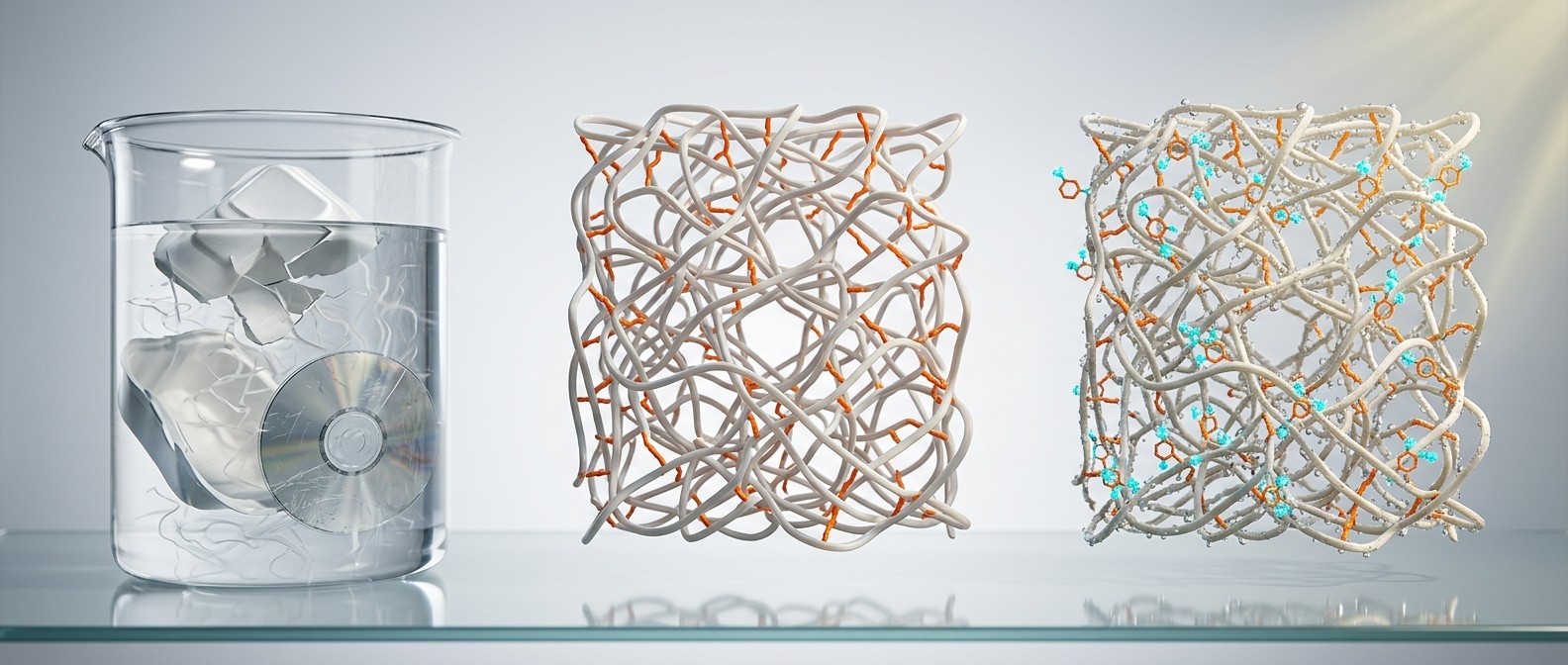
The process is simple to describe and, by the standards of advanced adsorbents, unusual in how little it asks of the feedstock. The study in Chem Circularity sets it out in three stages.
Step one: dissolving the plastic
Each feedstock is dissolved in a solvent. This step strips away the thing that makes plastic recycling so awkward, namely the additives, fillers, pigments, and blends that give each product its properties. In a solvent, the polymer chains are free to move, and the history of the material stops mattering much.
It is also the first of several costs. Large volumes of solvent have to be handled and, in any sane industrial process, recovered and reused. The paper names the energy and material expense of production as one of the barriers to scale, and solvent recovery is a large part of that bill.
Step two: tying the chains together
Short chemical bridges are then inserted between the long polymer chains, a process known as crosslinking. Woodward’s description is memorable: many short bridges are fitted in among the long chains, creating networks with tiny internal voids. The result is a single rigid framework rather than a heap of loose strands and a vastly larger internal surface area for its volume.
The technical term for the outcome is a hypercrosslinked polymer. Hypercrosslinking is well established in polymer chemistry and is valued precisely because it generates permanent porosity without needing the careful crystal engineering that metal-organic frameworks demand.
Step three: grafting sulfonic acid groups
Crosslinking alone produces a sponge that is not thirsty. The decisive step is treatment with sulfuric acid, which installs sulfonic acid groups on the framework. These groups are strongly hydrophilic, meaning they attract and bind water molecules, and they do so even when the surrounding air holds relatively little moisture.
That is the whole trick. A hydrophobic plastic becomes a hydrophilic solid, and the porosity supplies the surface area on which the newly hydrophilic chemistry can work.
Why Aromatic Plastics Work So Well
The feedstock list is not arbitrary, and understanding why explains both the strength and the limits of the approach.
Polystyrene, polycarbonate, and ABS are all aromatic polymers: their molecular backbones contain rings of six carbon atoms. Those flat, rigid rings are the reactive handles the process needs. They act as anchoring points from which neighbouring chains can be tied together during crosslinking, and the same rings accept the sulfonic acid groups during treatment.
One structural feature therefore does two jobs. The rings provide the sites for building the network and the sites for making it water-loving, which is why a single two-step reaction sequence works across three chemically distinct plastics. “Many commercial polymers are aromatic, above all polystyrene,” Woodward told the APA news agency, pointing to yoghurt pots and foam packaging as everyday examples.
The abundance argument is as strong as the chemical one. Polystyrene is one of the highest-volume plastics in municipal waste and one of the least rewarding to recycle mechanically, because it is bulky, low-density, and often contaminated with food. A process that turns it into a functional material, rather than back into a slightly worse version of itself, addresses a genuine gap in the recycling system rather than adding another route for the easy fractions.
Waste figures give the scale some context. Roughly 430 to 460 million tonnes of plastic are produced annually, and only about 9% of plastic waste has ever been recycled, according to data compiled by Our World in Data. Anything that can accept the low-grade remainder is worth a serious look.
What the 60% and 20% Figures Really Mean
The headline numbers are gravimetric water uptake: grams of water held per gram of dry material. The paper reports up to about 0.19 grams of water per gram of material at 30% relative humidity and up to about 0.57 grams per gram at 90% relative humidity, with polystyrene-derived sponges performing best. Expressed as percentages of the material’s own weight, those correspond to roughly 19% and 57%, which is where the widely reported 20% and 60% come from.
Three things follow, and all three are routinely lost in the coverage.
It is a ratio, not a volume. A sponge that holds 20% of its own weight tells you nothing about how much water a device would produce. That depends on how much material the device contains, how quickly air moves through it, how many cycles it completes per day, and how efficiently the released vapor is condensed. Sorption systems in the literature are typically quoted at 0.5 to 2 liters of water per kilogram of material per day, with desert trials sustaining around 0.8 liters per kilogram per day at 15 to 20% relative humidity, as one 2025 review of adsorptive harvesting systems reports. The Vienna paper does not report device-level yield, and no sensible liter figure can be inferred from it yet.
The dry-air number is the demanding one. Anyone can harvest water from muggy air. The value of an adsorbent rests on how much it takes up at low humidity, because that is the regime where water stress is concentrated. Around 1.2 billion people live in areas where annual average relative humidity falls below 30%, according to that same review. At 0.19 grams per gram, the plastic sponge is a real performer in this regime, but it is not a record holder.
The comparisons are not like for like. The chart below sets the Vienna figure against benchmark sorbents reported in the wider literature at the humidity level that matters most for arid regions.
Read it plainly, and the honest verdict is this: the Vienna sponge is competitive with unmodified frameworks but sits below the salt-loaded composites that dominate the low-humidity literature. Its claim is not superiority. Its claim is that it can be made from rubbish.
The Catch: Acid, Solvents, and a Short Durability Record
Sulfuric acid is not a gentle reagent. It is corrosive, it demands specialized equipment, and handling it at industrial volume carries real safety and environmental obligations. The Vienna team’s own assessment of the wider field is strikingly direct on this theme: despite strong water adsorption performance, they write, large-scale and sustainable use of such materials remains a challenge because of energy-intensive production, high material costs, corrosion risks, and limited recyclability.
Those four objections apply with uncomfortable neatness to the plastic route itself, and the fourth is the one that rarely gets mentioned.
- Energy-intensive production covers the solvent dissolution, the crosslinking reaction, and the acid treatment, each of which needs heat, time, and solvent management. The chemistry is simple, but simple is not the same as low-energy.
- Material costs include sulfuric acid, solvents, and catalysts. The feedstock may be free, but the reagents are not, and they dominate the economics of a process in which the raw material is a waste product.
- Corrosion risk applies twice over, both to the plant that handles hot acid and to any device that houses residual acid-loaded polymer in a humid, condensing environment.
- Limited recyclability is the quiet irony. The plastic has been given a second life, but not a third one.
Durability is the other open question. The team reports that the sponges survive repeated cycles without notable loss of performance. That is encouraging, and it is also early. Stability over hundreds or thousands of cycles, fouling by dust and airborne organics, and the slow leaching of sulfonic acid groups in condensing humidity all remain to be characterized. Reporting on the work notes that assessment of long-term performance and overall resource requirements is ongoing.
Then there is the question nobody has answered, because the paper was not designed to answer it. Sulfonic acid groups are strong acids. Water desorbed from a sulfonated polymer is not automatically potable, and no water-quality testing appears in the reported results. Whether the condensate meets World Health Organization drinking-water criteria and what washing or neutralization would be needed to ensure it does is a necessary next experiment rather than a settled fact. The phrase “drinking water” in much of the coverage is a description of an intended future application, not a laboratory result.
How It Compares With MOFs, Hydrogels, and Salt-Based Devices
The sorption field is crowded, and the plastic sponge enters it with one clear advantage and several clear handicaps.
| Material class | Typical low-humidity uptake | Strengths | Weaknesses |
|---|---|---|---|
| Metal-organic frameworks | 0.3 to 0.6 g/g at 30% RH, higher with salt loading | Precisely tunable pores, sharp step-shaped uptake, low regeneration temperatures | Expensive synthesis, often long solvent-heavy routes, limited industrial production |
| Hydrogels | Variable, weaker below 20% RH | Cheap, low regeneration energy, flexible form factors | Slow kinetics, mechanical degradation, salt leakage when loaded |
| Hygroscopic salts | Very high, up to roughly ten times their own mass | Cheapest and thirstiest option | Deliquescence, corrosion of hardware, can require 150°C or more to regenerate |
| Plastic-derived sulfonated sponges | About 0.19 g/g at 30% RH (see table above) | Waste feedstock, unsorted mixtures tolerated, fast cycling, mild release temperatures | Reagent handling, unproven longevity, no water-quality data yet |
The frameworks deserve their reputation. Metal-organic frameworks won the 2025 Nobel Prize in Chemistry for Susumu Kitagawa, Richard Robson and Omar Yaghi, and the award citation itself pointed to harvesting water from desert air as a flagship application. The underlying approach has a long history, and a survey of water harvesting technologies that turn air into drinking water shows how many different routes have been tried. Commercial systems built on them are now producing water at pilot scale, including machines that run on waste heat from data centres rather than grid electricity. Their weakness is cost and manufacturing maturity, not performance.
Hydrogels are the cheap-and-flexible option, and they are genuinely good at releasing water at low temperatures. Earlier designs such as an aerogel built to pull drinkable water out of thin air showed how far engineered porous solids can be pushed. What hydrogels lack is uptake in genuinely dry air, and their mechanical robustness over thousands of cycles is unresolved.
Hygroscopic salts are the other extreme. The most common, calcium chloride, is also the reason bare salts are rarely deployed outside sealed test rigs.
- Calcium chloride can absorb roughly ten times its own mass in water at high humidity but needs 155 to 165°C to release it, beyond what simple solar heating delivers.
- Lithium chloride turns acidic once relative humidity climbs above 40%, which is why researchers encapsulate it inside frameworks or hydrogels.
- Salt leakage into the product water is a recurring failure mode, and encapsulation is the field’s answer to it.
The plastic route’s distinctive proposition is the feedstock, not the performance. It is the only class in that table whose raw material is a liability someone else is trying to get rid of, which is why the acid and solvent bill carries so much weight in judging it. A review of sorbents for atmospheric water harvesting makes the design point that matters here: a good sorbent needs its main uptake to occur in the humidity band where the device will operate, with adsorption and desorption steps close together so regeneration is not an energy sink. The Vienna data suggest reasonable behavior on kinetics. They do not yet settle the energy balance.
The Quietly Important Result: Mixed Waste Still Works
Buried in the reporting is a finding that may matter more than the headline uptake figure.
Plastic recycling normally begins with sorting, and sorting is expensive and imperfect, and that’s the reason so much mixed plastic ends up in landfill or incinerators. The Vienna team showed that a selected mixture of waste plastics could be converted into a working adsorbent without being separated first. If that holds up under real-world contamination, it removes the single most costly step in the conventional recycling chain.
It also changes what the process is for. The target is not the clean, high-value plastic streams that recyclers already fight over. It is the mixed, low-value, contaminated residue for which there is currently no economic use. That is the part of the waste stream where a functional-material outlet would actually change outcomes, and it is where the aromatic-chemistry approach has a structural advantage, because it does not care whether the rings arrived as polystyrene, polycarbonate or ABS.
Woodward has been careful about the framing. The ability to give plastic waste a second life as a useful functional material, he said, offers a promising route to addressing two major ecological challenges, plastic pollution and water scarcity. He has also noted that the same materials could serve in energy storage, catalysis, and gas purification, which is a reminder that the adsorbent application is one use among several rather than the endpoint.
Frequently Asked Questions
Is the water from these sponges safe to drink?
That has not been demonstrated. The paper reports no water-quality testing, so until a product sample is measured against World Health Organization drinking-water guidelines, the safe description is water that has been captured, not water that has been certified. The acidity of the sulfonic acid groups is the obvious reason to check first.
Can it work in real deserts, or only in the lab?
The sponges were tested at controlled humidities, including below 30% relative humidity, which is the range that corresponds to arid conditions. That is laboratory performance, not field performance. Real desert service adds dust loading, temperature swings, day and night cycling, and the practical business of condensing the released vapor against hot ambient air, none of which the reported results address.
What happens to the plastic after its useful life?
It cannot be recycled again. Crosslinking and sulfonation convert a thermoplastic into a thermoset, so a spent sponge needs its own disposal or degradation route rather than another trip through mechanical recycling.
When could this reach households?
No timeline is credible at this stage. The work is a laboratory demonstration from a research group, published in a journal whose first issue appeared in June 2026, with no pilot plant or commercial partner disclosed. Sorbent-based harvesting generally is still at low technology readiness, with frameworks at roughly the demonstration stage. A realistic sequence runs from process optimization and solvent recovery, through continuous-flow production, to field trials, before any product question arises.
Could the same chemistry work with other waste plastics?
Only with aromatic ones. Polyethylene, polypropylene, and PET lack the aromatic rings that both anchor the crosslinks and accept the sulfonic acid groups, so they are not candidates for this exact route without modification. Since polystyrene, polycarbonate, and ABS together represent a substantial share of rigid consumer plastic, that is a meaningful limitation rather than a fatal one, but it is a limitation.
Does this solve plastic waste?
No. Even a fully deployed adsorbent industry would consume a small fraction of the roughly 400 million tonnes of plastic produced each year, and the process generates its own solvent and acid waste streams. The realistic contribution is a new outlet for a difficult fraction of waste, not a solution to the volume problem. Reduction and conventional recycling remain the larger levers.
What Would Need to Be True for This to Scale
The honest way to read the Vienna paper is as proof of a chemical concept with an unusually good feedstock story and a to-do list attached.
The scale question really comes down to four numbers: solvent recovery rate, acid-handling cost, verified cycle life in dusty air, and certified water quality. None of them is published yet, and any one of them failing on its own would end the commercial case.
The more telling condition is economic. Waste plastic is free; the chemistry applied to it is not, and it has to compete with frameworks already attracting commercial capital and with salt systems that cost almost nothing per kilogram.
None of that diminishes what has been shown. Water capture has spent two decades being an expensive, elegant business built on precision-engineered crystals. Demonstrating that the same job can be done with the contents of a recycling bin, using reactions that tolerate mixed and contaminated feedstock, moves the question from whether the chemistry is possible to whether the engineering can be made to pay. That is a far better problem to have. It is also the point at which the headlines should have started hedging.

