
A cloud outage during a quiet weekday is a technical incident. The same outage during a major sales event is a business event: lines grow, returns stop, customer service improvises, and managers need to know whether a payment was authorized before they can decide what to do next.
That distinction should shape an enterprise point-of-sale modernization program. The objective is not to build a diagram with two regions and declare the system “always on.” It is to preserve a correct payment and order state through partial failure, intermittent store connectivity, retries, and reconciliation. A POS environment is resilient only when the cashier, customer, and finance team can all establish what happened.
This article presents a practical resilience model for retailers operating many stores and selling across digital channels. It focuses on the failure modes that tend to survive otherwise successful infrastructure migrations.
Availability is not the same as payment correctness
A checkout endpoint may respond quickly while the downstream ledger records the wrong tender. A failover can restore API availability but replay a refund event twice. A store may continue accepting approved offline operations while central systems hold an incomplete picture of what was sold.
Define separate objectives for service availability, transaction correctness, and recovery:
| Objective | What to measure | Dangerous blind spot |
| Checkout availability | Successful accepted sales by store and region | API uptime with rejected payments |
| Payment correctness | Authorizations, captures, voids, and settlement agreement | Duplicate or orphaned operations |
| Refund integrity | Accurate original-tender and split-tender reversals | Cross-system refund mismatch |
| Inventory consistency | Store events vs. central availability | Oversell after reconnect |
| Failover recovery | Time from impaired region to usable checkout | A second region with stale state |
| Operational recovery | Time to reconcile queued/offline exceptions | Unresolved transactions after systems recover |
If a retail architecture review covers only host uptime, it is measuring the wrong system. The business operates transactions, not servers.
Map the failure domains before adding another region
Multi-region architecture can reduce exposure to a regional cloud problem, but it also introduces cross-region state complexity. A retailer must decide what remains available when a payment provider, network link, database, message broker, or one entire region becomes impaired.
Begin with a failure-domain map. List storefront and store clients, POS services, tender processing, payment gateways, account/loyalty services, OMS, data stores, and event streams. For each dependency, answer three questions: Can the transaction proceed? What state will be recorded? How will the system recover without double action?
A second region is useful only if the application knows how to route traffic to it, the data it needs is sufficiently current, and the response can be reconciled afterward. Active-active operation is not an automatic requirement. Some components perform better with controlled active-passive failover to preserve a clear writer and consistent transaction ordering.
The desired topology depends on store connectivity, latency, acquirer configuration, legal requirements, data replication behavior, and the cost of conflicting writes. Architecture choices must be documented as tradeoffs, not sold as one universal high-availability pattern.
The payment state machine is the backbone
Treat every tender as a stateful business object with a durable identifier. At minimum, distinguish initiated, authorized, captured, voided, refunded and unknown/reconciliation required. Different payment providers expose different steps and constraints; the retailer’s internal state model should preserve those distinctions rather than compress every response into success or failure.
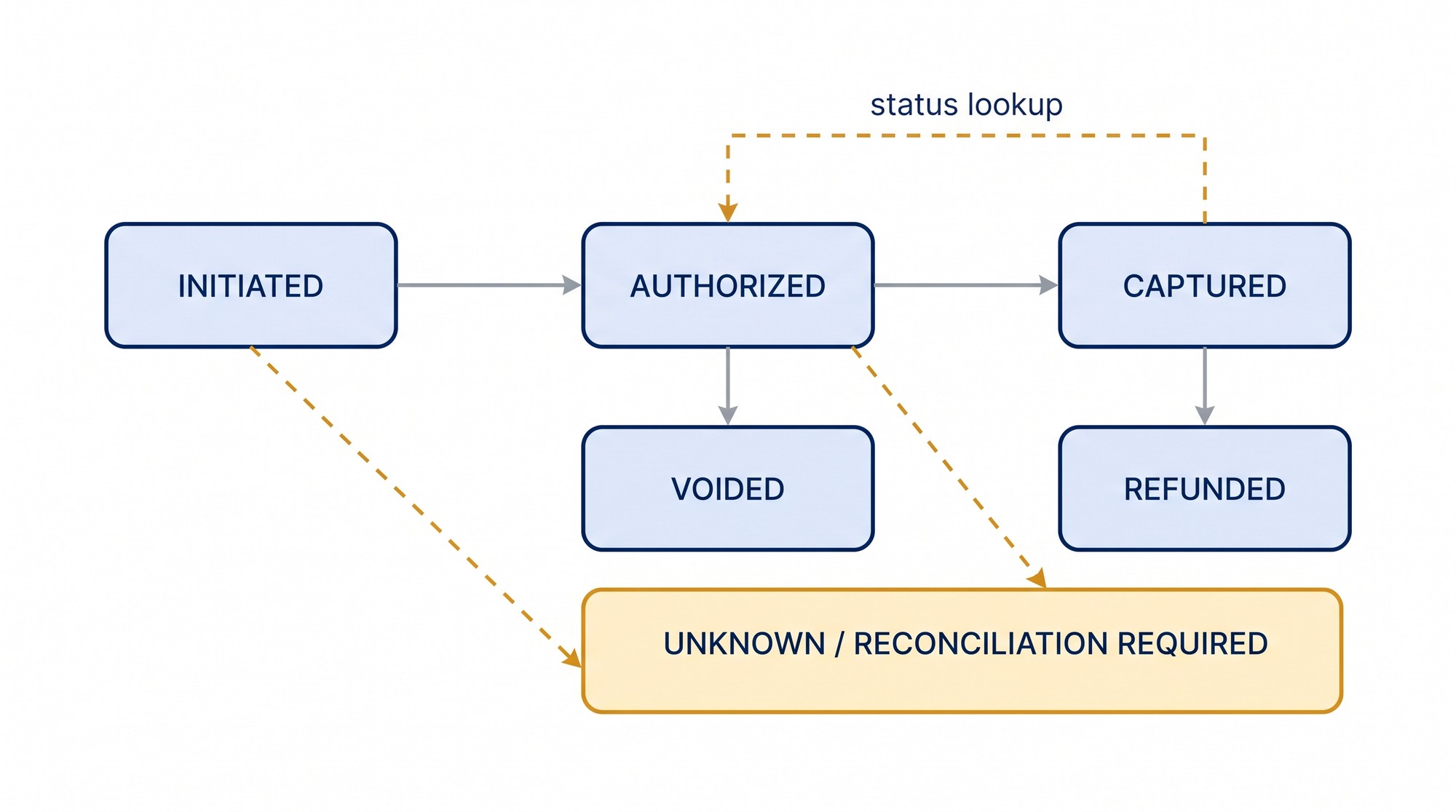
A timeout is especially ambiguous. Suppose the POS sends an authorization and the connection drops before the reply. The payment may have succeeded. Blindly retrying with a new identity risks a duplicate authorization; assuming failure may allow goods to leave without confirmed payment. The safer response is to use the provider’s supported idempotency and status-lookup mechanisms, retain a correlation ID, and resolve the unknown state before an irreversible next step.
Stripe’s published API reference on idempotent requests explains idempotency keys as a mechanism for safely retrying supported operations without repeating a mutation. That is a useful illustration, not an excuse to assume every tender, gateway, or offline terminal behaves identically. The integration contract must state which operations can be retried and how long identities remain valid.
For returns, the state machine becomes more involved. One original purchase may contain cash, a gift card, a card payment, and promotional value. A partial return must allocate amounts back according to the retailer’s tender and jurisdictional rules. The system should preserve the original sale identity and a unique refund intent so that retries do not create a second credit.
Event durability and idempotency belong together
An event-driven POS platform can separate store operations from downstream systems, allowing services to recover independently. It can also duplicate or reorder events during network problems and failover. Durable messaging alone does not guarantee the correct business state.
Every meaningful event should carry a transaction identity, source, timestamp, schema version, and enough context to identify the permitted state transition. Consumers must be able to recognize replays. A reconciliation process should compare expected and observed transactions against authoritative payment and order sources.
Design a dead-letter or exception flow with named ownership. If a refund event cannot be processed, parking it quietly in a queue is not a recovery strategy. The operator must know which payment or customer was affected, whether the action can safely be retried, and how resolution is audited.
A concrete failure exercise
Consider a fashion retailer with hundreds of stores, two cloud regions, and a single payment orchestration layer. Region A experiences high error rates midway through a store transaction. The POS has already sent a tender request but has not received a confirmed response.
The runbook should lead the operator through a defined sequence:
- Preserve the original transaction ID and mark its state unknown rather than starting a new sale.
- Query or reconcile the transaction with the authoritative gateway using a supported mechanism.
- Switch subsequent eligible traffic to Region B, subject to data freshness and routing health.
- Resume the current transaction only after the tender’s state is known or an approved exception path is invoked.
- Reconcile every transaction that crossed the failover interval, including later callbacks and returns.
This is an illustrative scenario, not an account of a specific retailer’s incident. Its value is the decision order: protect financial state first, then restore throughput, then prove that recovery did not manufacture a second transaction.
Offline stores need a policy, not a heroic workaround
When store connectivity is unavailable, the software may be technically capable of queueing local events. That does not mean it is authorized to approve any offline card payment. Offline payment acceptance depends on the terminal, processor, network, acquirer, and security rules. In some environments, certain transactions must be declined or moved to an approved manual procedure.
Separate recording a store event from authorizing a tender. A local queue can preserve events for replay once the link returns. The checkout interface should explain which capabilities remain available, which require a confirmed central decision and which are temporarily unavailable. Store associates need concise instructions; silent, degraded behavior invites customer disputes.
Once the store reconnects, replay events idempotently and reconcile inventory, tax, tenders, receipts, and refunds. A stale store timestamp should not automatically override a newer central decision. Define conflict precedence and retain an audit trail of corrections.
Offline scenarios must also be tested against security controls. Mask sensitive payment fields, limit access, and verify that logs, debug traces, and replay payloads do not expose prohibited cardholder data.
What a documented retail payments case shows
Zoolatech has published a multi-region POS and payments case study for a large North American fashion retailer. The case describes a move away from a vulnerable single-region setup, with cross-region processing, durable events, replication controls, idempotent logic, and redesigned multi-tender refunds.
The public account reports recovery improving from hours to minutes and describes $110 million in revenue exposure safeguarded through resiliency. That figure should not be misrepresented as $110 million of realized incremental revenue or a measured profit increase. It is the case’s stated protected exposure associated with critical retail operations.
The more transferable details are architectural: cross-region validation, original-tender logic, replay safety, and deferred reconciliation when stores reconnect. Those are the elements that distinguish a real modernization engagement from a slide claiming “near-perfect uptime.”
This also explains why retail software development services should be evaluated on payment and operational workflows, not just point-of-sale user interfaces. A cashier-facing app is the visible edge of a much larger financial system.
A resilience test day before rollout
A good test program should contain deliberate faults, not only average-load performance checks. Select failure scenarios with business owners and document expected states before injecting any fault.
| Failure injected | Expected behavior | Evidence after recovery |
| Region A becomes unavailable | New eligible traffic follows approved routing | No unexplained tender duplication |
| Gateway response times out | Original payment state stays traceable | Authorization/capture reconciled |
| Refund callback arrives twice | Refund intent executes once | One correct credit, full audit trail |
| Store network disappears | Only permitted degraded actions continue | Replayed events match store ledger |
| Events arrive out of order | Consumer respects state-transition rules | No invalid order or refund state |
| Replication is delayed | Failing over does not assume impossible consistency | Divergences detected and resolved |
The result should be a failure report with exceptions, named owners, and corrective actions. If a test reveals a business rule the architecture cannot satisfy, pause the rollout. Passing an infrastructure benchmark while failing a financial invariant is not a pass.
The partner evaluation: what to ask before awarding a contract
- Show the payment state machine. How do you handle unknown outcomes, partial capture, voids, and mixed-tender returns?
- Describe the data ownership. Which system settles truth after a regional failover, and what happens if its replica is stale?
- Walk through one real failure drill. What failed, which alert fired, who made the decision, and how were exceptions reconciled?
- Explain your store-offline policy. What can be queued, what requires processor authorization, and how are associates trained?
- Define rollback beyond DNS. If financial actions occurred on the new path, what state must be reconciled before routing can move back?
- Name the service objectives. Availability is necessary, but so are accepted-sale correctness, refund integrity, and time to operational reconciliation.
A credible engineering partner should be able to answer these questions without implying that more regions always produce more safety. In payment systems, consistent state and explicit recovery often matter more than architectural complexity.

FAQ
Does a multi-region POS automatically guarantee uninterrupted payments?
No. It reduces certain infrastructure risks but introduces replication, failover, and state-management decisions. Payment processor outages, store network problems, and transaction inconsistencies still require separate controls.
Can POS systems safely queue transactions while offline?
They can queue permitted local events, but payment authorization rules depend on processors, terminals, and compliance requirements. Do not assume every card transaction may be approved offline.
Why is idempotency essential in retail payments?
Networks and services retry requests. Idempotency helps prevent a repeated request or callback from executing the same financial action more than once, subject to the provider’s contract and the application’s business-state controls.
How should a retailer measure POS resilience?
Measure successful customer transactions, payment and refund correctness, recovery time, unresolved exception counts, and reconciliation completion, rather than infrastructure uptime alone.


