
The dryer had died a year earlier. The sensible replacement, the one an energy-conscious household would normally choose, was a heat pump model that uses far less electricity than a conventional machine. The household had solar on the roof and a battery on the wall, so the running cost barely seemed to matter.
“Why bother, because its free electricity,” the participant told researchers. The quote appears in a CSIRO-led study of 35 households across Greater Sydney, the Central Coast and Greater Brisbane, monitored from August 2025 and released in September 2026. The report’s central behavioural finding is that a large-capacity battery can reshape how a household thinks about energy, changing “perceptions of energy from scarce to abundant”. The authors describe the result as a possible “rebound” effect, in which cheaper or more available energy leads people to use more of it.
It would be easy to turn that into a headline about batteries being a con and just as easy to dismiss it as a quirk of a handful of homes. Neither reading survives contact with the evidence. The Australian study did not measure emissions at all, and its 35 households were early adopters who are more energy-engaged than the national average; the researchers state plainly that the sample does not represent Australia. The study that does attach a number to the effect, a 2026 paper in Operations Research on 3,200 German households, also concludes that batteries may reduce emissions where solar penetration in the grid is sufficiently high. The direction of the effect is conditional.
What follows is an attempt to separate the behaviour from the physics and to explain why the same home battery can be a modest climate positive in one electricity system and a modest negative in another.
What the CSIRO-led study actually found
The work sits inside a larger project called Scenarios for Future Living, funded by the RACE for 2030 research centre and run with Monash University, UNSW, UTS, CSIRO and a group of industry partners. Its Work Package 7 fitted 35 homes with circuit-level electricity monitoring, indoor environmental sensors and, where relevant, gas monitoring. Researchers also interviewed the households repeatedly.
The design matters for what the study can claim. Circuit-level monitoring shows when energy is used, not why, and the interviews supply the why. The finding that travel was not really about kilowatt-hours. It was about a change in how electricity felt.
The report sets out three stages of household energy logic. Without solar or a battery, the goal is to use less. With solar, the goal becomes using appliances while the sun is out. With a large enough battery, the report says, the goal becomes using energy at any time “with no financial or sustainability consequences”. Participants described the realisation as “limitless” electricity.
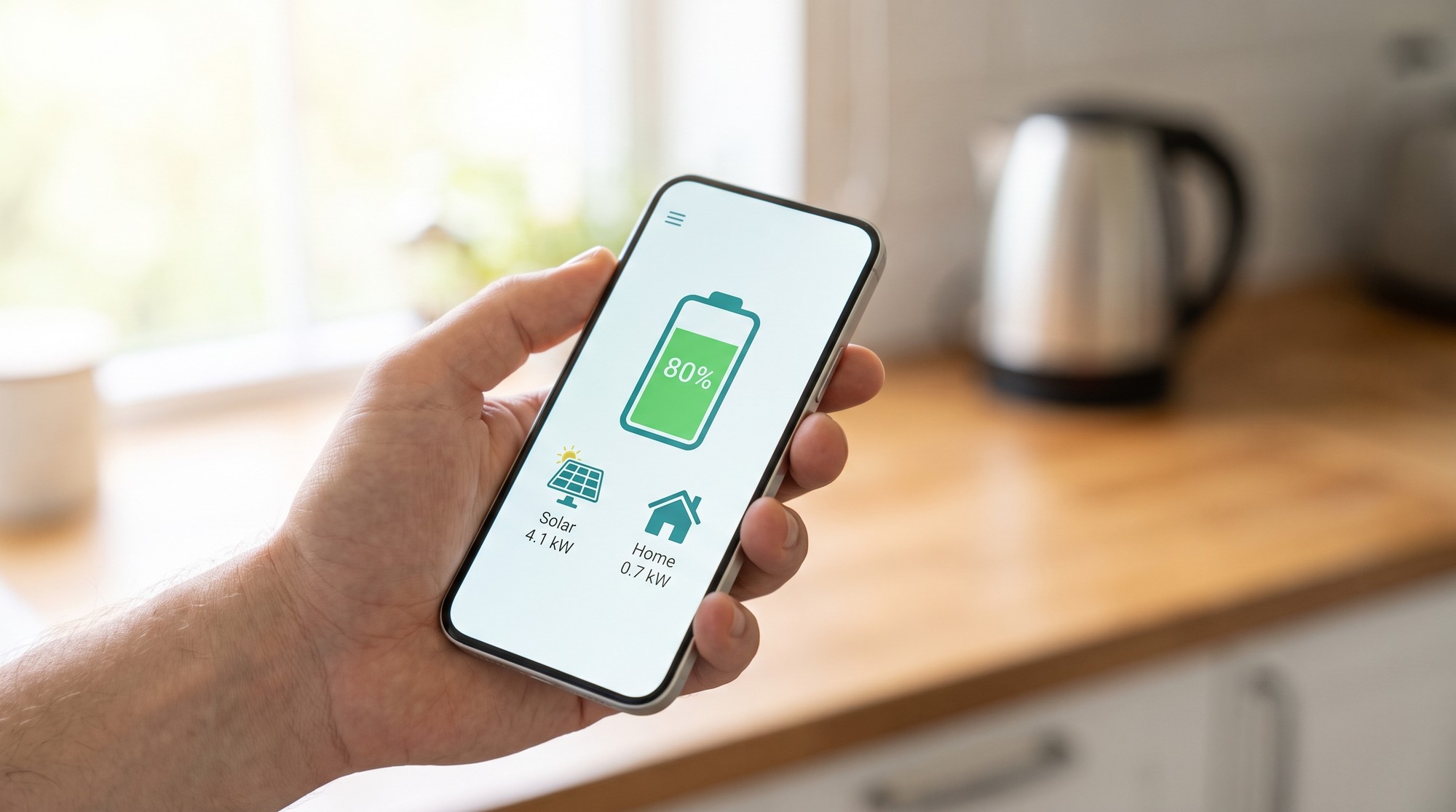
One participant, identified in the report as Liam, described the shift: “At first it was like ‘am I allowed to do that?’ […] But then we were waking up with still like 80% battery capacity, so our mentality changed to ‘use electricity like it’s free!'”
The authors are careful about what this means. They write that large-capacity batteries “risk facilitating a new norm of excessive consumption” and describe a possible rebound effect “associated with battery ownership, where efficiency gains lead to increased consumption of a resource”. They also say the opposite of what a headline writer wants: “future work is necessary to quantify this effect for household batteries.”
Why the dead dryer is more than a funny anecdote
The dryer is a useful detail because it separates two decisions that energy bills usually blur. The first is marginal: should I run this appliance now? A battery makes that decision feel cheap, and in the moment it often is cheap, because the electricity came from a roof that was going to generate anyway. The second is structural: which machine do I install for the next decade? That decision locks in a level of efficiency no battery can recover.
Heat pump dryers are not a marginal improvement. According to ENERGY STAR, they can reduce energy use by at least 28% compared with standard dryers because they recycle heat in a closed loop instead of venting warm, humid air outside. A household that skips that upgrade has traded a one-off saving for years of higher consumption, and the battery is what made the trade feel rational.
The report found the same pattern beyond laundry. Participants described abandoning load-shifting habits because the battery would “store everything we need”. One said the washing machine no longer needed to run during the day.
Appliance replacement is also a rare trigger for wider electrification: the report notes that appliances reaching end of life were a major reason households switched away from gas, which means a missed replacement can delay more than a dryer. Households weighing up how much storage they actually need can work through the trade-offs in our guide to solar with and without a battery.
A German paper that is about more than the rebound
The Australian study documents behaviour. A separate paper tries to put a number on the consequences, and it is broader than the rebound headline suggests.
Christian Kaps, an assistant professor at Harvard Business School, and Serguei Netessine of the Wharton School published “Residential Battery Storage: Reshaping the Way We Do Electricity” in Operations Research in 2026 (volume 74, pages 596 to 614). The question it sets out to answer is why households buy storage at all, what that does to the power market, and what it does to emissions. They built a structural model of household electricity use from 3,200 German homes supplied by the solar company Solarwatt, covering 2018 to 2020.
The model separates what a household consumes from what it prefers. That let the authors estimate a “nonmarket valuation”: the premium a household is willing to pay to use its own solar power instead of grid electricity. For the median household, that premium was 0.29 euros per kilowatt-hour, roughly the German retail price of electricity at the time, driven by sustainability and a desire for independence from the grid.
Owning storage, they found, increased a household’s electricity demand, which they call the storage rebound. The journal’s summary of the work puts the increase at about 4%, and it is worth being precise about what that measures: overall electricity consumption, not the electricity the household buys from the grid. A household can use more kilowatt-hours in total and still draw less from the network because the extra load runs on stored solar. The paper then estimates the emissions consequence: a marginal increase of 57 kg of CO2 per year for every kilowatt-hour of battery capacity, under Germany’s observed grid mix at the time.
That number is per unit of capacity, so it accumulates. A 10 kWh home battery implies roughly 570 kg of CO2 a year by that coefficient, and a 15 kWh system implies about 855 kg. Those figures are arithmetic, not a forecast. They describe the grid consequences of how storage changes consumption and exports, not a lifecycle assessment of manufacturing the battery itself.
The paper’s next sentence is the one that should travel with the first: “However, batteries may reduce emissions if solar penetration in the grid is sufficiently high.”
Kaps went further in his own account of the research, published by the Harvard Salata Institute. “This is not a verdict on storage as a technology,” he wrote. Batteries, he added, “may have increased emissions five years ago, but they are likely to become essential for emissions reduction in the grids of the future.”
The underlying logic is not mysterious. Rooftop solar on its own, in a grid already flooded with midday sun, can displace clean power that would have been generated anyway. A battery does something different: it moves clean power to the hours when the alternative is fossil generation. The 57 kg figure is a snapshot of Germany between 2018 and 2020, when storing midday solar often removed clean power from a system that still had uses for it, and the household then used more electricity than before. It is not a fixed property of batteries.
The paper’s abstract makes the same point from the other direction. At future technology costs, 2023 European electricity prices and no subsidies, the published abstract states that investing in storage is optimal for 54% of households, which would reduce the residential grid load by 38%, but also make it more variable. That variability is a problem for utilities rather than for the climate. A battery that cuts a household’s draw on the grid by more than a third is not a marginal device.
| Aspect | CSIRO-led Living Lab | Kaps and Netessine |
|---|---|---|
| Who and where | 35 households in New South Wales and Queensland, monitored from August 2025 | 3,200 households in Germany served by Solarwatt, 2018 to 2020 |
| Method | Circuit monitoring, environmental sensors, surveys and interviews | Structural economic model of demand and preferences |
| Headline finding | Large batteries can make power feel “limitless”, weakening conservation habits | Storage raised electricity demand by about 4% and marginally raised emissions by 57 kg CO2 per year per kWh of capacity |
| The caveat | Qualitative, early-adopter sample; the rebound has not been quantified | Batteries may reduce emissions where grid solar penetration is high |
| What it cannot say | How common the behaviour is nationally | What the effect would be in Australia |
Why the same battery can raise or lower emissions
A battery does not generate anything. It moves electricity through time: charging when generation is plentiful or cheap, discharging when the household needs it. Those choices land on a grid whose emissions change hour by hour. If the marginal generator when a household charges is a coal or gas plant, extra consumption adds emissions. If the grid is soaking in solar at that moment, storing and shifting the energy can displace fossil generation later. The sign of the effect therefore depends on the generation mix, the time of day, and the rules that govern when batteries charge and discharge.
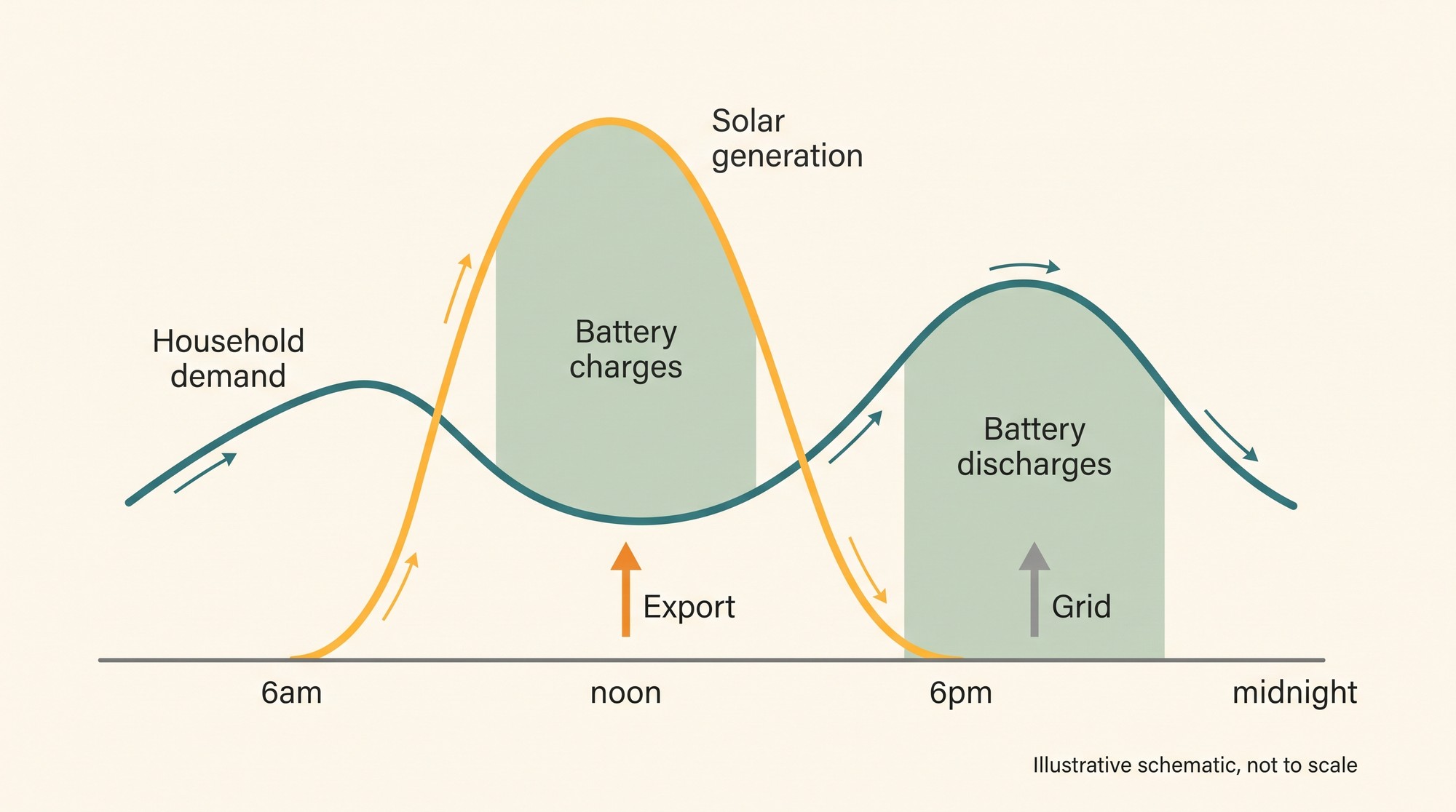
Germany in 2018 to 2020, the period the paper models, was not solar-saturated at the relevant hours. That is what the positive estimate implies.
Australia is a different test case. The federal Solar Sharer rules, which began in July 2026, require retailers in New South Wales, South Australia and south-east Queensland to offer at least three hours of free electricity around midday, and the country has repeatedly set records for household solar installation. The condition the German paper identifies is more likely to be met in a solar-heavy grid at the middle of a sunny day. That does not mean an Australian battery is automatically emissions-negative, and no Australian estimate of the 57 kg figure exists.
The irony is that a policy designed to soak up midday solar can also normalise the feeling that power is free. Analyst Alan Pears told Renew Economy that messaging of “bountiful energy” is a problem, because it drives higher peaks and lower utilisation of infrastructure, which shows up as higher fixed charges that are “unavoidable and potentially disempowering”. Whether the rebound matters depends on what the extra electricity replaces and on when it is used.
What the study also found, and what the strong reading of the story tends to drop, is that the same batteries were doing their job. Battery households had flatter daily load profiles than the solar-only households in the sample, with lower peak-time demand and less power exported. Those are the mechanics of a battery working as intended. Households across Australia have reported the same pattern at scale: the head of the Australian Energy Market Operator, Daniel Westerman, said in October 2026 that homes with batteries have been drawing 70% to 75% less power from the grid at peak times than homes with rooftop solar alone. Any honest account of the rebound has to hold both findings at once: a battery can lower a household’s draw from the grid at the expensive hours and still, in some homes, coincide with using more electricity overall.
There is a useful check on how far the “limitless electricity” finding generalises, and it comes from CSIRO’s National Energy Analysis Centre, which used the 35-household lab as the prototype for a much larger Living Lab.
In August 2026, the centre surveyed almost 700 participants, including 323 battery owners. The results do not show a uniform surge in consumption. Reported changes in total electricity use were “more varied, with some households using more electricity, some less, and many reporting little or no change.”
The survey also asked about sizing. Most owners, 62%, said their battery was about right. More than a third, 37%, said it was too small, and only 1% said it was too large. That matters for the trajectory. If more than a third of owners want more capacity, the conditions the CSIRO team associates with rebound are likely to spread rather than shrink. It also suggests the behaviour in the 35-home study is concentrated among a particular group: households with enough storage to stop thinking about limits.
The two findings are compatible. A rebound effect does not require every battery owner to consume more. It requires a subset with abundant capacity to stop conserving, which is exactly what the qualitative study describes and what the German model estimates on average.
Rebound is a design choice, not a battery defect
If the effect depends on capacity relative to load, on tariffs and on when batteries are allowed to work, then it is a design problem rather than an inherent property of storage. Several levers follow from the research.
- Sizing. The Australian report ties the shift to large batteries. A system matched to evening demand behaves differently from one that is still full most mornings.
- Access to markets. Few battery owners in the CSIRO sample were in a virtual power plant or exporting at peak times. The report attributes this to usability and interoperability problems rather than unwillingness, which means the emissions benefit of sharing stored energy is currently being left on the table by friction, not by sentiment.
- Subsidy design. Australia’s Cheaper Home Batteries Program has offered about a 30% discount on eligible systems since 1 July 2025. In the NEAC survey, 54% of battery owners had installed after that date, 38% said they would not have installed one without government support, and 41% said they would either have installed a smaller battery or delayed their purchase. Kaps has argued that policy should reward storing and timing the release of solar, not just generating it.
- Feedback. Stephen Snow, the CSIRO researcher who led the Living Lab work, frames the cultural question directly: how do you teach your kids about energy conservation when there appears to be no real need to conserve? Better dashboards can make the invisible visible, but they cannot manufacture scarcity.
If you already own a home battery
The research is not an argument for guilt, and it is not an argument against storage. It is an argument for noticing which decision you are making.
- Keep the capital decision honest. When an appliance fails, choose efficiency on its own merits, as though the battery did not exist. The marginal cost of running it may be near zero; the cost of a poor choice lasts a decade.
- Ask what the extra electricity replaces. A household that uses more kilowatt-hours but replaces gas heating, petrol or a diesel generator may still lower total emissions. More electricity is not automatically worse; the counterfactual is what matters.
- Charge heavy loads from your own generation, not from the feeling of abundance. Timers and delayed starts do the work that habits used to.
- If you routinely wake up with a full battery, look at tariffs and virtual power plants. Stored energy that never leaves the house earns nothing and displaces nothing.
For households planning deeper changes, our guide to upgrades that ready a home for electrification covers the sequencing that tends to matter most. Readers weighing whether storage is worth the outlay at all can start with the case for solar battery backup.
What the research still cannot tell us
Several limits deserve to be stated plainly.
- The Australian study is qualitative and small: 35 households, selected for their engagement, in two states and mostly in major cities. It can show how behaviour changes. It cannot measure how common that change is.
- The German paper is a model, not a meter reading. Its emissions estimate rests on assumptions about grid mix and on data from its early-adopter sample.
- Neither study establishes whether the rebound persists. A family that stops worrying about the dryer in year one may revert in year three or may never have changed at all.
- There is no published estimate of the emissions effect for Australian households. Importing the German figure would be a mistake, because the electricity systems, tariffs and solar shares differ.
Frequently Asked Questions
Do home batteries increase emissions?
Not as a general rule. The German study found a small marginal increase under that country’s grid mix at the time, and the same authors say batteries may reduce emissions where solar penetration in the grid is high and are likely to become essential for cutting emissions in future grids. The result depends on what generates the electricity a battery stores and displaces and on how much extra electricity the household uses.
What is the rebound effect?
It is the gap between the savings an efficiency or supply improvement is expected to deliver and the savings that actually occur, because people use more of the cheaper resource. It has been documented for insulation and electric vehicles. The CSIRO team describes it as a possible effect of battery ownership and says quantifying it for household batteries is future work.
Does a bigger home battery make you use more electricity?
It can, for some households. The Australian study links the shift to large-capacity systems that leave little reason to conserve. The broader NEAC survey found mixed reports, with many owners saying their total use barely changed. Capacity relative to household demand appears to be the deciding factor.
Is a heat pump dryer still worth it if my electricity is free?
The running cost may be close to zero at midday, but the purchase decision is separate. ENERGY STAR estimates heat pump dryers can use at least 28% less energy than standard dryers, and the difference persists for the life of the appliance, including on winter evenings and cloudy weeks when the battery is doing the work.
The bottom line
The most defensible reading of the evidence is narrower than either side of the argument would like. Large home batteries can change behaviour, and one Australian study of 35 households caught that change in unusually clear detail: a dead dryer, a skipped upgrade, and a feeling that the electricity was free. That same study is too small to say how common the behaviour is. A German model of 3,200 households suggests that, in a grid like Germany’s between 2018 and 2020, the extra consumption carried a small emissions cost.
Both findings come with the same condition attached, and it is the condition that matters. Batteries lower emissions where the grid is solar-heavy enough for stored energy to displace fossil generation, and the authors of the German paper expect that to become the normal case rather than the exception. Where the effect can turn negative, it is a matter of sizing, tariffs and timing rather than of the technology. Rebound, in other words, is not what a battery is. It is what a battery, a tariff and a household habit add up to.

