
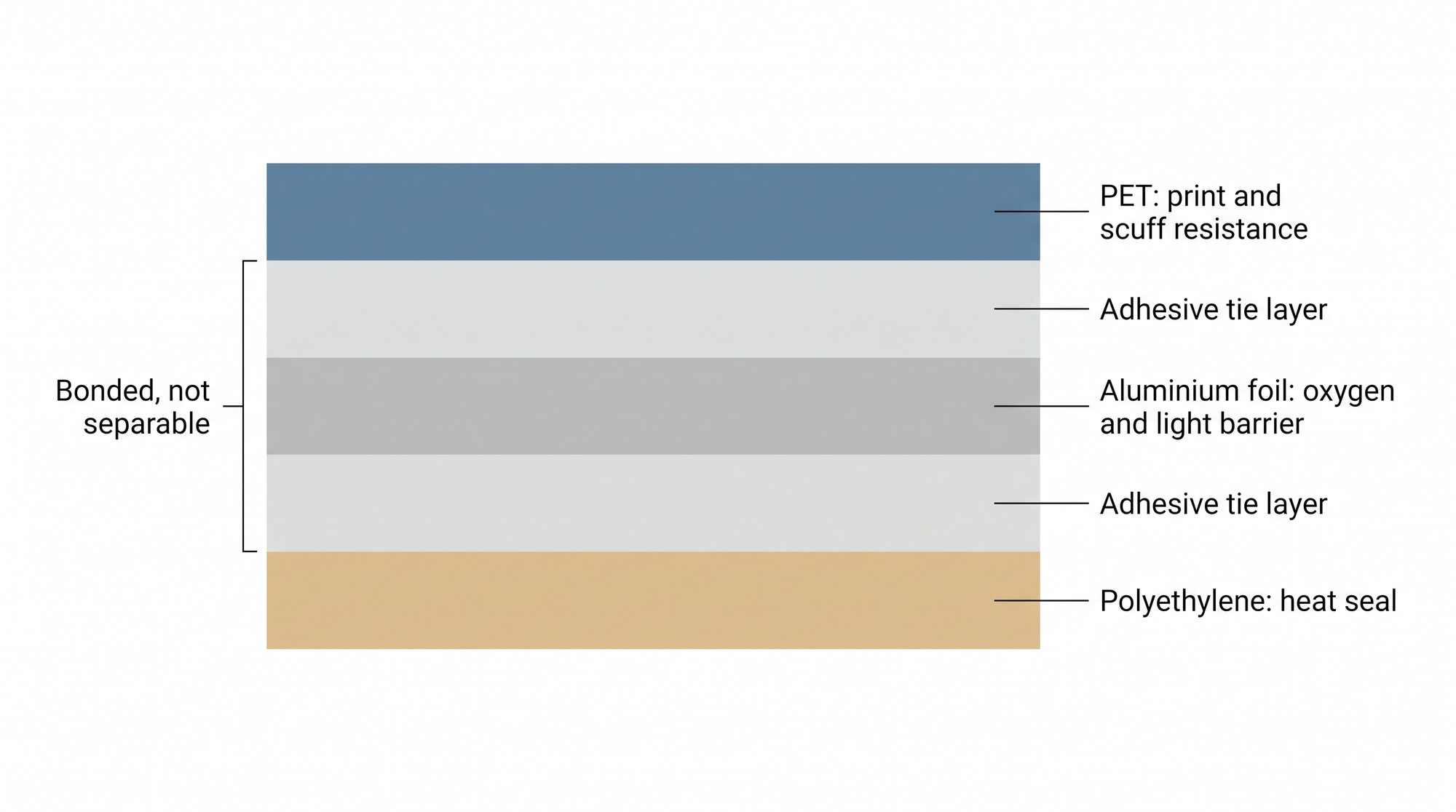
A coffee bag, a retort food pouch, a sachet of shampoo: each is not one plastic but several, bonded into a single sheet. Polyethylene provides the heat seal, PET on the outside takes the printing and the scuffing, an aluminium foil or EVOH layer blocks oxygen, and tie layers hold the stack together. Each layer earns its place, and together they make a material that keeps food safe and that almost no recycling system on earth can dismantle.
esa Inc., a Tokyo company formally named Environmental Solutions Architect and founded in March 2022, has attacked the problem from the other end. Instead of trying to separate the layers, its process assumes they cannot be separated and turns the mixture into pellets anyway. It announced full operation of the Yuki Circular Factory in Yuki City, Ibaraki Prefecture, on 9 April 2026, describing it as Japan’s first plant dedicated to material recycling of composite plastics. In October it announced a funding round that took its cumulative raise to 1.15 billion yen, about $7.6 million.
Why Multilayer Plastic Ends Up in an Incinerator
Three separate obstacles push composite film toward thermal recovery. It helps to keep them apart, because esa only solves one of them, and together they explain why multilayer plastic recycling has stayed stuck at pilot scale.
- Sorting cannot see what it is sorting. Near-infrared scanners, the workhorse of modern plastics sorting, read only about the outer 10 micrometres of a surface, as the Belgian research centre Centexbel explains in its technical survey of multilayer recycling. Everything below that first layer is invisible to the machine, so a pouch whose print layer sits above a barrier layer presents the wrong identity to the sorting line.
- The streams are too thin to be worth collecting. Centexbel puts the commercial threshold at roughly 250 tonnes a year before a waste stream becomes interesting to a recycler. Household flexible packaging arrives scattered across millions of bins in quantities far below that at any single point.
- The polymers refuse to mix. Polyethylene and polyamide have incompatible molecular structures, which is why recycling them together usually requires added compatibilisers to stop the blend separating into phases. Melt blended without help, the result is a material with poor mechanical properties, a limitation documented in peer-reviewed work on designing multilayer packaging for separation. That research also notes that multilayer film accounts for about 26% of all flexible packaging and the largest share of non-recyclable packaging.
Thin films are the hardest version of this problem, a point that has driven a decade of work on making thin-film plastics recyclable without much of it reaching commercial scale. Manufacturers have also tried solving it from the design side, including investment in dedicated flexible plastic recycling plants.
Turning the Problem Into the Process
The company’s process, which it markets as esa method, abandons separation entirely. A purpose-built kneading mechanism and tightly controlled temperature and pressure disperse the different resins into a stable blend rather than trying to pull them apart. The company puts the conversion at roughly 20 minutes from collected composite waste to recycled resin.
It is material recycling, not chemical recycling: no depolymerisation, no breaking the plastic back down to monomers or oil. That places it on the opposite side of a long-running argument from solvent-based approaches, which dissolve the layers so they can be recovered separately, the route pursued by projects such as CreaSolv and the EU’s MultiCycle project. esa’s bet is that skipping the separation step saves more energy and money than the purity is worth.
What the company has not published is equally relevant: the washing method, the plant’s capacity, its yields, and how much contamination it will tolerate. A Japanese technical analysis of the plant notes that these details are not in the public record. Without them, outside engineers cannot judge the process, only the outcome.
Inside the Yuki Circular Factory
The plant sits at 1-2 Shin’yahata in Yuki City, north of Tokyo in Ibaraki Prefecture, and runs two production lines for recycled pellets made from composite waste that cannot be split into single materials. The equipment is a full line rather than a single machine: sorting units, crushers, extrusion equipment and prototype development kit. The company says the machinery is configured according to the type of waste plastic and the intended end use.
That single-site combination of pelletising and application prototyping is the part worth watching. The gap between a pellet and a product that a manufacturer will actually specify is where recycled materials usually die.
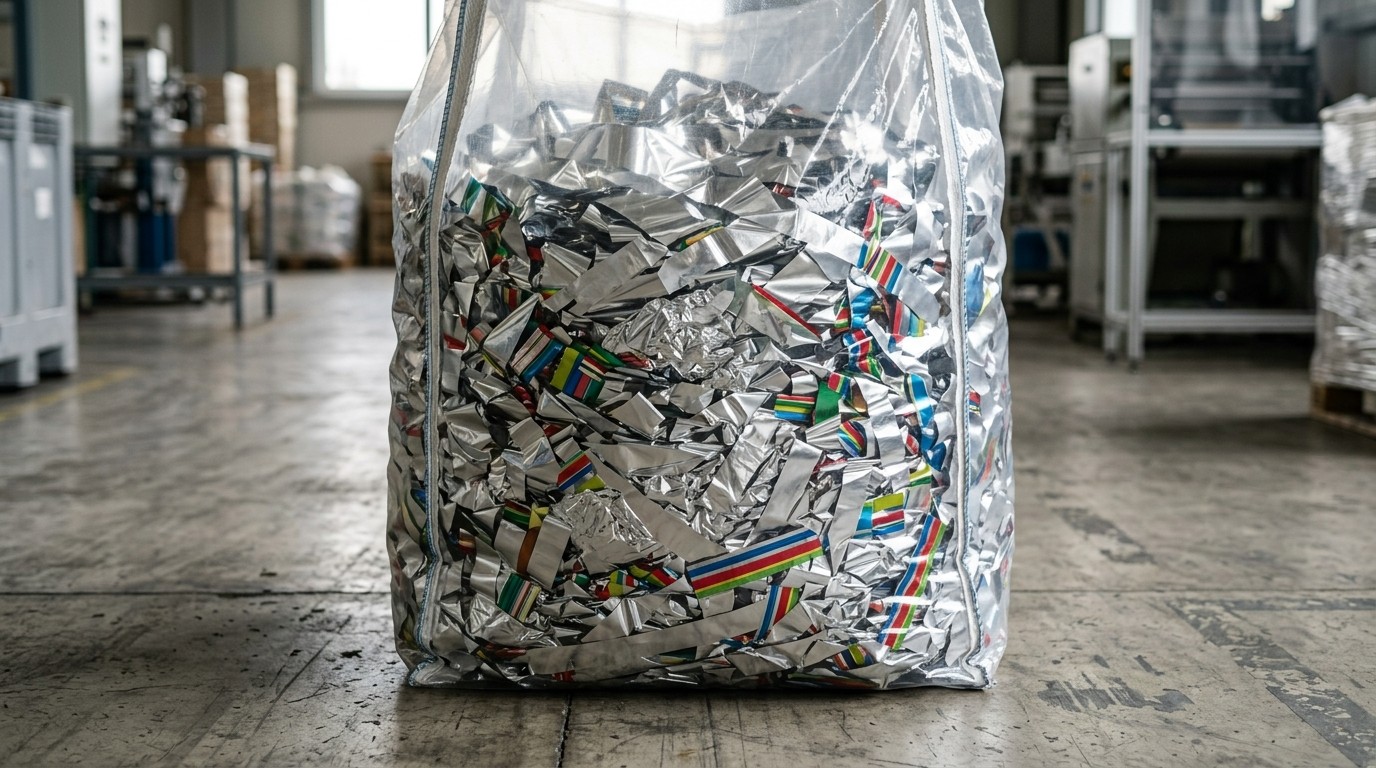
The feedstock matters just as much as the hardware. The peer-reviewed assessment that underpins esa’s environmental claims studied uncontaminated post-industrial film, meaning clean factory offcuts and trimmings. Post-consumer pouches are a different proposition: printed, food-stained, mixed with other waste and collected in dribs. That is the work the new money is meant to fund.
The 1.15 Billion Yen and Who Put It In
The 1.15 billion yen round brought in four investors: Mitsubishi UFJ Trust and Banking, Mitsubishi UFJ Capital, Environmental Energy Investment, and SG Wonder Zone, according to the company’s funding announcement of 13 October 2026.
The stated use of funds is instructive. It goes to strengthening production and supply capacity and to developing applications. That is not a research budget. It is the budget of a company that believes the chemistry works and now has to prove it can deliver consistent quality in volume.
Beyond that, esa has flagged product co-development with partners, plastic credits, and licensing its process to other operators. Licensing is the only one of those with a plausible route to scale: one plant in Ibaraki is a rounding error against Japan’s plastic waste, but a licensed process could travel.
There is a policy tailwind. Japan’s amended Act on the Efficient Use of Resources took effect in April 2026, introducing a requirement for businesses to draw up plans for recycled resource use and report them to the government. Demand for recycled material is becoming less voluntary.
What the Life Cycle Data Actually Says
The environmental case does not rest on a press release. In 2025 a team including researchers from Kyoto University’s Graduate School of Advanced Integrated Studies in Human Survivability and Graduate School of Energy Science published a life cycle assessment in Green Chemistry, using SimaPro and the Ecoinvent database. The study, a comparative life cycle assessment of virgin polyethylene, bio-polyethylene and recycled polyethylene from post-industrial film, was supported by esa and is genuine peer-reviewed work.
Its central figures are these. Pelletising Repla emits about 364 kg of CO2-equivalent per tonne, against roughly 2,755 kg for virgin polyethylene and 2,110 kg for bio-based polyethylene. That is about 87% lower than virgin plastic and 83% lower than the plant-based alternative. Fossil resource use falls to about 100 kg of oil equivalent per tonne, against 1,769 kg for virgin polyethylene and 3,129 kg for bio-polyethylene. Human carcinogenic toxicity is estimated 90% lower than virgin polyethylene and 95% lower than bio-polyethylene.
Then there is the figure most often quoted in coverage of this company, and it is the easiest one to misread. For a bag made with a 50% blend of Repla, the study found CO2 emissions about 42% lower, human carcinogenic toxicity about 61% lower and fossil resource consumption about 61% lower. The comparison in that scenario is against a bag made with a 50% blend of biopolyethylene, not against a conventional virgin-plastic bag. A Repla blend measured against ordinary polyethylene would produce a different number, so the two cannot be swapped.
The study models scenarios rather than measuring what comes out of the Yuki plant’s stack. For dirty, printed, post-consumer composite packaging, the energy and washing burden will be higher and the advantage narrower until someone publishes otherwise.
The Catch: These Pellets Are a Downgrade
Recycled composite pellets are not a like-for-like substitute for virgin plastic, and the company does not claim they are. Blending several resins together averages out their properties, so the resulting material is less stiff, less clear and less predictable batch to batch than a single polymer. Consistency, not chemistry, is the commercial bottleneck.
The consequence is that Repla cannot go back into the pouches it came from. There is no closed loop here, and no food contact application. This is downcycling in the precise sense: the material drops a tier. Compare it with the ambition behind research into genuinely closed-loop plastic recycling, where the polymer is designed so it can be unzipped back to pure monomer. esa’s route accepts impurity as a permanent feature.
What it displaces is still worth having. Repla has gone into products where a blended, slightly variable material is acceptable:
- Logistics pallets
- 3D-printed architectural formwork, developed with the company DigitalArchi
- Parts for wheelchairs
- Chalkboard erasers, made with Nihon Rikagaku Kogyo
esa reports that its Repla pallet, tested by SGS to the ISO 8611 load standard at 4 tonnes static and 2 tonnes dynamic and cleared for storage at minus 40°C, cuts CO2 by about 48% against an equivalent pallet made with virgin material. That figure is the company’s own assessment rather than a peer-reviewed finding, so treat it as a manufacturer claim. The pallet took a 2026 Good Design Award, three years after the Repla material itself won one in 2023.
Those products currently consume virgin plastic, and the alternative fate for composite waste is an incinerator. Displacing virgin material in a pallet is a real gain. It is simply a smaller gain than turning a pouch back into a pouch, and the difference should not be blurred.
The bigger prize lies elsewhere. esa has joined an accelerator run by Vietnam’s National Innovation Center under a Japanese ODA programme, as reported by the company’s announcement of its selection, and has said it is looking at a plant there, drawn by the electronics and semiconductor manufacturing that generates composite waste in the north of the country. That is the licensing model in practice: the process travels, and the material stays local.
What This Means for Japan’s 89%
Japan generated 9.11 million tonnes of plastic waste in 2024 and reports an effective utilisation rate of 89%, according to material flow data from the Plastic Waste Management Institute published in December 2025. The headline sounds like a solved problem.
The breakdown says otherwise. Of that total, 67% goes to thermal recovery, roughly 6.08 million tonnes, much of it burned as fuel or in cement kilns. Material recycling accounts for 20%, about 1.82 million tonnes, and chemical recycling for 3%, around 270,000 tonnes. A further 11% is not utilised at all: 8% simple incineration and 3% landfill.
Japan counts energy recovery as recycling. A 2021 opinion paper from the Japan Federation of Bar Associations argues that the term thermal recycling appears only in Japan and that internationally heat recovery is treated as recovery, a fallback where recycling is not possible, which is why nearly seven in ten tonnes of the country’s plastic waste are described as effectively used while sitting inside a furnace. Strip that out and the domestic recycled-material utilisation rate is 4.6%, against a national target of 10% by the 2030 fiscal year. Packaging recycling sits at 34.4%.
That is the gap the Yuki plant addresses. Composite multilayer material has had no material recycling route at all in Japan, so every tonne processed is a tonne that would otherwise have burnt. If the licensing model works, the plant is a proof point. If it does not, it remains a demonstration.
Frequently Asked Questions
Is multilayer plastic recyclable?
Yes, but not through kerbside collection, and the route matters. The layers are bonded with adhesives or tie layers, so conventional mechanical recycling struggles and near-infrared sorting cannot identify what is underneath the surface layer. Workable approaches include designing the packaging so layers can be peeled apart, adding compatibilisers so mixed resins blend more successfully, dissolving the layers in solvent, or, as esa does, accepting the mixture and pelletising it whole. What is new here is a commercial plant doing the last of those at a material recycling scale, not the idea itself.
What are examples of multilayer plastic?
Coffee and snack bags, stand-up food pouches, retort sachets, toothpaste tubes, shampoo refill packs, some beverage cartons, medical packaging and sealed lid films. The common thread is a product that needs a barrier against oxygen or moisture, a printable outer surface and a heat-sealable inner surface, which is difficult to deliver with a single polymer.
Can recycled composite pellets replace virgin plastic one for one?
No. Because the feedstock is a mixture, the recycled pellet has averaged and less predictable properties, and it is not suitable for thin barrier films or food contact. It is suited to thicker moulded and extruded parts such as pallets, formwork and components where slight variation in mechanical properties is tolerable.
Is esa’s process the same as chemical recycling?
No. It is mechanical, or material, recycling. The polymers are melted and blended, not broken back down into monomers or converted to oil. The trade-off is consistent across the industry: mechanical routes use far less energy but are limited by the quality of what comes out, while chemical routes can, in principle, restore virgin-grade material but remain energy-intensive and small in scale.
Where does Japan’s multilayer plastic go now?
Mostly for thermal recovery as fuel or feedstock for cement production, and some for simple incineration. A small share is landfilled, and some is exported. Only a marginal amount is recycled as material, which is the gap the Ibaraki plant is designed to open.
The Bottom Line
esa has built something that did not previously exist in Japan: a commercial plant that takes composite multilayer plastic, skips the step everyone else considers essential, and produces a usable pellet. The funding announced in October gives it a supply chain to build and applications to open up. That is a real advance, and the peer-reviewed life cycle assessment behind it is stronger evidence than most recycling startups can offer.
Three things remain unresolved, and they are the ones to track. The plant’s capacity and yields are still undisclosed, so its significance cannot yet be measured. The environmental case is proven on clean industrial offcuts, not on the food-stained pouches that dominate the waste stream. And the output is a downgraded material, which means success looks like displacing virgin plastic in pallets and panels rather than closing the loop on packaging.
None of that makes the plant a bad idea. It makes it an honest first step in a category where the previous step count was zero.


