
Inside every electric car motor, every hard drive, and every direct-drive wind turbine sits a piece of engineered crystal that took an extraordinary amount of energy to make. When the machine around it stops working, that crystal usually becomes scrap metal and then landfill.
Rare earth magnets are the strongest permanent magnets available. By weight, though, they are mostly iron. That single fact explains most of why they are so rarely recycled: the valuable material is a minority of the object, the metal surrounding it is cheap, and the two are bonded together in ways that actively resist being taken apart.
This year, the picture shifted. Commercial plants in Arizona, Birmingham, and Pforzheim began pulling magnets out of end-of-life products and returning them to the supply chain. What follows is the story of what happens to a magnet after its machine dies, why recovery is far harder than the coverage suggests, and what the new plants genuinely solve and what they do not.
The stakes are not abstract. Most global rare earth processing sits in a single country, which is why magnet supply keeps being discussed as a security question rather than a materials one. Recycling is the only source of rare earths that does not require a new mine, a new separation plant, or a new trade agreement. It requires something less glamorous: getting the magnet out of the machine before the machine is destroyed. That makes rare earth magnet recycling less a chemistry problem than a logistics and design one, and the following sections take each part of that claim in turn.
Why so little magnet material ever comes back
Ask how much of the world’s rare earth magnet material is recycled, and the honest answer is that nobody has a clean global measurement. What exists are estimates from people close to the industry, and they are strikingly low.
Professor Allan Walton, a founding director of the magnet recycler HyProMag and head of the Magnetic Materials Group at the University of Birmingham, put the figure plainly in a technical article: less than 5% of rare earth magnets are currently recycled from end-of-life components. That is an industry estimate rather than a measured statistic, and it should be read as one. Its direction is not really in dispute, though, because until this year there were almost no commercial facilities equipped to do the work at all.
Other published figures in circulation are lower, but they are not measuring the same thing and should not be read as contradicting this one. A widely reused industry statistic, less than 1% of rare earths are recycled, refers to rare earth elements across all end uses, including the fluorescent lamp phosphors, polishing powders, and catalysts that magnets are only one part of. A 2016 survey in Chemistry & Industry gives the same figure with its scope spelled out: in 2011, less than 1% of rare earths were recycled from end-of-life products globally. That is element tonnage in a specific year. Walton’s 5% figure, published in 2022, is about magnets. The two sit together without conflict: magnet recovery is a subset of rare earth recovery, and it is slightly healthier than the whole.
There is also a definitional issue underneath both numbers. A large share of what does get recycled is manufacturing scrap from magnet factories, which is clean, single-grade and never leaves the plant. Post-consumer material from shredded devices is far harder and makes up much less of the total. A rate that counts factory offcuts will always look better than one that counts only end-of-life products, which is exactly what the 5% figure specifies.
What the “less than 5%” figure actually means
The number describes how much of the magnet material inside discarded products returns to manufacturing as magnet material. It does not mean that 95% of rare earth elements vanish, because it is a magnet recovery figure and not an element recovery figure. Some end-of-life magnets are processed as scrap steel, where the rare earth content ends up diluted and largely unrecovered. Some devices are exported as waste, a problem documented in the broader picture of how much e-waste richer countries generate. Some sit in warehouses and drawers. A small share is genuinely recycled back into magnets.
That distinction matters because “recycling” covers several very different things, and only one of them preserves the thing that made the magnet valuable in the first place: not the neodymium, but the alignment.
A magnet is not a lump of metal. It is a manufactured crystal.
To understand why recovery is difficult, it helps to know what is actually being recovered. A neodymium-iron-boron magnet is roughly 30% rare earth elements, 69% iron, and 1% boron by weight, with small additions of cobalt, aluminium or copper and a corrosion-resistant coating.
The rare earth fraction is not one element. It is typically neodymium and praseodymium, which is why new ways to extract rare earth elements keep attracting research funding, plus a small fraction of dysprosium or terbium, added to stop the magnet losing its strength when it gets hot. That is why magnets in traction motors and wind turbine generators can carry several percent dysprosium: heat resistance is the whole point.
Getting those elements into a useful magnet is a manufacturing sequence, not a smelting job. The alloy is cast, crushed, and milled into a fine powder; the powder is aligned in a magnetic field so its grains point the same way, then pressed and sintered until the grains fuse into a dense body with a thin neodymium-rich skin around each one. The alignment is what creates the strength. The grain boundary is what holds the alignment in place at temperature.
That structure, not the elemental recipe, is the thing a recycler has to either preserve or rebuild.
What the shredder does to a magnet
Most end-of-life electronics and vehicles are not carefully dismantled. They are shredded because shredding is fast, cheap, and, in the case of data-bearing equipment, secure.
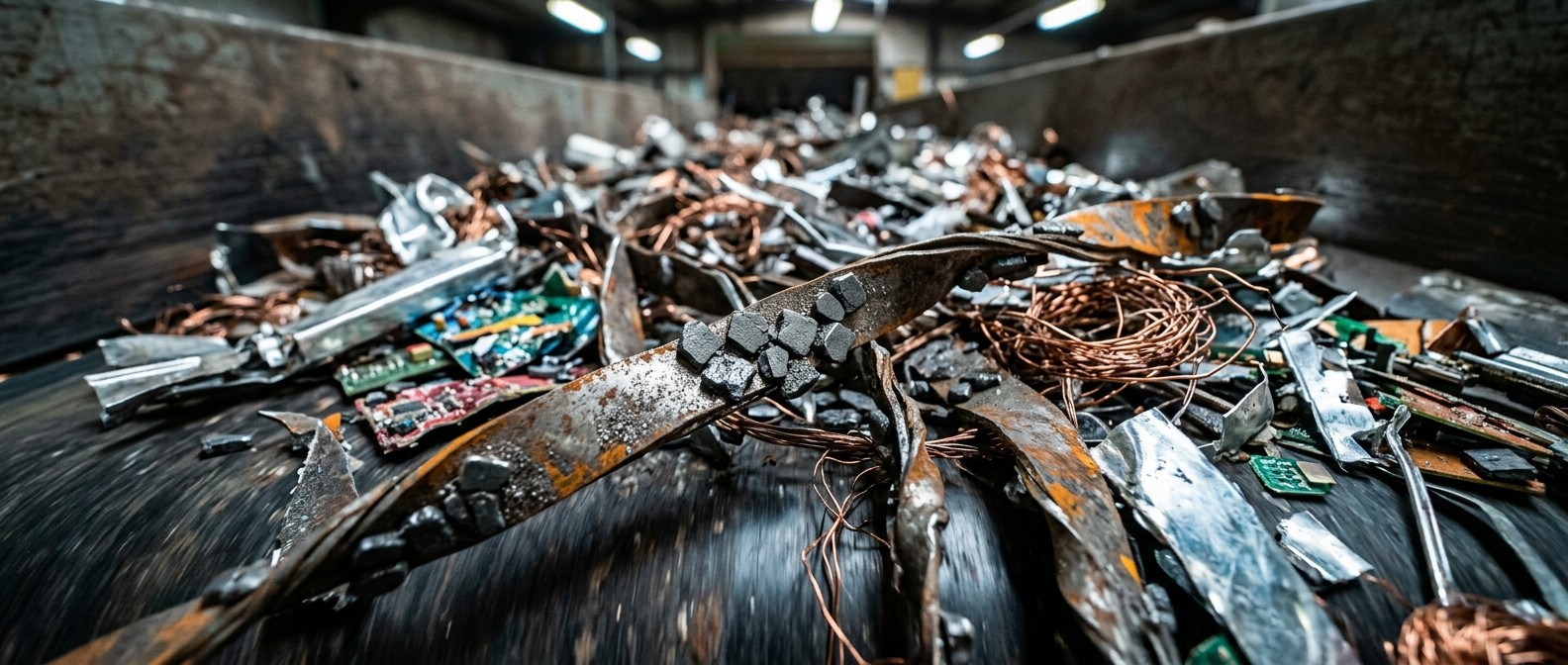
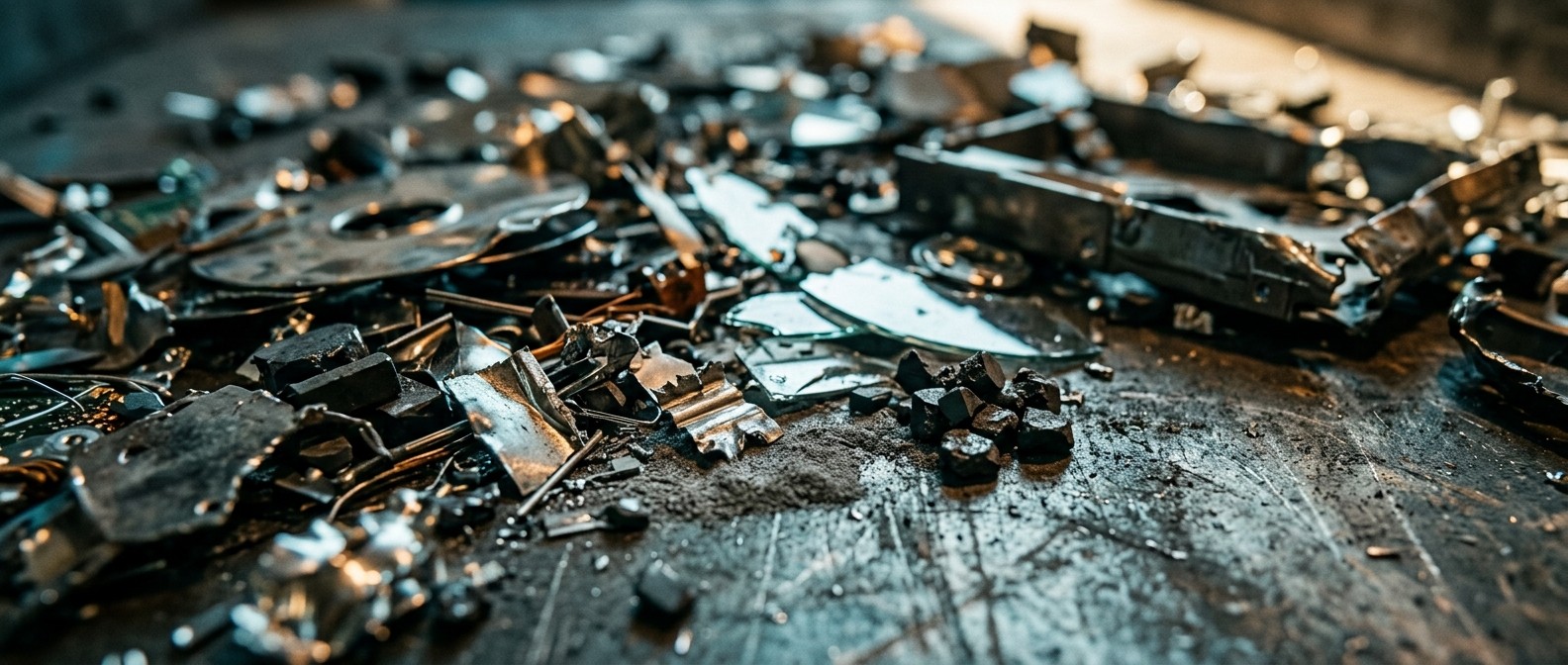
Sintered neodymium magnets are brittle. Under a shredder they do not bend or pull free cleanly. They fracture into fragments and powder, and those fragments then behave in a way no other scrap fraction does: they are powerfully magnetic. A 2026 review of NdFeB waste recycling in the journal Materials notes that rare earth recovery becomes economically impractical when tiny magnets are attached to ferrous metal because of their enormous magnetism and that shredding technique itself changes how much magnet material can be captured. Precise shredding paired with a 30 mm grate recovered magnet concentrate far better than coarse shredding, but even the better case leaves material smeared into the steel stream.
The magnet does not end up in a magnet pile. It ends up on the steel, or inside it, and then in a furnace that has no interest in separating neodymium from iron.
Why separation, not chemistry, is the hard part
This is the detail that most coverage skips. The chemistry of separating rare earths from each other is genuinely difficult, but it is well understood and has been done at an industrial scale for decades. The unsolved problem sits earlier in the chain.
If a magnet arrives intact, it can be demagnetized, removed, and remade. If it arrives as fragments stuck to a steel bracket, the options narrow sharply. Conventional hydrometallurgical routes then have to deal with a dilute, contaminated feed, which is where the economics usually fail.
The scale of what is being destroyed instead of dismantled is considerable. Oak Ridge National Laboratory has estimated that around 35% of used hard drives in the United States are shredded for data security reasons, and that recovering those drives alone could yield roughly 1,000 metric tons of magnet material a year.
Three things can happen to a magnet at end of life
Almost every end-of-life magnet follows one of three paths, and the differences between them explain the entire economics of the sector. Only the third keeps enough of the original material to rebuild a high-grade magnet. The rest trade purity of purpose for convenience, and the cost of that trade is paid in grade rather than in elements.
- It is shredded and lost. The magnet fractures, clings to ferrous scrap, and is diluted into steel recycling. The rare earth content is dispersed beyond economic recovery. This is the default outcome, and it is why the recovery rate is so low.
- It is melted and downgraded. The magnet is fed into a furnace and returned to alloy. The elements come back, but the specific grade does not, and impurities accumulate. This route works, but it produces a generic material rather than the magnet a customer ordered.
- It is decrepit and rebuilt. The magnet is broken down into powder without melting, cleaned, and re-sintered into a new magnet of controlled grade. This preserves the most value and is what the new commercial plants are built around.
The third route is usually called short loop or magnet-to-magnet recycling, which is not marketing language but a description of a specific technical choice.
Melt it down and you lose the grade, not the elements
Melting is the intuitive approach: put the old magnet in, and get the metal out. What comes back is an alloy whose composition is an average of everything that went into the furnace. If a batch contains hard drive magnets, loudspeaker magnets, and a few motor segments, the resulting alloy reflects that mixture.
Recycled magnets produced from melt-blended feed are therefore generally downgraded relative to the virgin sintered magnets they came from. The rare earth content is there, but matching a customer’s specified dysprosium level and coercivity becomes a blending problem, and every additional processing step adds cost and energy to a product that is already competing with cheap primary metal.
Oxygen is the other constraint. University of Birmingham researchers working on remanufacturing sintered magnets from high-dysprosium end-of-life scrap note that while small amounts of oxygen can be beneficial, excessive oxygen above roughly 3,000 parts per million reduces densification during sintering and degrades the finished magnet’s properties. Corroded magnets from a damp warehouse are therefore not equivalent feedstock to clean production scrap.
This is exactly why direct magnet-to-magnet reuse matters. It is the only route that keeps the aligned microstructure and the rare earth distribution close enough to the original to rebuild a high-grade magnet rather than a compromise one.
What is actually running in 2026
For most of the last two decades, magnet recycling existed as pilot plants, academic papers, and grant-funded consortia. That changed within a nine-month window this year, with three facilities opening and a fourth under construction. They are not identical, and the differences matter more than the headlines.
| Facility | Location | Approach | Announced capacity | Status, October 2026 |
|---|---|---|---|---|
| Cyclic Materials, Mesa | Arizona, USA | MagCycle automated mechanical separation, feeding REEPure refining | Up to 25,000 t a year of magnet-bearing end-of-life products, input only | Opened 9 September 2026, commercial shipments underway |
| HyProMag, Tyseley | Birmingham, UK | HPMS hydrogen decrepitation plus sintering | 100 t a year of sintered magnets on one shift, over 300 t on multiple shifts | Opened 15 January 2026 |
| HyProMag GmbH, Pforzheim | Germany | HPMS plus sintering | About 100 t a year initially, up to about 350 t on multiple shifts, permitted to 750 t, all of it NdFeB magnets and alloys | Opened 28 April 2026, commissioning through 2026 |
| HyProMag USA, Texas Hub | Northlake, Texas | HPMS plus magnet manufacturing | 550 t of magnets plus 484 t of co-products in Phase 1, about 1,526 t total payable in Phase 2 | Finishing operations targeted for 2027, HPMS section for 2028 |
Note that these capacity figures are not the same kind of number. Cyclic’s 25,000 tonnes describes how much magnet-bearing material goes in, not how much magnet comes out. The HyProMag figures describe finished magnet output. Comparing them directly would be misleading.
Mesa, Arizona: separate the magnets while they are still whole
Cyclic Materials opened its Mesa facility on 9 September 2026, describing it as America’s first commercial-scale rare earth magnet recovery facility. The plant uses MagCycle, an automated mechanical separation system that pulls magnet material out of end-of-life products and produces a concentrate the company calls Mag-Xtract, alongside copper, aluminium and steel.
The site has capacity for up to 25,000 metric tons of magnet-bearing products a year. That figure is an input number, not an output number: it measures the material going in, not the magnet coming out. More than 7,000 tonnes had already been delivered by the time the plant opened. It was built in 17 months, at a reported cost of about $20 million across 144,000 square feet, and is designed to be feedstock-agnostic rather than dependent on one product type.
A second U.S. campus in McBee, South Carolina is planned for 2028, combining magnet recovery with rare earth refining on one site. The state announcement put the investment at more than $82 million.
The company had raised a $75 million Series C round in January 2026, bringing total equity funding past $162 million. Its refining step, REEPure, is a hydrometallurgical process that turns recovered magnet material into mixed rare earth oxides, which is a different product from a finished magnet.
Birmingham and Pforzheim: break the magnet down where it sits
The HyProMag plants take the opposite approach. Rather than separating magnets mechanically, they use Hydrogen Processing of Magnet Scrap, a process developed over four decades in Birmingham’s Magnetic Materials Group and licensed to HyProMag.
There is a catch, and it is the same catch that defeats mechanical separation. Hydrogen can only reach the magnet if there is a path to the alloy, and a finished magnet is wrapped in a nickel or epoxy coating precisely so that it does not corrode. That is why the process is applied to components whose magnet surface is exposed, or cropped open, rather than to anything that arrives in a bag. The components are then loaded into a rotating drum inside a pressure vessel and exposed to hydrogen at roughly atmospheric pressure and room temperature. The magnets absorb hydrogen and expand and break apart into a friable powder in around 30 to 40 minutes. Crucially, the reaction also demagnetizes the material, so the powder no longer clings to the steel around it and can be tumbled free. Coatings and adhesives separate as the material breaks down.
That single trick solves the ferrous contamination problem at its source. There is no need to fully disassemble a hard drive or a motor: the magnet destroys itself in place and falls out as powder.
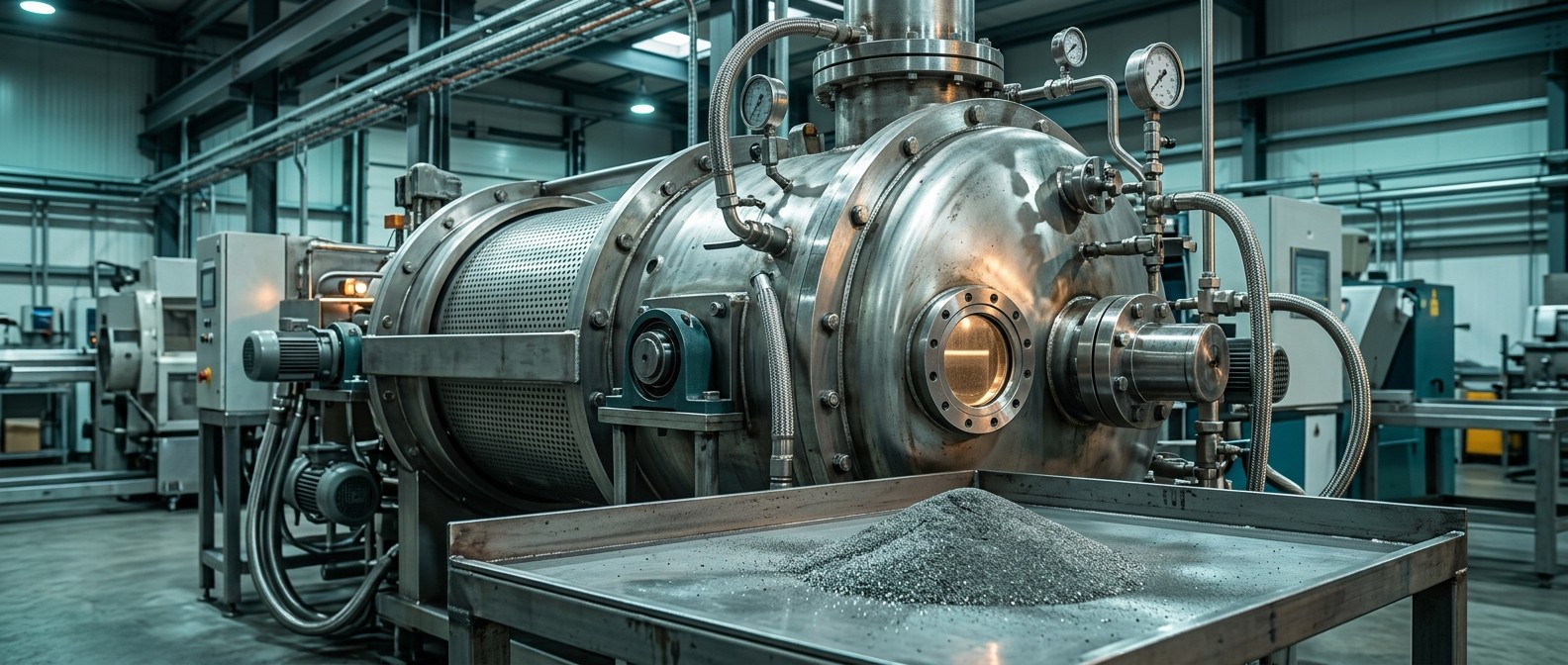
The Tyseley Energy Park facility opened on 15 January 2026 and can recover over 400 kg of rare earth alloy per batch, producing sintered magnets at 100 tonnes a year on a single shift and over 300 tonnes on multiple shifts. Progress against those numbers is public: by April 2026 the plant had produced 9.2 tonnes of recycled NdFeB alloy powder, of which 7.4 tonnes had shipped to customers, and one of those customers, Siemens, had built recycled magnets into a SIMOTICS servomotor rotor shown at Hannover Messe. That is a real magnet in a real product, and the cumulative tonnage is still a small fraction of the plant’s annual rating. The University of Birmingham puts the carbon saving at around 90% compared with magnets made from mined minerals, a figure in line with an earlier lifecycle study finding that the short-loop route uses 88% less energy than primary magnet production.
HyProMag GmbH opened its Pforzheim plant on 28 April 2026, the first facility of its kind in the European Union. It is permitted to produce up to 750 tonnes of NdFeB magnets and alloys a year, with an initial capacity of about 100 tonnes rising to roughly 350 tonnes on multiple shifts, and it was designated a Strategic Project under the EU Critical Raw Materials Act in October 2026. That designation is the clearest signal yet that Germany’s first magnet recycling plant is being treated as infrastructure rather than a curiosity.
Texas: the largest number on the board is also the furthest away
HyProMag USA is building a Texas Hub at Northlake, in the Dallas-Fort Worth area, with pre-processing spokes at electronics recycling sites in South Carolina and Nevada. Phase 1 is designed to produce about 550 tonnes a year of sintered magnet blocks and finished magnets, plus about 484 tonnes of co-products. Phase 2 would take total payable production to roughly 1,526 tonnes a year.
None of that is operating yet. Magnet finishing is targeted for the first half of 2027 using magnet blocks shipped from the UK and Germany, with the integrated HPMS section targeted for the second quarter of 2028. Anyone quoting the Texas capacity as current is describing a plan.
Fort Worth and Mountain Pass: the demand signal that changes the math
The fourth significant project is not a recycler at all. In July 2025, MP Materials and Apple announced a $500 million agreement to supply Apple with magnets made from 100% recycled feedstock, processed at MP’s Mountain Pass site in California and manufactured at its Independence facility in Fort Worth, Texas. Shipments are targeted to begin in 2027.
That matters for a reason beyond tonnage. A recycler’s hardest problem is not extracting rare earths; it is finding a customer who will commit to buying recycled material at a specified grade. A multi-year purchase agreement from a consumer electronics manufacturer does more for the sector than another pilot plant, because it turns recycled magnet material from a novelty into something with a forward price.
What comes out of the other end
The output of these plants is not automatically a drop-in replacement for a virgin magnet. Getting recycled material into a car or a wind turbine requires the manufacturer to accept it, which means qualification testing for magnetic performance, mechanical strength, and corrosion resistance, often against specifications written around the primary material.
This is where the harder, less glamorous work sits. A three-year, £6.5 million project called REACT-UK, led by HyProMag with Jaguar Land Rover, EMR, Less Common Metals, Mkango Rare Earths UK, and the University of Birmingham, is specifically aimed at closing that gap for automotive-grade recycled magnets, including work on grain boundary diffusion to restore performance in recycled material.
The composition problem is central. Birmingham researchers have shown that because the grade available from scrap rarely matches the grade a customer needs, blending recycled powders of different compositions can be used to hit a target grade rather than accepting whatever the feedstock dictates. That is a quiet but important shift: recycled magnets become a formulated product rather than a by-product.
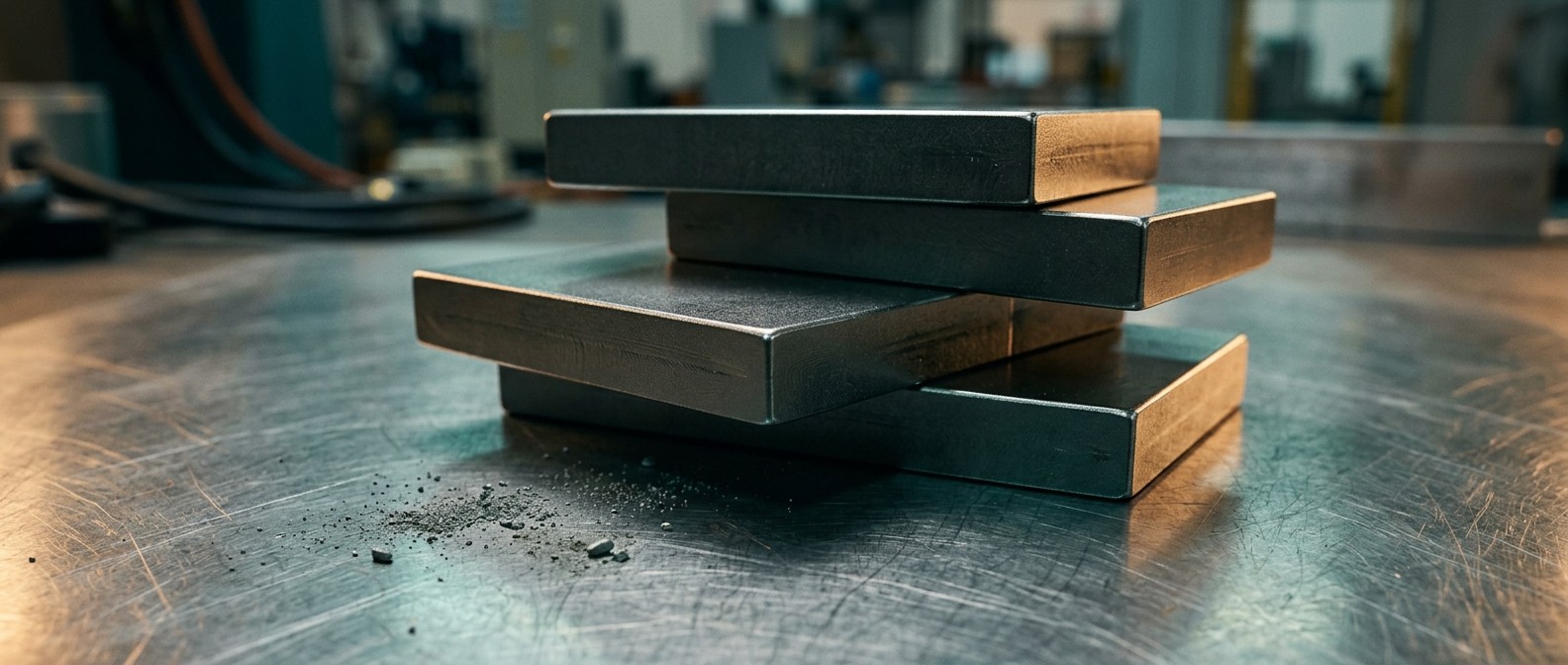
Not everyone is chasing the same output. Fraunhofer’s institutes in Germany have pursued hydrometallurgical recovery of neodymium, praseodymium, and dysprosium at laboratory scale, and researchers there are candid about the trade-offs. Konrad Opelt of Fraunhofer IWKS, who works on recycled magnets for e-mobility, has said that “the recycling process can cause some losses in terms of quality, but it’s possible to compensate for those, for example by changing the microstructure”.
At the other end of the technology spectrum, the Critical Materials Institute at Ames Laboratory developed an acid-free process that dissolves magnets without pre-sorting or demagnetization, aimed squarely at the mixed shredded waste that mechanical sorting handles badly, with the laboratory reporting recovered rare earth oxides above 99% purity. Oak Ridge National Laboratory’s membrane solvent extraction method has been validated by its industrial partner at more than 95% recovery of rare earth product at over 99.5% purity.
Both are genuinely important, and neither is a commercial magnet plant. They solve the problem for feedstock that has already been shredded and mixed, which is the harder end of the problem but also the more expensive place to start. The distinction is worth holding on to: a peer-reviewed recovery rate is not a production line, and a pilot reactor is not a supply chain. Rare earth magnet recycling has no shortage of clever chemistry. What it has had, until now, is a shortage of places to do it at scale.
What would make recycling normal
The new capacity is real, and it is also small. Even with every announced plant running at nameplate, magnet-to-magnet output would be measured in the low thousands of tonnes a year, which is a rounding error against the size of the magnet market. Three things would change that faster than anything else.
- Design for disassembly. A magnet that can be reached and removed as a component is worth vastly more than one welded into a sealed assembly. Birmingham’s REACT-UK work on grain boundary diffusion makes the same point from the other direction: it is possible to restore performance, just not for free.
- Feedstock that arrives intact. Data security rules push hard drives toward destruction. Segregating magnet-bearing components before shredding, rather than after, is cheaper than any downstream chemistry.
- Demand-side commitment. Recyclers need buyers willing to specify recycled content and qualify recycled grades. Without that, plants run below capacity, and the economics stay marginal.
There is also a substitution story running in parallel. Some manufacturers are designing motors that reduce or eliminate rare earth magnets entirely, which lowers demand for recycled material by lowering demand for magnets. That is not a fringe idea: a magnet-free motor designed by a 17-year-old has already drawn serious attention from the EV industry. For heavy-duty applications such as wind turbines, this is harder, which is why end-of-life turbine components are becoming a recycling problem in their own right.
Seen from the waste side, magnets are one narrow stream inside a much larger recovery challenge. The wider picture of recovering critical minerals from e-waste involves very different chemistry, timelines, and economics, and the two are often discussed as if they were the same problem.
Frequently Asked Questions
Can you recycle rare earth magnets?
Yes, and there are now commercial plants doing it. Sintered neodymium-iron-boron magnets can be mechanically separated from products, broken down into alloy powder using hydrogen, or dissolved chemically to recover the rare earth elements. What limits the practice is not whether it can be done, but whether intact magnets can be collected in sufficient volume and whether the recovered material can be sold at a grade a manufacturer will accept.
What are rare earth magnets worth?
A finished sintered magnet’s value comes mostly from its rare earth content, which is roughly 30% of its weight, and disproportionately from dysprosium and terbium where those are present. New magnet prices are usually quoted per kilogram and vary with grade, coating and rare earth prices. Recycled magnet material trades at a discount to virgin material because of qualification requirements and composition uncertainty, so the scrap value of a magnet is well below the value of the elements inside it.
What is the scrap value of magnets?
There is no single published scrap price for neodymium magnets, and anyone quoting one without specifying grade, dysprosium content, and form is guessing. Neodymium magnet scrap is bought and sold in industrial lots rather than by weight at a local yard, and small quantities from consumer devices are rarely economic to process because collection and handling cost more than the material is worth. For context, a single hard drive typically contains only a few grams of magnet material.
What can I do with rare earth magnets?
The most useful thing is to keep them in a stream where they can be recovered. That means sending hard drives, speakers, and small motors to an electronics recycler that segregates components rather than one that shreds everything immediately, and asking explicitly whether magnets are recovered. Reusing a magnet in a workshop project is fine, but it delays rather than prevents the magnet reaching the waste stream.
Are recycled magnets as strong as new ones?
They can be, and that depends entirely on the route. Short-loop processes that keep the alloy powder and re-sinter it preserve the microstructure, and Birmingham’s work has produced recycled sintered magnets with properties comparable to the starting material. Melt-based routes blend everything into an average alloy and generally produce a downgraded magnet unless the composition is corrected. The honest answer is that recycled does not determine quality; the process does.
Where can I recycle rare earth magnets near me?
Consumer-scale magnet recycling is not yet a drop-off service in most places. The practical route is through established electronics and metal recyclers who handle hard drives, electric motors, and appliances, or through municipal e-waste programs, some of which are listed in local authority directories. For businesses generating magnet-bearing scrap, the relevant counterparties are the recycling companies named in this article and the scrap processors that supply them.
The magnet problem is a design problem wearing a chemistry costume
The reason rare earth magnets are barely recycled is often described as a chemistry problem, a policy problem, or a supply chain problem. It is none of those first. It is a materials problem created at the design stage and settled at the shredder, where a brittle aligned crystal is broken into fragments and then held against steel by its own magnetic field.
The plants that opened in 2026 matter because they attack that specific failure, and because that failure is not unique to magnets. Wind turbine blades have their own version of it, which is why recyclable blade designs and blade recycling plants have been advancing on a parallel track. Hydrogen decrepitation demagnetizes the magnet, so it stops clinging and falls free. Automated separation pulls whole magnets out before they are destroyed. Neither is a complete solution, and both depend on feedstock that someone bothered to collect.
What has changed is that the question is no longer whether magnet-to-magnet recycling works. It does, at a commercial scale, in three countries as of this year. The remaining questions are about volume, grade, and who pays for the collection step that everything downstream depends on.

