
Automobile manufacturers outside China are racing to build an electric motor that doesn’t incorporate permanent magnets, partly because they require rare earth materials, and mining for such elements causes pollution. But also partially because the mining is completed in China, a daunting automotive competitor.
Magnets found at the heart of most electric vehicle motors typically use rare earth metals like neodymium. China supplies 97% of the world’s rare earth metal supply. State control over this resource essential to various high-tech industries has been a severe problem in the past. For example, the country decided to restrict rare earth exports back at the start of the last decade, and the result was a 750% leap in neodymium prices and a 2,000% jump in dysprosium prices.
And while companies can procure these metals from somewhere else, the only way to economically turn them into magnets is to ship them over to China for processing. No other country can compete with China’s low labor costs and environmental regulations. So, the nation holds a lot of sway in trade negotiations and poses a genuine supply line security problem for other countries.
A few organizations, including BMW, Audi, Renault, and others, are making at least some of their electric motors without magnets already; everyone else also has their attention on the new technology of this type. Such alternative engines turn the rotor making use of electromagnetic force. However, as marvelous as they are for not needing rare earth metals, their designs involve a rotor that transmits electricity to a moving target, and the point of contact is subject to wear and tear.
It’s in the midst of this madness that German company Mahle announces a new electric motor that’s free of both rare earth and physical contact. The central feature of the engine is the inductive and thus contactless power transmission—this permits the machine to work wear-free and efficiently at high speeds. This should allow it to be highly durable as well.
Dr. Martin Berger, the company’s VP of Corporate Research and Advanced Engineering, stated:
Our magnet-free motor can certainly be described as a breakthrough because it provides several advantages that have not yet been combined in a product of this type. As a result, we can offer our customers a product with outstanding efficiency at a comparatively low cost.
There are no contacts to transmit electricity, no abrasion, no dust formation, no mechanical wear. Also, I have to say, if one must service a non-magnetized rotor, it’s not difficult to exchange the rotor.

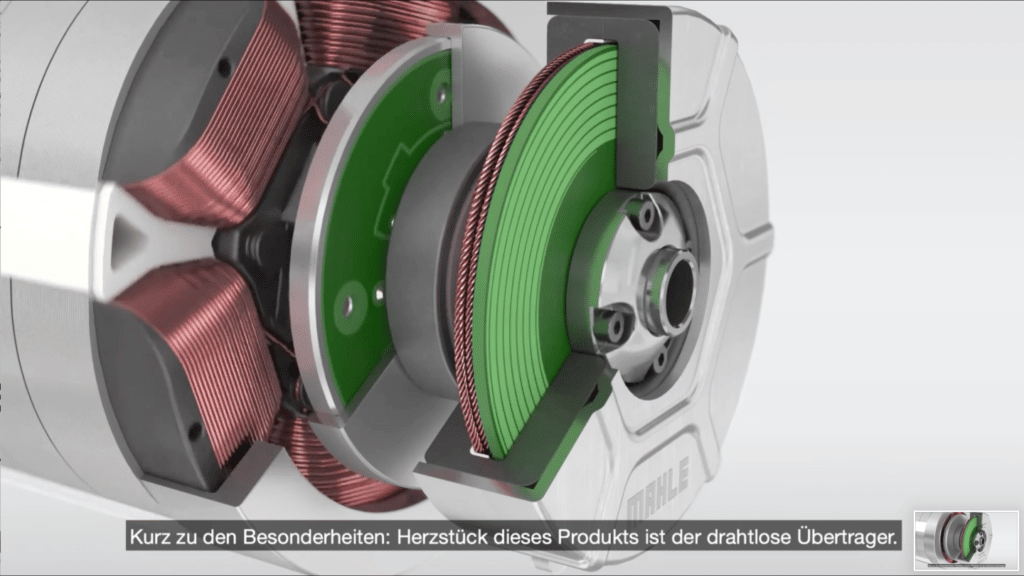

The capacity to tune and change the parameters associated with a rotor’s magnetism, rather than being stuck with what a permanent magnet has to offer, has permitted MAHLE engineers to attain efficiencies above 95% through a range of operating speeds. That’s a level previously only accomplished by Formula E racing cars.
The engine is also remarkably efficient at high speeds, so it could help increase the range, squeezing some extra miles out of a battery in everyday use.
Plus, the lack of expensive metals should make the machine cheaper to manufacture than typical motors with permanent magnets.
Michael Frick, CFO and Chairman of the MAHLE Management Board (ad interim), said:
With our new electric motor, we’re living up to our responsibility as a sustainably operating company. Dispensing with magnets and therefore the use of rare earth elements offers great potential not only from a geopolitical perspective but also concerning the responsible use of nature and resources.
Car manufacturers can use the engine in nearly all vehicle types as it’s easily scalable.
MAHLE has succeeded in combining the strengths of the various electric engine in one product by using an innovative simulation. The tool takes various motor designs are adjusts them along with different parameters until an optimum ground is found. Through this process, the company is forging the necessary technical conditions to advance e-mobility worldwide sustainably.
Samples of the engine are currently being delivered, and mass production is only about two-and-a-half years away.


