
A team of Singaporean engineers has devised a means of controlling the Venus flytrap plant using electrical signals from a smartphone. They hope to manifest various technologies utilizing the plants, from environmental monitoring (bio-sensors) to plant-based robotics.
Researcher Luo Yifei, of Singapore’s Nanyang Technological University (NTU), showed how a signal from a smartphone application to small electrodes attached to the plant could make its trap close, as it does when catching a fly.
The NTU researchers produced a communications device that can deliver electrical signals between the plants and phones or other connected devices. A conformable electrode is added to the plant’s surface employing a hydrogel to collect and transmit electrical signals; this enables the scientists to monitor how the plant reacts to its environment and exactly what may cause it to close its leaves correspondingly.
Dr. Yifei told Reuters:
Plants are like humans; they generate electric signals, like the (electrocardiogram that is ECG from our hearts. We developed a technology that is non-invasive to detect these electric signals from the surface of plants without damaging them.
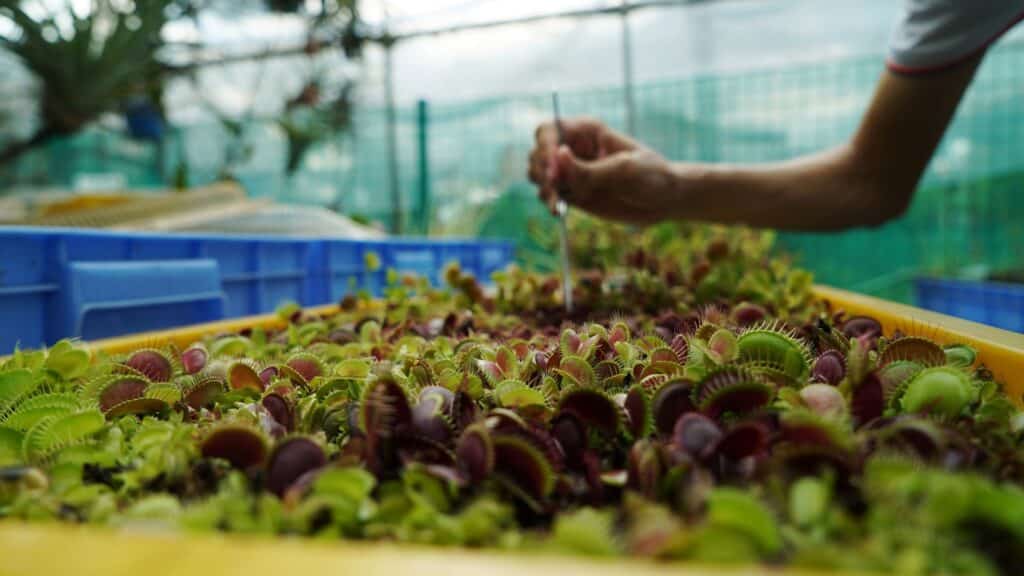
This study builds upon the team’s previous work, which had first turned a Venus flytrap into a soft robotic arm for getting delicate objects, and then developed a device that delivers electric signals to and from the little plant. The scientists could get some Venus flytraps to grip light and thin objects, like a piece of wire, when given a signal. This way, the plant could be employed as a “soft robot” to pick up fragile things that industrial grippers might damage. Plus, it’s more eco-friendly.
In the more recent study, the carnivorous plant can act on command via a smartphone. The team hopes the technology will pave the path for using plants as ecological sensors to offer us very early warnings of potential diseases or abnormalities that land on its delicate leaves. The group is keen to explore the possibilities of utilizing plants as communicators or living sensors capable of monitoring pollution like toxic gas or water pollution.
Luo Yifei, a researcher that’s taking care of the project at NTU’s School of Materials Science and Engineering, said:
We developed a technology that is non-invasive to detect these electric signals from the surface of plants without damaging them.
Getting the Venus flytrap’s “mouth” to shut and open via commands sent from the smartphone was not an easy task. The plants produce weak electrical signals, so the electrode must be in solid contact with the waxy, hairy, irregular surfaces of plants.
To overcome this, the team used thermal hydrogel, aka Thermogel, as their adhesive. Thermogel transforms from liquid to a flexible gel at room temperature, making it possible to add the electrode to various surfaces and improve signal detection, even as the plants grow and move.
The researchers attached the 3mm electrode to the hairy surface and used a smartphone to transmit electric pulses, inducing the plant to close its leaves on demand. They also fastened the flytrap to a robotic arm like in the previous study so the plant could grab small pieces of wire within its leaves.
Luo admitted that a lot more work needs to be done before people can commercially use such plant technologies. He said:
We are exploring using plants as living sensors to monitor pollution that is environmental gas, toxic gas, or water pollution.
Nevertheless, their findings shed light on the potential for plant-based technologies – which could include soft robotic grippers, agricultural monitors for detecting signs of crop disease early, and much more.
Nature is exceptionally good at inspiring researchers to be innovative. The Singapore group’s smartphone-operated Venus flytrap isn’t the only device created that uses nature to “communicate” and potentially save lives and the environment.
Another good example is the DraBot by a team of Duke University engineers. It’s a traveling autonomous dragonfly-like soft robot that skims over water to signal environmental changes such as rising temperature, pH levels, or oil spills. It travels in circles over the hazard spot so people can find them more easily.
And another: a soft robot built by engineers in China that can reach and operate in the Marina Trench – the deepest part of the ocean. The device is a silicone battery-powered robot that can withstand the extreme pressures there – thanks to its soft body and unique components layout. It was modeled after a real deep-sea creature and can handle the depth in the same way its natural counterpart does.
And yet another: Spinach that can detect explosives!
Soon, the list will be endless.


