
Drywood termites are exceptionally good at hiding. Unlike subterranean termites, which build nest galleries connected to soil, a drywood colony can live entirely inside a single piece of wood, spending almost its whole existence out of sight while it chews through beams, trim, and furniture. That makes them genuinely hard to find and hard to eliminate. If you are already dealing with an infestation, our guide to professional termite-proofing for homeowners covers the inspection and prevention side.
Researchers at the University of California, Riverside, think they have found a way around that. A chemical called bistrifluron, which blocks termites from building the new outer shell they need in order to grow, killed roughly 95% of western drywood termites in laboratory testing. More surprisingly, colonies where only about 5% of the insects had directly encountered the treatment still reached 100% mortality within 90 days. The contaminated termites carried the chemical inward to nestmates they never would have met.
That is a genuinely interesting result, and it comes with a genuinely interesting limitation. The same laboratory work that produced the 95% figure also produced a warning: nobody can currently tell you whether the droppings outside a drywood termite colony are from a colony that is still active or one that abandoned the wood months ago. And that distinction decides whether any of this matters.
What is bistrifluron and how does it kill termites?
Bistrifluron is a type of insecticide known as a chitin synthesis inhibitor. It belongs to a chemical family sometimes called benzoylureas, which is the same family as insect growth regulators used in some termite baits.
The mechanism is what makes it different from a conventional spray. Humans and other mammals have internal skeletons. Insects have an exoskeleton, a rigid outer covering made largely of chitin, a tough natural material that also forms fungal cell walls and squid beaks. For a termite, that shell is not just armor. It is the anchor point for every muscle that moves a leg.
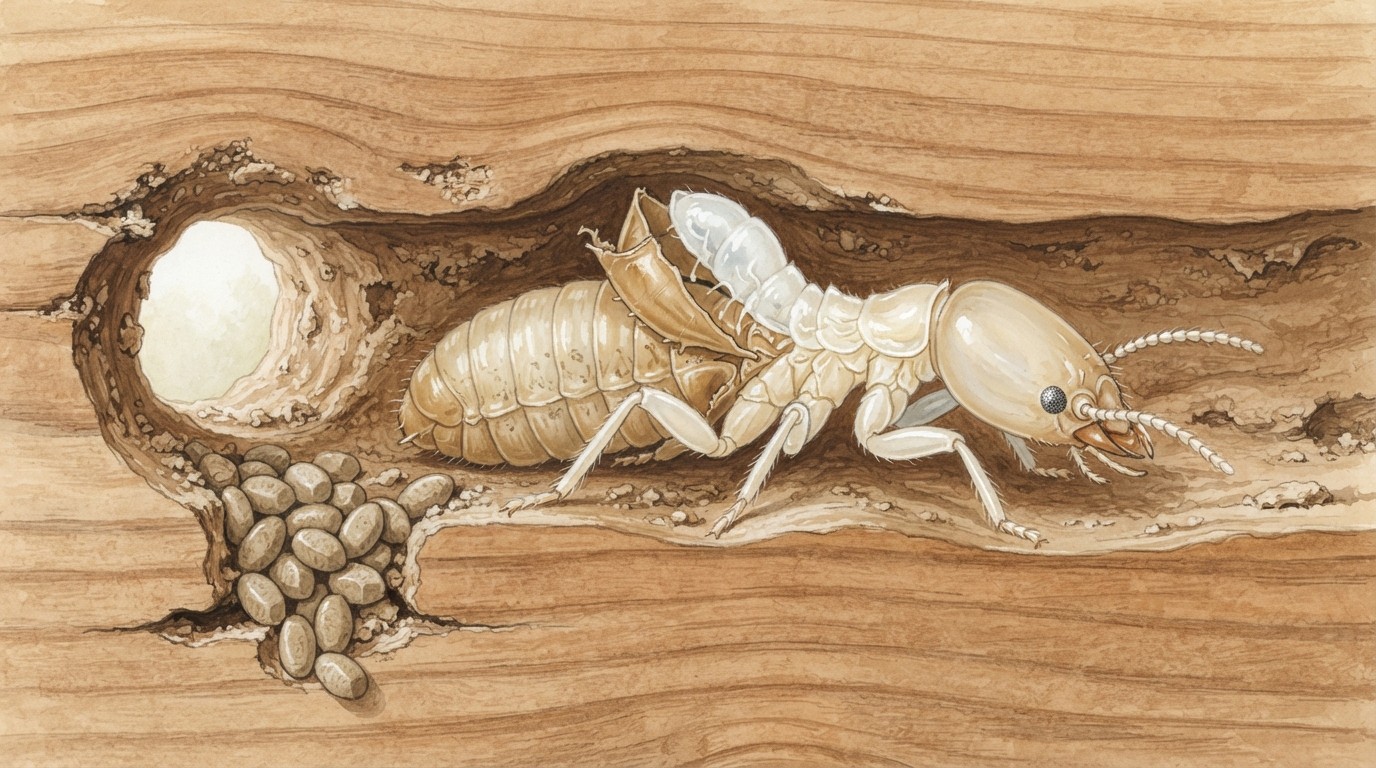
A growing insect cannot simply stretch that armor forever. Drywood termites molt roughly seven times over their lives, shedding the old shell and replacing it with a larger one. Just before a molt, the termite produces the chitin for its new exoskeleton while still safely inside the old one. Bistrifluron blocks that production.
The result is not instant death. Activity and feeding slow first. Then the termite reaches a stage where it must molt, tries to shed its old exoskeleton, and discovers no new one is ready to protect it. There is no stage in that cycle at which they can simply wait the problem out.
Chitin is not an exotic target. It is everywhere in nature: it forms fungal cell walls, fish scales, and the hard beaks of squid and octopuses. The reason bistrifluron is worth testing is that a compound aimed at an insect-specific structure is far less likely to trigger the off-target effects that make older termite products harder to live with.
That is the appeal of the approach, and the selectivity is not incidental. Chitin-based skeletons are an arthropod problem, not a vertebrate one, which is why Nicholas Poulos, the corresponding author of the study and a doctoral student in UCR’s entomology department, says the chemical is specific to insects and cannot harm humans. He describes it as more environmentally friendly than the products traditionally used against drywood termite infestations.
That is not the same as harmless to everything else alive, though. The same chitin-building process is shared by other arthropods, including beetles, mites, and spiders, and the compound has documented toxicity for some aquatic invertebrates. The risk to other insects and animals is covered in detail below.
One important qualifier. Poulos and senior author Dong-Hwan Choe, a UCR entomology professor, were careful to frame this as a laboratory result. The experiments used small groups of termites in controlled conditions, and the researchers described the findings as support for developing bistrifluron further as a localized treatment or a possible bait ingredient. Treating a house with it tomorrow and expecting the same mortality rates is not what the data shows.
Why the slow death is the point
Read the headline number, and the obvious reaction is that a slower-acting chemical sounds like a worse chemical. In this case, the delay is not a drawback. It is the mechanism that makes whole-colony control possible.
Termites are social insects that routinely exchange food and other material with nestmates. UCR researchers have documented this behavior closely, including images and video of western drywood termites performing proctodeal trophallaxis, a feeding behavior in which one termite receives material from another termite’s hindgut. In ordinary conditions, that intense social cooperation is exactly what helps a colony survive. It is how nutrients and the gut microbes termites rely on to digest wood move through the population.
For pest control, the same behavior becomes an advantage. A chemical that kills instantly would remove exposed termites before they had much opportunity to interact with the rest of the colony. A slow-acting one gives contaminated individuals time to move around and pass material to untreated nestmates, carrying a lethal dose deep into galleries nobody can reach.
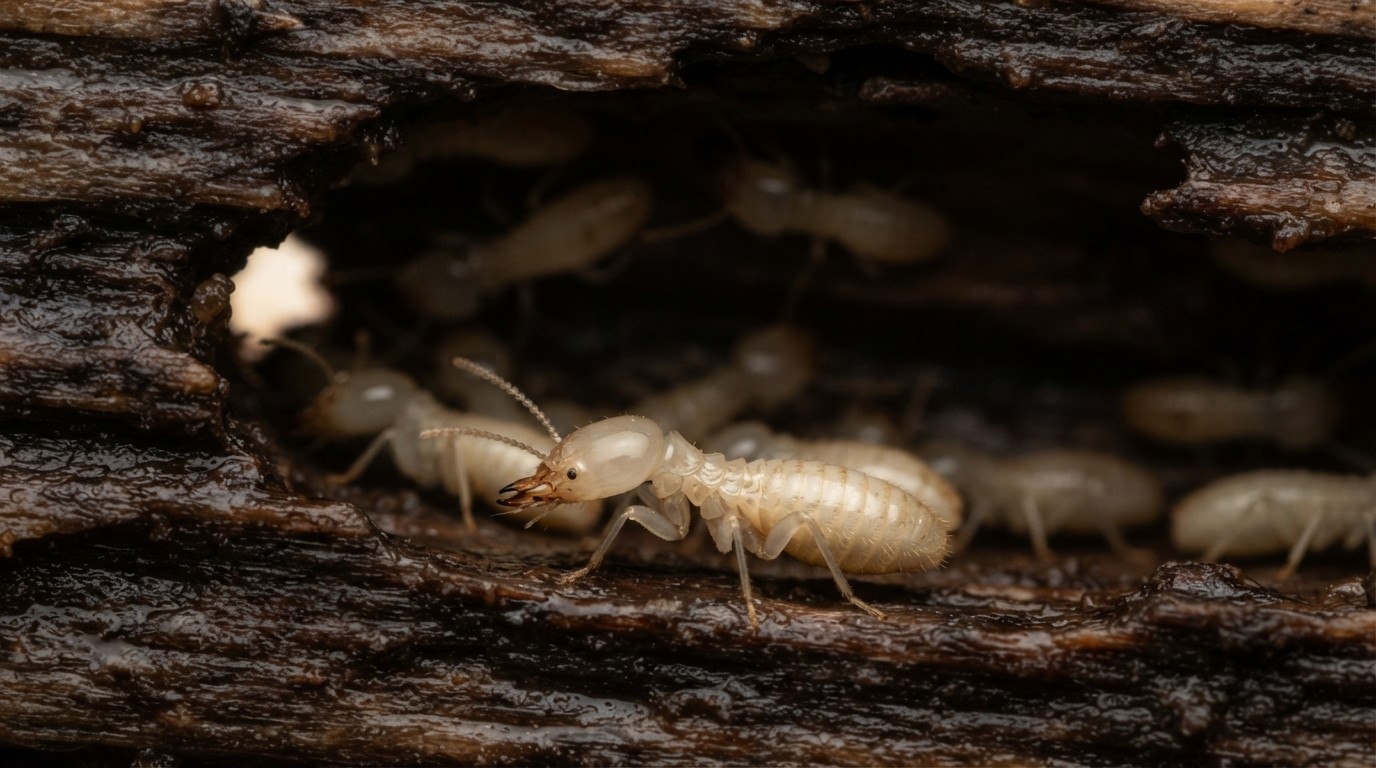
In laboratory transfer assays, the research team fed bistrifluron to a group of termites, then placed them with unexposed nestmates from the same colony. Using colored food to track movement, they found that material from the treated termites reached untreated individuals within 24 to 48 hours. The underlying findings were published in the Journal of Economic Entomology.
The survival curves are the striking part. Groups in which only about 5% of termites had initially encountered the chemical reached 100% mortality by day 90. Groups starting with 50% exposure showed a broadly similar pattern. Both ratios ended in the same place, which suggests a small number of termites can retain enough of the compound to carry an effective dose into the rest of the colony.
There is a practical implication buried in that finding. Choe believes spot treatment of this kind could kill a larger colony and spread more easily than current methods, and that you do not have to apply very much to get a good result. For a homeowner, that is the difference between treating a whole structure and treating a localized area.
The laboratory results, taken together, look like this:
- No untreated wood available: about 99% mortality after 60 days at a 0.1% concentration.
- Both treated and untreated wood available: about 96% mortality after the same 60 days, so termites still moved toward treated material even when they had a choice.
- Only 5% of the colony directly exposed: 100% mortality by day 90.
- 50% directly exposed: a broadly similar survival pattern, ending in the same place.
Fumigation vs. localized treatment: what it actually costs you
Because bistrifluron is not yet a product a homeowner can buy for drywood termites, it is worth being clear about the comparison it is meant to inform. Fumigation is currently one of the most effective methods for eliminating drywood termite infestations throughout an entire building. It is also disruptive, heavily regulated, and expensive. University of Florida IFAS guidance on termite prevention and control notes that fumigation effectively kills everything in the structure and works as a reset button for drywood termites, but requires residents to leave, that food be protected or removed, and that the structure be sealed. The 2025 study adds two further drawbacks: cost and the absence of residual protection against termites that arrive later.
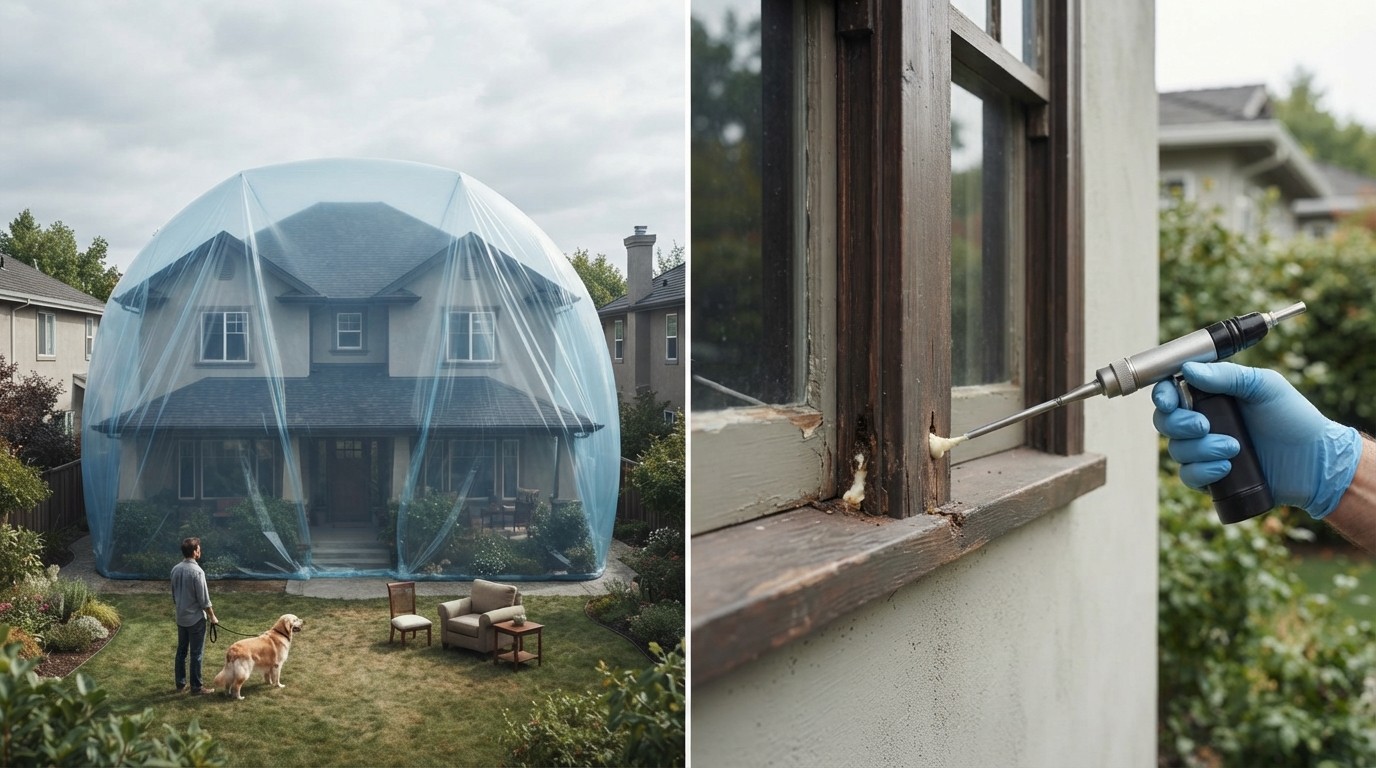
Here is how the two approaches compare on the dimensions that actually matter to a homeowner:
| Consideration | Whole-structure fumigation | Localized treatment |
|---|---|---|
| Who can stay in the home | No, residents must leave | Yes, generally |
| Scope | Entire structure | Affected area or colony |
| Cost profile | Higher, plus regulatory fees | Lower, plus possible repeat visits |
| Residual protection | None against later arrivals | Possible; chitin inhibitors may remain active in wood |
| Reliance on detection | Lower, because the whole structure is treated | High, because you must find the active colony |
| Best suited to | Widespread, established infestation | Localized, accessible infestation |
The catch sits in the fifth row. Fumigation is powerful precisely because it does not require you to pinpoint anything. A localized treatment depends entirely on knowing where the active colony is, and right now that is exactly what is difficult.
It is also worth saying plainly what bistrifluron is not. It is not currently available over the counter for this purpose, and the acetone solvent used to dissolve it in the laboratory experiments is flammable and strongly odorous, which makes it poorly suited to routine household application. The researchers are working on a more practical formulation, and Poulos said the work is aimed at making the treatment feasible in real-life scenarios. If you want a general sense of how pest treatments are weighed against each other, our look at which pests cause the most trouble covers the range.
One detail worth knowing if you do end up comparing quotes. Fumigation usually means sulfuryl fluoride, and the process is more precise than the word suggests. Gas monitoring lines are typically installed inside the structure so the concentration can be verified, and monitored fumigation has the highest rate of success. Unmonitored fumigation may simply fail to reach a lethal concentration. It is also a restricted-use pesticide, which is one reason the process is regulated rather than something a homeowner attempts on their own.
Established actives like bifenthrin, fipronil, chlorantraniliprole, or imidacloprid remain the products professionals actually use for termite control. Bistrifluron sits alongside them as a compound in active development, not as a replacement.
The detection problem that decides whether any of this works
Here is the part of this story that is genuinely unresolved, and it deserves more attention than it usually gets.
Drywood termites eject tiny, hard fecal pellets. Finding those pellets is one of the main ways people discover an infestation. The problem is that the pellets do not go away. Old droppings can remain in place long after the termites that produced them have left or died. University of California guidance is explicit that it is not possible to determine from fecal pellets alone whether an infestation is currently active.
That matters enormously for a slow-acting, colony-transferring treatment. A colony-transfer treatment works by termites carrying a dose inward to nestmates that never touch treated wood. If there is no live colony, nothing carries anything anywhere, and the treatment achieves nothing at any price. University of California guidance on drywood termites is explicit on this point.
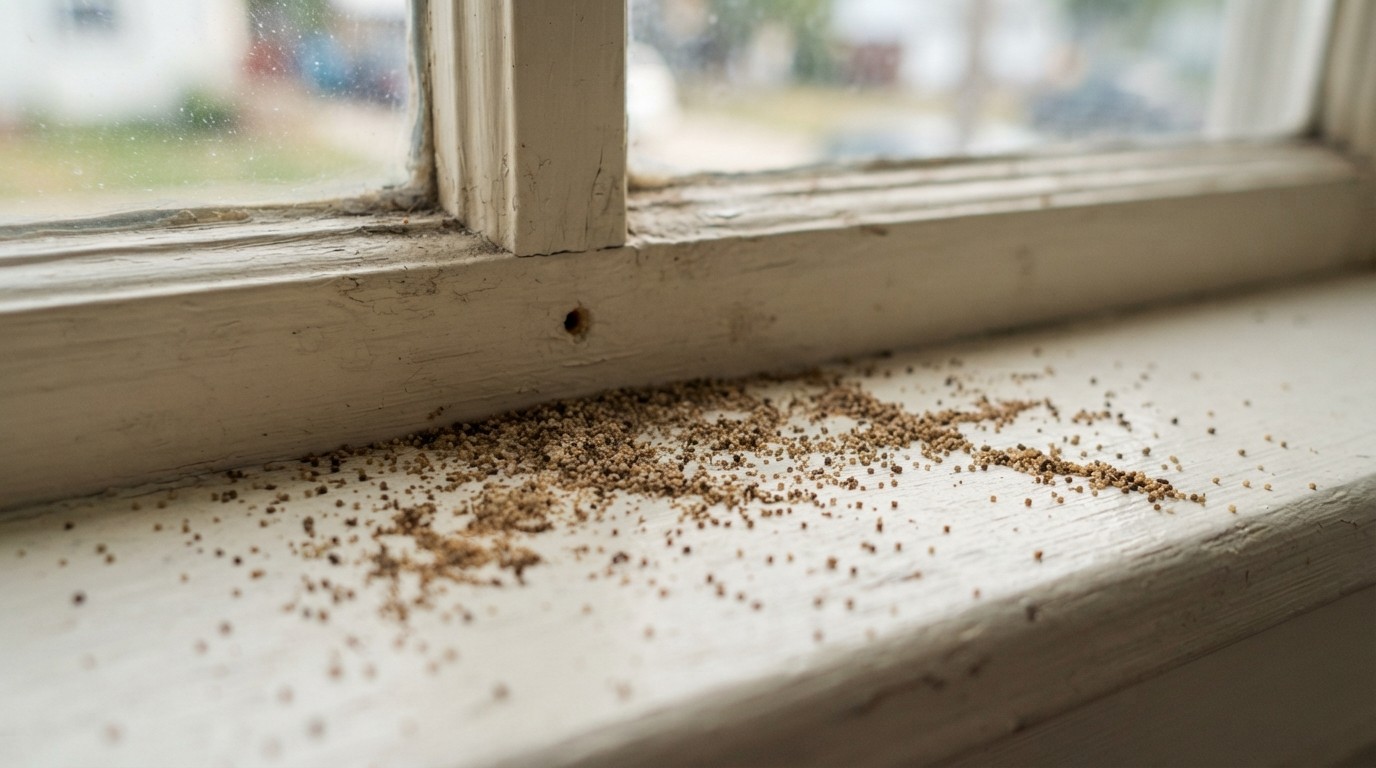
Poulos and his colleagues may have found a way to tell fresh pellets from old ones. They examined western drywood termite pellets when fresh and again after three months, six months, and one year of aging. Using quantitative PCR, they measured bacterial DNA in the samples, on the theory that the anaerobic microbes living in a termite’s gut are shed along with the pellets and then begin dying once exposed to air.
The bacterial DNA in pellets from termites fed natural hardwood fell by up to a 190-fold estimated amount between fresh samples and those aged a year. A similarly large decline occurred in pellets from termites fed Douglas fir, which is the wood most commonly used for house framing. The composition of the bacterial community also shifted: the researchers identified five bacterial families that were consistently present in all fresh Douglas fir pellets but completely absent after certain periods of aging.
If that signature holds up, it could eventually form the basis of a simple diagnostic tool. A technician finding pellets could test whether they are recent enough to justify treatment, which is the question that currently makes localized treatment a gamble. As Choe put it, one line of research aims to tell technicians where an infestation is still active, and another attempts to eliminate the termites with a more targeted treatment. The two have to work together for either to be worth much.
Until such a tool exists, extension guidance offers a crude field test worth knowing: clean up the pellets around a kickout hole, then check back a few days later to see whether new ones have appeared. Fresh activity means fresh pellets. The obvious caveat is that building vibrations and ordinary movement can also shake pellets loose, so it is a useful clue rather than a verdict. Dogs, acoustic emission devices, fiber-optic probes, and odor detectors have all been tried commercially, but they are infrequently used. Visual inspection remains the mainstay of the industry.
It is worth noting that this is a promising diagnostic approach, not a product. It has not been validated as a field test that a technician could run on site, and no such commercial diagnostic existed at the time of writing.
Luring termites to the treatment instead of just waiting
Because a slow treatment depends on termites moving through the colony, anything that concentrates that movement is useful. The same UCR laboratory has been working on exactly that.
Researchers tested whether pinene, a fragrant chemical naturally released by many trees, could draw western drywood termites toward localized insecticide deposits rather than away from them. Inside a piece of wood, that scent can act as a signal pointing toward a potentially attractive part of the environment.
The effect on mortality was substantial. The team reported roughly 70% mortality with fipronil alone, rising above 95% when pinene was added. Beta-pinene specifically was found to significantly accelerate the time course of mortality.
The idea has moved toward practical use. A University of California patent application filed in April 2025 and published in October 2025 describes adding alpha-pinene or beta-pinene to localized insecticide injections for western drywood termites. The application proposes that attracting termites toward treated areas could let technicians space treatment holes farther apart, reducing labor and possibly the amount of insecticide needed.
Those remain proposals within a patent application rather than proof that the approach has replaced existing methods. But it is a coherent pairing: a lure that pulls termites toward a deposit and a slow-acting compound that pays off when they carry it home.
Other options that avoid chemical treatment entirely
Extension guidance recommends considering nonchemical tactics before pesticides and notes that this may be especially useful against drywood species. The main options are:
- Wood replacement: If damage is limited to door or window trim, replacing the infested wood can solve the problem outright. Infested furniture and other items can simply be removed.
- Heat treatment: Heated air is used to create lethal temperatures inside infested wood as an alternative to fumigation or localized chemicals.
- Localized chemical treatment: Products applied directly to galleries, which works best where the active colony can be located.
- Fumigation: Treating the whole structure, which remains the most effective option for widespread drywood infestations.
Heat treatment is the other major nonchemical route. Heated air is used to create lethal temperatures inside infested wood, and UCR researchers have been investigating ways to improve it. Their published work found that structural heat sinks, essentially parts of a building that resist heating, significantly raise the minimum air temperature needed for a complete kill. In a proof-of-concept experiment, adding a volatile essential oil at the site of a heat sink counteracted that insulating effect. As with the pinene work, this was a small-scale experiment rather than a field method.
Species identification also changes the answer, because drywood and subterranean termites behave differently. Drywood colonies are not connected to the ground, so their galleries have no mud. They stay relatively localized and often remain inside a single piece of wood. Their galleries run across the grain and can extend for several feet, and the pellets they produce have six hexagonal sides, which is diagnostic. Dampwood termites also produce pellets, but those are rounded at both ends, football-shaped rather than six-sided.
That means the pellets you find are a useful first diagnostic step before any treatment decision is made. If the wood in question is a structure rather than a piece of furniture, you may also want to read our guide to wooden buildings and their materials.
Where drywood termites have spread
Drywood termites are usually discussed as a regional problem, but the western drywood termite has been transported well beyond its native range, and climate is deciding where it can next establish itself.
The species is native to parts of the southwestern United States and northwestern Mexico and is particularly important as a structural pest in California, where it is the most common species of drywood termite and the state’s second most important termite pest overall. Along the Pacific coast its range extends into northern California and in a discontinuous distribution further north, and inland it reaches through the Central Valley and into isolated high desert pockets, east to central Arizona and south into Baja California and Sonora. The University of Florida’s species profile for the western drywood termite documents the full range and the introduced populations.
Human movement of lumber, furniture, and other wood products has carried it far outside that range. Documented introduced populations include Hawaii, New York, Florida, Canada, China, Japan, Korea, Australia, and a range of US states including Arkansas, Iowa, Maryland, New Jersey, Oklahoma, Ohio, Texas, Georgia, South Carolina, and Louisiana. A heavily infested structure was reported in Toronto.
The lifestyle makes that spread hard to control. A colony can remain concealed inside a single piece of wood indefinitely, with winged reproductive termites representing one of only a few life stages that routinely venture outside. For transported termites to establish themselves, climate conditions have to be suitable, and as those conditions shift, researchers are concerned the insects could become a problem in additional regions. As Choe noted, as lumber moves around the world, the termites move with it, and if they find the climate acceptable where they land, the problem spreads.
What about the risk to other insects and animals?
This is a fair question, and it deserves a straight answer rather than a reassuring one.
The selectivity that makes bistrifluron attractive is real, but it is narrower than the phrase “safe for humans” implies. It works by blocking chitin synthesis, and that mechanism applies to any animal that molts and builds a chitinous outer shell. Humans and other vertebrates have internal skeletons and do not share the target, which is why the compound is unlikely to harm people or pets. But that same chemistry reaches far beyond termites.
Three pathways are worth considering, and they carry different levels of documented risk.
Other arthropods in the same building
This is the most likely route and the one most relevant to a homeowner. Research on chitin synthesis inhibitors used in termite bait has established that these compounds spread through colonies not only by food sharing and grooming but also by cannibalism, with termites consuming dead or dying nestmates. In a treated gallery, that means poisoned termites can be eaten by unexposed insects.
The same reasoning extends to the wider arthropod community in and around the structure. Beetles, spiders, mites, and other insects that scavenge in or around infested wood are exposed to the same risk, and because chitin synthesis is shared across arthropods, there is no reason to expect them to be unaffected. The compound is not tuned to termites specifically; it is tuned to a biochemical pathway that many invertebrates rely on. Honeybees fall squarely inside that pathway, since they are arthropods that build their own chitinous exoskeleton and go through the same vulnerable molting stage.
How much any of this matters in practice is genuinely uncertain, because regulatory assessments do not agree. The Australian APVMA concluded that bees and earthworms were not sensitive to bistrifluron, while the University of Hertfordshire Pesticide Properties Database reports moderate to high toxicity for both. When two reputable assessments disagree, the honest position is that the effects on non-target invertebrates are less certain than a simple “specific to insects, therefore safe” framing suggests.
Birds and other predators
This is the scenario most people imagine first, and the evidence is comparatively reassuring. Regulatory testing found birds were not sensitive to bistrifluron, with acute oral LD50 values above 2,250 mg/kg in northern bobwhite quail and mallard and dietary LC50 above 5,000 mg/kg in Japanese quail. Assessments have also specifically considered predators exposed through secondary poisoning, meaning animals eating poisoned prey, and judged the risk acceptable for the registered bait product.
That is reassuring but not absolute. It reflects acute toxicity in controlled testing, and the compound is persistent in soil and aquatic systems, so questions about chronic exposure over longer periods remain open.
Aquatic life
This is the clearest genuine weakness in the safety profile. The Australian regulatory assessment states plainly that bistrifluron is chronically very toxic to aquatic invertebrates, and the University of Hertfordshire Pesticide Properties Database reports moderate to high toxicity for most aquatic species.
For a localized treatment injected into drywood termites, which do not travel through soil or water, direct aquatic exposure should be limited. It is worth noting, though, that the same compound sold as a subterranean termite bait is applied to soil, where groundwater pathways exist and the risk profile is entirely different.
None of this makes bistrifluron a bad option. Chitin synthesis inhibitors are generally considered a lower-impact class than the older neurotoxic insecticides they would partly replace, and researchers at UC Riverside describe the compound as more environmentally friendly than traditional drywood treatments. The point is narrower: lower impact is not the same as no impact, and for anyone with a bee-heavy garden, a pond nearby, or an interest in the insects living in their timber, that distinction is worth understanding before treatment.
Frequently asked questions
What is the most effective insecticide for termites?
It depends on the species and the extent of the infestation. For widespread drywood infestations, fumigation remains among the most effective options because it treats the entire structure. For localized, accessible infestations, targeted products applied to galleries can work. Bifenthrin, fipronil, chlorantraniliprole, and imidacloprid are all commonly used. Bistrifluron is a compound in active development for localized drywood treatment rather than a product currently available for that use.
Are drywood termites the worst termites to have?
They are among the hardest to control, but not necessarily the most destructive. Subterranean colonies grow larger and can consume structural wood faster once established. Drywood termites are more difficult to locate because they live entirely inside the wood rather than connected to the ground, they stay relatively localized, and they are spread in human-transported lumber. Their colonies are also small and slow-developing, so the sense of urgency is often lower than with subterranean damage.
Is Bifen I/T effective against termites?
Bifen I/T is a bifenthrin-based product used in termite control, and bifenthrin is a widely used active ingredient. Effectiveness depends on the species and whether it is applied as a barrier, injection, or localized treatment rather than to the whole structure. It works best where termites can be located, which is one reason detection is the limiting factor for drywood species specifically.
Is bistrifluron safe for humans and pets?
It targets chitin synthesis, a process that invertebrates rely on to build exoskeletons and that vertebrates do not share. Poulos states the chemical is specific to insects and cannot harm humans, and describes it as more environmentally friendly than traditional drywood termite treatments. That is accurate as far as it goes, but it is limited to vertebrate safety rather than general environmental safety. The compound does affect other arthropods that share the same molting chemistry, and it carries documented toxicity for some aquatic invertebrates, so the risk to bees, beetles, and other insects sharing the building is real, if smaller than the risk to the termites. The compound is also not currently sold as a household treatment. Follow label instructions for any product that contains it, should one become available.
How much does termite fumigation cost?
Fumigation is one of the more expensive termite treatments because it involves sealing the structure, releasing a fumigant, waiting, and then reopening and re-lining it. Costs vary widely by structure size, location, access difficulty, and regulatory requirements, and quotes are the only reliable way to know a local figure. The main argument against fumigation is rarely the price alone, since it is also the most disruptive: residents leave, and the treatment leaves no residual protection against termites that arrive later.
Do I need to treat the whole house if I find termite pellets?
Not necessarily, but you do need to establish whether the colony is still active, and pellets alone cannot tell you that. University of California guidance is explicit that fecal pellets cannot determine whether an infestation is currently active or how far it extends. An inspection to locate the active colony is the step that determines whether a localized treatment is viable and whether the damage warrants fumigation instead.
What this research does not tell us yet
The honest summary is that this is a promising result at an early stage and that the most interesting part of it is not the kill rate.
It is the demonstration that a termite colony’s own social behavior can be turned against it. Rather than overpowering termites with a faster or stronger poison, bistrifluron works with the fact that they must eventually molt and with the fact that they feed each other. Both are weaknesses a colony cannot design away. The pinene work points the same way, using an attractant rather than a deterrent to concentrate the same cooperative behavior.
What remains unresolved is everything between the laboratory and the living room. Bistrifluron needs a commercial formulation that does not rely on flammable acetone. Localized treatment needs a reliable way to locate live colonies. The microbial clock for dating droppings needs field validation before a technician could rely on it. And the environmental questions are open rather than settled: researchers have tested how the compound affects termites in groups, but the effect on other arthropods sharing the treated structure, and on the insects that eat the treated termites, has not been examined in this work at all.
So the practical takeaway for now is narrower than the headline suggests. Fumigation still works, and for a widespread drywood infestation it remains difficult to argue against. What the research offers is a credible direction of travel for the cases fumigation handles worst, which are the localized infestations where the homeowner would rather not leave home, and where the current options are expensive and leave nothing behind.


