
Most diet advice treats protein as the nutrient that keeps hunger quiet until the next meal. Nutrition scientists have spent about two decades testing whether that holds up, what drives it, and whether it actually changes how much people eat.
The short answer is yes, protein does make a meal feel more filling. The longer answer is more interesting, because the effect is smaller and more specific than most diet advice suggests.
What “Fuller” Means in a Feeding Trial
Researchers separate two ideas that everyday language blurs together. Satiation is what makes you stop eating during a meal, while satiety is how long you stay satisfied afterwards.
Protein’s reputation rests mostly on satiety. A 2008 review in the American Journal of Clinical Nutrition, written by researchers including Douglas Paddon-Jones and Arne Astrup, concluded that protein generally increases satiety to a greater extent than carbohydrate or fat.
That review pointed to a second mechanism as well: thermogenesis. Higher-protein diets are associated with more energy spent on digestion and processing, and the authors noted that this extra heat output also feeds into how satisfied people feel.
There’s a third thread, and it matters for anyone cutting calories. The same review described a possible stimulatory effect of moderately higher protein on muscle protein building in some people, which favours keeping lean mass while weight comes off.
The Part the Headlines Skip
A 2015 review in the same journal, led by Heather Leidy at the University of Missouri, looked back over the acute feeding trials. It confirmed a modest satiety effect: people reported greater fullness, and their satiety hormones rose after higher-protein meals.
Then came the caveat. Those trials did not show that people ate less at their next meal, which is the outcome most of us actually care about.
The longer studies told a messier story. Leidy and her co-authors found that short, tightly controlled feeding studies consistently favoured more protein, while longer trials produced limited and conflicting findings.
Their explanation was blunt: compliance. People who actually stuck to the higher-protein plan saw improvements in weight management; those who drifted off it saw no marked change.
How Much Protein Per Meal Seems to Matter
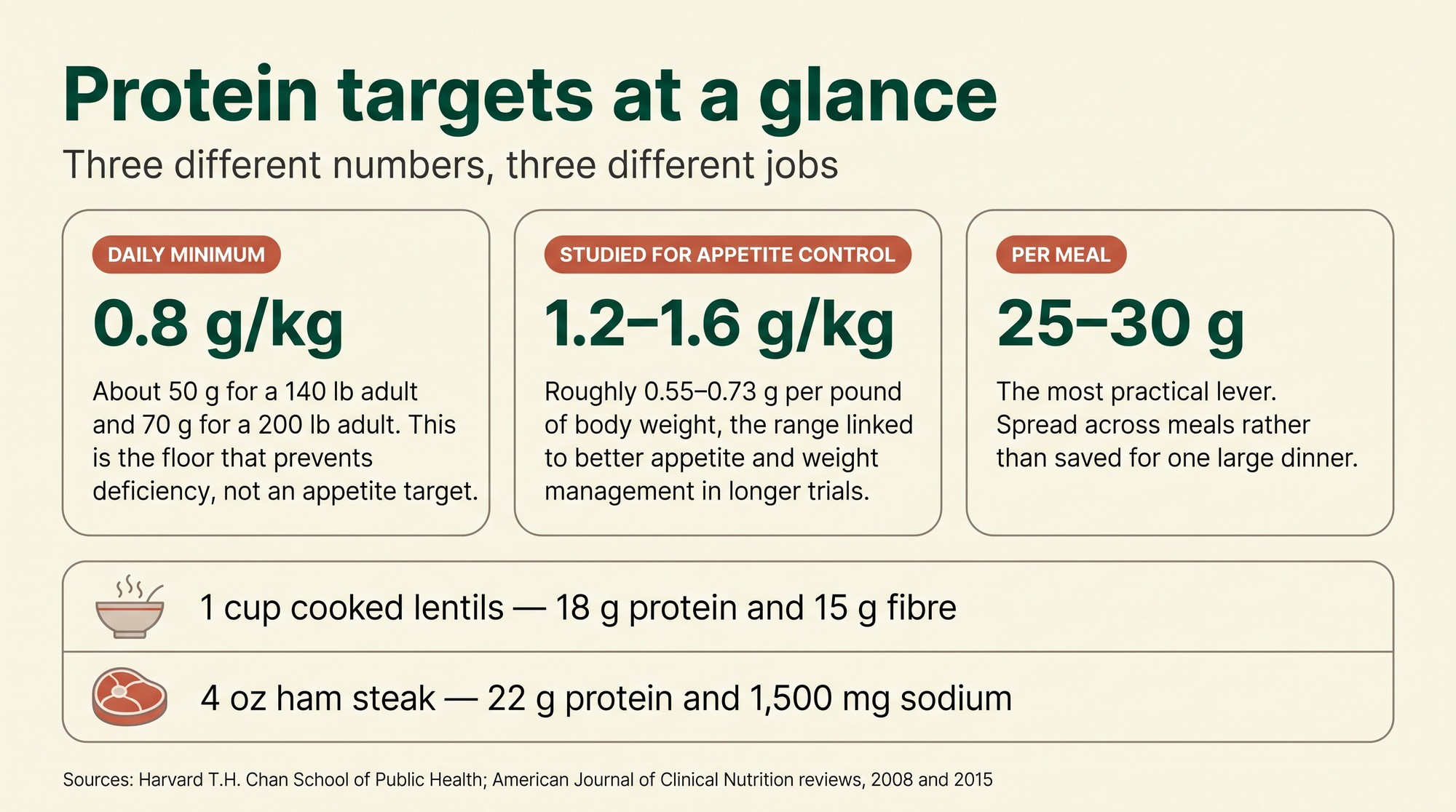
The baseline most Americans hear about is the recommended minimum, and the Nutrition Source from Harvard’s school of public health puts it plainly: 0.8 grams per kilogram of body weight a day, or just over 7 grams for every 20 pounds. For a 140-pound adult that comes to roughly 50 grams; for a 200-pound adult, about 70.
That figure is a floor to prevent deficiency, not a target for appetite control. The 2015 review suggested that diets in the range of 1.2 to 1.6 grams per kilogram (roughly 0.55 to 0.73 grams per pound) may help, potentially with at least 25 to 30 grams of protein at each meal.
Picturing 25 to 30 grams is harder than it sounds, and prepared meals with printed macros make a decent yardstick. In one Australian high-protein ready-meal range, 19 of the 41 dishes carry 41 grams of protein or more per serve, according to Bondi Meal Prep.
One of them, a grass-fed lamb and broccoli rice dish, lists 53.1 grams of protein against 347 calories and only 4.8 grams of carbohydrate. That’s nearly double the per-meal threshold in a meal that sits under 350 calories, which shows how lean protein can carry a plate without pushing the energy total up.
The per-meal threshold is the most practical part of that guidance. It shifts attention away from a daily total that can be hit with one big steak dinner, and towards breakfast and lunch, where it’s easiest to fall short.
Protein Is Not the Only Lever
Fullness is rarely about one nutrient acting alone. Fibre adds bulk, so a plate that pairs protein with beans, whole grains or vegetables tends to hold up better than either on its own.
If fibre is the half of the plate you tend to neglect, this guide on how to get thirty grams of fiber a day spreads the target across meals in a way that sits neatly beside a per-meal protein goal.
The source of the protein matters too, and Harvard’s guidance stresses the protein “package”, meaning everything that arrives with it.
A 4-ounce ham steak brings 22 grams of protein along with about 1,500 milligrams of sodium, while a cup of cooked lentils supplies about 18 grams of protein and 15 grams of fibre.
Processing also changes how a food behaves. Many heavily processed snacks are built for shelf life rather than satiety, and this practical breakdown of ultra-processed foods and the NOVA system is a good way to tell a reasonable convenience meal from one that will leave you hungry an hour later.
Putting the Evidence to Work
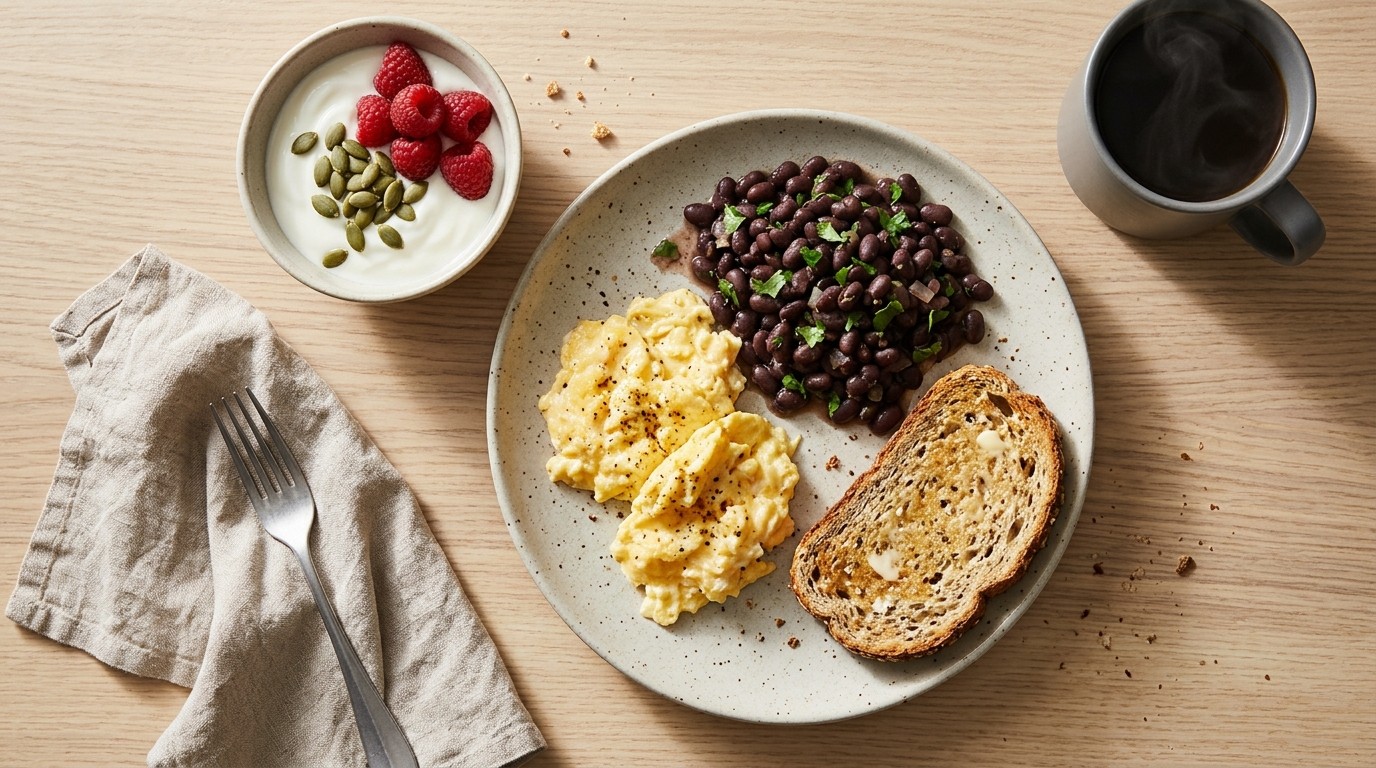
Start with the meal that currently carries the least protein. For many people that’s breakfast, and moving it from 10 grams to 25 or 30 is a smaller change than overhauling dinner.
Expect a modest effect, not a miracle. The research supports feeling fuller after a protein-rich meal; it doesn’t promise you’ll automatically eat less at the next one.
Build the plate around protein and fibre together rather than chasing either one alone. Eggs with beans, yoghurt with seeds, or chicken over lentils all stack the two levers in a single meal.
And pick a pattern you can keep. The clearest finding across the longer trials wasn’t about any particular food or ratio, but about whether people stayed with the plan long enough for it to work.


