
Ultra-processed foods now serve as shorthand for modern dietary risk, yet treating every packaged item as an identical villain often leaves shoppers paralyzed by confusion. A decision framework like the UPF Sorting Hat empowers you to cut high-risk servings first and build better habits without overwhelming uncertainty.
Spotting these industrial formulations often feels like learning a second language because the Group 4 label encompasses diverse products ranging from artisan-style loaves to neon-colored snacks. Manufacturing processes often break down the natural structure of food, substituting healthy fiber with cosmetic additives optimized for shelf stability rather than lasting fullness. Finding the balance means looking past marketing buzzwords and focusing on how a product is actually constructed in a factory.
Small daily adjustments create the most significant shifts in metabolic resilience over time. Instead of aiming for total dietary purity, targeting a ‘two-serving swap’ reduces the cumulative exposure that drives heart-risk signals. Strategic habits transform complex scientific debates into repeatable routines that remain effective during busy weekday schedules or rushed commutes.

Decoding the UPF Baseline: Understanding Modern Dietary Reality
The Two-Minute Strategy: Why this isn’t Traditional Clean Eating
Defining Ultra-Processed Foods as an Industrial Category
Ultra-processed foods (UPFs) originate from industrial formulation methods rather than specific nutrient profiles, anchoring them within Group 4 of the standardized NOVA food classification system.
What the Evidence Can and Cannot Prove
Research gaps in this area often lead to confusion for shoppers. The strongest research base is still mostly observational, meaning it tracks what people eat and what happens over time, but it cannot prove that a single additive or ingredient causes disease in isolation. The UK SACN position statement on processed foods makes that limitation explicit; keep this in mind while making practical changes.
Why Servings Beat Food Purity
Controlled feeding trials elucidate the mechanisms behind these emerging health patterns. In a landmark controlled inpatient feeding study, participants on an ultra-processed diet consumed more calories and gained weight despite the menus appearing similar on paper. The broader eating pattern remains hard to ignore, despite these scientific caveats. A comprehensive review of epidemiological data found that higher UPF exposure is consistently associated with a wide range of adverse outcomes, although the quality of evidence varies across outcomes and study designs.
Crucial Data Points: The Current Reality of UPFs in America
Take a moment to understand the scale of the issue before clearing your pantry shelves. In the US, ultra-processed foods aren’t a niche issue; they are a default, which is exactly why small serving changes can add up fast.
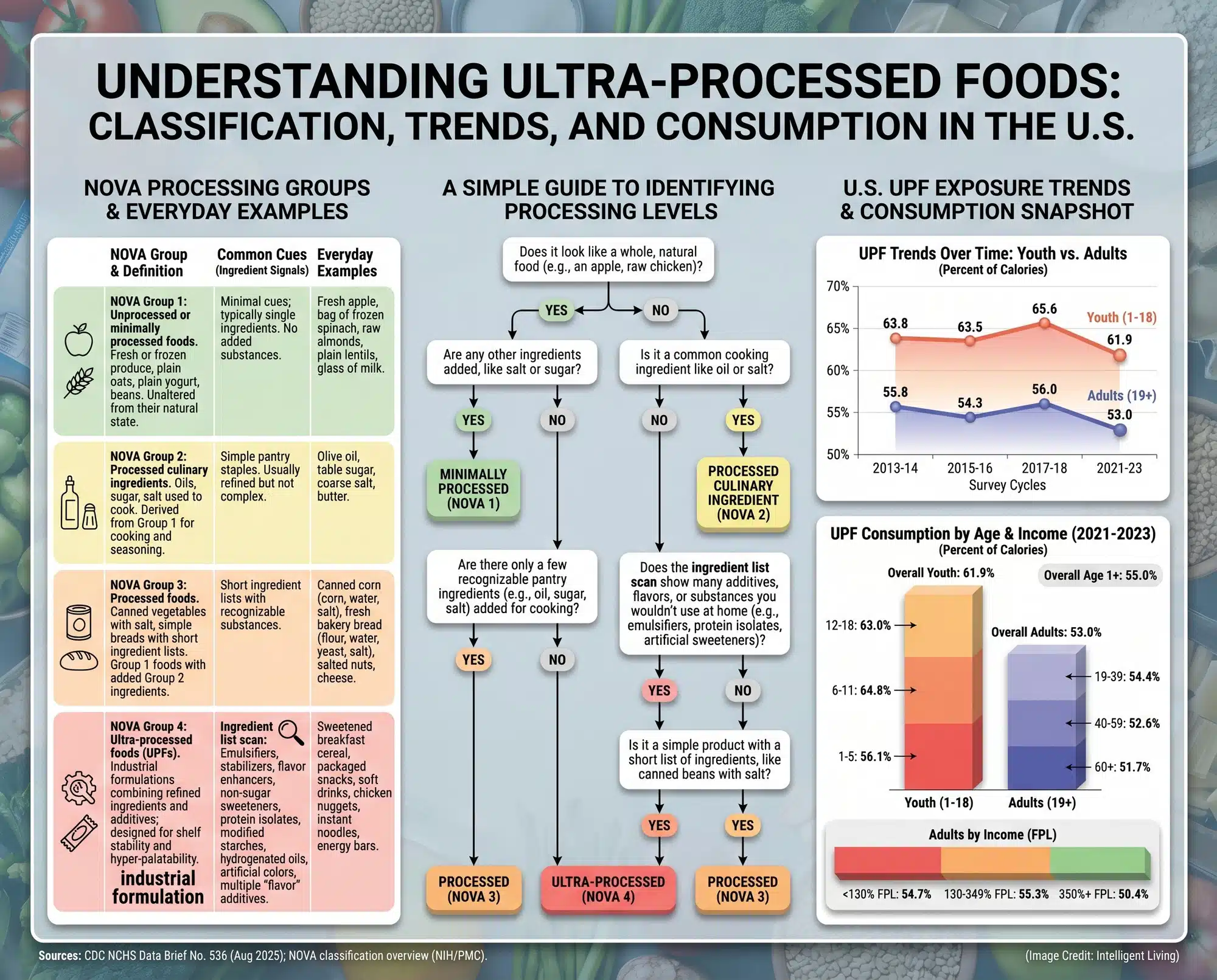
- The US diet is now dominated by UPFs, with roughly 55% of total American calories originating from ultra-processed foods, and the share runs even higher among children and teens.
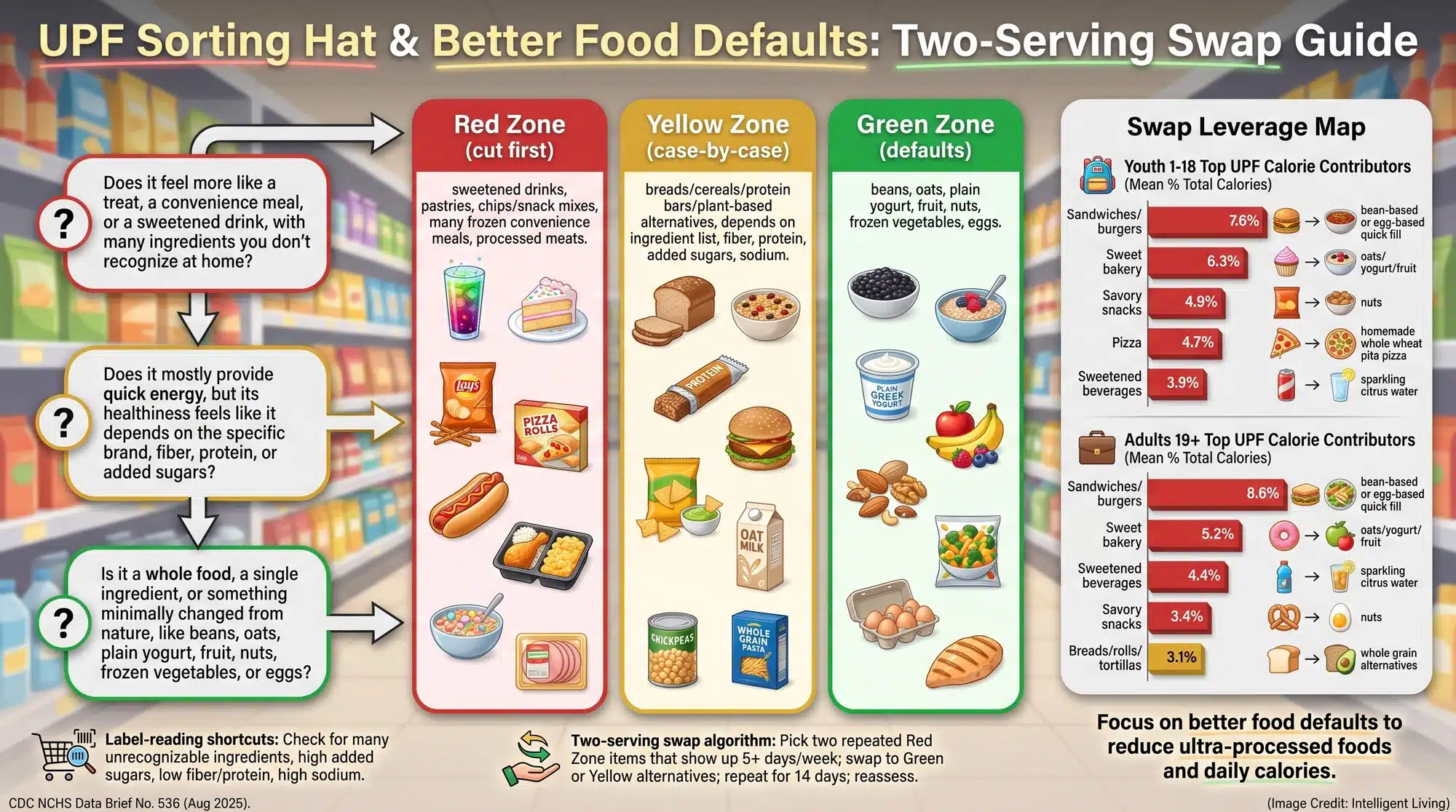
- Identifying the primary sources of UPF calories reveals that sandwiches and burgers, sweet bakery products, savory snacks, and sweetened beverages sit near the top for both youth and adults.
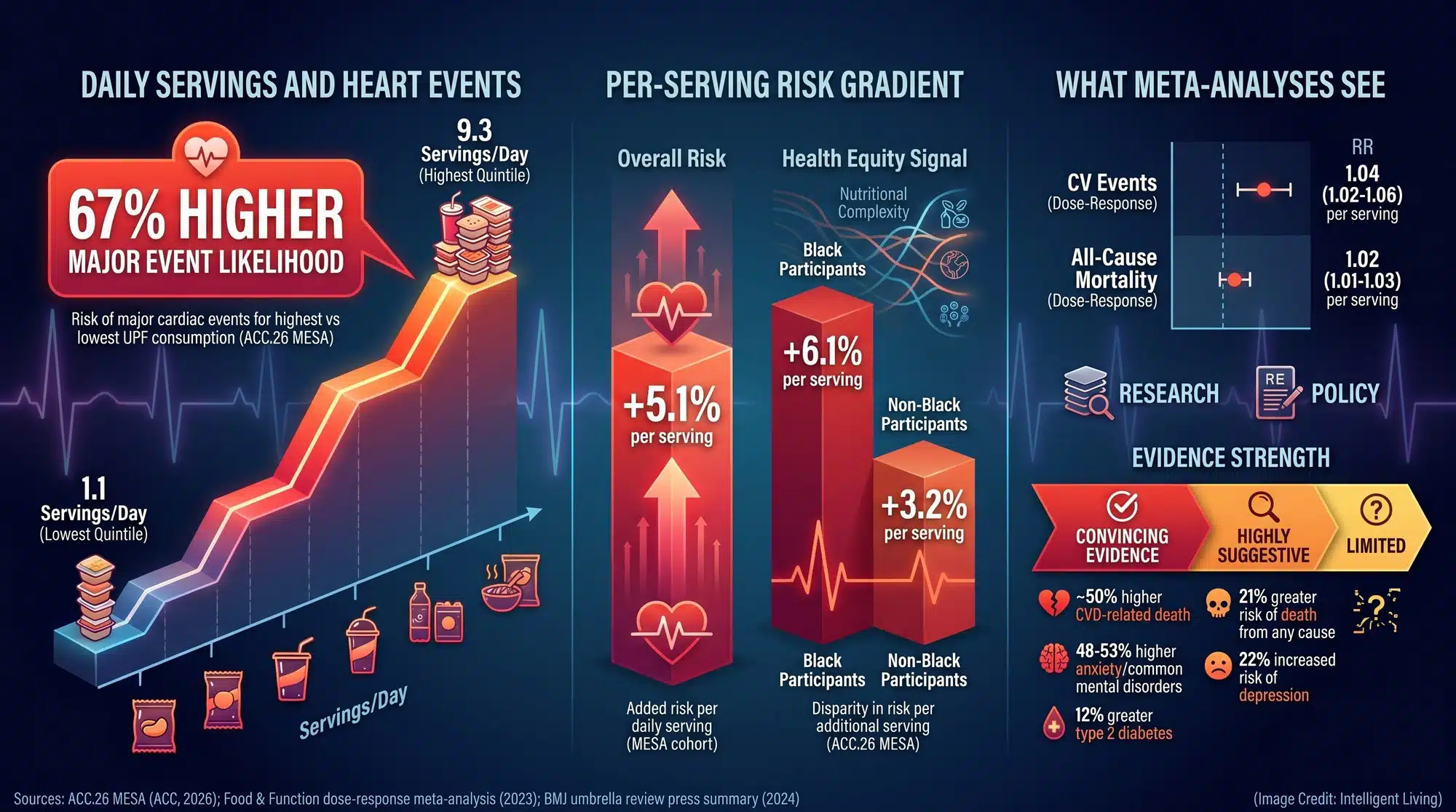
- At ACC.26, the clinical link between ultra-processed foods and serious heart problems described higher major cardiac event risk among people with the highest UPF intake, a pattern that also includes a disparity signal in outcomes.
- A controlled trial found that participants consumed about 500 extra calories per day on an ultra-processed diet compared with a minimally processed diet, and the NIH summary of that inpatient feeding trial helps show why passive overeating acts as a realistic risk pathway.
- Researchers are increasingly arguing that UPFs should not be treated as one monolithic exposure, and the emerging scientific shift toward category-level nuance is a clear example of that shift.
Practical application matters most when turning these scientific concepts into a system for grocery aisles and office breakrooms. A clear risk pattern emerges from the data: while high exposure leads to cumulative risk, the current expert conversation focuses on practical nuance rather than blanket fear.
Proven Strategies to Identify Ultra-Processed Foods without Confusion
Accurately Classifying Ultra-Processed Versus Minimally Processed Foods
A Rapid Overview of the NOVA Food Classification System
The NOVA system categorizes food into four distinct groups based on the level of processing involved, and the FAO report on ultra-processed foods and diet quality explains why the purpose of processing matters as much as the fact that processing occurred.
The Signs that Usually Push a Food into Group 4
Group 4 typically includes industrial formulations characterized by:
- Sugary sodas and energy drinks.
- Instant noodles and pre-packaged snack packs.
- Processed and reconstituted meat products.
Chemical agents and cosmetic additives found in these items rarely appear in a standard home kitchen.
A Realistic Approach to Scanning Food Ingredient Lists
Processing alone is not the full story when evaluating dietary risk. A quick scan of the label is often more productive than assigning moral labels to food groups:
- Look for fortified staples that provide essential nutrients despite their Group 4 status.
- Identify packaged plain foods that remain useful shortcuts for busy schedules.
- Spot lists that look like chemistry sets, signaling a focus on shelf life over nutrition.
Evaluating these factors distinguishes essential staples from products that undermine your nutritional goals.
A research-backed map of ultra-processed food risks and swap ladders can help you spot the easiest early wins, especially drinks and snack patterns that quietly add servings.
Understanding Nutritional Nuance: Are All UPFs Equally Risky?
Identifying Why Specific Food Categories Influence Health Risk
Current research suggests that treating all UPFs as a single group masks critical nutritional differences. Some categories, such as processed meats and sweetened beverages, show more consistent associations with adverse outcomes, while other categories show mixed signals depending on what they replace in the diet.
Overcoming Analysis Paralysis in Modern Grocery Stores
Analysis paralysis arises when whole-grain loaves and sugary sodas both carry the ‘Group 4’ designation despite vastly different physiological impacts. The nuance argument isn’t hand-waving. Recent data on highly differentiated UPF food groups highlights why subtypes matter, and the NOVA classification critical review explains how the system can sometimes mix nutritionally different products into one bucket.
Confusion sets in quickly when whole-grain bread and sugary soda share the same ‘Group 4’ label despite their different health impacts.
The Practical Exit Ramp: Prioritizing High-Exposure Swaps
Concentrating on high-risk, low-benefit servings delivers the fastest health gains. If the scientific details feel overwhelming, simply switch your focus to the easiest available swaps. The point is not to win a philosophical debate about processing. The point is to reduce the servings that add risk with the least benefit, and interpreting the complexities of nutrition science data offers a useful way to interpret diet research without getting whiplash.
The Cumulative Heart-Risk Signal: Why Daily UPF Servings Matter
Analyzing the Recent Cardiology Signals Linked to UPF Intake
Cardiac risk signals progressively increase alongside serving counts, allowing minor daily modifications to yield exponential benefits. Extensive tracking data reveals that UPF intake acts as a cumulative health exposure.
Interpreting Per-Serving Risk Signals for Daily Habits
Recent data shows that major heart risks rise significantly for individuals with the highest processed food intake. This clinical connection suggests that daily defaults—the things you eat every single day—impact your long-term health more than a once-in-a-while treat.
A Simplified Serving Dashboard for Sustainable Habit Change
Avoid the urge for surgical avoidance. Tracking and prioritizing high-exposure items provides a durable foundation for change. Replacing just two servings daily creates a measurable target that outperforms vague health goals. Implementation like this is also far easier to track than attempting to overhaul your entire identity.
A helpful north star is that long-term heart outcomes tend to improve when daily eating patterns become more whole-food centered, and Mediterranean diet mega-studies are a practical reminder that consistency beats dietary extremes.
The UPF Sorting Hat: A Practical Framework for Better Food Defaults
The UPF Sorting Hat: A 3-Bucket Decision System You Can Use Today
A simple way to act is to sort foods into three buckets. Use this system as a daily checklist while shopping or scanning your pantry.
The Red Zone: Identifying High-Risk Foods to Cut First
These items are the fastest wins because they combine high frequency, high energy density, and low nutritional upside. Various savory chips, sweet bakery items, snack mixes, and convenience meats sit in this category. They reliably add servings without delivering fiber, protein, or the kind of intact food structure that supports satiety. The NOVA practice review for clinicians helps explain why sweetened drinks and desserts so quickly crowd out better options.
The Yellow Zone: Managing Case-by-Case Processed Foods
These products deserve scrutiny rather than automatic exclusion. Numerous industrial breads, some cereals, and plant-based alternatives fall here. The practical move is to check whether the product replaces a whole-food option or displaces it. A packaged grain mix can be a step up if it replaces a drive-through meal and includes whole grains with modest additives.
Dietitians often warn that NOVA is helpful but imperfect, and the clinical evaluation of modern food classification systems gives concrete examples of why label-reading skills matter.
The Green Zone: Establishing Minimally Processed Food Defaults
These are the shortcut foods that keep your week functional without turning dinner into a second job. Plain frozen vegetables, canned beans, plain yogurt, nuts, and whole-grain staples preserve more of the food matrix and fiber; they tend to make later choices easier because hunger is steadier.
An analysis of how specific grains influence metabolic health is useful here because it explains why one carb does not behave like another, even when calories look similar.

Why Sustainable Defaults Outperform Discipline in the Habit Engine
Your surroundings dictate your eating patterns more than raw willpower ever could.
When industrial formulations become the kitchen default, decision fatigue rises and daily serving counts quietly climb. Shifting your immediate environment offers the most reliable path to lasting change.
Studies comparing minimally processed patterns and long-term metabolic outcomes reinforce the value of making minimally processed foods your baseline. A crossover feeding study suggests that even when people follow broadly health-oriented guidance, minimally processed patterns can deliver stronger weight and fat-mass improvements than UPF-heavy patterns.
Optimizing Home Environments for Better Dietary Defaults
Success at home starts with making the healthiest choice the easiest one to grab:
- Move red-zone items to the highest or lowest shelves out of direct sight.
- Keep plain yogurt and pre-cut whole fruit at eye level in the refrigerator.
- Replace sugary sodas with sparkling water and fresh citrus wedges.
That fruit bowl by the door that empties by Thursday is not a productivity hack; it is just the first option your eyes land on when you are hungry and in a rush. Optimizing the kitchen reduces decision friction and naturally lowers your daily serving count without the need for constant discipline.
Encouraging Workplace Wellness through Improved Team Defaults
Professional environments should move beyond pastry-centric defaults to support cognitive energy. Water, nuts, fruit, and simple savory options reduce the sugar crash cycle without turning food into a moral project.
Maintaining wellness in professional office settings relies on predictable lunches and removing the temptation of automatic vending-machine decisions. Operational changes in the workplace support long-term metabolic resilience.
Maintaining Consistency with Travel and Late-Night Defaults
Airports and irregular schedules necessitate robust contingency strategies to avoid the Red Zone. Keeping a small backup snack in your bag ensures that hunger does not force a red-zone choice.
Anyone who has landed late, skipped dinner, and then grabbed the first shiny packaged snack knows how quickly “just this once” turns into a weekly pattern when the default keeps repeating.
Incorporating fermented staples into a daily routine significantly improves resilience, as highlighted in the latest, a 2026 guide to fermented staples and metabolic resilience.

Smarter Food Labeling: Implementing Sustainable Two-Serving Swaps
A Practical Adoption Listicle: 10 Ways to Cut 2 UPF Servings Per Day (Without Cooking Every Meal)
- Swap a soda for sparkling water with a lemon wedge.
- Replace packaged sweet bakery breakfast with overnight oats or plain yogurt and fruit.
- Choose whole fruit over candy bars for commuting.
- Use canned beans and a simple vinaigrette as a sandwich filling instead of processed deli meat.
- Keep a small jar of mixed nuts to replace chips when hunger spikes.
- Choose plain popcorn rather than heavily flavored snack varieties.
- Microwave frozen mixed vegetables as a quick side instead of ordering a processed meal.
- Use whole-grain wraps with grilled chicken rather than a frozen entrée built around refined starches.
- Keep single-serve cheese and fruit on hand for late-night hunger.
- When rushing, choose rotisserie chicken and a bagged salad instead of a fast-food combo.
Each swap replaces a high-risk serving with a green- or yellow-zone choice; two swaps per day is a realistic target. identifying diverse sources of dietary fiber can help you build a grocery list that feels filling instead of restrictive.
Physiological cravings represent the most significant hurdle for most people. Pairing protein with fiber is a proven strategy to silence late-day urges and keep your transition on track.
Policy to Pantry: How Marketing Rules Influence Your Food Choices
The Impact of Marketing Restrictions and Warning Labels
Government policy levers help redefine what a normal diet looks like. Implementing standardized front-of-package labeling explains how warning labels act as scalable tools to shift purchasing defaults across entire populations.
Lessons from Chile: How Warning Labels Shift Purchasing Habits
Chile’s policy package has been linked to measurable changes in what households buy. The measurable shifts in household purchasing habits were evaluated after warning labels, marketing restrictions, and school sales rules were introduced.
Mastering the Label-Reading Skills that Improve Long-Term Health
Ignore deceptive marketing buzzwords at the grocery store and focus exclusively on the ingredient list. Emerging global evidence for labeling systems summarizes how these systems can shift purchasing and prompt product reformulation, which means your “yellow zone” label-reading skills become more valuable over time.

Sustaining Metabolic Resilience With the UPF Sorting Hat
Practical health gains rarely come from an all-or-nothing crusade against modern convenience. Success relies on designing defaults that replace the highest-risk servings with minimally processed shortcuts that keep your week functional. Utilizing simple sorting rules to distinguish between healthy shortcuts and routine setbacks helps you regain control without the exhaustion of constant label-policing.
Prioritizing the food matrix and intact nutrients ensures your diet supports longevity while remaining flexible enough for real life. Limiting industrial formulations minimizes your pantry’s environmental footprint while recalibrating natural appetite regulation. A framework for designing a sustainable food system describes why that co-benefit matters.
FAQ: Ultra-Processed Foods (Real Questions, Straight Answers)
What is the easiest way to identify a UPF?
Industrial formulations typically qualify as ultra-processed if they contain cosmetic additives and lack the structure of intact whole foods. Check for substances like high-fructose corn syrup or hydrogenated oils.
Is every type of bread considered ultra-processed?
It depends on the ingredients. Mass-market loaves often contain stabilizers that push them into Group 4, whereas sprouted grain or artisan breads usually count as minimally processed.
Are plant-based meats a healthy alternative?
Most plant-based burgers qualify as ultra-processed because they are:
- Industrial formulations designed to mimic meat.
- High in sodium and chemical binders.
While they are useful transition foods, they remain in the NOVA Group 4 category.
How many servings should I aim to cut first?
Risk levels typically escalate alongside serving counts, making the ‘two-serving swap’ a realistic starting point to lower cumulative health exposure.
Do food warning labels actually change behavior?
Studies show that front-of-package labels help shoppers quickly identify high-risk items, often prompting manufacturers to reformulate products for better health profiles.


