
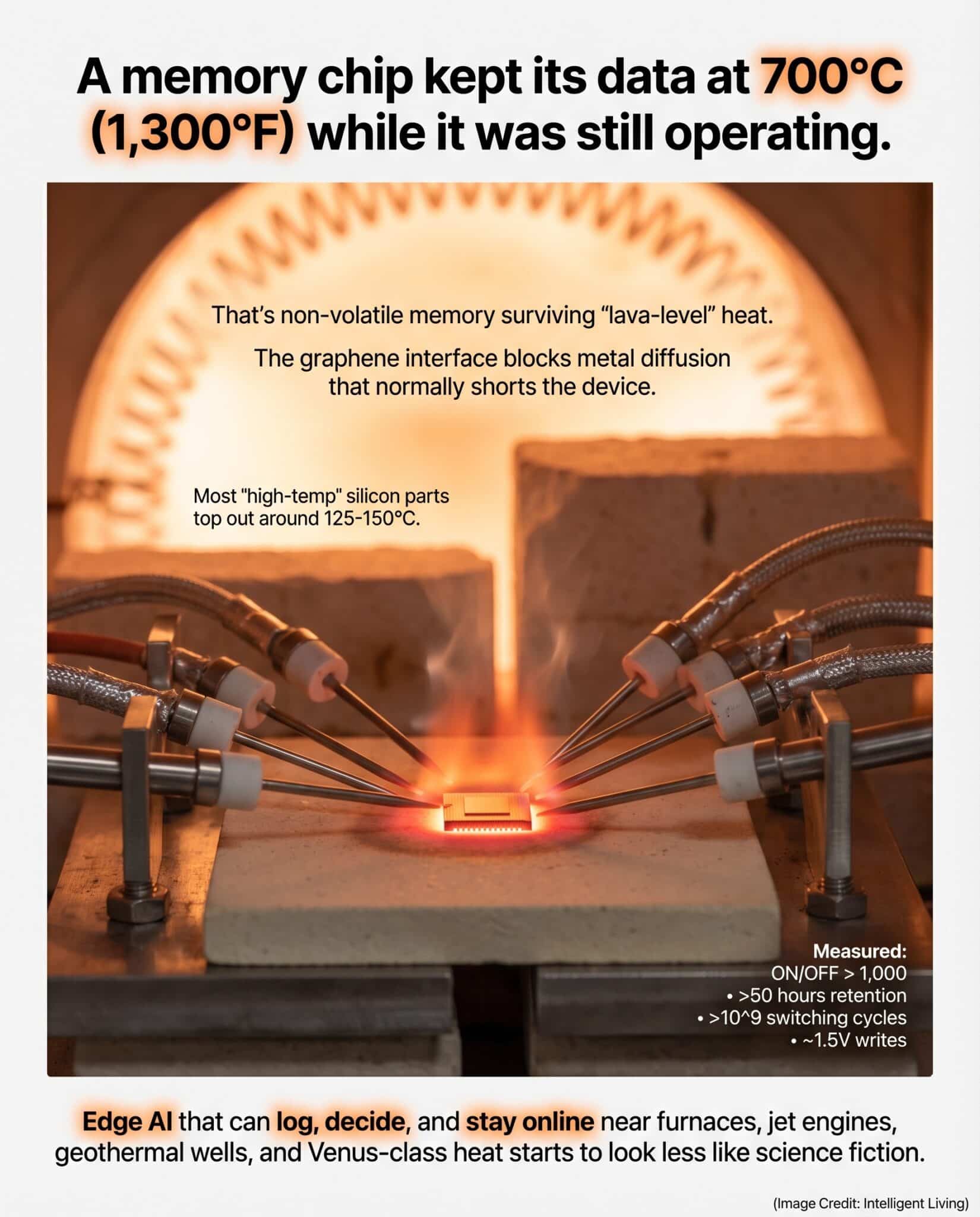
A 700°C memristor result describes a memory device that kept data while running at 700°C, roughly 1,300°F. Such temperature levels are far beyond what standard silicon electronics typically tolerate.
Materials-design milestones like this prototype prove that reliable data storage is possible in volcanic conditions. While a finished AI accelerator remains a future goal, this stack represents a massive leap in engineering resilience.
Imagine placing a digital brain directly inside a jet engine or onto the surface of a volcano without a cooling system.
Chasing the dream of reliable data retention at 700 degrees Celsius is a priority because current systems often fail the moment the mercury rises past a few hundred degrees. This breakthrough in graphene interface engineering changes the math for extreme-temperature edge AI, proving that we can build memory chips that survive temperatures hotter than lava.
Reliable computation in these zones requires more than just heat-shielding; it demands high-temperature electronics that function natively in the heat. A tungsten, hafnium oxide, and graphene stack allows researchers to prevent the atomic-scale drift that usually destroys non-volatile memory. These developments open the door for Edge AI inference in harsh industrial environments, where local intelligence is often more valuable than a distant cloud connection.
High-Temperature Electronics Summary: Why Cooling is Now Optional for Edge AI
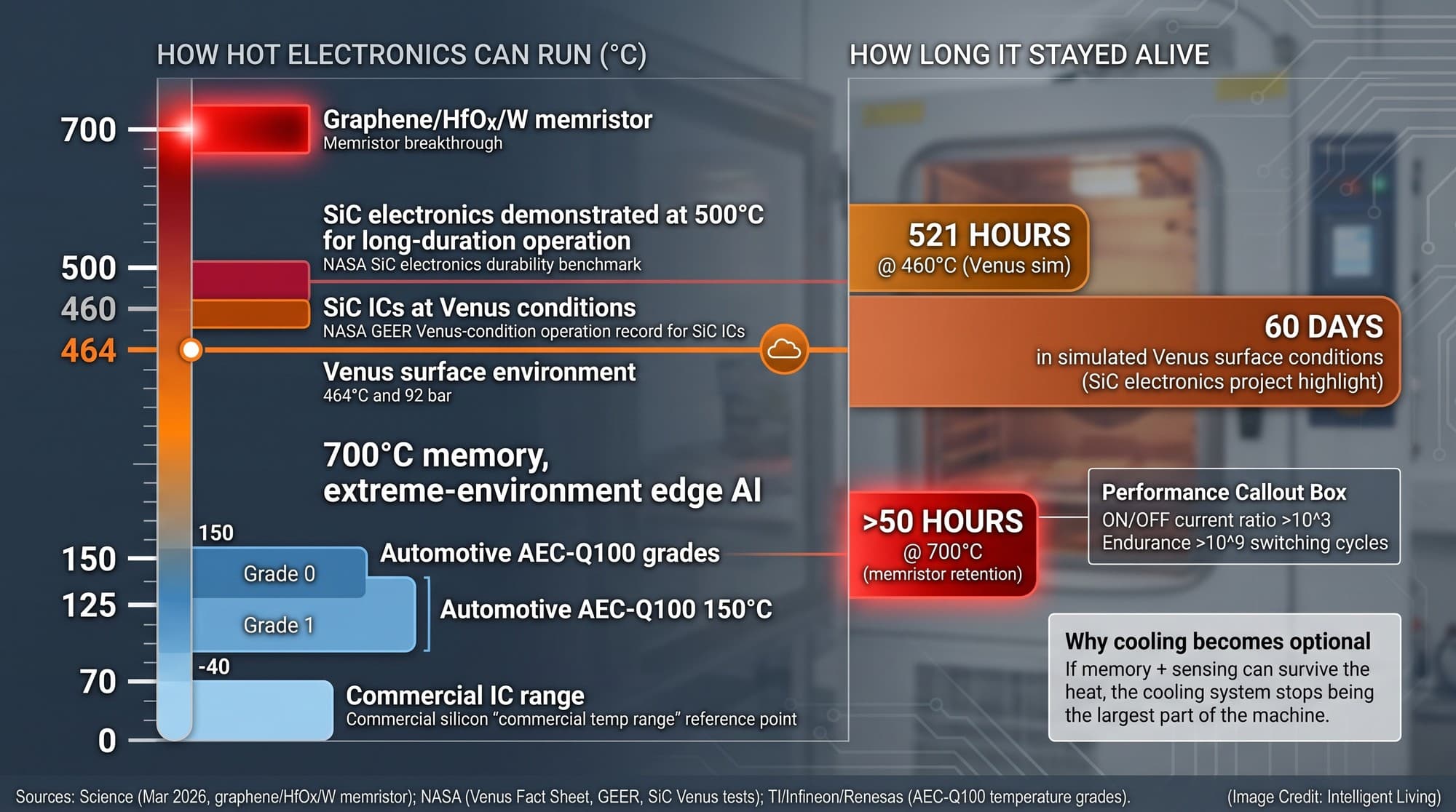
High-temperature electronics results like this push non-volatile memory into a range where cooling becomes optional instead of mandatory. Scalable versions of this approach strengthen the case for extreme-environment edge AI systems that can sense, decide, and log data where heat normally wipes out conventional chips.
Quick Facts: 700°C Memristor Performance Metrics and Materials Stack
- Operating Temperature: Demonstrated reliable operation at 700°C, a ceiling set by test equipment rather than an observed failure point.
- Retention: Data remained intact for over 50 hours at 700°C.
- Endurance: Measured switching endurance exceeded 10^9 cycles under the reported test conditions.
- Materials Stack: Tungsten / Hafnium Oxide / Graphene.
- Switching: Approximately 1.5 volts and tens of nanoseconds per write event.
- ON/OFF Ratio: Device performance metrics indicate an ON/OFF ratio greater than 1,000, as documented in reliable high-temperature memristor performance data.
Materials Science Breakthrough: Building a Memristor that Survives 1,300°F
Material selection defines how these chips withstand brutal thermal environments. Success in this field came when USC scientists engineered a memristor, which functions as a two-terminal electronic component capable of holding resistance states without needing constant power. Engineers utilized a multi-layered stack of tungsten, hafnium oxide, and graphene interface to ensure the device remains functional when standard hardware would melt.
- Tungsten serves as a robust thermal anchor.
- Hafnium oxide provides a reliable switching layer for data.
- Graphene acts as an atomic barrier to prevent structural decay.
During rigorous lab trials, these prototypes maintained data integrity for more than 50 hours at 1,300°F. The testing also proved that the stack could survive a billion switching cycles while operating at extremely low voltages around 1.5 volts and switching times measured in tens of nanoseconds.
Conductance vs. Charge: Why Memristors Outperform Traditional RAM in Harsh Conditions
Memristors store information by changing conductance instead of relying on charge held in capacitors or trapped in floating gates. Advanced crossbar arrays allow hardware to execute neural-network math directly where data is stored, bypassing the need to move data between isolated blocks. Processing locally in this manner saves massive amounts of energy compared to traditional architectures.
In-memory computing promises come with a real systems tax. Factors like drift, noise, and device-to-device variation must be measured and corrected to ensure the math stays reliable. A crossbar array in-memory computing approach explains why researchers care about that detail: in large grids, conductance states can behave like adjustable weights. This allows hardware to compute pieces of neural-network math using physical laws rather than moving data constantly between separate blocks.

Why This 700°C Breakthrough Matters for Extreme-Environment Edge AI
Preventing Thermal Breakdown: How Graphene Stops Tungsten Diffusion at High Heat
Conventional memory devices fail at high temperatures because metal atoms can drift through the oxide switching layer and form a permanent conductive bridge. This leaves the device effectively shorted.
Permanent conductive bridges effectively wipe out the contrast needed for high-speed memory arrays to function. Research insights from an interfacial-engineered high-temperature memristor study highlight why this design works:
- Microscopy results point to tungsten diffusion as the primary failure pathway in conventional designs.
- The graphene interface effectively blocks this breakdown, ensuring the boundary between layers does the heavy lifting.
In high-heat test rigs, the failure can look sudden: current jumps, switching stops behaving normally, and the memory reads like a single state that never clears. In many metal-oxide stacks, heat turns a tiny defect pathway into a permanent shortcut. Here, graphene acts like an interfacial guardrail that makes that shortcut much harder to form.
Analog Compute Advantage: Using Resistive Memory for Efficient Neural-Network Math
Memristors are promising building blocks for in-memory, analog compute because arrays of resistive elements can compute parts of neural-network math without constantly shuttling data between memory and processors. Scaling these architectures appears feasible based on wafer-scale crossbar array circuits, even though engineers must still solve for yield and variability. Edge AI inference relies on this gap because the practical win is lower energy per decision when workloads are memory-bound.
Industrial environments often generate massive amounts of heat. A sensor cabinet placed near a furnace could use these chips to run local anomaly detection. This prevents the need to send raw data to a distant, cooled server room, which reduces lag and improves safety.
Ruggedized gateways often face similar constraints, requiring on-device models to handle real-time decisions when network links are too slow or unstable. Localized intelligence functions optimally when supported by memory-rich local AI inference hardware tailored for on-site model execution.
Training research is circling the same constraint. Specifically, host-RAM offloading strategies for 100B-scale training show how often memory capacity, not raw compute, becomes the chokepoint.
Strategic Use Cases: Deploying Edge AI from Venus Surfaces to Jet Engines
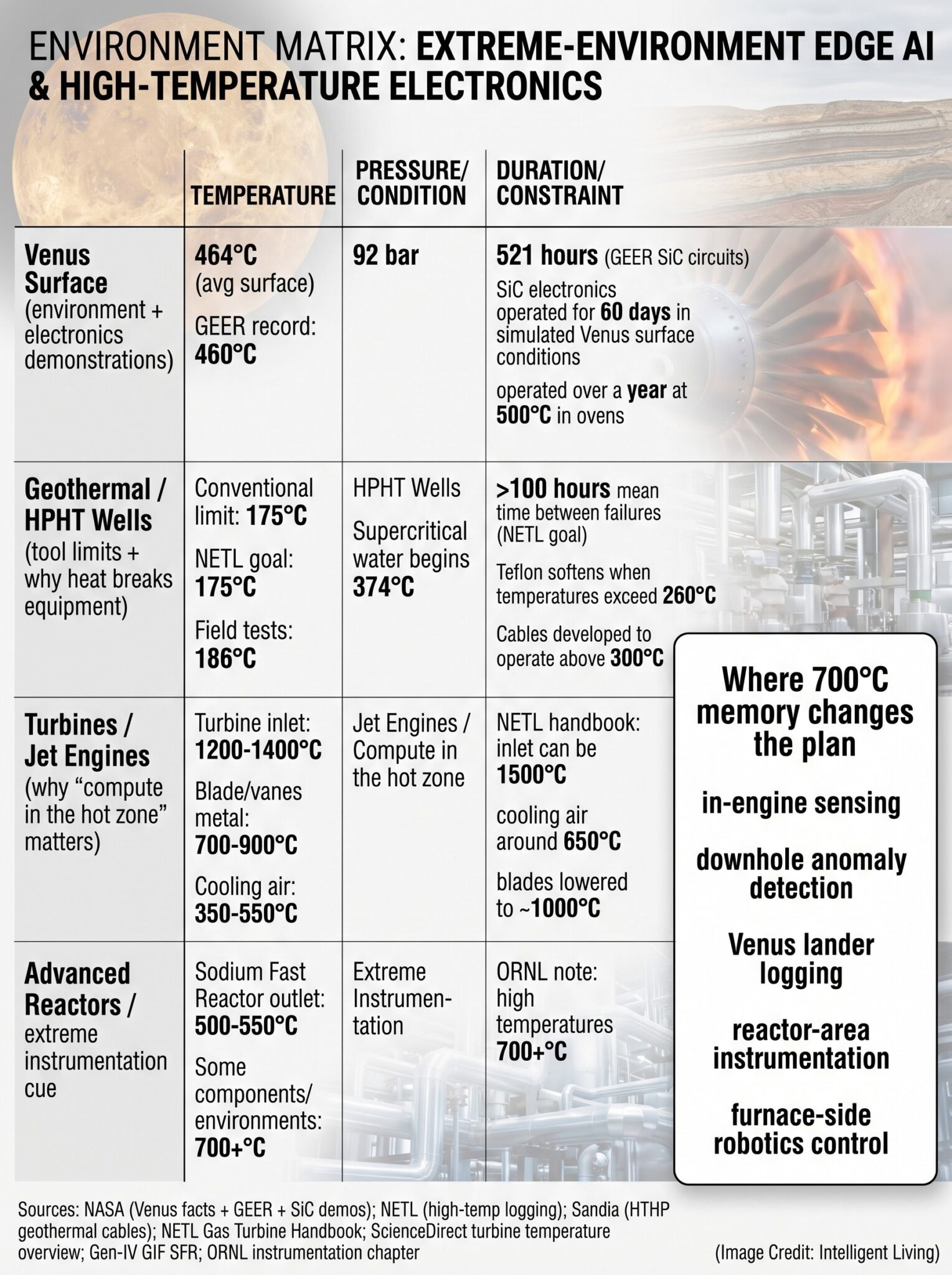
Expanding the reach of silicon involves finding the most hostile environments on or off the planet. High-temperature electronics thrive in zones where traditional cooling is impossible, even though most electronics require heavy shielding to survive.
- Venus Surface Missions: Surviving extreme atmospheric heat on the surface of Venus requires memory that remains stable at 464°C (867°F). Simulated Venus-condition electronics tests show how quickly standard silicon hits its physical limitations.
- Geothermal Energy: Real-time logging inside deep, hot wells, supporting closed-loop geothermal energy systems that circulate working fluid without needing a conventional reservoir.
- Nuclear and Fusion Monitoring: Direct monitoring of high-heat reactor zones or within the high-heat zones of tokamak-based nuclear fusion systems where diagnostics encounter plasma-facing structures.
- Turbine and Jet Engine Instrumentation: Placing monitoring directly inside hot stages to catch anomalies earlier.
- Industrial Edge AI: Utilizing AI-driven factory edge systems reduces dependence on constant uplinks and cooling-heavy compute rooms.
- Harsh-Environment Robotics: Enabling furnace-side perception for robots, especially as perception-rich visuo-tactile robotic hands push more sensory processing into local hardware.
- Automotive Underhood Electronics: Wider thermal margins simplify designs in hot engine bay environments, utilizing graphene-based thermal management solutions to reduce the thermal burden on engine bay shielding.
Deploying intelligence into these sectors transforms how we monitor infrastructure. While this 700°C memristor pushes the limits of heat tolerance, researchers are also exploring a radically different approach: growing memristors from living fungal mycelium, which trades extreme-temperature operation for biodegradability and self-healing capabilities. Instead of relying on delayed signals from protected zones, operators get immediate feedback from the hottest parts of the system.

Scaling Challenges: Moving High-Temperature Prototypes from Lab to Industrial Reality
Production Obstacles: Array Uniformity and Thermal Cycling Stability
A single memristor that survives 700°C is an important demonstration, but productizing the concept requires large arrays with consistent device-to-device behavior, high-temperature peripheral circuits, and packaging that survives thermal cycling in real environments. Systems built for the field must manage demanding requirements like stable converters and readout paths. Signal stability is difficult to maintain when heat and vibration stack up over time. Complex hurdles like the advanced CoWoS packaging bottleneck demonstrate that lab results still require massive interconnect density to survive production. In real deployments, repeated hot-cold cycling can also stress interfaces and shift resistance states, so stability has to be proven across long-duration testing, not just peak-temperature demos.
Future Milestones: Neuromorphic Computing Prototypes and Array-Scale Proofs
The most meaningful follow-up milestones will be array-scale demonstrations, stable operation under repeated thermal cycling, and proof that supporting circuits can operate at comparable temperatures. Moving forward, the most meaningful milestone will be a clear readout that shows array-level uniformity. Research funded by the neuromorphic computing under extreme environments center will likely define how these high-heat prototypes transition into hardware found in real-world environments, since deployment-grade testbeds often decide which ideas graduate from papers to hardware.

The Future of High-Temperature Electronics and Local AI Resilience
The headline number is 700°C, but the more lasting idea is that interface engineering can push memory devices into temperature regimes where electronics usually stop being practical. Scientists have effectively created a new thermal margin, proving that neuromorphic computing doesn’t have to be delicate. While this doesn’t instantly rewrite the hardware stack, it widens the space of designs that can compute on-site in harsh environments without turning cooling into the primary system constraint.
Engineers are developing controllable training signals using oxygen-gradient memristor learning-rate clocks, highlighting a trend where device physics drives the computation. We are seeing a broader pattern where in-memory computing physics becomes part of the computation rather than a nuisance for engineers to fix. As these scalable memristor crossbar array circuits move from the lab to the field, the ability to process data at the source will become the gold standard for industrial and aerospace resilience.
Frequently Asked Questions: Extreme-Environment Edge AI and 700°C Memory
What kind of memory works at 700 degrees?
The USC device uses a specific stack of tungsten, hafnium oxide, and graphene to maintain reliable data retention at 700 degrees Celsius, far exceeding standard silicon limits.
How do memristors survive extreme heat compared to RAM?
Memristors hold electrical resistance states rather than charge. The graphene layer acts as a guardrail, preventing metal atoms from drifting and shorting out the device under high thermal stress.
Can AI run on the surface of Venus using this technology?
While this memory breakthrough solves a major hurdle, a successful Venus landing still requires a full suite of pressure-resistant electronics and robust power systems.
Will this replace current GPUs in data centers?
Not directly. These are specialized components designed for Edge AI inference in harsh industrial environments where traditional GPUs would melt or fail without massive cooling.
Why does standard silicon fail in geothermal wells?
Heat causes atoms to migrate and leakage currents to spike. Standard silicon usually hits a physical wall at much lower temperatures, making high-temperature electronics necessary for deep-well logging.


