
Oxygen-gradient memristors solve algorithmic instability by transforming inherent conductance drift into a precise hardware learning-rate clock. This intrinsic second-order architecture ensures internal dynamics evolve with the gradual rhythm required for stable continual reinforcement learning, contrasting sharply with traditional components that snap between binary states. Neuromorphic experiments and brain-mimicking systems have progressed significantly, helping make the idea mainstream: efficiency is not only about faster math; it is about steady dynamics that keep learning from wobbling. This remains a lab demonstration, but it is a sharp example of materials design shaping algorithm behavior instead of merely storing a number.
Neuromorphic efficiency extends beyond raw throughput, requiring steady internal dynamics to prevent weight update instability. This materials-centric design demonstrates how vacancy physics stabilizes AI agents. By anchoring learning sensitivity to a physical relaxation curve, hardware architects minimize the computational overhead usually required to compensate for erratic conductance shifts.

Essential Physics of Oxygen-Gradient Memristors for Continual Learning
Core Metrics: Oxygen-Gradient Memristor Performance
These advanced memristors combine long-term stability with granular state control. Specific ionic movement physics allow for quantified performance metrics that set these architectures apart from standard resistive memory implementations.
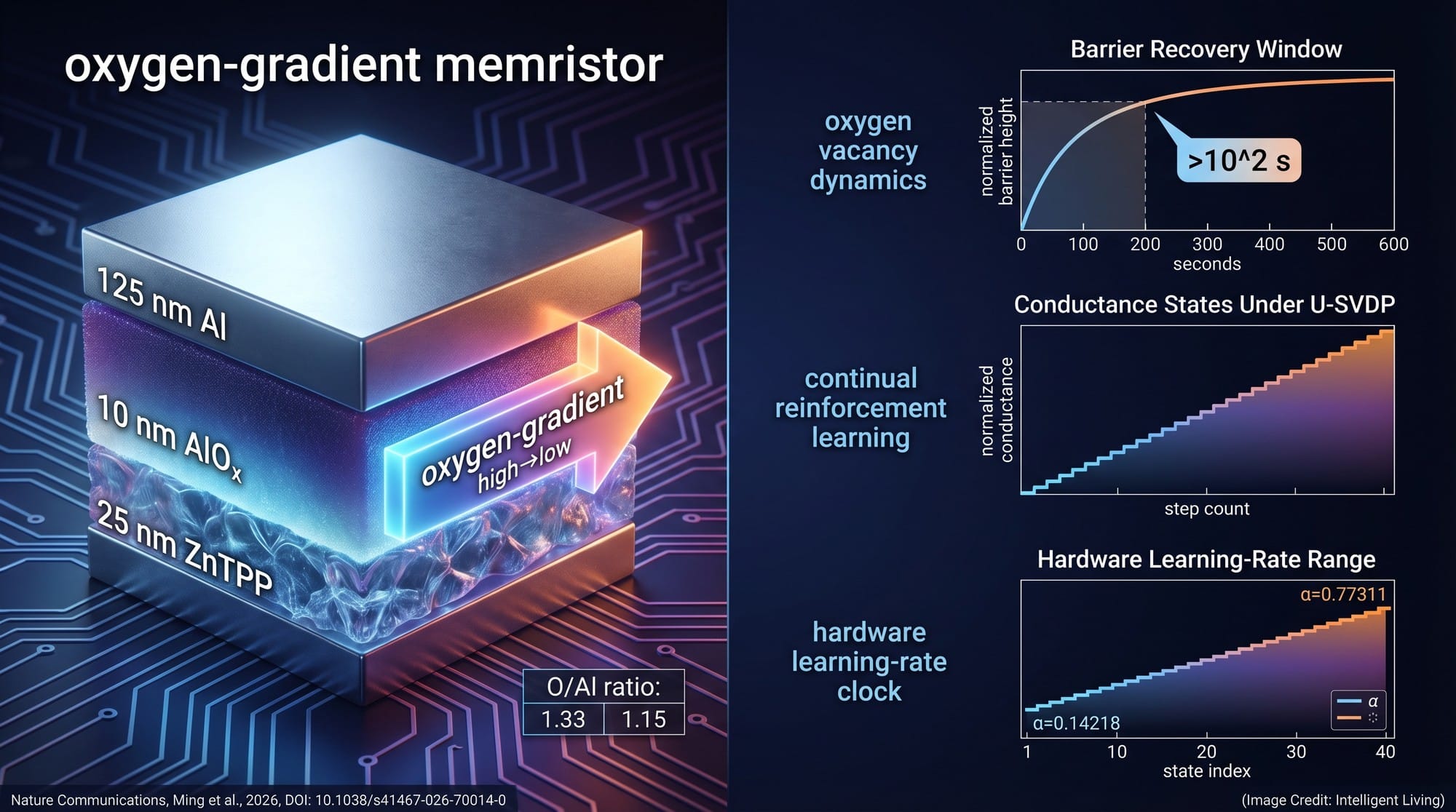
- Device Dynamics: Internal barrier evolution beyond 10^2 seconds indicates a slow internal time constant that functions as a rhythmic learning frequency rather than a transient error.
- Conductance Range: Researchers demonstrated a conductance modulation near −98.1%, providing a broad dynamic range that supports numerous intermediate states.
- Discrete States: Device behavior produced roughly 40 distinguishable conductance plateaus used as time-resolved states.
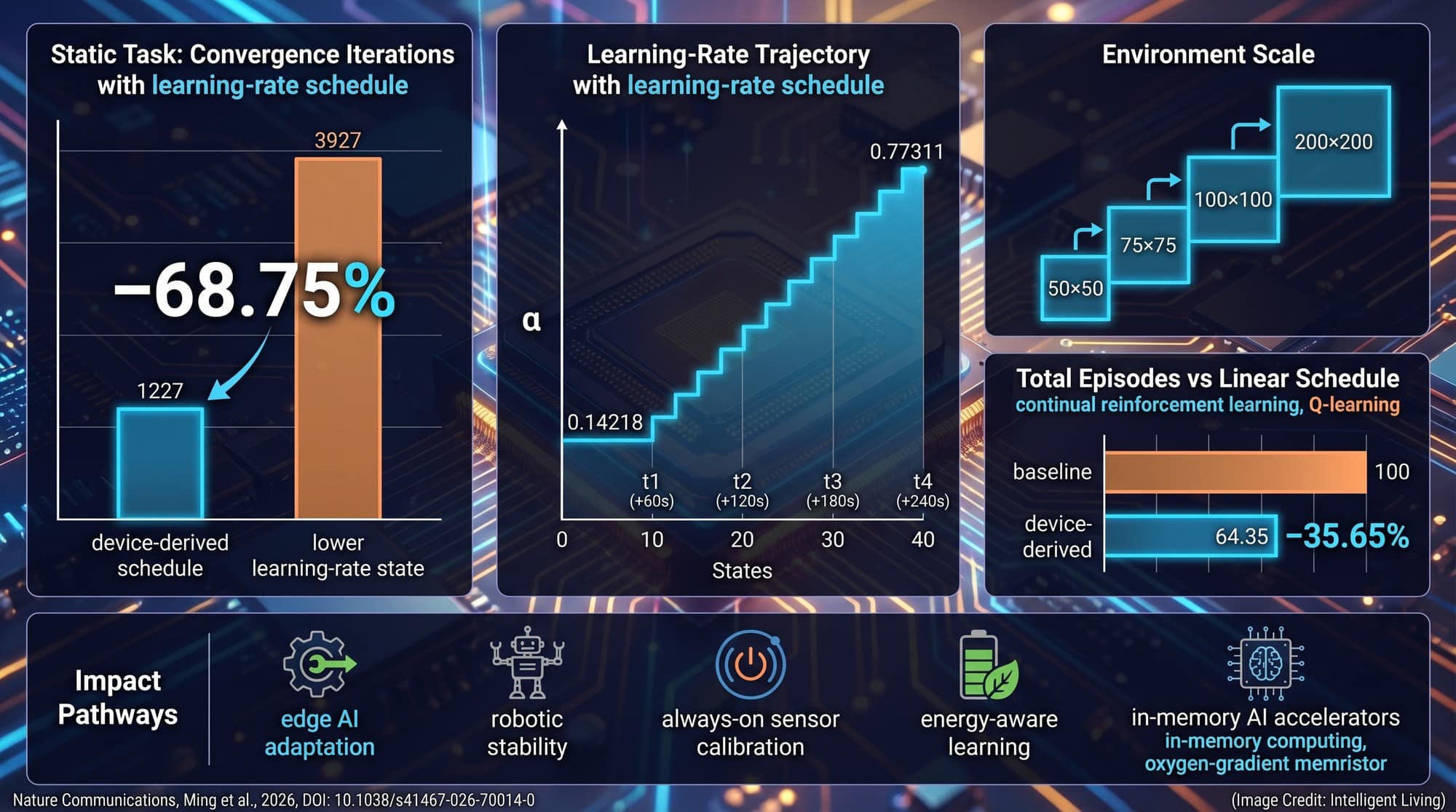
- RL Performance: Mapping these hardware states to Q-learning schedules reduced iterations by 68.75% in static tasks and improved dynamic task episodes by 35.65%, as detailed in the peer-review file and author responses.
- Mechanism: A metalloporphyrin coordination layer paired with a deposited oxide stack preserves the intrinsic oxygen gradient required to bias ionic motion.
- Strategic Significance: Predictable internal dynamics allow reinforcement learning algorithms to adapt with greater precision, mitigating instability in volatile, nonstationary environments.
These metrics suggest that the device is more than a passive storage element; it is an active participant in the learning process. Such a high degree of conductance modulation ensures that AI agents can fine-tune their policies without experiencing the abrupt weight shifts that typically lead to catastrophic forgetting.
Fundamental Memristor Physics and Oxygen Vacancy Dynamics
A memristor is a two-terminal component that adjusts its resistance based on historical electrical stimuli. This unique trait allows it to function as both a non-volatile memory element and a tunable resistor. Scientific literature on memristive computing and ionic motion explains how thin-film stacks store and process data simultaneously. This dual-purpose behavior closely resembles the biological synergy between memory and computation found in the human brain.
Within oxide-based architectures, conductance shifts occur as oxygen vacancies and oxygen ions migrate and diffuse, modulating the internal electron barrier. This ionic migration dictates the device’s operational stability:
- Rhythmic Migration: Facilitates smooth conductance changes, essential for gradual learning.
- Erratic Shifts: Causes sudden, violent weight updates that force the stored state to jump prematurely, disrupting the training trajectory.
Predictable vacancy movement is the cornerstone of this design. The oxygen-gradient approach in this story targets stability by biasing ionic redistribution so the device relaxes slowly rather than flipping abruptly.
Engineering the Oxygen-Gradient Hardware Learning-Rate Clock
Intrinsic Oxygen-Gradient Device Architecture and Design
Optimized Device Stack and Fabrication Methodology
The team’s intrinsic oxygen-gradient device architecture layers a transparent conductive oxide with an organic coordination layer and an ALD-grown aluminum oxide film. This metal electrode stack creates a built-in oxygen concentration slope directly across the switching region.
Material Physics and the Origins of Slow Device Dynamics
Maintaining an oxygen-rich side against an oxygen-poor region establishes a preferred direction for ionic motion. This structural bias eliminates random vacancy wandering and forces the device to relax along a predictable, time-resolved curve.
Two effects matter. First, reversible coordination sites can hold oxygen in place long enough to prevent a rapid collapse back to equilibrium. Second, the graded oxygen concentration changes the local migration barriers for ions, so relaxation stretches out in time. Similar to a physical system returning to equilibrium after a disturbance, the device’s internal states recover gradually rather than transitioning abruptly. In this device, the oxygen landscape encourages that same kind of gradual return.
Automating Learning-Rate Schedules through Hardware Timebases
Reinforcement learning depends on a learning rate, the fraction of new experience that overwrites old knowledge. Too large a learning rate and policies oscillate; too small and learning stalls. In standard Q-learning, the step size, often written as “alpha,” controls how strongly each new reward update shifts the value estimates, and that sensitivity is a common source of instability when environments change.
Researchers used voltage pulses to move the device through roughly 40 distinct conductance plateaus. These states function as a hardware learning-rate schedule rather than a traditional static weight. Since the device evolves slowly over several minutes, the effective learning rate transitions smoothly. This physical evolution automates the complex tuning process that software engineers must typically perform by hand. The appeal is that the schedule is not arbitrary; it is anchored to a physical relaxation curve. Reinforcement learning can optimize CUDA code for GPU performance, demonstrating how aggressive update steps can overshoot and waste search time, while gentler schedules converge more reliably.
Performance Metrics and Impact Pathways for Memristive Reinforcement Learning
Experimental Validation and Remaining Challenges in Reinforcement Learning
Laboratory evaluations confirm that hardware-derived schedules significantly slash training requirements. Experimental data highlights:
- Static Tasks: A near 69% reduction in required iterations.
- Dynamic Scenarios: A 35.65% efficiency gain in time-varying environments.
These metrics demonstrate the potential for oxygen-gradient devices to function as adaptive AI accelerators by merging physical measurements with learning algorithms to stabilize policy search.
That said, the evidence is a proof of principle, not a production result. The team tested single devices and small arrays under controlled conditions. They did not yet show large crossbar matrices of tens of thousands of devices running full‐scale learning workloads, nor did they demonstrate the peripheral circuit design needed to read, write, and protect these devices in a noisy, real‐world system. The results therefore invite optimism while anchoring expectations: the materials story is strong; the systems story remains to be written.
High-Impact Applications for Adaptive AI Accelerators
- Autonomous Edge Adaptation: Disconnected agents can leverage device-native schedules to stabilize on-device adaptation, ensuring reliable policy updates in fluctuating environments without cloud reliance.
- Robotics That Keep Their Balance: Robots operating in unpredictable conditions benefit when internal learning does not swing wildly in response to a solitary event.
- Always‐On Calibration In Sensors: Environmental sensors that recalibrate to drift can avoid catastrophic resets if updates are spread out by stable hardware dynamics.
- Energy-Efficient Policy Tuning: Reducing the number of training episodes can shrink repeated data movement and the energy footprint of iterative policy search, a theme that shows up in sustainable AI efficiency stack discussions when workloads stop wasting cycles on avoidable retraining.
- In‐Memory Learning Accelerators: This materials approach dovetails with the architecture shift toward compute‐in‐memory and may simplify co‐design for low‐power learning engines.
This pressure for stable online updates is a core component of lifelong learning in autonomous devices, where models cannot pause environmental interactions to retrain every time conditions drift.
Addressing Crossbar Variability and Peripheral Circuit Overhead in AI Scaling
Evolutionary Trends in In-Memory Learning and Weight Storage
Prior demonstrations of analog memristor arrays performing actor-critic temporal-difference reinforcement learning in-memory underscore the primary objective: minimizing data movement by localizing learning within the storage state. The novelty in the oxygen-gradient device is reliability. It treats materials as an active design lever for learning stability, not a passive storage medium that software has to babysit.
Chip design teams have already utilized AI to design advanced processors to reduce trial-and-error and land on workable layouts more consistently. The same mindset shows up here: reliability matters as much as raw speed when a system has to keep learning without wobbling. This memristor story is similar in spirit. It tries to make the learning curve behave predictably by shaping the physics underneath it.
Scaling Challenges: Managing Crossbar Array Variability
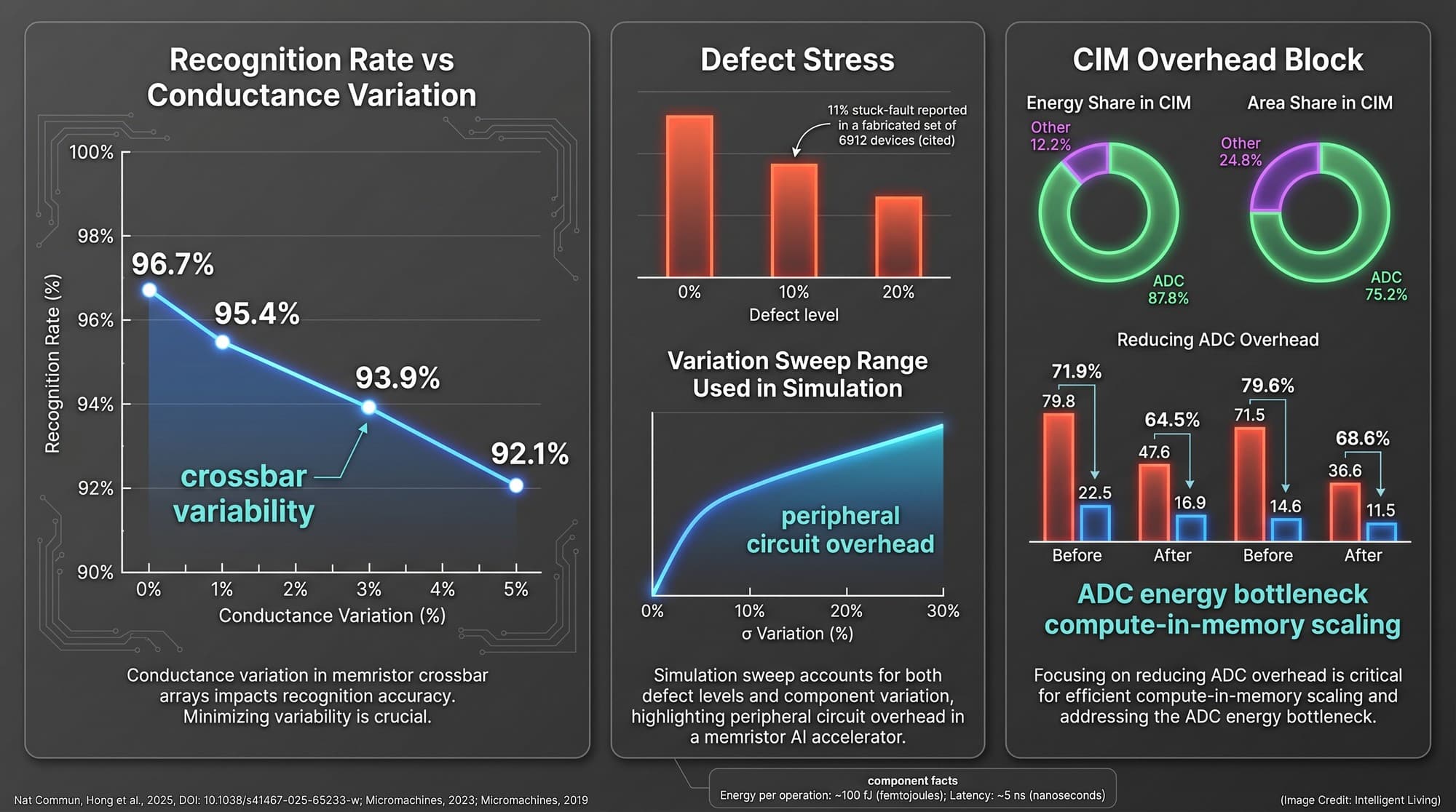
Material-level innovations often encounter significant reproducibility hurdles when transitioning to crossbar arrays. Minute deviations in film thickness or local ion mobility compound into systemic conductance variations. This variability remains the primary obstacle preventing laboratory prototypes from maintaining consistency across high-density integrated circuits.
Minimizing Peripheral Circuit and Control Complexity
System-level friction often comes from the plumbing that sits around the device. A variability-aware memristive crossbar tutorial breaks down how device-to-device spread, programming nonlinearity, and peripheral circuits can inject error into large arrays even when the underlying device physics is sound. In practice, the sensing amplifiers, selectors, write-verify loops, and error mitigation can dominate area and energy if the devices are not uniform.
Overcoming Packaging and Interconnect Bottlenecks
Even when a device-level concept is strong, real systems still collide with wiring density, memory traffic, and heat. Modern packaging constraints, including CoWoS bottlenecks in semiconductor manufacturing, show how interconnect and thermal ceilings decide whether new memory-compute ideas scale.
Quantifying the System Tax on Memristive Hardware
Immediate priorities include validating the oxygen-gradient effect at scale and designing peripheral architectures to ensure signal integrity. Robust sensing amplifiers and selectors are essential to prevent stochastic drift from corrupting stored weights. As highlighted in a 2025 overview, peripheral circuit overhead and system co-design determine whether innovative device concepts remain viable during operational deployment.
Strategic Roadmaps for Memristive AI Research
Advancing this hardware learning-rate clock toward commercial viability requires a rigorous focus on large-scale reproducibility and system-level performance. Future efforts must reconcile the elegant physics of the oxygen gradient with the harsh realities of industrial chip manufacturing.
- Array Scaling: Demonstrations of the oxygen-gradient mechanism in larger crossbar arrays to verify its tolerance to device variation.
- Stress Testing: Endurance and retention evaluations conducted under realistic temperature and environmental stress cycles.
- Circuit Co-design: Development of peripheral circuits that translate device plateaus into reliable learning-rate inputs at scale.
- Synchronization Benchmarks: System tests in GPU training bottlenecks to quantify how synchronization stalls can erase device-level gains.
- Energy Efficiency: These measurements should connect to the efficiency gains offered by 3D AI chip architectures, where shorter data travel reduces memory wall pressures.
Addressing these research directions will determine if oxygen-gradient stability can survive the transition from a laboratory bench to a high-density AI accelerator. Success in these areas would validate the use of material-native dynamics as a primary design lever for energy-efficient computing.
Materials Intelligence: Stabilizing Continual Reinforcement Learning Dynamics
Engineering slow, predictable internal dynamics allows these oxygen-gradient devices to provide a physical timebase for learning-rate updates. This hardware-native clock bridges the gap between raw memristive switching and the delicate stability requirements of lifelong learning agents. By utilizing a second-order state, the architecture ensures that conductance modulation remains meaningful across extended training durations, preventing the catastrophic forgetting often seen in traditional digital implementations.
The path toward commercial neuromorphic accelerators now depends on refining these oxygen-gradient stacks for high-density crossbar integration. While scalability and endurance remain the next critical milestones, the synergy between material vacancy physics and Q-learning efficiency offers a clear blueprint for energy-efficient AI. Moving toward reliable computing building blocks requires this exact fusion of chemistry and algorithmic design to handle the complexity of nonstationary real-world environments.
Practical Insights: Oxygen-Gradient Memristors and Adaptive AI
How Do Oxygen Vacancies Create a Learning-Rate Clock?
Ions and vacancies migrate across a built-in concentration gradient to produce a slow, predictable relaxation curve. This intrinsic drift functions as a hardware-timed schedule, automatically adjusting learning sensitivity without external software intervention.
Why is Continual Reinforcement Learning Difficult for Hardware?
Most devices switch states too abruptly, causing the AI policy to oscillate or lose previous knowledge. Stable, second-order memristors prevent these sudden jumps, allowing for gradual weight adjustments during online training.
What is the Advantage of a Second-Order Memristor Architecture?
Second-order devices track an internal history variable alongside conductance. This added complexity allows the hardware to exhibit temporal dynamics, making it ideal for time-resolved tasks like reinforcement learning and sensory adaptation.
Can these Devices Cut Energy Costs in Edge AI?
Yes, by reducing the number of required training episodes by up to 68%, the system minimizes unnecessary data movement. This efficiency is critical for autonomous robots and remote sensors with limited power budgets.
What are the Main Challenges for Crossbar Array Scaling?
Device-to-device variability and peripheral circuit overhead remain significant hurdles. Future research must focus on maintaining uniform oxygen-gradient behavior across thousands of cells while minimizing the energy used by interface electronics.


