
Alibaba and China Telecom recently unveiled a massive expansion at the Shaoguan AI data center, anchoring the facility with 10,000 in-house Zhenwu 810E accelerators. Such a move shifts China’s domestic AI push from experimental milestones toward rigorous infrastructure planning. Every component—from specialized silicon to high-efficiency cooling systems—now undergoes testing against the relentless demands of live, enterprise-grade environments.
This 10,000-card intelligent computing cluster serves as a definitive proving ground for the entire domestic supply chain. It asks a hard question: can local silicon power the next generation of AI without relying on outside vendors? Market analysts increasingly observe that the shifting balance of LLM market power depends on owning the data center and the chip roadmap rather than just the models themselves. Developers rushing to ship an enterprise copilot or regional providers struggling with stable inference capacity feel this reality every day.
Success in Shaoguan demonstrates that homegrown AI chips have transitioned from conceptual milestones to a dependable backbone for the industry. A newer contender, DFSX’s DF1000 AI chip, takes a different architectural path, stacking DRAM directly onto logic through hybrid bonding to achieve 6.4 TB/s of memory bandwidth on a fully domestic 14nm supply chain. Businesses can then expect predictable costs and reliable access to large-model training infrastructure. These clusters represent the first real attempt to build an end-to-end AI ecosystem that is both resilient and vertically integrated.

Mapping the Shaoguan Deployment: Collaboration Between Alibaba Cloud and China Telecom
Project Architecture: Stakeholders Behind the 10,000-Card Intelligent Computing Cluster
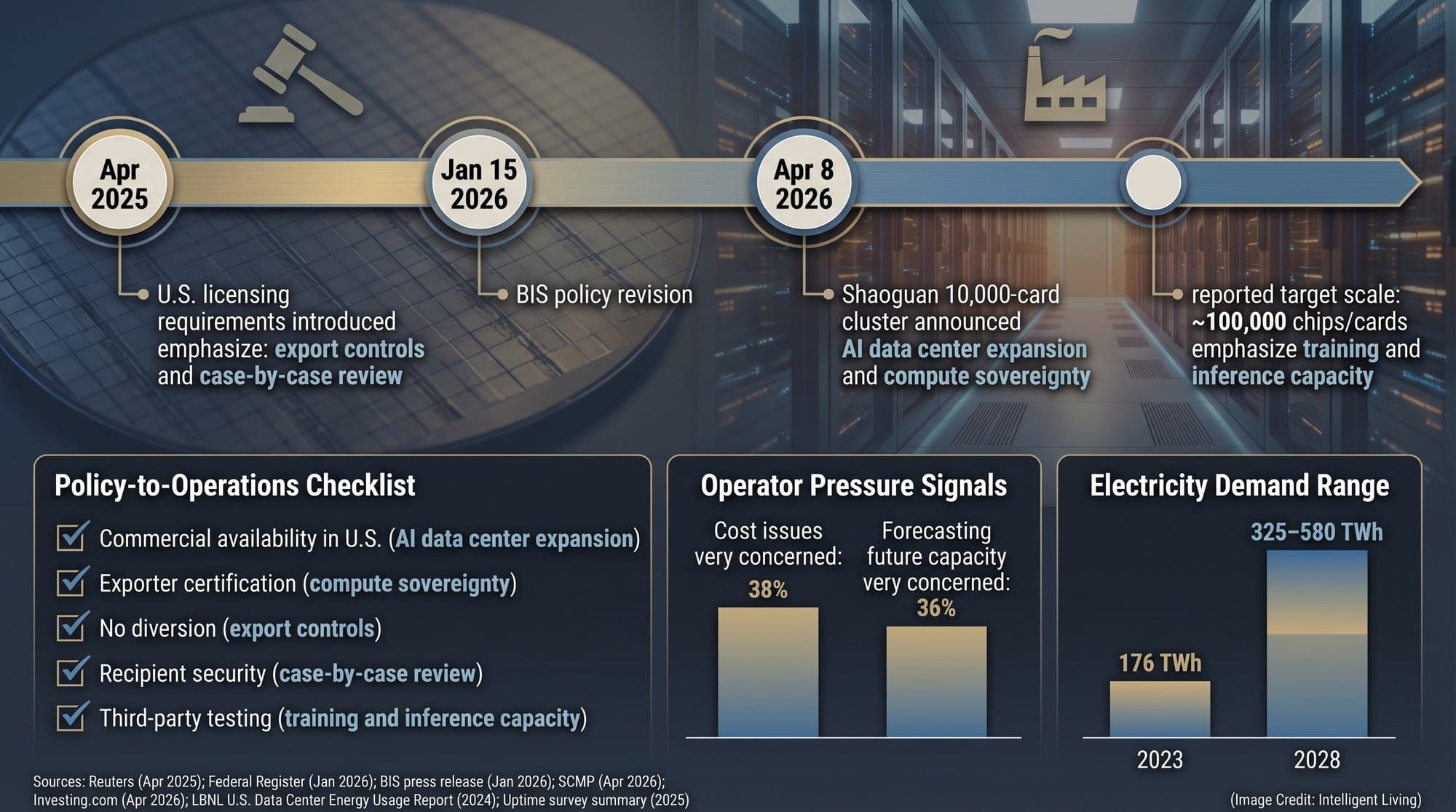
Alibaba Cloud, working with China Telecom, recently activated a nationally developed 10,000-card intelligent computing cluster in Shaoguan to anchor its domestic accelerator strategy. While the 10,000-card milestone is a significant start, the roadmap to scale the facility toward 100,000 chips highlights the massive scope of projected enterprise demand in the region.
Several outlets also report engineering claims about the cluster fabric, including ultra-low end-to-end network latency and very high peak utilization during large collective communications. At this scale, optimized test runs often mask the complexities of average operational performance. Consequently, these latency and utilization figures should be treated as operator claims until independent benchmarks provide neutral validation.
Critical Infrastructure Metrics: Shaoguan AI Cluster Location and Scale
- Location: Shaoguan, Guangdong province, China
- Scale: 10,000 Zhenwu accelerator cards reported deployed, with a longer-term expansion target described as roughly 100,000 chips
- Chip Family: Zhenwu 810E, positioned for large-model training and inference
- Workloads: AI training plus high-volume inference
- Systemic Infrastructure Complexity: Industrial-scale deployments rely on more than just silicon; they require high-speed photonic networking inside data centers to manage the massive data throughput inherent to large-model clusters.

Inside Zhenwu 810E and the 10,000-Card Scale-Up
Zhenwu 810E Technical Profile: Performance Capabilities and Design Intent
The Zhenwu 810E is an in-house accelerator developed by Alibaba’s T-Head group. T-Head engineers specifically designed Zhenwu 810E inter-chip network ports and multi-card coordination as a core design goal for large-model training and inference in clustered deployments. Integrating high-performance silicon allows the Zhenwu 810E performance and 96GB HBM2e capacity to deliver the inter-chip bandwidth necessary for complex model orchestration.
Throughput Determinants: Memory Capacity, Bandwidth, and Interconnect Latency
Large AI models demand intense data movement, causing accelerators to stall whenever they wait on memory. Current AI hardware debates frequently center on the ‘memory wall,’ where the AI accelerator memory bandwidth bottleneck leaves compute cores idle while the data pipeline struggles to keep pace.
In practice, three specifications tend to decide whether a large-model cluster feels smooth or constantly starved:
- High-bandwidth memory capacity: how much model state and activations each card can keep close, instead of paging in and out.
- Memory bandwidth: how quickly the card can stream data to the compute blocks without stalling.
- Interconnect bandwidth and latency: how efficiently many cards can share tensors during training and serve requests during inference.
Theoretical vs. Actual Throughput: Limitations of Paper Specifications in AI Clusters
Much like a high-capacity highway system, a chip’s raw bandwidth figures must withstand the friction of contention, node failures, and complex orchestration under real workload mixes. Specs are useful, but they do not automatically translate into real throughput. Cluster behavior depends on the software stack, scheduling, and how the model is split across cards.

Strategic Scale-Out Architecture: The 10,000-Card Cluster as a Competitive Unit
Engineers can design a single fast accelerator, yet orchestrating ten thousand into a predictable system requires a discipline akin to global logistics management. Deploying at this scale transforms the nature of hardware management. Engineers must now contend with several systemic pressures:
- Failure modes multiply across thousands of nodes.
- Network hot spots emerge during heavy collective communications.
- Orchestration layers must evolve to keep the entire machine fed with data.
System predictability depends on shifting the engineering focus from raw chip speed to total network stability.
Networking Constraints: Impact of AllReduce and Collective Communications on Speed
Scaling to this level prioritizes system reliability over individual chip speed, ensuring the continuous flow of data across the fabric. This explains the industry’s obsession with collective operations like AllReduce and AlltoAll. Such operations act as the invisible gears of the machine. Their efficiency determines if the GPU communication wall encountered in massive training becomes a hard practical constraint or a manageable engineering hurdle.
Performance Degradation Factors: Identifying Bottlenecks in Cluster Scale-Up
Real-world deployments often reveal a critical threshold: models scaling cleanly across a few racks may stall when the network fabric introduces latency or storage reaches its capacity. Anyone who has watched a major launch stall because a single backend dependency fell behind already understands the feel of that problem.
Orchestration Complexities: Managing Fault Domains and Multi-Rack Scheduling
- Failure domains expand, so single-node faults need to be masked without pausing long training jobs
- Scheduling gets more complex as jobs span hundreds or thousands of cards
- Network and storage become shared infrastructure that must scale predictably under bursty workloads
Operational Reliability Strategies: Maintaining Stability in Large-Scale Deployments
Operators maintain stability by leaning on redundancy, phased rollouts, and workload shaping. These methods keep utilization high without allowing noisy neighbors to starve critical jobs.
Supply constraints also dictate architectural shifts. Packaging and memory availability dictate production limits, a reality emphasized by the advanced CoWoS packaging bottleneck that currently restricts the global accelerator market. Furthermore, rising HBM4 supply and memory pooling pressures act as a significant limiter. Ultimately, the fastest accelerators are only as effective as the memory they can reliably source.
Strategic Drivers: Accelerating China’s AI Data Center Expansion
Market Pressures: Export Controls and Vertical Integration Incentives
At the heart of this push lies a simple reality: the supply of advanced accelerators has become deeply unpredictable.
Regulatory Impact: Export Controls and Licensing Volatility
Export restrictions and licensing shifts have repeatedly changed what can be shipped, when it can ship, and under what conditions. Market dynamics changed significantly after the U.S. licensing requirements for Nvidia H20 and AMD MI308 proved how quickly hardware availability can evaporate for standard data center parts. Consequently, domestic operators are pivoting toward power-delivery and rack-level workarounds, such as adopting GaN-powered 800VDC AI racks, to mitigate supply chain pressure.
That context overlaps with a longer-term strategic move: owning more of the stack.
Economic Shifts: Impact of Vertical Integration on AI Procurement
Vertical integration transforms the stack into a control system rather than a simple shopping list. Cloud operators now prioritize vertical integration and custom silicon economics to secure direct control over energy efficiency and hardware availability. The industry is also seeing an accelerated adoption through open-weight distribution models, which simplifies the scheduling of stable compute resources for enterprise users.
Policy also matters in a more procedural way than most readers realize.
Regulatory Framework: Formal Export Review Policies and Licensing Revisions
Recent BIS updates mandate a case-by-case export review policy for high-performance semiconductors destined for Chinese data center deployments.
Government officials recently formalized license review policy revisions to clarify the scope of export controls in standardized legal terms.
Early Adoption Sectors: Primary Use Cases for Zhenwu Compute Capacity
- Enterprise Copilots and Customer Service: High-volume inference thrives on concurrent queries. Consequently, banks and service platforms typically lock down inference capacity long before they authorize massive new training budgets. The early phase often looks like internal tools that cut response time and reduce repeat tickets.
- Healthcare Informatics and Imaging Pipelines: Modern medical facilities increasingly rely on integrating AI to maintain healthcare affordability by prioritizing safe workflow support systems like queue prediction. Hospitals can use large inference resources for image triage and operational analytics, including automated documentation triage.
- Materials Discovery and Industrial Simulation: Screening candidate materials and simulating physical behavior can be compute hungry and parallelizable. Research breakthroughs in large-scale 4-billion-atom materials simulations demonstrate that sustained cluster availability is often more critical for industrial outcomes than brief bursts of peak speed.
- Manufacturing Digital Twins and Robotics Perception: Factory planning increasingly relies on AI-driven factory systems and digital twin infrastructure to reward stable throughput and continuous simulation loops.
- Regional AI Utility Access via Telecom Provisioning: If carrier platforms expose this capacity to smaller firms, the effect can resemble a utility model where advanced compute becomes a service rather than a capital project.
These use paths blend what is explicitly reported with cautious inference grounded in how training and inference capacity tend to be consumed at scale.
Future Outlook: Resilient Blueprints for Domestic AI Data Center Infrastructure
Long-term viability for the Shaoguan cluster hinges on operational longevity and technical transparency. Specific indicators of success include transparent benchmark disclosures, clear customer access models, and verifiable buildout milestones. Operators are increasingly adopting a dual AI factory hedging strategy to balance performance with availability when specific compute ecosystems face constraints. Moving beyond the hype proves that domestic clusters handle the sustained, heavy lifting of global AI competition.
Operational viability depends on converting efficiency gains into budget decisions. Consequently, adopting carbon-aware FinOps and GreenOps scheduling has become the primary method for justifying the environmental and financial costs of large clusters. Systemic scaling constraints explain why AI infrastructure is now a grid planning priority, pushing technical discussions from the server room to the urban planning level.
Energy Intersection: Scaling AI Factories within Global Power Grids
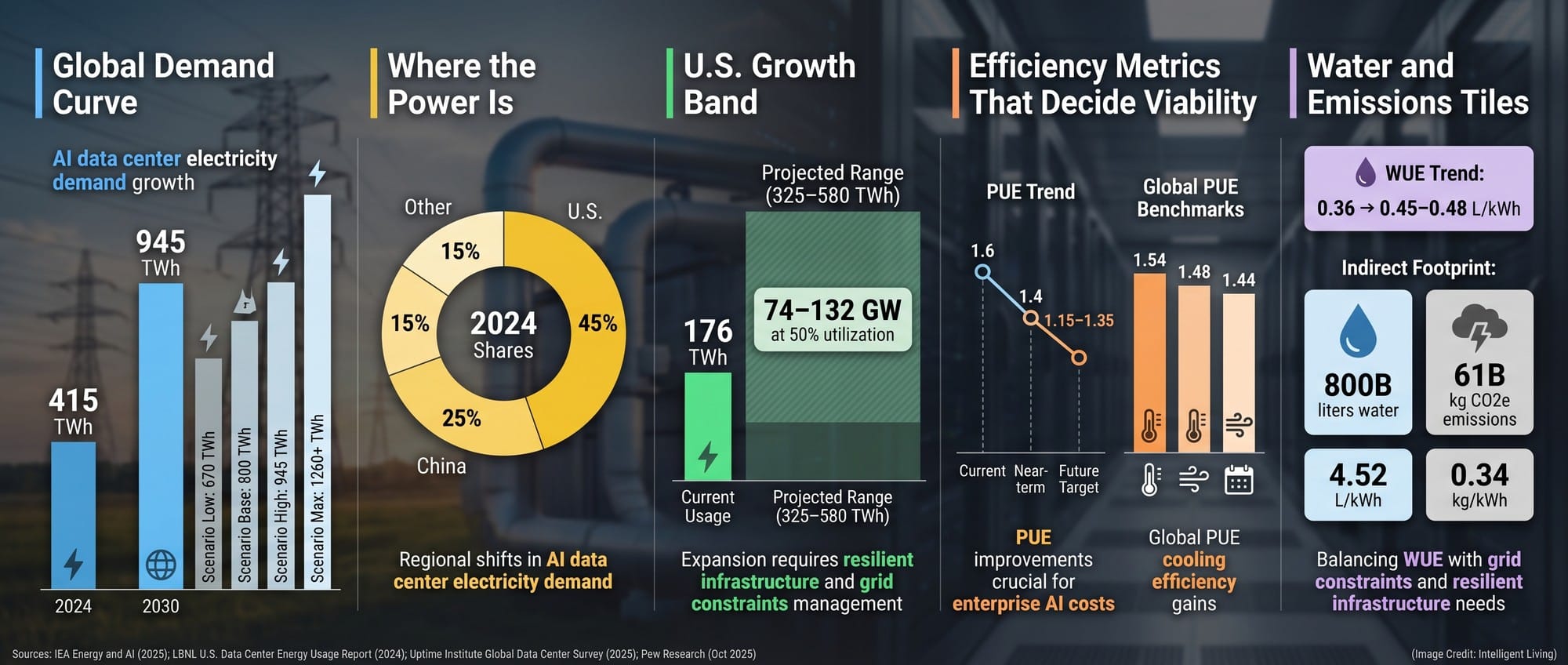
Clusters of this size behave like industrial loads. Global energy forecasts, including the IEA projection of rising AI electricity demand, indicate that data center consumption could roughly double by 2030. Such growth transforms AI from an abstract trend into a core driver of grid capacity and infrastructure siting strategies. It is also why some operators are looking past the grid entirely: Google began testing Project Suncatcher in orbit in October 2026, running AI chips on solar power rather than a substation. Current benchmarks for U.S. data center electricity consumption show that the load is already significant even before the next wave of massive AI-only builds arrives.
Engineers are exploring complex cooling and water resource trade-offs to ensure that massive clusters remain sustainable under peak electrical loads. Strategic planning must account for evolving energy and water resource constraints, treating power budgets and cooling infrastructure as linked engineering variables.
Information Gaps: Missing Benchmarks and Unverified Performance Claims
- Public benchmarks are missing: There are not yet independent, peer-reviewed results that validate performance under standardized tests across comparable software stacks.
- Unit economics are not public: Pricing, scheduling policies, and the real cost per token for customers remain undisclosed.
- Expansion schedule is unclear: “100,000 chips” appears as a target in reporting, but building evidence will matter more than ambition statements.
- Comparative claims need neutral tests: Any suggestion that one accelerator family “beats” another requires standardized measurement under identical model and software conditions.
- Cluster fabric performance claims are not independently verified: Preliminary data points toward Zhenwu cluster network latency and utilization reaching 4 microseconds and 95%, respectively, though neutral third-party validation is still required for these fabric metrics.
Future Indicators: Monitoring China’s Compute Sovereignty and Expansion Timelines
Several key indicators will distinguish sustained capability from temporary industry headlines: benchmark disclosures tied to real workloads, customer access models that show who can actually rent or schedule this compute, and procurement or buildout milestones that corroborate expansion timelines. A comparison lens like the dual AI factory hedging strategy makes it easier to see how operators hedge when one compute ecosystem faces constraints.
Efficiency gains translate into budget and emissions decisions that determine where large clusters can be justified. Long-term sustainability now depends on adopting carbon-aware FinOps and GreenOps scheduling, translating efficiency gains into clear budget and emissions decisions. This bigger picture is why AI infrastructure is now a grid planning priority that keeps appearing in conversations that used to belong solely to cloud architects.

Frequently Asked Questions About Alibaba’s Shaoguan Cluster
What is the Alibaba Zhenwu 810E chip designed for?
The Zhenwu 810E is an in-house accelerator from Alibaba’s T-Head group, specifically optimized for high-performance large-model training and inference in massive data center environments.
Why is a 10,000-card intelligent computing cluster a major milestone?
Deploying 10,000 cards forces engineers to solve complex multi-rack orchestration and networking challenges that simply don’t appear in smaller, isolated test environments.
Are export controls the only driver for Chinese AI data centers?
While restrictions add urgency, vertical integration and the desire for compute sovereignty are equally strong drivers, allowing firms to control costs and performance from the silicon level up.
How will these large-scale AI clusters affect local energy demand?
Massive clusters behave like industrial factories, requiring significant grid capacity and liquid cooling solutions to manage the intense thermal and electrical loads of AI-only builds.
When will enterprise customers get access to Zhenwu compute capacity?
Access typically follows internal stability testing. Enterprise users should monitor for upcoming cloud instance availability and specific pricing models for regional AI utility services.


