
Researchers at Nanyang Technological University in Singapore have built a compact device that does two jobs at once. It uses sunlight to make hydrogen from seawater while breaking down hydrazine, a toxic industrial chemical found in some wastewater. The work was led by Prof. Lydia Wong with Dr. Anupam Sadhu, Dr. Stener Lie, and Dr. Hao Zhe Chun, published in Nature Communications on May 20, 2026, and summarized by NTU in September 2026. It is reported in the peer-reviewed study in Nature Communications.
The headline numbers are striking, and they come with conditions. The device held a photocurrent near 25 milliamps per square centimeter for more than 72 hours and produced hydrogen at about 466 micromoles per square centimeter per hour. In a separate cleanup test, it cut hydrazine from 0.5 molar to 0.5 parts per billion in about 30 hours. That final level sits 20 times below the 10 parts per billion limit cited by the researchers for drinking water. This article explains what was built, how it works, what those figures mean in physical terms, and where the limits sit.
What the team actually built
The device is a self-powered photoelectrochemical cell, not a biological leaf. One side absorbs light and makes hydrogen. The other side destroys hydrazine instead of making oxygen. No external power supply is used during operation.
The light-absorbing side is a lead halide perovskite solar cell with the composition Cs0.05(FA0.83MA0.17)0.95Pb(Br0.17I0.83)3. Perovskites are strong light absorbers, which is useful, and they fall apart quickly in water, which is a serious problem. The team therefore sealed the cell behind conductive silver copper epoxy and titanium foil, then added a thin platinum layer to help hydrogen form. The protection stack is doing essential work here, because without it the perovskite lost performance within 30 minutes in testing.
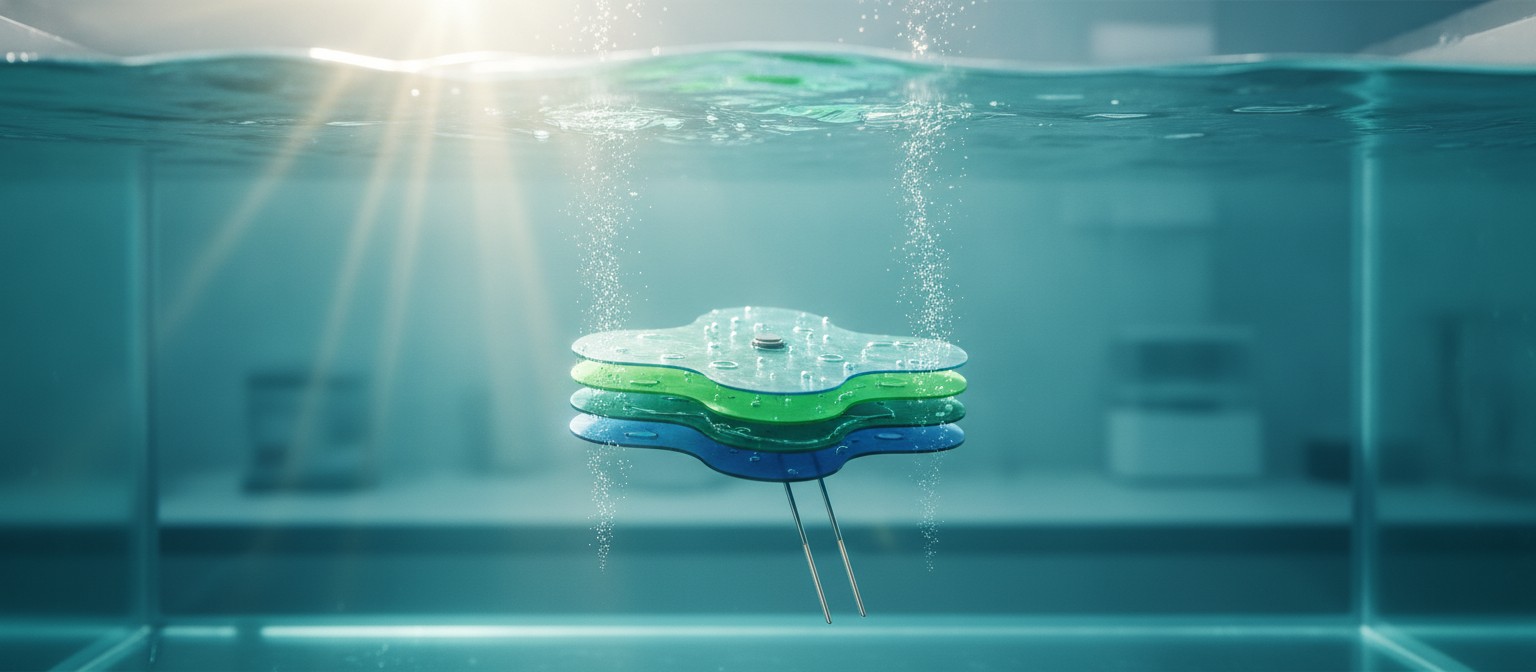
The other side is an anode made from a noble metal-free spinel oxide with the formula Fe0.3Co0.9Cr1.8O4, supported on nickel foam. That formula means iron, cobalt, and chromium arranged in a spinel crystal structure. The catalyst contains no platinum or iridium, which matters for material cost, although the cathode still uses a thin platinum coating.
The small hydrogen test device used a photocathode area of 0.56 square centimeters, roughly the size of a fingernail. The larger hydrazine cleanup device used a photocathode area of 6.25 square centimeters, about the size of a postage stamp or a 2.5 centimeter square. The team also tested the system outdoors under natural sunlight in Singapore and observed hydrogen and nitrogen bubbles forming, which shows operation outside solar simulator lighting, although that outdoor test was a proof of function rather than a long-term trial.
How it swaps oxygen for hydrazine to save energy
Conventional water electrolysis splits water into hydrogen at the cathode and oxygen at the anode. The oxygen side needs a relatively large voltage, and much of the energy goes into a product that is simply released. Seawater makes this harder because chloride can trigger unwanted chlorine chemistry that corrodes parts and lowers efficiency.
The NTU design replaces the oxygen reaction with hydrazine oxidation. Hydrazine can be broken down at a far lower electrical potential than water can be oxidized to oxygen. The paper reports an anode onset near minus 70 millivolts versus the reversible hydrogen electrode and only 5 and 75 millivolts to reach 100 and 600 milliamps per square centimeter in 1.0 M potassium hydroxide with 0.5 M hydrazine. For comparison, reaching the same currents through oxygen evolution needed about 1.47 to 1.49 volts under the same conditions. That voltage gap is why the perovskite can drive the whole cell on sunlight alone.
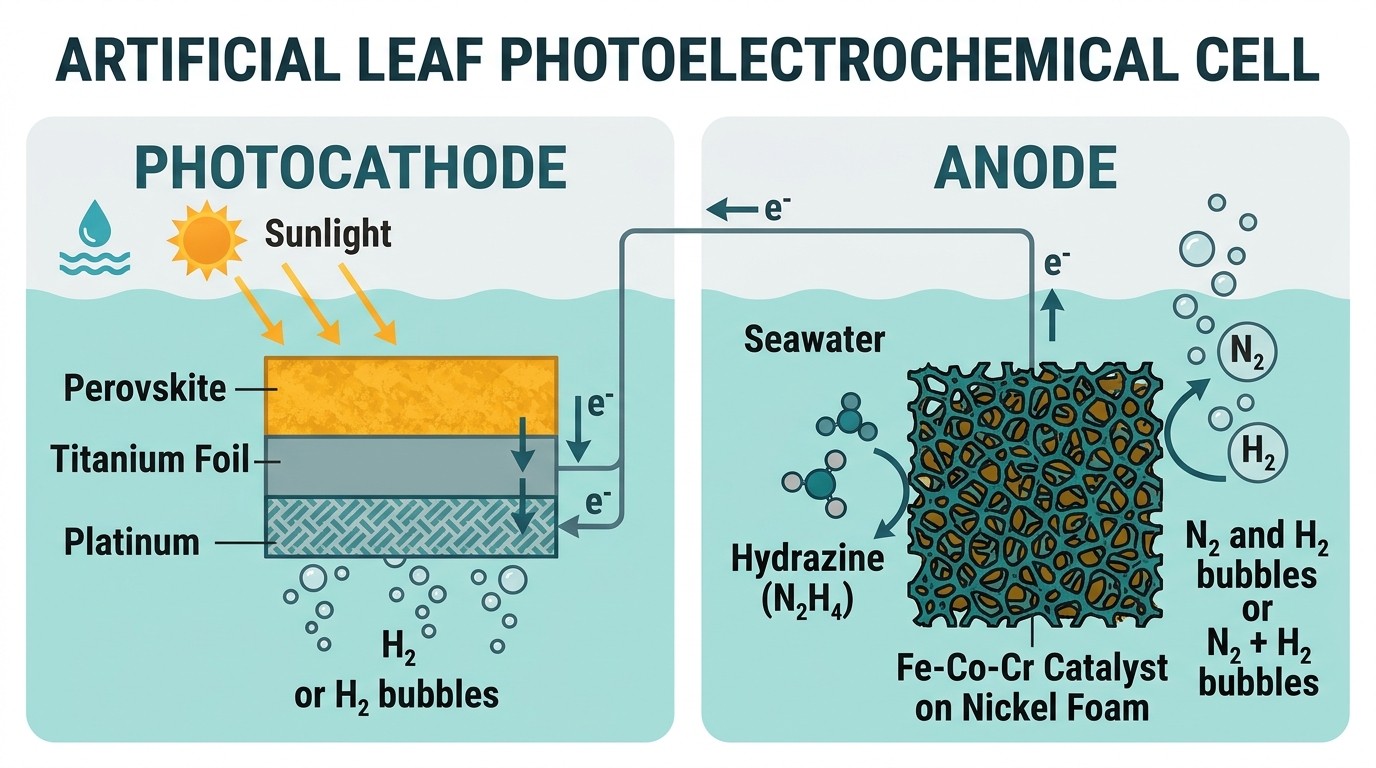
The chemistry has two useful paths at the anode:
- Electrochemical oxidation converts hydrazine mainly into nitrogen gas, water, and electrons.
- A second chemically driven path, strengthened under applied potential through a process called electrochemical promotion of catalysis, breaks some hydrazine directly into nitrogen and extra hydrogen.
The researchers measured nitrogen as the main anode gas, with additional hydrogen at roughly 30 micromoles per hour in the small cell tests. Gas analysis put the hydrogen-to-nitrogen ratio near 15 percent, so the normal electron-driven route dominates while the second route adds a bonus.
This swap also helps with seawater. Because hydrazine oxidation happens far below the potential where chloride oxidation begins near 1.72 volts, the harmful chlorine side reactions are largely avoided while hydrazine is present. The iron-cobalt-chromium catalyst was also chosen for corrosion resistance and stable operation in a salty alkaline solution.
Crucially, the cell produced essentially no current when hydrazine was absent. The perovskite and oxygen evolution curves did not overlap, so the bias-free current fell to zero. That is the central condition of this design. It is a system for hydrazine contaminated alkaline seawater and wastewater, not a general method for turning any ocean water into fuel.
What the test numbers mean in plain terms
The headline figures were measured under 1 sun illumination, meaning artificial light set to about 100 milliwatts per square centimeter, roughly the intensity of clear midday sun at the surface. Tests used alkaline solutions with simulated or real seawater plus added hydrazine.
| Measure | Reported result | What it means |
|---|---|---|
| Photocurrent density | About 25 mA per cm2 at zero bias | Electron flow per sunlit area. Among the highest reported for lead-based perovskite photocathodes. |
| Hydrogen rate at cathode | About 466 micromol per cm2 per hour, near 100 percent Faradaic efficiency | About 10.4 milliliters of hydrogen gas per square centimeter per hour at standard conditions, or about 5.8 milliliters per hour from the 0.56 cm2 test piece. |
| Stable operating time | More than 72 hours | Three days of steady lab operation. Strong for a perovskite in contact with alkaline seawater chemistry, but still far from the months or years needed in industry. |
| Hydrazine cleanup | 0.5 M to 0.5 ppb in about 30 hours | A cut of roughly 32 million-fold, from about 1.6 percent by weight to a trace below the cited 10 ppb drinking water limit. |
| Test sizes | 0.56 cm2 for hydrogen rate, 6.25 cm2 for cleanup | Fingernail scale and postage stamp scale. |
To put the hydrogen volume in context, the larger 6.25 square centimeter piece would make about 65 milliliters of hydrogen per hour at the reported rate. That is a useful lab signal, not a household supply. Scaling would require much larger areas, gas collection, safe handling, and stable operation in variable real wastewater.
The stability figure also needs its stated context. The slight fall in current during the 72-hour run was linked by the authors to gradual hydrazine consumption and bubble buildup on surfaces. In other words, fuel and pollutant supply, plus gas management, affect the curve even before materials age.
Why the hydrazine cleanup figure matters
Hydrazine is used in boiler water treatment, chemical manufacturing, agricultural chemicals, pharmaceutical intermediates, and propellants. It is highly reactive, catches fire easily, and is listed by the U.S. Environmental Protection Agency as a Group B2 probable human carcinogen. The EPA hazard summary for hydrazine notes risks to the liver, kidneys, lungs, and nervous system after substantial exposure.
The starting test solution was intentionally strong at 0.5 molar, about 16 grams per liter. The ending point was 0.5 parts per billion, which is 0.5 micrograms per liter. The researchers cite 10 parts per billion as the permissible limit for drinking water, so the final water measured 20 times below that benchmark. That does not mean the treated seawater became drinking water. It means the specific pollutant fell below a strict health-based reference after about 30 hours in a small batch reactor.
Public health summaries also note that hydrazines can dissolve in water and break down over weeks into less toxic compounds, while breathing or ingestion can cause nausea, tremor, nerve effects, and organ injury depending on dose and duration. The federal toxicology FAQ for hydrazines gives a plain language overview of those exposure routes. The value of the NTU result is speed and pairing: the pollutant is removed in hours while its chemical energy helps make hydrogen, rather than using extra oxidants or a separate treatment stage.
What it does not yet prove
This is a laboratory proof of concept, and the paper states the remaining gaps directly. The strongest results depend on hydrazine being present at useful concentration. As hydrazine is consumed, current can fall. Real industrial wastewater varies in pH, salt mix, competing chemicals, and pollutant load, so performance in one controlled alkaline seawater mix does not guarantee the same result elsewhere.
Lead containment is the second open issue. Lead halide perovskites absorb light well, but lead is toxic, and perovskites degrade in moisture. The epoxy and titanium encapsulation kept the cell running for days and isolates lead from direct contact, yet years of outdoor exposure, thermal cycling, mechanical damage, and end-of-life recycling remain untested. Long-term leakage prevention is still a challenge for this class of materials.
Scale and system design are the third gap. The areas tested were fractions of a palm. Industrial use would need larger modules, durable seals, hydrogen collection without major leaks, control of nitrogen and hydrogen mixing, and integration with existing treatment plants. The team also notes the need to handle complex sewage and seawater compositions and to improve gas collection and overall durability.
Finally, the work does not show that ordinary seawater without a suitable low-potential fuel can be split bias-free by this exact pairing. When the researchers removed hydrazine, the bias-free photocurrent disappeared. Readers should therefore treat this as contaminated water to hydrogen plus cleanup, not as unlimited hydrogen from the sea.
What comes next
The researchers say they are now developing catalysts for pollutants beyond hydrazine and for converting waste materials into fuels and industrial chemicals. That direction makes sense because the core idea is general: replace difficult oxygen evolution with an easier oxidation that also removes something unwanted.
Useful next tests would be:
- Larger modules beyond postage stamp size, with durable seals.
- Longer runs with pollutant refills to separate aging from fuel depletion.
- Real effluent rather than spiked seawater, across varied pH and salt mixes.
- Full gas accounting for hydrogen, nitrogen, and any trace byproducts.
- Lead leakage monitoring during outdoor operation over weeks.
- Integration trials with existing treatment plants and safe gas collection.
For context on how perovskite light absorbers have been protected in other designs, Intelligent Living has covered an earlier perovskite-based artificial leaf module and floating artificial leaves designed to make fuel on water. The NTU advance is distinct because the anode chemistry both avoids chlorine formation and contributes extra hydrogen while cleaning hydrazine.
The detailed methods, catalyst characterization, and device data are available in the NTU Research Hub summary, which also links the full paper.
Frequently Asked Questions
How does the artificial leaf work?
Sunlight hits a protected perovskite solar cell, which creates electric current. That current drives hydrogen formation at the cathode and hydrazine breakdown at the iron-cobalt-chromium anode. The two reactions are wired together, so no plug-in power is needed while light and hydrazine are available.
What fuels and products does it make?
The main cathode product is hydrogen. The anode mainly releases nitrogen, with a smaller amount of extra hydrogen from a secondary chemical path. No oxygen fuel is produced because oxygen evolution is deliberately replaced.
Can it make hydrogen from plain seawater?
No, not in this configuration. Tests without hydrazine produced essentially no bias-free current, so the pollutant is required as a low-energy chemical partner.
Is 0.5 parts per billion hydrazine safe?
It is 20 times below the 10 parts per billion drinking water reference cited in the study. That is a strong cleanup signal for that one chemical, not a claim that all seawater contaminants were removed or that the water is ready to drink.
How much hydrogen does it actually produce?
About 10.4 milliliters per square centimeter per hour under 1 sun in the lab. Total output scales only with larger area and continuous pollutant supply.
Will the lead in the perovskite leak?
Short lab tests reported no leakage through the epoxy and titanium sealing. Long-term outdoor containment, damage tolerance, and recycling still need demonstration.
Bottom line
The NTU artificial leaf is best read as a clever pairing rather than a universal seawater solution. When hydrazine polluted alkaline seawater is available, sunlight can drive useful hydrogen output while cutting that pollutant from percent levels to below the cited drinking water limit. The perovskite delivers unusually strong current for its class, and the chromium-containing catalyst keeps chlorine chemistry out of the way while hydrazine lasts. The proof is small, short, and conditional: a postage stamp area, three days of stability, and chemistry that stops without its pollutant partner. If the same approach can be extended to other wastes and proven over months with safe encapsulation, the pairing of cleanup plus fuel could become genuinely practical.

