
The FDA keeps a running tally of medical devices that use artificial intelligence, and it has grown faster than most people realize. By the end of March 2026, the count stood at 1,524 authorizations, according to a tally of the agency’s list by Radiology Business, and roughly three out of every four of them were radiology tools. That number gets quoted a lot, usually as proof that AI has already arrived in medicine.
It’s a real number, but it doesn’t tell you much on its own. An FDA clearance means a product can be sold. It doesn’t mean a hospital uses it, and it doesn’t mean anyone has shown it helps patients. So this piece asks a narrower question: where does the evidence say these tools genuinely earn their place, and where is the record still thin?
What the FDA’s AI List Actually Counts
Start with what you are looking at. The FDA publishes the agency’s public list of AI-enabled medical devices, updated every few months. Each entry is a product the agency has authorized, along with the date, the company, and the medical specialty panel that reviewed it. The FDA itself says the list isn’t exhaustive, and it mixes stand-alone software with scanners and monitors that happen to have AI built in.
- 510(k) clearance. The company shows its device is “substantially equivalent” to something already on the market. It is the fastest and most common path, and it often relies on performance testing rather than new clinical trials.
- De Novo classification. Used when a device is new enough that there is nothing to compare it to, but the risk is low to moderate. It sets up a fresh category that later products can follow through 510(k).
- Premarket approval (PMA). The strictest route, reserved for high-risk devices, and usually requiring clinical evidence. Very few AI products have gone this way.
So when a headline says “FDA-approved AI,” it usually means “FDA-cleared,” which is a lower bar. That’s not a scandal. The 510(k) system was built for incremental devices, and plenty of AI tools are incremental. But it does mean the clearance itself is a starting point for your questions, not the answer.
Radiology: Where Most of the Tools Live
Radiology dominates the list for a simple reason. The data is already digital, standardized, and labeled by specialists every day. A chest CT or a mammogram is a clean input, and “find the suspicious spot” is a well-defined task. Software can be trained and tested on millions of archived images long before it touches a live patient.
The strongest real-world evidence for any AI tool in medicine comes from breast screening. Sweden’s MASAI trial randomized more than 100,000 women to either standard double reading by two radiologists or an AI-supported workflow, where software triaged each mammogram and flagged the high-risk ones for closer review. The interim safety results, published in The Lancet Oncology in 2023, showed the AI arm cut radiologists’ screen-reading workload by 44% without raising false positives. A 2025 update in The Lancet Digital Health reported 29% more cancers detected in the AI group, and the final results, published in The Lancet in early 2026, found 12% fewer interval cancers (the ones that surface between scheduled screenings, often the more dangerous kind).
That’s the gold standard: a large, prospective, randomized trial measuring things patients care about. It’s also rare. Most radiology AI products have nothing close to it, and plenty of them do narrower jobs, such as measuring nodules, flagging fractures, or speeding up MRI reconstruction. Imaging also isn’t the whole story. If you want the wider picture of what’s being tried outside the scanner room, a broader rundown such as Benefits of AI in Healthcare – Glorium Technologies walks through use cases from administrative paperwork to remote patient monitoring.
Here’s the honest takeaway for radiology. The tools that work best don’t replace the radiologist. They sort the pile, so a human spends more attention on the scans that need it.
Stroke Triage: When Minutes Are the Whole Point
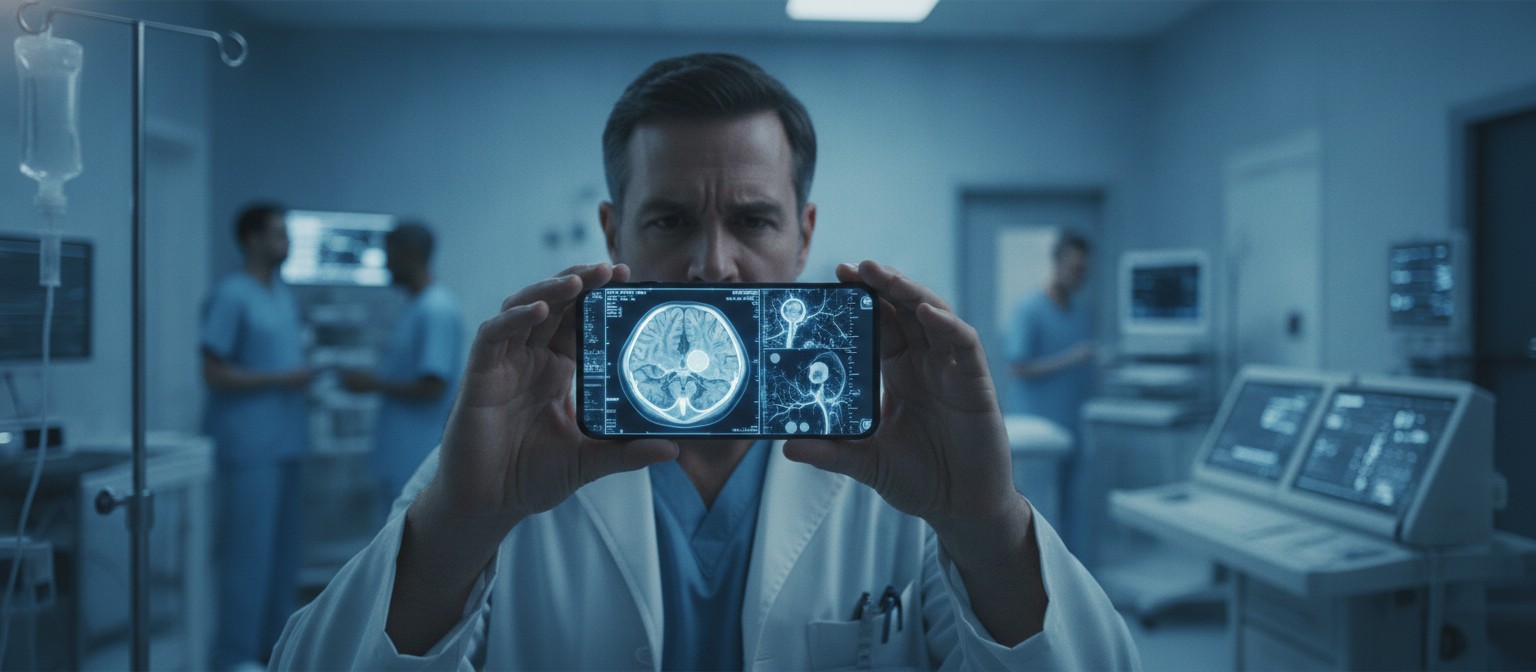
Stroke care is the clearest example of AI changing hospital logistics rather than diagnosis. In a large-vessel occlusion, a clot blocks one of the brain’s major arteries, and the treatment (a procedure that physically pulls the clot out) works best the faster it happens. The bottleneck often isn’t the scan. It’s getting the right specialist to look at it.
Viz.ai’s software, cleared by the FDA through the De Novo route in 2018, reads CT angiography images as soon as they’re taken and sends an alert, with the images, straight to the stroke team’s phones. The idea is to skip the queue: no waiting for a radiologist’s report before the neurointerventionalist hears about the case.
In 2020, Medicare’s payment agency granted the product a new-technology add-on payment, which lets hospitals get paid extra when they use it for stroke patients who are admitted. Viz.ai described it as the first such payment for AI software. For context, that program asks companies to show real clinical improvement over existing care, and the company’s case rested on shorter time to treatment. Payment decisions like this matter more than clearances, frankly, because hospitals adopt what they can afford to run. That adoption pattern fits the wider story of how AI is being used to enhance medical care, where workflow and staffing gains often matter as much as raw accuracy.
The Eye Exam That Doesn’t Need an Eye Doctor
Diabetic retinopathy is a slow, silent eye disease that can cause blindness, and people with diabetes are supposed to get screened every year. Many don’t, because it means a separate appointment with an eye specialist. In 2018, the FDA granted De Novo authorization to IDx-DR (now sold as LumineticsCore), the first AI system cleared to make a screening call without a doctor reviewing the image.
Here’s how it works in practice. A staff member in a primary care office takes photos of the back of the eye. The software decides whether the patient has more-than-mild retinopathy and should see a specialist, or can come back in a year. The pivotal trial enrolled 900 people with diabetes at 10 primary care sites and reported a sensitivity of about 87% and specificity of about 90%, results later published in npj Digital Medicine.
What makes this case useful is that the study was prospective and run where the device would be used, by the staff who would use it, after just a few hours of training. That’s a far better test than accuracy on a tidy research dataset. It also shows the real promise of AI in medicine: not replacing specialists, but reaching patients who weren’t going to see one anyway.
Cardiology and the Long Tail of the List
After radiology, the list thins out quickly. Cardiology has a growing set of entries, including software that reads electrocardiograms (ECGs) for rhythm problems and tools that guide or measure heart ultrasounds. Some of these are promising, especially algorithms that spot signs of heart weakness in an ordinary ECG. But for most of them, the public evidence is accuracy testing on past records, not trials showing patients did better.
Below cardiology, you’ll find neurology, gastroenterology (software that highlights polyps during colonoscopy), pathology, and a scattering of others. The table below sums up where the evidence stands for the examples in this article.
| Specialty | What the AI does | Example | Evidence strength |
| Breast imaging | Triages mammograms, flags high-risk scans | MASAI trial workflow (Sweden) | Strong: large randomized trial with patient outcomes |
| Stroke care | Detects large-vessel occlusion on CT, alerts team | Viz.ai LVO | Moderate: time-to-treatment data, Medicare add-on payment |
| Eye screening | Autonomous diabetic retinopathy screening | IDx-DR / LumineticsCore | Moderate to strong: prospective trial in primary care |
| Cardiology | Reads ECGs and heart ultrasound images | Various ECG and echo tools | Mixed: mostly retrospective accuracy studies |
| Sepsis prediction (not FDA-cleared) | Predicts sepsis from health-record data | Epic Sepsis Model | Weak: poor external validation |
The Evidence Gap Behind the Clearances
This is the part that rarely makes the press release. A study in JAMA Network Open in 2025 by Siontis and colleagues looked at 903 AI-enabled devices cleared through August 2024. Of those, 877 came through the 510(k) route. Only about 56% reported any clinical performance study, and in nearly a quarter of submissions, the companies said no clinical study had been done at all. Most of the studies that did exist looked backward at old data rather than following patients forward.
None of that means the tools are unsafe. It means the public often can’t tell how well a given product performs on patients like the ones at their own hospital, which can differ in age, ethnicity, scanner brand, or disease mix from the data the company tested on.
And some of the AI running in hospitals never went through the FDA at all. The best-known warning is the Epic Sepsis Model, a prediction tool built into one of the most widely used electronic health record systems. When University of Michigan researchers tested it on about 38,000 hospitalizations, they found the model’s discrimination was an AUC of just 0.63, far below what the developer had reported. It flagged only about a third of the patients who developed sepsis, while generating alerts for many who didn’t. Epic disputed the study’s definition of sepsis, but the episode shaped how hospitals think about vetting algorithms.
A few patterns separate the tools with solid track records from the rest:
- They do one narrow job with a clear, checkable answer.
- They were tested prospectively, in the setting where they would be used.
- They keep a clinician in the loop, or they cover a gap where no clinician was available.
- Someone outside the company checked them.
Frequently Asked Questions
Does “FDA-cleared” mean an AI tool is proven to work?
Not quite. Clearance through the 510(k) route means the FDA agreed the device is substantially equivalent to an existing one and is safe enough to sell. It doesn’t require proof that patients have better outcomes. Look for published trials if you want that.
Is AI reading my scans right now?
Possibly, especially for mammograms, chest CTs, and stroke imaging. In the US, a radiologist still signs off on the report. The AI usually works in the background, flagging or prioritizing images.
Why isn’t every hospital using these tools?
Cost is a big part of it. Most AI products don’t come with their own insurance payment, so hospitals pay out of their own budgets. Integration with existing systems and staff time to check the results add to the bill.
Can I ask whether AI was used in my care?
Yes, and it’s a reasonable question. Hospitals don’t always disclose it by default, but your care team should be able to tell you which tools were involved.
What to Watch
The FDA list will keep growing, so the count alone isn’t news anymore. Watch for three things instead. First, more randomized trials like MASAI, because they’re what separate useful tools from marketable ones. Second, payment decisions from Medicare and insurers, which drive real hospital adoption more than clearances do. Third, local testing: the hospitals doing it best check an algorithm on their own patients before trusting it. Next time you see a big number of AI approvals, ask which of those tools has been tested on people like you.


