
Picture a belt that never stops moving. On one side it breathes in ordinary outdoor air. On the other side it exhales a concentrated puff of carbon dioxide, ready to be collected. Each spot on the belt completes that loop in less than a second.
That is the mental image behind a concept from Empa, the Swiss federal materials lab. Its Mining the Atmosphere team is asking a simple engineering question. What if direct air capture was built for speed rather than for holding a lot of CO2 at once? This article explains the energy problem, the proposed answer, what computer models show so far, and what remains untested.
Why pulling CO2 from air uses so much energy
Direct air capture, usually shortened to DAC, is different from capturing CO2 at a smokestack. A smokestack has a concentrated stream. Ambient air does not. The Swiss announcement puts the current concentration at about 430 parts per million, which means only around 430 CO2 molecules in every million molecules of air.
To collect a useful amount, machines must move huge volumes of air with fans. The air passes through porous filter materials that trap CO2 in a step called adsorption. Then the material is heated, often under vacuum or with steam, so the CO2 lets go and can be gathered. That release step is called desorption.
Heating is where much of the energy goes. Conventional systems heat a bulky structure plus the captured CO2 plus the water that often comes along with it. According to the IEA analysis of carbon removal innovation, currently available DAC approaches need roughly 5.5 to 9.5 gigajoules of energy per tonne of CO2, mostly as heat. That wide range is modelled and reported, not a figure Empa has beaten.
What Empa is proposing instead
On Oct. 22, 2026, the Swiss federal government published Empa’s announcement of a different design direction. The work sits inside Empa’s Mining the Atmosphere initiative, which studies how captured carbon could later become reusable materials and chemicals.
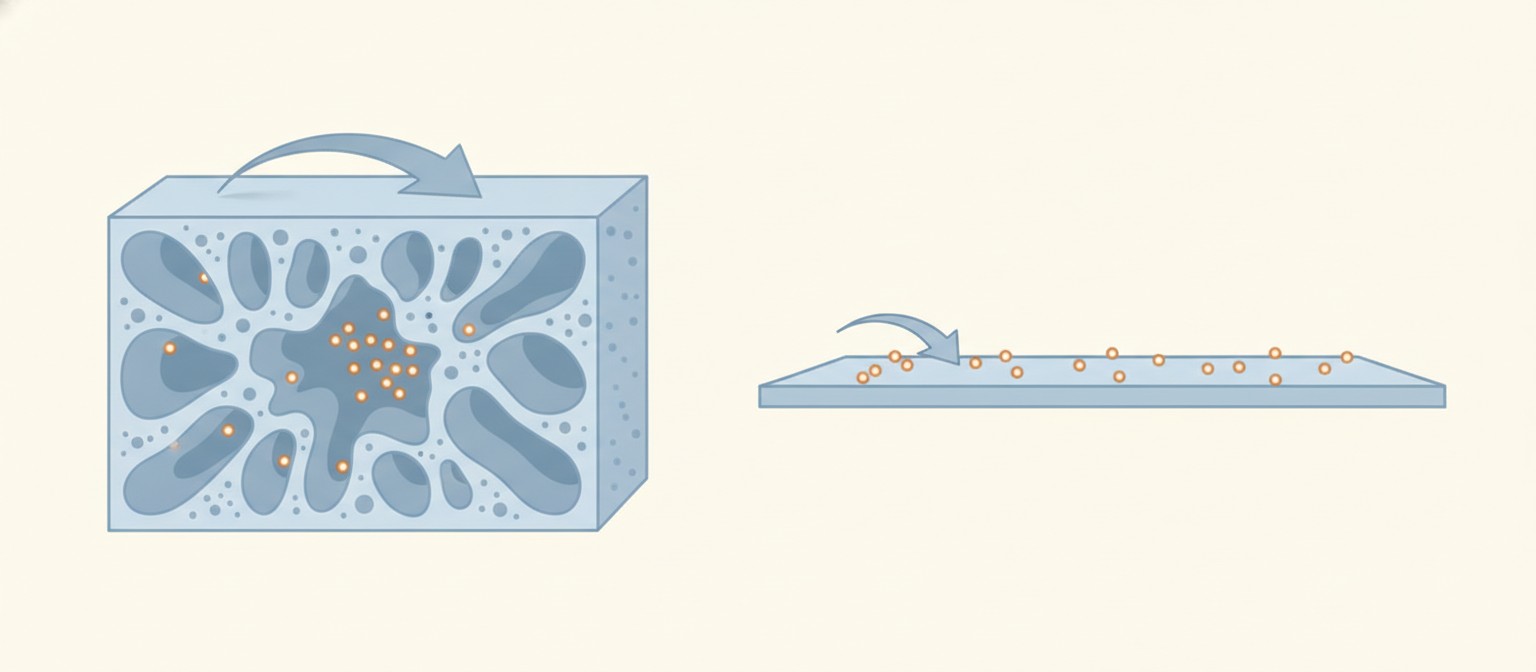
Instead of bulky porous filters that soak up CO2 deep inside, Empa proposes ultra-thin amine-containing coatings that hold CO2 at or near the surface. Amines are a family of nitrogen-containing chemicals already widely used to bind CO2. Here the point is geometry. The layer is extremely thin, so there is far less material to heat when it is time to release the gas.
Researcher Sandra Galmarini states the tradeoff plainly: “We capture significantly less CO2 per cycle and compensate for this with faster cycles.” Instead of several minutes per cycle, the team is aiming for less than one second.
How the conveyor belt cycle would work
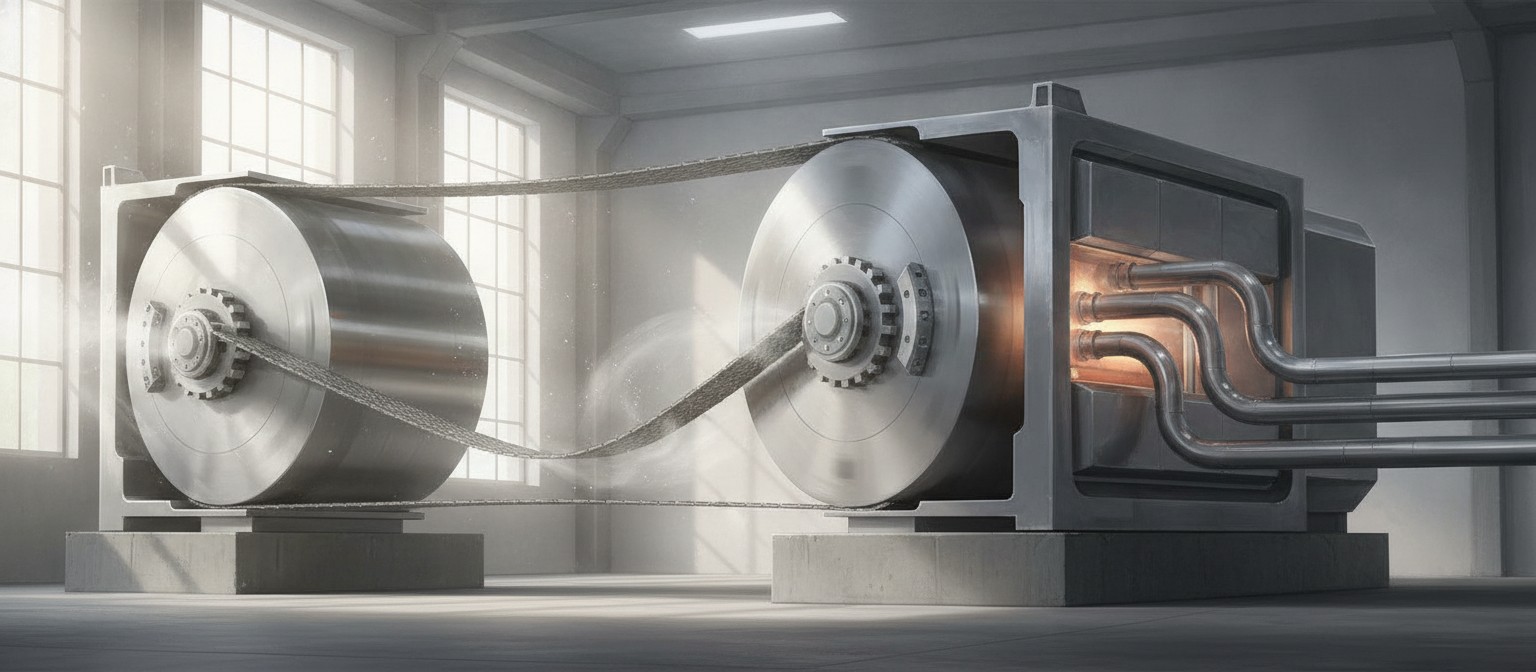
Empa describes the idea as a loop, a little like a conveyor belt carried over rotating cylinders. A coated surface keeps moving through two separate zones that are tuned for different jobs.
In the capture zone, outdoor air flows across the coating, and CO2 sticks to the surface. In the release zone, the same spot on the surface enters a much smaller, sealed volume. There it is warmed under reduced pressure, the CO2 comes off, and the clean coating travels back toward the air side for another pass.
Keeping the zones separate matters. Capture wants open space and plenty of airflow. Release wants the smallest gas volume possible, because a smaller volume needs less pumping work to hold a vacuum and less heat to warm up. The moving surface links the two without mixing them.
Why a thin film changes the heating maths
Thermal mass is the key idea here. It is a measure of how much heat you must put in to raise the temperature of an object. A thick ceramic brick has high thermal mass. A sheet of foil has low thermal mass. It warms and cools quickly because there is simply less stuff to warm.
Conventional DAC often heats a large porous block. Empa would heat only a thin skin. Researcher Dirk Hegemann, who works on functionalising surfaces with plasma coating, puts it this way: “If you reduce the adsorption material to a surface or a very small volume, less CO2 is bound per cycle, but the process can be significantly accelerated thanks to the low thermal mass.”
That speed is the whole bet. Less CO2 per pass is acceptable if each pass is hundreds of times faster and each heating pulse touches far less material. The team also suggests two possible bonuses, both still unproven. The motion of the surface itself might help move air and trim fan energy. Thin coatings might also use less material and be easier to replace than specialised adsorbents. Other labs are attacking the same heating problem differently, including with a battery that removes carbon dioxide straight from the air using voltage swings instead of heat.
What the simulations show so far
This is where careful labels matter. What Empa has so far is simulation only. Teams led by Sandra Galmarini, Dirk Hegemann, Dorina Opris and Manfred Heuberger studied candidate ultra-thin coatings and ran initial flow and process simulations.
According to the Swiss release, those early results showed that rapid CO2 capture could, in principle, be possible and competitive. That is a modelled possibility, not a measured result. No sub-second capture cycle has been demonstrated in hardware yet.
| Feature | Conventional DAC cycle | Empa sub-second concept | Status of Empa claim |
|---|---|---|---|
| Cycle time | Several minutes | Less than one second targeted | Target, simulation only |
| CO2 per cycle | Relatively large amount per cycle | Deliberately small amount per pass | Design intent |
| Material heated each cycle | Bulky porous adsorbent bed | Ultra-thin surface coating only | Design intent |
| Energy per tonne of CO2 | About 5.5 to 9.5 GJ per tonne in literature | Unknown, expected to be lower per molecule | Unknown, not measured |
| Throughput per volume over time | Measured at pilot and commercial plants | Unknown | Unknown, needs test rig |
| Coating stability over many fast cycles | Known failure modes from operating experience | Unknown at high speed | Unknown, needs testing |
What still has to be tested
Empa is unusually clear about the gaps. The lab says it currently lacks the experimental tools to measure binding and release in fractions of a second. So the next step is a new measurement platform that can watch CO2 attach to ultra-thin layers and leave them at that speed.
Galmarini frames the test this way: “Using this data, we want to show whether we can achieve enough CO2 per unit volume and time to keep pace with current technologies.” In other words, speed alone is not enough. The system must move enough CO2 per hour from a sensibly sized box.
Three unknowns will decide whether the idea survives contact with reality:
- Throughput per volume and time. Fast cycles help only if the total CO2 collected per hour competes with existing machines. This is unknown.
- Full energy per tonne. Heating less mass helps, but fans, vacuum pumps, cooling between cycles, and moving parts all draw power. The net energy per tonne is unknown.
- Durability at speed. Thin films must survive constant heating, cooling, air exposure, moisture, and fast motion past seals between pressure zones. Coating life and seal performance at high rotational speeds are unknown.
What a realistic path forward looks like
The sensible sequence is measurement first, then a small test loop, then honest comparison. First the team needs kinetic data, meaning how fast CO2 actually binds and releases on these plasma-made coatings under realistic air conditions. Then comes a bench scale loop that proves the two zones can stay separated while a surface rushes between them.
In practice that means four checks, in order:
- Measure binding speed on real coatings in realistic air, with moisture included.
- Prove the two pressure zones stay separated while the surface moves at speed.
- Publish throughput per volume over time against existing machines.
- Test film life and seal wear through many fast heat and cool cycles.
If those steps work, the design offers an interesting structural choice. Hegemann suggests combining many smaller units rather than building ever larger and more complex single systems. Galmarini notes that current technologies make economic sense mainly at a large scale, while this approach might allow smaller and more flexible systems. Both points are possibilities to explore, not promises of near-term deployment.
It helps to place this in context. Other capture hardware, from Europe’s largest carbon capture and storage facility to experimental sorbents, is already operating or being tested at various scales. Empa’s concept is earlier in that journey. It is a proposal with supporting simulations, now waiting for its first decisive lab test.
Frequently Asked Questions
How does direct air capture work in simple terms?
Fans push outdoor air across a material that grabs CO2. Once the material is full, heat and often a vacuum force it to let go of the concentrated gas. The clean material then goes back to capture more. The cycle repeats.
How much energy does direct air capture use?
Published literature surveyed in recent assessments puts current technologies at roughly 5.5 to 9.5 gigajoules per tonne of CO2, equal to about 1,500 to 2,600 kilowatt hours. Most of that is heat for the release step. Empa has not published a comparable measured figure for its concept.
What is different about the Empa approach?
Conventional systems maximise how much CO2 each cycle holds. Empa would minimise the heated mass and maximise how often cycles happen. Ultra-thin amine coatings bind CO2 near the surface, so each heating pulse warms far less material, and a moving surface shuttles continuously between an open capture zone and a compact release zone.
Has sub-second CO2 capture been demonstrated?
No. The sub-second cycle is a design target supported by initial flow and process simulations. Empa says a new measurement platform is needed before binding and release at that speed can even be tracked, let alone proven over many cycles.
What would captured CO2 be used for?
Under the Mining the Atmosphere vision, captured carbon would feed into reusable materials and chemicals made from CO2 emissions rather than simply being buried. That full chain does not exist for this concept yet. Capture itself must first be shown to work at a useful rate and energy cost.
Conclusion
The appeal of Empa’s idea is easy to see once you picture the heating step. Warm a thin skin hundreds of times per hour, and you may spend less energy than baking a heavy block a few times per hour. That is a neat bit of physics, and early simulations suggest it is worth testing.
The honest status is just as clear. Throughput, net energy per tonne, and coating life at speed are all unknown. The next milestone is not a plant. It is a lab instrument fast enough to see whether the core cycle behaves as modelled. If it does, a small flexible form of air capture becomes more plausible. If it does not, the field will still have learned something useful about where speed stops paying off.

