
A cheaper, easier, and more efficient way to remove carbon dioxide from the air has been developed by a pair of MIT engineers. What’s unique about this new system, compared to the ones typically used today, is that it can work with the gas at virtually any concentration level – even down to the roughly 400 parts per million currently found in the atmosphere. This makes the range of potential applications quite wide.
The approach uses a battery that absorbs carbon dioxide while charging up and then releases pure carbon dioxide when discharged. The technique is based on passing air through a stack of charged electrochemical plates. It requires no chemicals and the parts that make up the battery can be commercially manufactured at low cost. The paper outlining the recent research was published in Energy & Environmental Science.

Inside the battery is a row of thin sheets coated with stacks of electrodes (using the compound polyanthraquinone). These electrodes have a natural affinity for carbon dioxide when charging and absorb the gas in any amount. When the electrodes are discharged, they have no affinity to carbon dioxide and so they release the carbon dioxide gas that was absorbed when charging.
The entire reaction can take place at room temperature and room pressure. Furthermore, the sheets of electrodes in the batteries could be developed to a commercial scale in rolls similar to industrial paper at a printing press, estimate the researchers.
Sahag Voskian, who developed the work during his Ph.D., said:
The process this system uses for capturing and releasing carbon dioxide is revolutionary. All of this is at ambient conditions — there’s no need for thermal, pressure, or chemical input. It’s just these very thin sheets, with both surfaces active, that can be stacked in a box and connected to a source of electricity.
Alan Hatton, also from the research team, added:
In my laboratories, we have been striving to develop new technologies to tackle a range of environmental issues that avoid the need for thermal energy sources, changes in system pressure, or addition of chemicals to complete the separation and release cycles. This carbon dioxide capture technology is a clear demonstration of the power of electrochemical approaches that require only small swings in voltage to drive the separations.
For the battery to work, a stream of air passes through it and over the electrodes as they are being charged up. This is when they absorb the carbon dioxide out of the air. Then when the battery is discharged, pure carbon dioxide gas gets blown through instead and the carbon that was absorbed by the sheet is released and joins the stream of gas passing through. By nature, the electrode material “has either a high affinity or no affinity whatsoever,” depending on the battery’s state of charging or discharging.
Voskian explained:
The greatest advantage of this technology over most other carbon capture or carbon absorbing technologies is the binary nature of the adsorbent’s affinity to carbon dioxide. This binary affinity allows capture of carbon dioxide from any concentration, including 400 parts per million, and allows its release into any carrier stream, including 100% CO2.
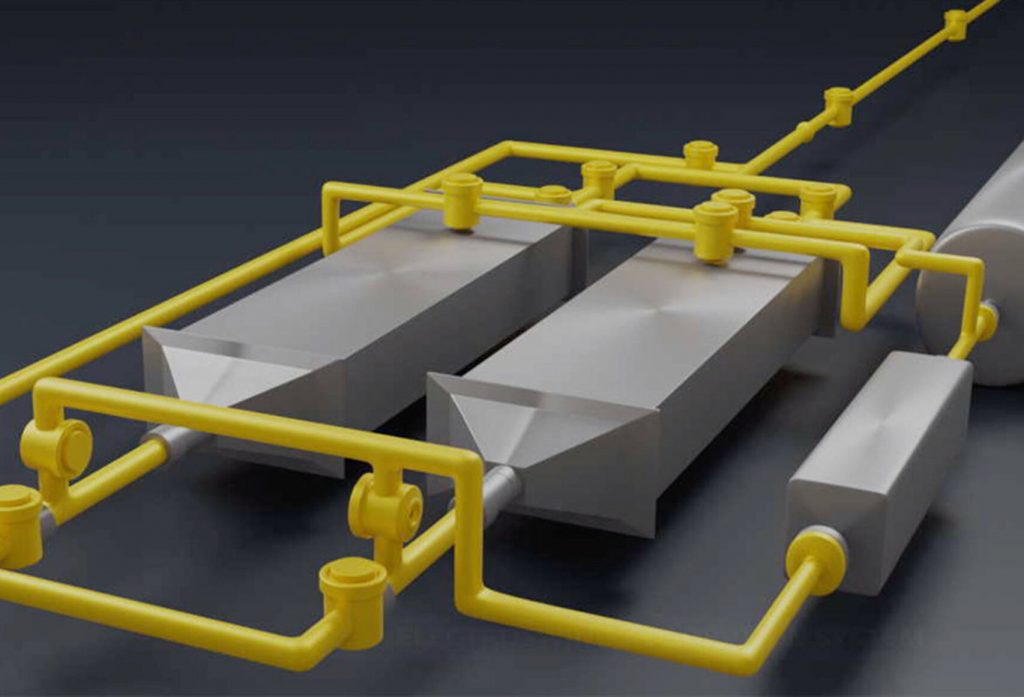
One of the many potential applications for this device is to carbonate beverages at a soft-drink bottling plant. Most plants currently rely on burning fossil fuels to get the carbon dioxide. This method could replace the need to burn fossil fuels by providing CO2 pulled straight out of the atmosphere instead! Plugging in a pair of these batteries allows for continuous carbon capture – with one battery charging while the other is discharging there’s a continuous loop.
Another potential application would be for greenhouses, which also burn fossil fuels to produce carbon dioxide to feed the plants inside. The system would be executed in the same manner as for the soft-drinks bottling plant.
Alternatively, the gas can just be compressed and injected underground – a strategy called carbon capture and storage. This involves removing the carbon dioxide from the atmosphere and pressurizing it before injecting it into depleted (old oil and gas fields for example) geologic formations where the porous rock has the ability to absorb significant volumes.
The team has proven in the lab that the system can withstand at least 7,000 charging-discharging cycles. However, they estimate that this number can readily improve up to 50,000 cycles. They have set up a company called Verdox to commercialize the process, and are working on the development of a pilot-scale plant to open within the next few years. This new way of simply removing carbon dioxide from a stream of air could provide a significant tool in the battle against climate change!


