
Land for AI data centers is getting harder to secure, power grids are congested, and neighbors are protesting. Korea’s three biggest shipbuilders think the workaround is to float the whole thing. Samsung Heavy Industries, Hanwha Ocean, and HD Hyundai are each developing floating data centers that put servers, onboard power, and seawater cooling on a hull built in a shipyard, with the first commercial units targeted for 2028.
None of these platforms is operating yet. What exists today is a stack of concept approvals, memorandums of understanding, and one funded subsea pilot off Ulsan. That distinction matters, because headlines can make an approval in principle sound like a ship in the water. This article separates what has actually been built from what has only been approved on paper, and explains why shipyards may still be the right companies for the job.
Why Land-Based AI Centers Ran Into Trouble
Candidates who promised tougher rules for new data center projects won several U.S. midterm races in November, and similar resistance has appeared on construction sites and in courts on three continents. Activists entered a Microsoft data center site in Amsterdam for a sit-in, protests over strained power and water spread in Indonesia and Malaysia, and residents in Mississippi and other U.S. states filed lawsuits over alleged noise and vibration from nearby facilities.
The health question is narrower than the politics. There is little direct evidence that living near a data center harms health, though few studies have examined the question. Opposition centers instead on practical burdens: data centers can drain local power and water, run cooling around the clock, and expose neighborhoods to persistent low-frequency noise and vibration. Those are exactly the pressures a platform anchored offshore is designed to move away from people.
That logic also explains the timing. Early floating concepts were small barges in the 0.2 to 7 megawatt range. Recent concepts start around 25 megawatts and now reach 100 megawatts, with classification-society approvals extending to 200 megawatts. At that scale, a floating unit stops being an edge experiment and starts looking like a real slice of AI capacity, which is why the same grid queues slowing land-based AI factories have pushed developers to look at the sea.
How a Floating Data Center Actually Works
A floating data center, or FDC, places three systems on one marine structure: server halls, power generation, and cooling. The hull can be a new barge, a semi-submersible platform, or a converted ship. Fiber and power cables connect it to shore, while seawater or outside air carries away server heat through heat exchangers. Because cold seawater is free and always nearby, designers expect lower cooling energy than a land hall that must run chillers and evaporate water.
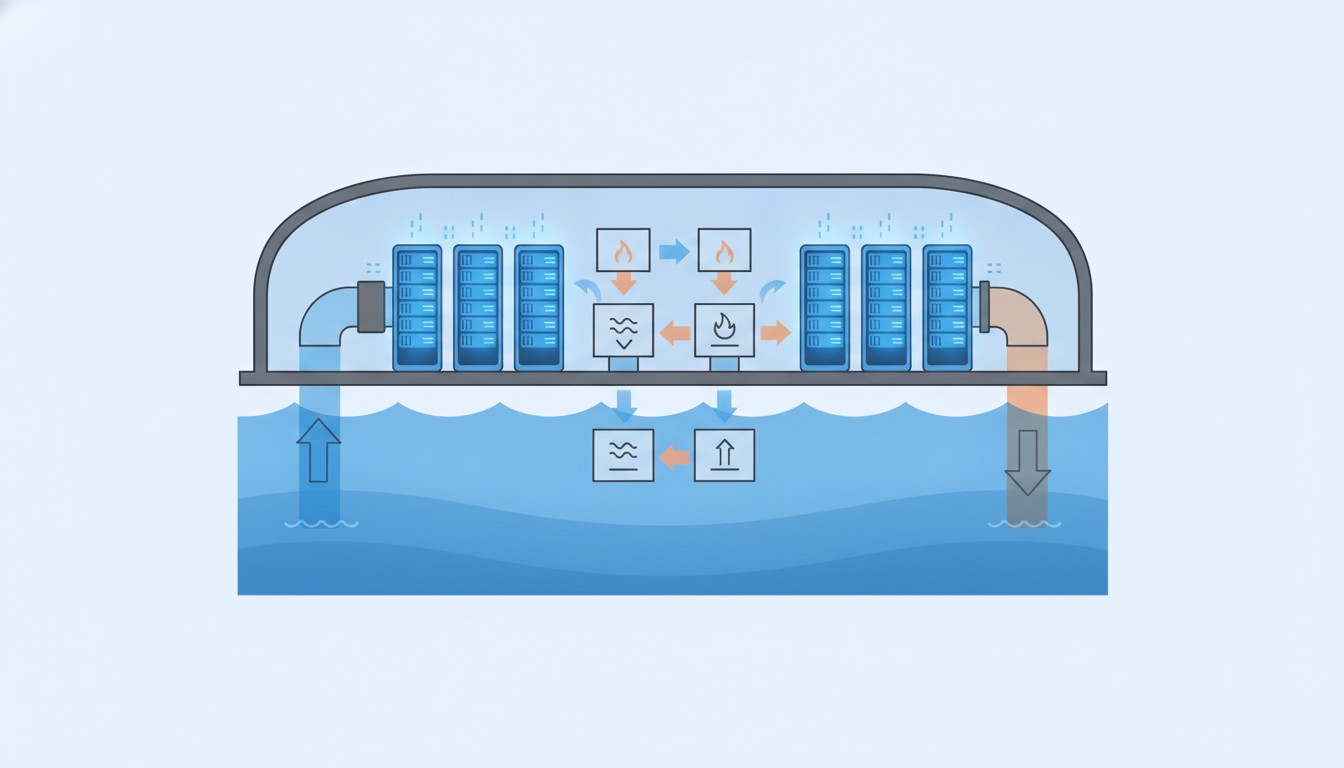
The power side is what makes the Korean approach different from a simple barge full of racks. Both Samsung Heavy and Hanwha Ocean describe platforms that generate much of their own electricity offshore, mainly with liquefied natural gas (LNG) engines, then manage fast swings in AI electrical load as computing demand spikes. HD Hyundai is developing a related product: a barge-mounted power plant that can feed a coastal industrial site or a separate data center. In every version, the shipyard builds the structure, integrates the engines and switchboards, and handles mooring, safety, and marine classification.
One useful precedent is Microsoft’s Project Natick research on subsea data centers, which sealed 855 servers in a steel capsule off Scotland’s Orkney Islands for 25 months. The underwater servers failed at roughly one-eighth the rate of a land control group, and the module recorded power usage effectiveness (PUE) of about 1.07 compared with about 1.125 for modern Microsoft land halls. Microsoft ended the program in 2024 with no commercial rollout, but Natick remains the clearest measured evidence that the ocean can cool servers reliably.
Three Shipyards, Three Different Bets
All three Korean yards are chasing the same market, but their hardware paths are not identical. Samsung Heavy is furthest along toward a U.S. deployment, Hanwha Ocean is pairing a modular hull with European power electronics, and HD Hyundai is starting from floating power generation rather than servers first.
| Builder | Concept and capacity | Validation so far | Power and partners | Target |
|---|---|---|---|---|
| Samsung Heavy Industries | 50 MW and 200 MW floating data center hulls, plus a 100 MW design patent | Approval in principle from the American Bureau of Shipping and Lloyd’s Register for 50 MW in April 2026, ABS approval for 200 MW in August 2026 | Engineering contract with U.S. developer Mousterian, power-system work with ABB, joint work with Samsung C and T | Commercial service in Q2 2028 |
| Hanwha Ocean | 60 MW modular floating data center shown at Gastech 2026 | ABS approval in principle in September 2026 | Non-binding memorandum with ABB through May 2027 on LNG-based power and control, Hanwha leads basic design | Raise technical maturity for future offshore business |
| HD Hyundai (HD Korea Shipbuilding and Offshore Engineering) | 100 MW barge-mounted power plant plus FDC infrastructure studies | ABS approval in principle for the 100 MW power barge, detailed design studies underway | Memorandum with Schneider Electric in July 2026, Himsen engines for onboard generation | Serve coastal loads and data centers from the sea |
Samsung Heavy’s lead is commercial, not just technical. After signing an early agreement with Mousterian in April at Data Center World in Washington, the yard signed an engineering contract in July covering basic design, detailed engineering, and production planning for moored units in Texas and other U.S. markets. Korean securities analysts describe a first phase of two 50 MW hulls for Mousterian’s Project Zeus, a planned 500 MW campus, with a larger 860 MW Project Sandpiper discussed as a follow-on. None of that is a final construction order yet: analysts expect a definitive engineering, procurement, and construction (EPC) contract decision in the fourth quarter, which would effectively confirm that permitting for the first site is resolved. The yard is also working with Lloyd’s Register and Greek shipowner Capital on project development and regulation, alongside joint work with Samsung C and T, and last year’s Samsung group letter of intent with OpenAI on AI infrastructure accelerated the program.
Hanwha Ocean’s story is more modular. The 60 MW model unveiled in Bangkok uses interchangeable blocks for generation, power distribution, server type, and capacity, so the same hull family can be tuned for different waters and customers. Under the November memorandum, Hanwha handles basic design and LNG power configuration while ABB reviews power-system design, reliability, and power quality, with a focus on handling the sharp load swings of AI workloads. The memorandum is non-binding and runs through May next year, which is normal for this stage but worth stating plainly.
HD Hyundai’s entry point is electricity itself. Its 100 MW barge-mounted power plant packs medium HiMSEN engines and generators onto a barge hull to deliver up to 100 MW where onshore grids are hard to build. That product can support industrial parks or power-hungry AI sites without putting the servers on the water at all, while the group’s July work with Schneider Electric covers the power, cooling, and energy-management layer a future floating data center would need. It is the least server-centric of the three strategies, and potentially the fastest to find buyers outside data centers.
The Other Korean Bet: A Data Center Under the Sea off Ulsan
Floating platforms are only half the Korean program. In April, Ulsan was selected for a national pilot to develop a carbon-zero underwater data center standard model, with about 51.1 billion won in combined funding through 2030. The team includes the Korea Institute of Ocean Science and Technology, UNIST, POSCO, GS Engineering and Construction, Korea Hydro and Nuclear Power, LS Electric, and SK Telecom, among 12 partners.
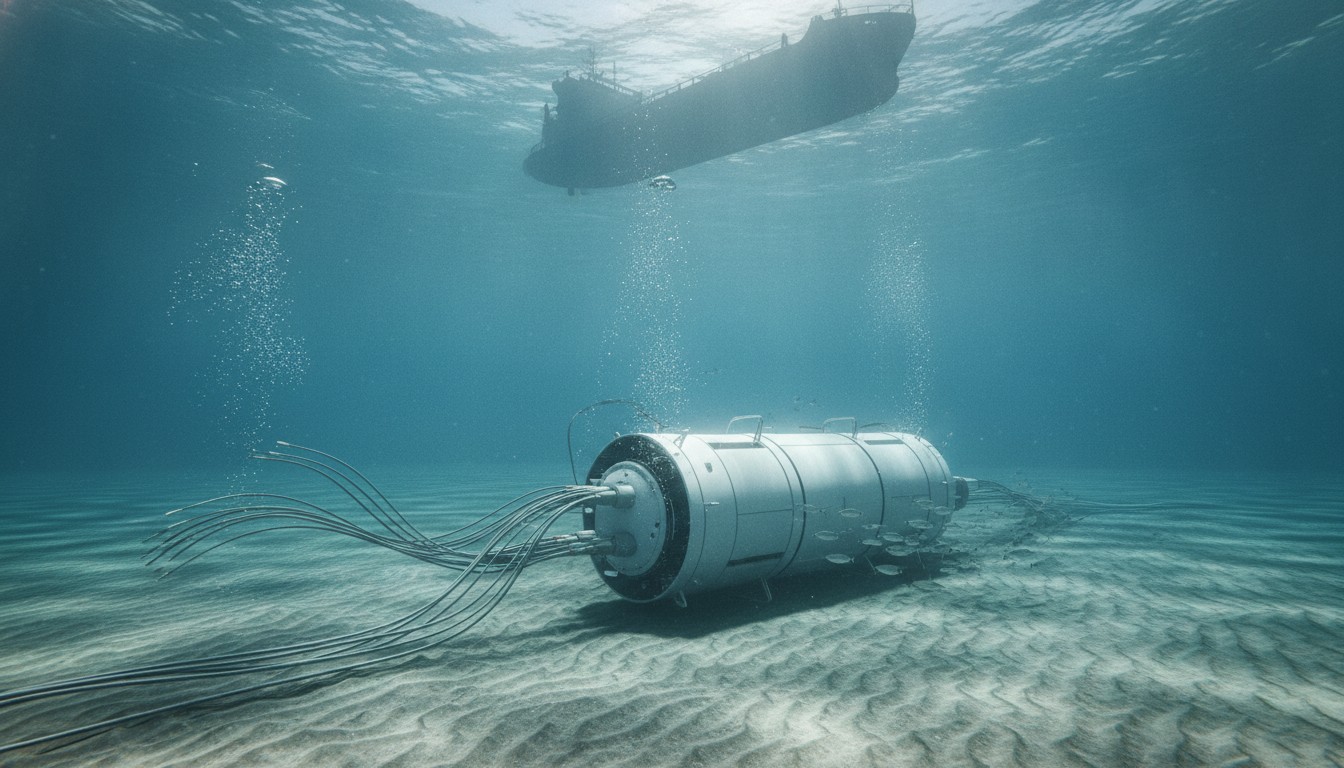
The plan is to place a capsule about 20 meters deep off Ulsan and verify operation at a PUE near 1.2. That target is less aggressive than Natick’s 1.07, which makes sense for a first domestic standard rather than a one-off experiment. Korean coverage of the project is explicit about the trade-offs: seawater cooling is efficient, but maintenance access, server swaps, and marine ecosystem effects remain unsolved. Unlike the shipyard FDCs, this is a funded government pilot with a fixed site and test depth, not a commercial product pitch. The commercial margin argument for shipyards is separate: FDCs need extra seawater cooling and safety systems, which lets yards command higher prices than on conventional vessels.
Ulsan is a logical place to try. The southeastern coast around Busan, Gyeongju, and Ulsan already hosts heavy industry, nuclear plants, and offshore engineering supply chains, and the country has pursued large offshore energy projects there for years, including the planned 8.2 GW offshore wind build once billed as the world’s largest. If subsea capsules ever scale, they will need the same cables, vessels, and maintenance crews that wind farms already use.
Who Else Is Racing to the Water
Korea is not alone. The field splits into two architectures: floating halls that stay dry above the waterline, and sealed capsules that sit on the seabed.
- Singapore and Keppel: Keppel has started work on a 25 MW floating facility due in 2028, the closest Asian parallel to the Korean hulls.
- Japan: Mitsui O.S.K. Lines and Hitachi are converting used merchant ships into data centers, aiming for commercial operation around 2027.
- United States: Offshore Data Center has described a gas power plant plus data center on a semi-submersible near an undeveloped offshore gas field, while startup Drogue plans to raise 20 million dollars for a single-digit megawatt prototype on a secondhand vessel by early 2028.
- China: A wind-linked subsea capsule has entered operation off Shanghai, adding to earlier Hainan activity, though technical details in English remain thin.
- Europe: The Netherlands and Norway appear repeatedly in search interest for floating sites, and Keppel-style barge concepts have circulated in Amsterdam, but no large floating hall is operating there yet.
The wilder end of the spectrum is worth naming so readers do not confuse it with the Korean program. An earlier American concept envisioned a floating AI cluster positioned as a sovereign nation in international waters, complete with more than 10,000 GPUs. The Korean yards are proposing the opposite: classed, grid-connected infrastructure built for utilities and hyperscalers, not legal autonomy.
What Is Still Unproven
The honest status line comes from the Korean press itself: no floating data center has reached commercial operation. Approvals in principle certify a concept design against classification rules, they do not mean steel has been cut. Memorandums with ABB and Schneider Electric fund design reviews and control-system studies, not production. Even Samsung Heavy’s Mousterian engineering contract is the design baseline for a later construction contract, not the construction itself.
Three practical gaps remain:
- Integration with power and telecom networks. A 50 or 200 MW platform needs subsea cables, landing stations, backup, and grid agreements. Those negotiations move slower than hull design.
- Operations at sea. Salt, storms, staffing, and server replacement cycles are well understood for ships and oil platforms, but not yet for AI halls that expect near-zero downtime.
- Standards and insurance. There are still no full international standards for floating data centers, which affects classification, financing, and liability.
None of this makes the idea hollow. Shipyards already build the hardest parts, from FLNG vessels to drillships and wind turbine installation vessels, and an analyst at Kiwoom Securities put the industrial logic bluntly: floating contracts could put unused dock capacity to work. The question is whether the first commercial deployments in Texas or coastal Korea can prove availability, PUE, and cost per megawatt against a land hall with its own gas turbines. Until then, treat every rendering as a proposal and every approval as a permission slip, not a product.
Frequently Asked Questions
Are there health risks to living near a data center?
Direct evidence of health harm is limited, and few studies have looked. Documented community complaints focus on noise, vibration, water use, and strain on local power, plus class-action lawsuits in places like Mississippi over alleged noise and vibration. Moving facilities offshore increases distance from homes, which may reduce noise complaints but does not answer the underlying research gap.
Is China putting data centers in the ocean?
Yes, in pilot form. Chinese operators have deployed subsea capsules linked to offshore wind off the coast near Shanghai, building on earlier trials off Hainan. These are sealed underwater modules, a different design from Korea’s floating barges. Public technical data in English is limited, so performance claims should be treated as preliminary.
Is the Netherlands building floating data centers?
The Netherlands is a site of interest rather than an operating hub. Search interest and early concepts cluster around Amsterdam, where land and power constraints plus data center protests make barges attractive. Keppel’s 25 MW floating project in Singapore and conversion projects in Japan are further along than any Dutch deployment reported to date.
Did Samsung build a floating data center?
Not yet. Samsung Heavy Industries has secured concept approvals for 50 MW and 200 MW designs, filed a 100 MW design patent, and signed design and engineering agreements with Mousterian targeting service in the second quarter of 2028. No Samsung floating data center is operating or under confirmed construction as of this writing. The same applies to Hanwha Ocean and HD Hyundai.
The Bottom Line: Steel in the Water, Proof Still on Land
Korea’s shipbuilders have a credible reason to bid for this market. They already weld large offshore structures, integrate power plants, and work with classification societies every day. Samsung Heavy has the clearest path to a first order, Hanwha Ocean has the most modular design plus ABB’s power expertise, HD Hyundai has the most pragmatic near-term product in floating power, and Ulsan has the only funded in-water test at a fixed depth and PUE target.
What would turn proposals into infrastructure is equally clear: a signed construction contract, a grid and fiber connection agreement, and a year of operating data on availability and efficiency. Watch for those three milestones, not the next rendering. If the sea can deliver reliable megawatts with less land, less freshwater, and fewer neighbors disturbed, shipyards may add data centers to the same order books that once depended on oil and gas. Until then, Korea’s ocean data center is best understood as an advanced prototype program with serious industrial backing, not a fleet.

