
Parking lots sit empty in the sun all day. A private university in northwest Germany just proved they do not have to. On November 9, the Private University of Applied Sciences for Business and Technology (PHWT) inaugurated a 237 kWp solar carport in Diepholz that covers 90 parking spaces and pairs them with Lower Saxony’s first sodium-ion battery.
The numbers are striking for a single campus project: around 1,150 square meters of glass-glass modules, roughly 230 kWp on the carports plus 7.3 kWp on a bike shelter, and two PHENOGY cabinets totaling 200 kWh and 100 kW. Built in just ten weeks over the semester break, it turns dead asphalt into a working power plant.
Why a Solar Carport Made Sense Here
PHWT’s building roofs were not suitable for solar panels, so the university looked down instead of up. Its parking lot, laid out in an unusual semicircle, became the site. German specialist PfefferKnecht designed a curved steel structure that follows the arc, and the solar modules double as a watertight roof, so no separate membrane was needed. Built-in LED strips keep the 90 spaces lit at night.
The university uses the power in two places: an EV charging park and energy-hungry lab equipment, including an injection molding machine used to make plastic test specimens. That machine creates steep demand peaks, and in Germany those peaks are expensive, because customers pay demand charges based on their highest draw, not just total energy used.
That is where storage earns its keep. Controller Andreas Nipper estimates peak shaving alone will save 6,000 to 7,000 euros a year, adding: “Battery storage lets us get more out of our solar power.”
How the Salt Battery Changes the Math
Solar peaks at midday, while campus demand spikes in the mornings and evenings. Without storage, surplus flows to the grid cheaply while the campus buys power back later at full price. The two sodium-ion cabinets fix that mismatch by charging when panels overproduce and discharging when labs or chargers surge. PHENOGY’s energy management system handles the timing automatically.
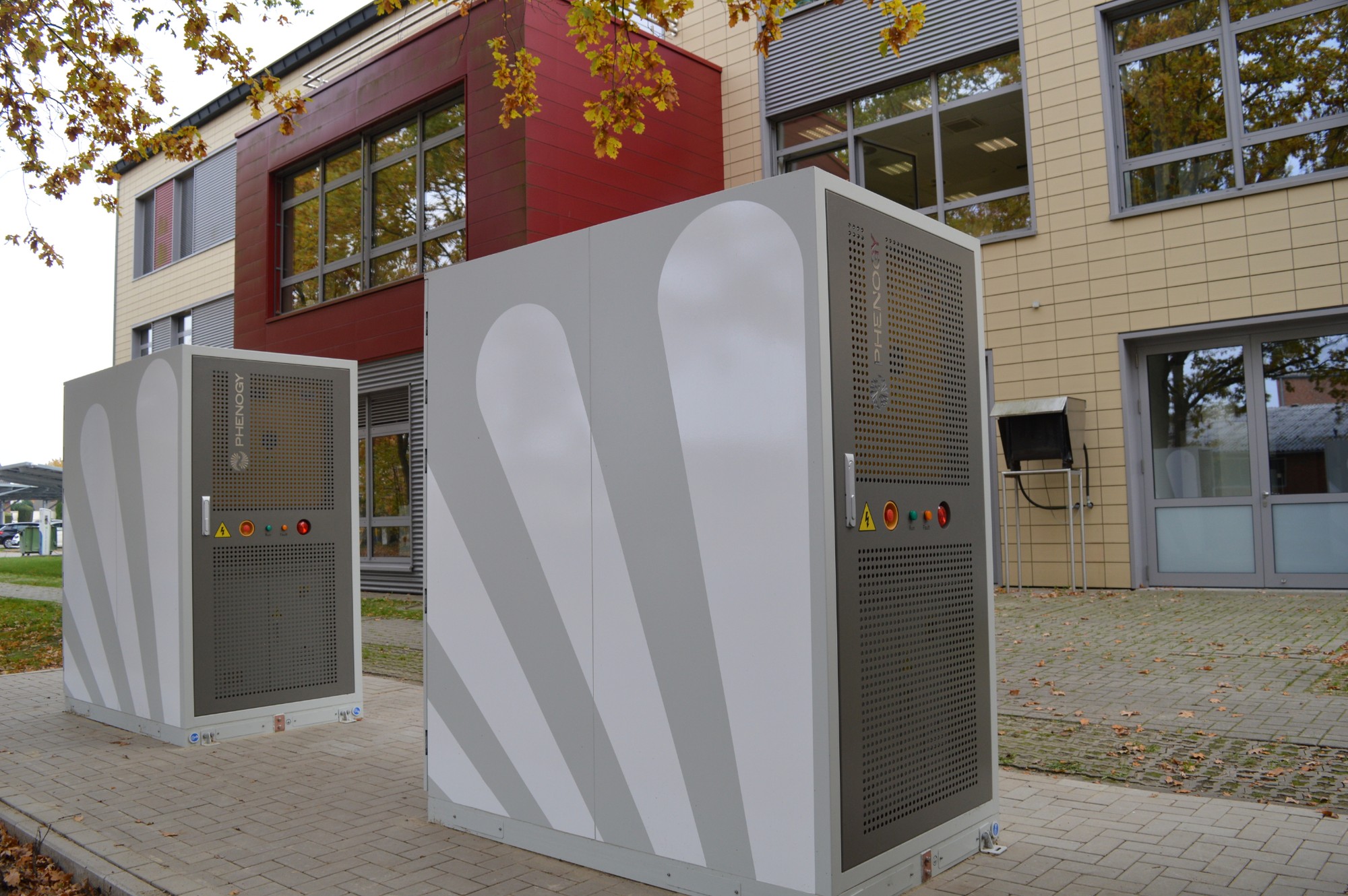
Choosing sodium-ion battery technology over lithium-ion was deliberate. President Prof. Dennis De cites three reasons: abundant raw materials, wider temperature tolerance, and safety.
- 1. Abundant materials: Sodium is the sixth most abundant element in Earth’s crust and available worldwide, unlike lithium, graphite, and cobalt concentrated in a handful of countries.
- 2. Cold and heat tolerance: PHENOGY cells operate from minus 20 C to 60 C, retaining up to 90% capacity even at minus 20 C, with simpler thermal management than lithium-ion.
- 3. Fire safety: Sodium-ion cells show higher thermal stability with a less severe reaction if a fault occurs. De takes this personally: PHWT’s Formula Student team Deefholt Dynamics has seen race-car cells catch fire twice.
Stationary storage is exactly where sodium-ion shines today. Weight matters little, while long cycle life, passive cooling, and low fire risk matter a lot. For the broader picture on where the chemistry wins, see our guide to sodium battery fast charging research and commercial progress.
Can You Install Solar Panels on a Carport?
Yes, and this project shows the template. Glass-glass modules act as both generator and roof, the steel follows the lot’s shape, and the system ties into existing loads like EV chargers. PHWT also covered a 20-bike shelter, lifting the total to around 237 kWp, registered at 236.6 kW in Germany’s market data registry since November 4.
The bigger lesson is integration. Diepholz already heats and cools with a rare ice storage system: a heat pump freezes a large water tank for winter heat, then uses the ice for summer cooling. Now electricity comes from the sun over the parking lot, heat and cold come from ice below, and the salt battery bridges the gaps in between.
What About Cost and Transferability?
PHWT has not published total project costs, so German figures will not transfer directly to US sites with different labor rates, permitting, and interconnection rules. What does transfer is the logic: peak-shaving savings stack on top of self-consumption savings, shaded parking and lit spaces add amenity value, and sodium-ion avoids lithium supply-chain exposure.
For context, US installers typically quote residential solar carports at roughly $3.15 to $6.00 per watt before incentives, versus about $2.50 to $3.50 for comparable rooftop solar, because the steel canopy, foundations, and extra labor add cost. A common 5 kW home system lands near $15,750 to $22,500, and adding a 13 to 15 kWh battery adds roughly $10,000 to $20,000. PHWT’s commercial-scale curved structure sits outside those residential ranges, but the premium-for-structure pattern is the same.
As Interesting Engineering noted, this is only the third sodium-ion storage system in Germany, so it remains an early deployment, not a mass-market proof. But with America’s first grid-scale sodium-ion plant coming to Sacramento, the supply chain behind cabinets like these is scaling fast.
Frequently Asked Questions
Can I install solar panels on a carport?
Yes. Solar carport structures use PV modules as the roof itself, as PHWT demonstrated with 1,150 square meters of glass-glass panels over 90 spaces. A residential solar carport is smaller but follows the same principle: steel frame, waterproof modules, inverter, and optional battery.
What is a solar carport with battery storage?
It pairs overhead solar panels with a stationary battery that stores midday surplus for evening or peak use. At PHWT, two 100 kWh sodium-ion cabinets store solar power and shave demand peaks from lab machines, saving thousands of euros yearly.
Why use a sodium-ion battery instead of lithium-ion?
Sodium is abundant and widely available, cells tolerate minus 20 C to 60 C with simpler cooling, and thermal stability is higher with less severe fault reactions. The tradeoff is lower energy density, which matters little for stationary campus storage.


