
Specifying school furniture requires more than selecting desks and chairs that complement a classroom’s interior design. Architects must consider ergonomics, safety, durability, accessibility and adaptability to create effective learning environments. From primary schools to university campuses, furniture should accommodate different physical needs, teaching methods and spatial requirements while remaining practical to maintain throughout its service life.
Why School Furniture Specification Matters
School furniture is one of the most frequently used elements within an educational building. Unlike decorative features, desks, chairs and storage systems must withstand repeated daily use while supporting a range of learning activities.
Poorly considered furniture can restrict movement, create accessibility barriers and limit how teachers organise classrooms. Conversely, appropriately specified furniture can support different teaching arrangements, improve physical comfort and make educational spaces more adaptable.
For architects, the challenge is to balance immediate functional requirements with long-term performance, maintenance and budget considerations.
1. Ergonomics: Designing for Different Ages and Body Sizes
Ergonomics should be a fundamental consideration when selecting school furniture.
Students vary considerably in height, proportions and physical development, even within the same age group. Furniture dimensions should therefore reflect the intended users rather than relying on a single standard size.
Important considerations include:
- Seat height: Students should be able to sit comfortably with appropriate support.
- Desk height: Work surfaces should accommodate writing, reading and computer-based activities.
- Legroom: Adequate space beneath desks allows comfortable movement and positioning.
- Adjustability: Height-adjustable furniture can accommodate users with different physical requirements.
The European standard EN 1729-1 provides functional dimensional requirements for chairs and tables used in educational institutions. It offers architects a recognised reference when evaluating furniture sizes.
However, ergonomic suitability should also be assessed through practical testing, particularly in classrooms serving students of different ages and abilities.
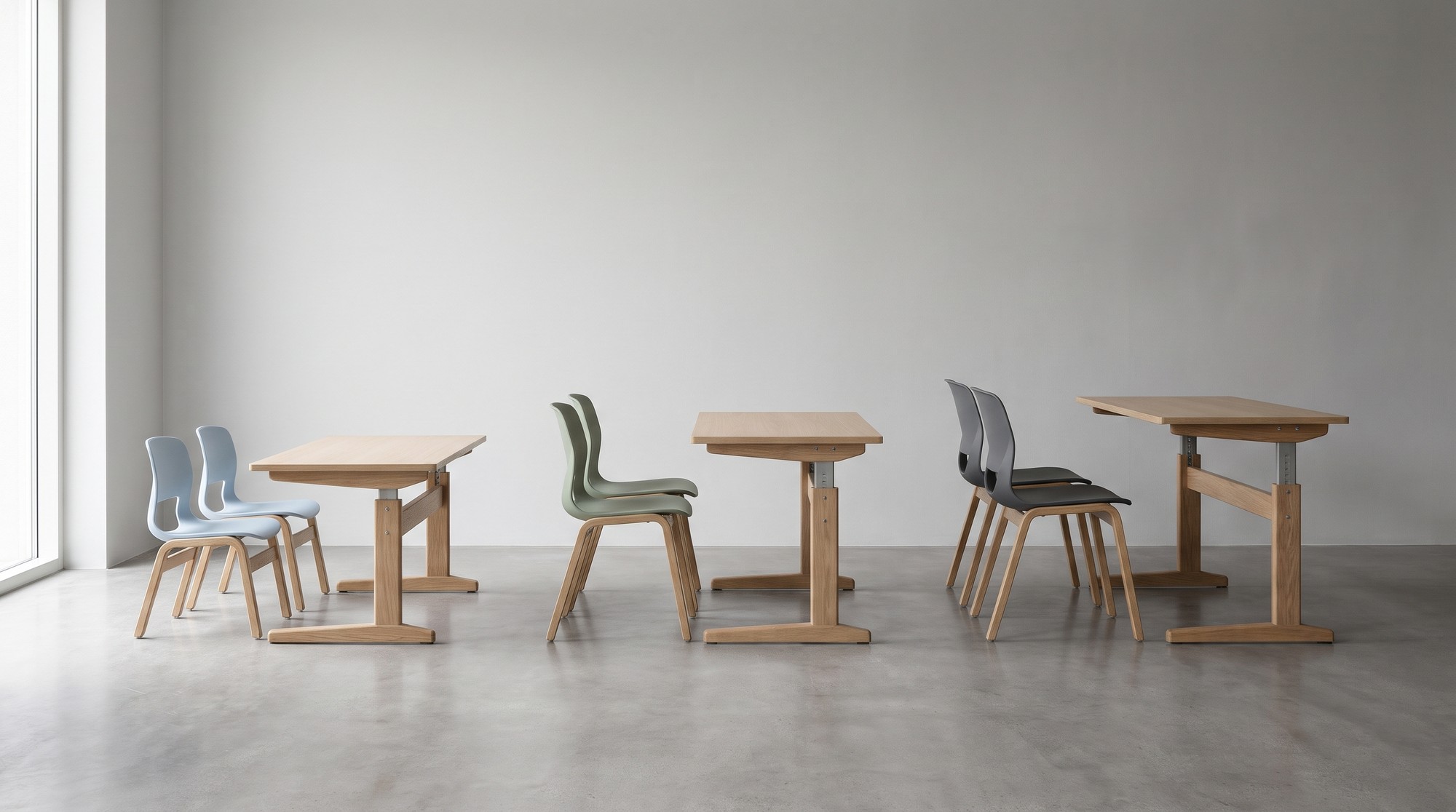
2. Durability: Choosing Furniture Built for Intensive Use
School furniture experiences frequent movement, cleaning and daily wear. Durability is therefore essential for maintaining safe and functional learning environments.
Architects should evaluate the construction and performance of furniture rather than selecting products based solely on appearance. Key considerations include frame stability, surface resistance, edge protection, hardware quality and the availability of replacement components.
For example, classroom tables should withstand repeated use without becoming unstable, while seating should maintain structural integrity under expected operating conditions.
Material selection should also reflect the environment. Furniture used in laboratories, art classrooms, libraries and cafeterias may face different demands relating to moisture, cleaning chemicals and physical wear.
A durable product may have a higher initial purchase cost but potentially reduce maintenance and replacement expenses over time. The most appropriate specification should therefore consider whole-life value rather than purchase price alone.
3. Flexibility: Supporting Different Teaching Methods
Modern educational environments increasingly accommodate individual study, collaborative learning, presentations and project-based activities.
School furniture should support these different teaching arrangements without requiring extensive effort to reorganise the classroom.
Movable tables, lightweight seating and modular furniture systems can provide greater flexibility than permanently fixed layouts. For example, individual desks may be arranged for examinations before being grouped for collaborative activities.
However, flexibility should remain practical. Furniture that is difficult to move, complicated to operate or unsuitable for available storage space may create more problems than it solves.
Architects should consider:
- How frequently the room needs to be reconfigured.
- Whether students or staff will move the furniture.
- The space required for circulation and storage.
- Whether furniture remains stable in different configurations.
The objective is to provide adaptability without compromising usability or safety.
4. Accessibility: Creating Inclusive Learning Environments
Inclusive school furniture design considers students with different physical abilities, mobility requirements and learning needs.
A classroom should not require every student to use identical furniture in an identical way. Height-adjustable desks, accessible work surfaces and appropriate seating options can accommodate a wider range of users.
Architects should also evaluate wheelchair access, circulation routes and the positioning of furniture within the room.
Accessibility involves more than selecting individual products. A suitable desk becomes ineffective if surrounding furniture prevents a student from reaching it comfortably. Visual contrast, clear circulation and ease of operation may also be important considerations.
Where specialised furniture is required, architects should coordinate with educators, accessibility consultants and relevant stakeholders.
5. Safety: Looking Beyond Product Appearance
Safety requirements should influence furniture specification from the earliest design stages. Classroom furniture must be appropriate for the intended age group and activities.
Potential risks include sharp edges, unstable structures, exposed moving components and furniture that can tip during normal use.
For movable furniture, architects should assess whether castors include suitable locking mechanisms and whether components remain secure during repositioning.
Relevant furniture testing and safety standards should be reviewed alongside local building and education requirements. Importantly, a product’s compliance with one standard does not automatically establish suitability for every educational environment.
6. Sustainability: Considering the Complete Furniture Lifecycle
Sustainable school furniture specification extends beyond choosing products made from recycled materials.
Architects should consider how furniture is manufactured, transported, maintained, repaired and eventually replaced. Products designed for longevity may reduce the frequency of replacement, while modular components can make individual repairs more practical.
Where relevant, specifications may also consider responsibly sourced timber, environmental product declarations and verified material certifications. Furniture that can be refurbished or adapted to changing requirements may offer additional resource-efficiency benefits.
However, sustainability claims should be supported by credible documentation rather than general descriptions such as “eco-friendly”. The most suitable choice balances environmental considerations with durability, safety and functional performance.
7. Acoustic Comfort and Spatial Planning
Furniture specification also influences how learning spaces function acoustically. Open collaborative areas, libraries and shared study environments often accommodate different activities within the same space.
Upholstered seating and certain soft furnishings can contribute to sound absorption, although furniture alone cannot replace a properly designed acoustic strategy.
Architects should consider furniture placement alongside partition systems, ceiling treatments and room acoustics. In larger learning environments, movable furniture can work with acoustic partitions to create separate zones for discussion and focused study.
That coordination increasingly extends to the building systems serving the room. As the sensor-driven classrooms examined in this look at ambient-intelligent classrooms show, ventilation, lighting and acoustic treatment are being tuned to match whatever activity is under way, which means furniture layouts need to work with those systems rather than against them.
Careful coordination helps ensure flexibility does not come at the expense of concentration or privacy.
School Furniture Specification Checklist
The following considerations can guide architects during product evaluation.
| Specification factor | Key question |
| Ergonomics | Does the furniture suit the intended users? |
| Durability | Can it withstand expected daily use? |
| Flexibility | Can it support different learning arrangements? |
| Accessibility | Can students with different needs use it comfortably? |
| Safety | Does it meet applicable safety requirements? |
| Sustainability | Can components be repaired, reused or responsibly replaced? |
| Maintenance | Is cleaning and replacement straightforward? |
| Whole-life cost | Does the product offer long-term value? |

Frequently Asked Questions
What Is the Most Important Factor When Choosing School Furniture?
There is no single determining factor. Ergonomics, safety, durability and functionality should be considered together. The appropriate furniture depends on student age, educational activities, accessibility requirements and expected usage.
Should Schools Choose Fixed or Flexible Furniture?
Flexible furniture is useful in classrooms that frequently change between individual and collaborative activities. Fixed furniture may remain appropriate in specialist teaching environments where equipment, stability or room configuration requires it.
How Can Architects Make School Furniture More Sustainable?
Architects can prioritise durable products, replaceable components, repairability and verified material sourcing. Considering maintenance requirements and expected service life can also help reduce unnecessary replacement.
Conclusion: Specifying for Long-Term Learning
Effective school furniture specification requires a balance between student comfort, educational functionality, safety and long-term value.
By considering ergonomics, adaptability, accessibility and lifecycle performance, architects can create learning environments that remain useful as educational requirements evolve.
JEB Group works with architects, designers and educational institutions to develop functional learning environments through furniture and architectural solutions.
Explore JEB Group’s insights on school furniture and flexible campus design to learn how thoughtfully integrated furniture and spatial systems can support modern education.

