
Smart homes are quietly teaching us what intelligent spaces can do for people. Lights change to nurture mood and focus, room temperature adjusts before discomfort sets in, and energy systems learn patterns to reduce waste. Now the same principles are reaching classrooms, where ambient intelligence turns the room itself into an ally for learning. Instead of asking teachers and students to manage distractions like stale air, glare, and noise, an ambient‑intelligent classroom senses conditions, interprets context, and makes subtle adjustments in real time.
Parents already encounter these ideas at home, where professional smart home planning and stepwise smart‑home upgrades provide practical steps that compound over time. The same calm, human‑centered design language applies to schools. When ventilation quietly improves air quality, when lighting matches the task, and when instruction adapts to class‑wide context, students receive more attention from their teachers and less friction from the room itself.
This article provides clear definitions, evidence‑backed quick facts, and practical examples of ambient intelligence that keep the smart school focus on well‑being, equity, and learning outcomes.
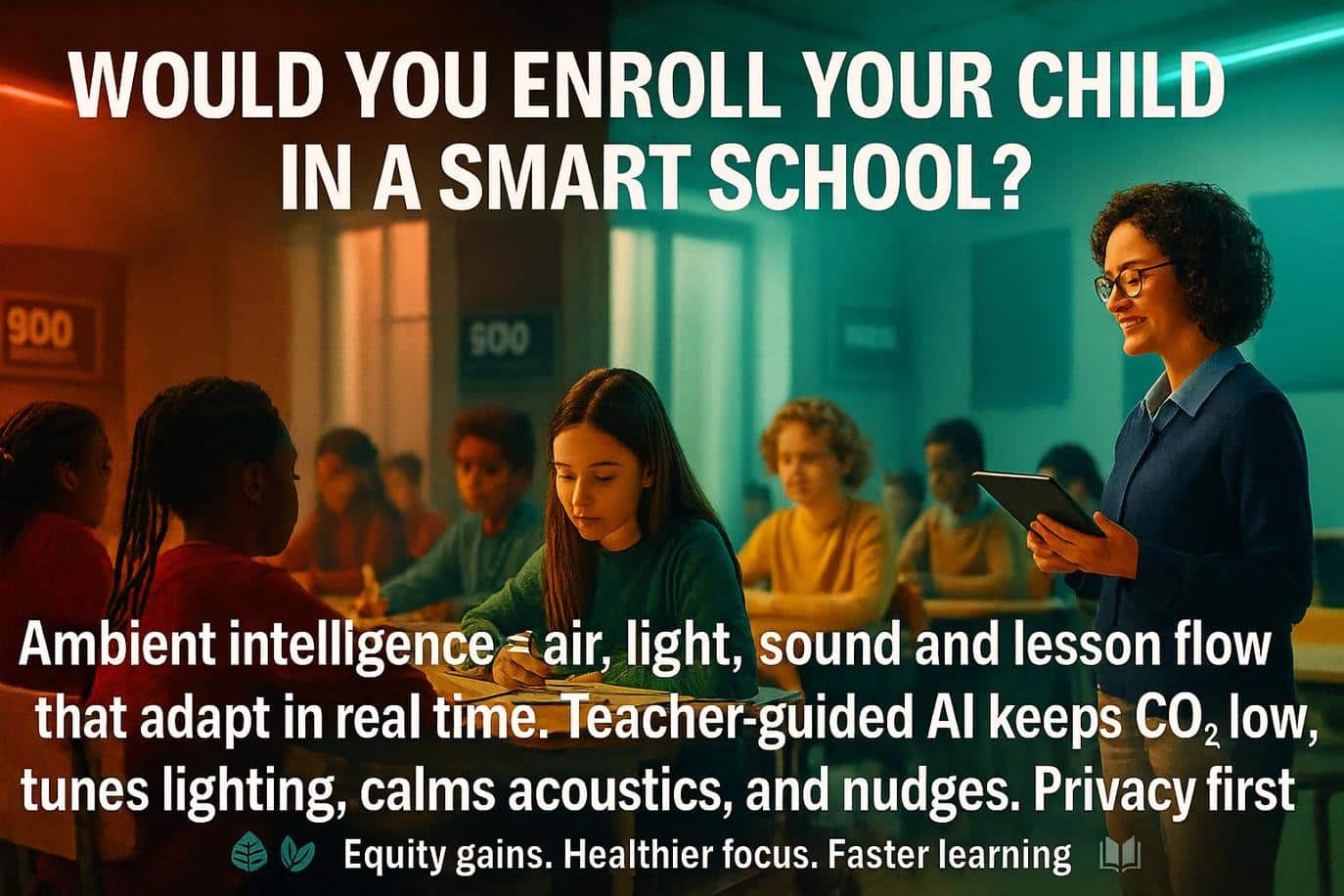
Ambient Intelligence: The Core Concepts
- Ambient intelligence, or AmI: refers to environments instrumented with networked devices and software that are embedded, context‑aware, adaptive, personalized, and anticipatory, as outlined in ambient intelligence research.
- Air quality affects thinking speed and accuracy: Research across schools shows that moderating carbon dioxide and improving ventilation can support attention and task performance; reducing classroom CO₂ from roughly 2,100 ppm to 900 ppm is associated with faster, more accurate schoolwork, and controlled exposure studies link better ventilation to higher cognitive scores.
- Lighting and noise shape working memory and stress: Tunable lighting aligned with the activity and acoustic treatments that reduce reverberation help learners sustain focus while reducing fatigue; evidence shows that longer reverberation times correlate with lower comprehension and engagement.
- Smart homes preview what works in schools: A similar playbook that coordinates thermostats, occupancy sensing, and scene‑based lighting in homes can be adapted to classrooms, labs, and libraries.
- Teacher judgment remains central: AmI works best when the system informs and supports teacher judgment rather than replacing it. Ethical design principles favor data minimization, local processing where possible, and aggregated views that respect privacy.
From Smart Home to Smart School: Why Spaces are Getting “Ambient”
A Day in the Life of a Child in Intelligent Spaces
Imagine a school day that starts in a calm home where lights brighten gently, the bedroom warms slightly before wake‑up, and morning routines are predictable. Families often practice versions of this, pairing simple automations with mindful habits. Smart living routines that support emotionally supportive smart‑home routines pair simple automations with mindful habits.
When a child arrives at school, the same design language continues at a larger scale. The classroom checks the air, adjusts fresh air flow, dials light levels for reading or discussion, and gives the teacher a quick glance at the room’s comfort and activity. The learner experiences fewer distractions and more time in the task’s optimal zone.
From Devices to Environments that Think with Us
First-generation “smart” referred to separate gadgets and apps. Ambient intelligence treats the whole environment as the unit of design in a smart school environment. In homes, this shift appeared as scene‑based lighting, presence‑aware temperature control, and appliances that sense context.
As emerging smart‑building practices show, the shift from isolated devices to coordinated systems has become clear. In schools, ambient thinking links sensors, analytics, and simple rules to keep conditions within healthy bands and allow instruction to adapt to the activity at hand. The room becomes quietly helpful rather than visually loud.

What Ambient Intelligence Means for Homes and Classrooms
The Core Ingredients of Ambient Intelligence
Ambient intelligence rests on five plain‑English ideas:
- Embedded: sensing and computing are part of the room, not add‑on gadgets that demand attention.
- Context-aware: the system understands the situation, such as time of day, number of occupants, or the type of lesson under way.
- Adaptive: settings shift in response to what is happening rather than staying fixed.
- Personalized: support can reflect the needs of a group or, when appropriate, individual learners.
- Anticipatory: the system predicts near‑term needs using patterns and schedules and prepares before discomfort or distraction builds.
These properties explain why AmI feels calmer than a gadget‑centric approach. Devices fade into the background, while the environment itself carries the intelligence. In education, researchers frame these spaces as smart learning environments grounded in context‑aware ubiquitous learning.
The Same Logic, Two Contexts: Home and School
The goal in both contexts is the same: a calm, supportive environment that helps people achieve optimal focus. In homes, ambient systems coordinate climate, air quality, and lighting to support sleep, focus, and social time.
Practical guides show how to get there step by step, from remodel‑ready home technology upgrades to smart security foundations that support energy and comfort. In schools, the same logic applies to a larger community. Sensors track temperature, humidity, CO₂, light, and noise. Software merges those signals with schedules and activity, using simple rules to keep conditions in healthy ranges.
Where appropriate, learning software adapts content difficulty or pacing when the class needs a different approach.
The Smart Home as a Prototype for the Ambient Classroom
Smart Homes as Everyday Ambient Intelligence
Readers may have seen ambient patterns in compact living too. Smart, efficient dwellings show how design, sensors, and automation increase comfort without increasing clutter.
Small‑footprint intelligence appears in smart tiny‑home design essentials. It is also found in circular builds such as a recycled wind‑turbine tiny home. These examples highlight principles that schools can borrow: simplicity, transparency, and a preference for long‑lived components that reduce maintenance.
Key Lessons from Smart Home Design
- Start with the environment: Classrooms benefit quickly from better air, light, and sound. CO₂ monitors and occupancy‑aware ventilation reduce grogginess. Tunable lighting supports reading, discussion, and creative work. Acoustic treatment shortens reverberation so everyone can hear.
- Favor scenes and schedules over micromanagement: The most usable homes rely on morning, study, and evening scenes rather than dozens of manual controls. This approach helps teachers keep attention on students instead of interfaces.
- Integrate wellness, not just energy savings: Smart homes prioritize comfort and mental clarity, not only utility bills. Schools can do the same by aligning IEQ targets with instructional goals.
- Built-in calm: Minimal visual clutter and legible controls reduce cognitive load. A calm aesthetic appears humane and trustworthy, which matters for parent and student acceptance.
- Connect the dots for learning: Ambient technology already improves study and inclusion in AI‑powered progressive learning environments and in inclusive education with AI and GPT‑4. These examples illustrate how adaptation can complement teacher expertise rather than compete with it.
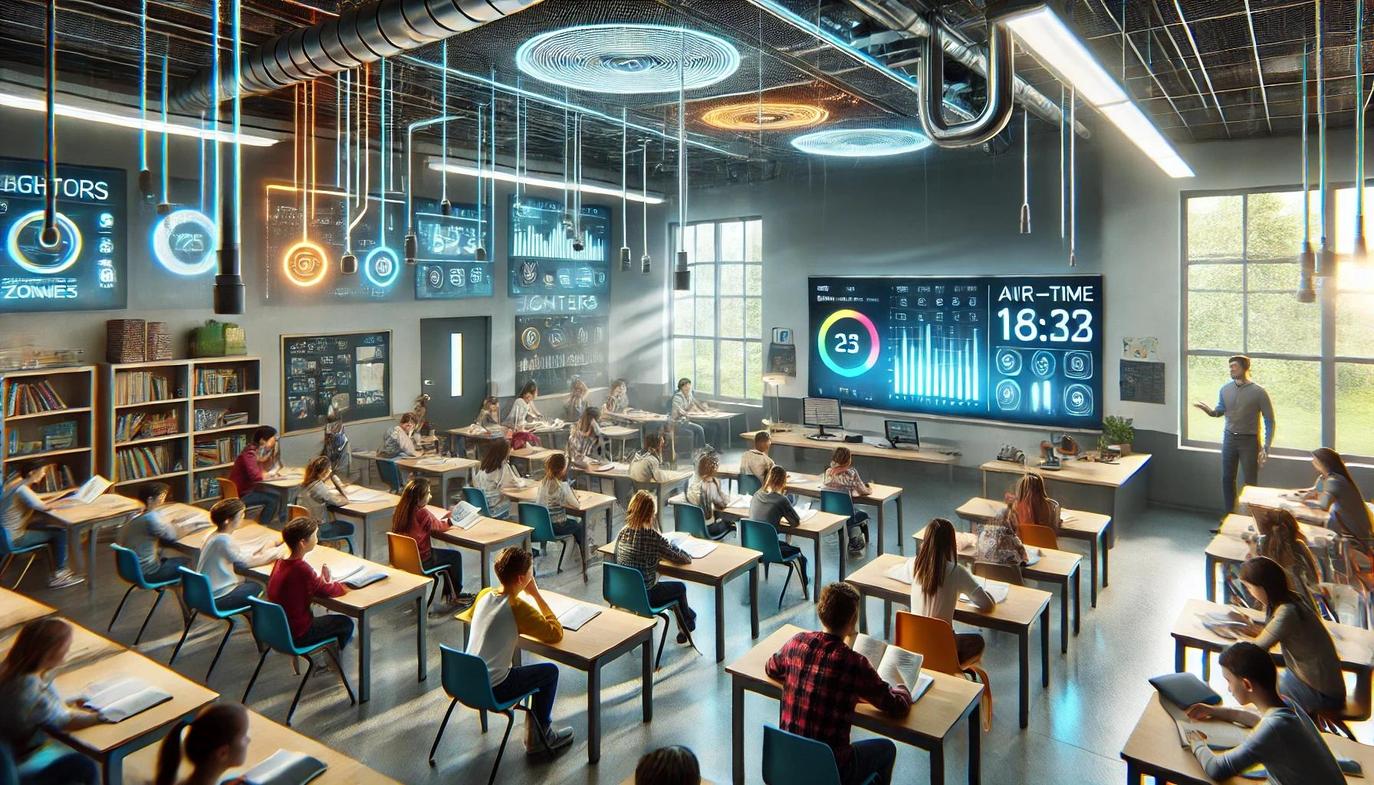
The Classroom as a Living System: Sensors and Real‑Time Adaptation
The Classroom’s Senses: How It Knows What’s Going On
A living classroom begins with thoughtful sensing. Common inputs include:
- Indoor Environmental Quality (IEQ) readings such as temperature, humidity, CO₂, light level, and background noise.
- Occupancy and movement are measured through passive sensors that respect privacy.
- Digital activity streams from tablets, whiteboards, and learning platforms add a picture of task flow.
Recent reviews catalog how sensors and AI shape educational paradigms. The goal is not to watch individuals but to understand the room’s context so the system can maintain healthy conditions and alert the teacher when the activity needs a different structure.
The Classroom’s Nervous System: Turning Data into Decisions
Signals travel to a simple decision layer, beginning with rules and thresholds that are easy to explain. If CO₂ crosses a preset limit, the system can increase fresh‑air intake or prompt a quick stretch break. If the sound level consistently rises during reading, suggest a quieter configuration or headphones for groups that need them.
Over time, analytics can learn patterns such as particular rooms that run warm in the afternoon or lessons that benefit from higher light levels. Research models of ambient‑intelligent classrooms also show how detecting signs of fatigue can inform strategy selection. Transparency is essential. Educators should understand what the system is doing and why, and they should remain in control of any instructional changes.

The Classroom’s Reflexes: Subtle, Supportive Changes
Air, Light, and Sound That Respond to Students
Fresh‑air delivery ramps up before grogginess sets in. Lights shift cooler and brighter for close reading, then warmer and dimmer for reflection. Portable acoustic panels or ceiling treatments shorten echoes so soft voices carry. Such changes are small but meaningful. Students experience less strain and more consistent attention, while teachers spend fewer minutes troubleshooting the room.
Lessons That Shift Pace and Modality
In some subjects, the best intervention is a small one. If a class stalls during multi‑step problem solving, an ambient intelligence system can suggest a worked example or a visual explanation for the teacher to use. If a group races ahead, it can prompt an extension task. These suggestions are aids, not mandates. Instruction remains personal and human, but the environment helps it move with the moment.
Social Flow and Group Dynamics
The classroom can also foster better collaboration without tracking individuals closely. Timers, layout cues, and shared displays help groups rotate roles and keep everyone engaged. Participation of quieter students rises when the room supports clear turn-taking and audibility. Teachers see participation patterns across the class and can intervene early, long before discouragement sets in.

A Full Ambient Day: The Home–School Ecosystem
Morning: Smart Homes Priming Kids for Focus and Well‑Being
Morning routines set the tone for learning. Scene‑based lighting can rise gently to cue waking, while pre‑heating or pre‑cooling keeps comfort steady without spikes later in the day. Air quality monitors catch stale rooms before headaches and sluggish thinking appear, and sleep‑friendly device settings align light and air with circadian rhythms.
Families seeking practical, incremental steps can use approaches used in calm, minimalist smart homes, as described in guidance on minimalist smart‑home habits. The goal is a predictable, supportive rhythm that reduces decision fatigue so children arrive at school ready to engage.
Daytime: Classrooms that Notice When the Room Needs to Breathe
Once at school, ambient‑intelligent classrooms continue the same pattern. Sensors keep CO₂, temperature, and light inside healthy bands, and simple teacher dashboards make conditions visible at a glance. When reading begins, lighting shifts to support focus; when small‑group discussion starts, acoustics and layout cues keep voices clear.
If attention flags after lunch, the system can recommend a short reset or a step‑by‑step example to restart momentum. The result is quiet changes that preserve teacher autonomy while protecting the class from avoidable friction.
Evening: Small, Smart, and Calm Spaces for Reflection
After school, children return to spaces that can either amplify stress or absorb it.
- Smart home scenes for study and decompression help them transition, and low‑impact study environments make it easier to concentrate without extra energy use.
- Online learning also plays a role. Thoughtful home setups support sustainable study sessions that reduce commuting and resource waste, a theme explored in environmental sustainability in online learning.
- Local learning ecosystems, community labs, and microschools connect the day’s lessons to neighborhood expertise, as seen in local learning ecosystems such as Edefy.
The connecting principle is continuity. Children experience a single ambient fabric that links home routines to school activities and back again.

Invisible, Not Invasive: A Practical Approach
Balancing Helpful Sensing with Privacy
Classrooms serve children, so respect for privacy and dignity comes first. Continuous sensing can drift toward monitoring if data collection exceeds what is needed, a concern long noted in work on ambient intelligence in education as documented in opportunities and consequences in smart classrooms.
Risk signals include detailed identity tracking, face analysis without clear purpose, black‑box decisions that override teacher judgment, and dashboards that isolate individual children rather than helping the whole class. Such risks are avoidable when schools set the right goals and design rules early.
Four Design Principles for Human‑First Ambient Classrooms
- Data minimization: collect the least data required to support comfort and learning, and keep it only as long as needed.
- Local or privacy‑preserving processing: favor on‑device analysis or aggregation that avoids sending raw streams to external services.
- Teacher‑in‑the‑loop controls: present clear recommendations, require human confirmation for instructional changes, and log actions for accountability.
- Transparency and choice: publish plain‑language policies, explain benefits and limits to families, and provide appropriate opt‑out paths.
A Three‑Phase Roadmap for Any School
Ambient intelligence does not require a major initial investment. Schools can progress in stages while staying aligned with budgets and capacity.
Phase 1: See the Environment Clearly
The first phase is to focus on indoor environmental quality. Add CO₂, temperature, humidity, light, and noise monitoring. Use visible thresholds so teachers know when to open windows, shift layouts, or start a fresh‑air cycle. Prioritize high-impact initial steps such as improving ventilation schedules, reducing glare, and treating the loudest surfaces.
Phase 2: Light‑Touch Context Awareness
Layer basic context on top of IEQ. Use schedules, simple occupancy cues, and activity tags to run scene changes automatically. Provide concise alerts when attention drifts or when the acoustics are hurting discussion. Keep identities abstract and avoid granular tracking. Integrate with existing classroom tools rather than adding new sign-ins.
Phase 3: Carefully Governed Ambient Intelligence Pilots
When the basics are stable, pilot richer sensor fusion in a few rooms with community governance. Define success metrics up front, such as fewer interruptions, steadier attention, and better audibility. Review results with teachers and families, and adjust or roll back features that add complexity without clear benefit. Treat procurement, maintenance, and training as part of the design, not afterthoughts.

Where Ambient Learning Goes Next
From Appliances to District-Scale Ecosystems
Consumer devices are gaining ambient features that sense motion, sound, and presence, as shown by ambient sensing arriving in mainstream platforms. This trend reduces the cost of building intelligent spaces. Districts can standardize on open, interoperable protocols so classrooms, libraries, and common areas work together. Over time, schools can coordinate energy use, indoor air quality, and after‑hours community access through the same ambient fabric that supports instruction.
Why Governance, Equity, and Design Literacy Matter More Than Gadgets
The future depends less on cutting‑edge hardware and more on habits. Districts that treat ambient intelligence as civic infrastructure will publish data policies and test systems with diverse communities. They must also fund maintenance and training alongside devices. Equity improves when the first dollars go to comfort and audibility in the most crowded rooms, not to experimental features in showcase spaces. Design literacy among educators and families ensures that intelligent environments feel supportive rather than intrusive.
Ambient Intelligence: The Future of Supportive Learning
Ambient intelligence is the fabric that connects a child’s learning environments. Smart homes demonstrate how calm, context-aware spaces remove friction from daily life, and schools can now extend those same benefits to group learning. By focusing on core indoor environmental quality (IEQ)—keeping air fresh, lighting appropriate, and sound manageable—these systems create a foundation for focus. When ambient-intelligent classrooms are designed as an ally, they help students feel supported and reduce the cognitive load of managing a distracting environment.
The technology, however, is only one part of the equation. The most successful smart learning environments are built on clear goals, transparent governance, and unwavering teacher leadership. These human-first principles are what turn sensors into genuine support rather than surveillance. When districts, teachers, and families build this supportive fabric with intention, they create spaces where children feel seen, not watched, and where classrooms become truly responsive partners in education.

Understanding Ambient Learning Environments
Is an Ambient-Intelligent Classroom Just Surveillance?
It should not be, as the two have different goals. Surveillance watches people; ambient intelligence is designed to care for environments and activities. The difference is apparent in the design choices: using aggregated signals to improve comfort, avoiding identity-level tracking, and keeping teachers in control of all changes.
Will Teachers Be Replaced by AI in These Systems?
No. The most effective smart learning environments use automation to handle environmental details (like air quality) and suggest small instructional adjustments. The teacher makes all final decisions, provides human context, and builds relationships that no system can replace.
Can Low-Income Schools Realistically Benefit from This?
Yes. The most impactful starting points are often the most affordable. Environmental basics like ventilation schedules, low-glare lighting, simple acoustic treatments, and clear dashboards deliver significant gains in comfort and attention before any advanced analytics are needed.
How Does this Connect to Remote and Online Learning?
Ambient intelligence strengthens the home-school link. At home, ambient routines and thoughtful study setups help students focus during online sessions. This extends the same supportive, low-friction design beyond the school walls, creating continuity across the entire learning day.


