
Choosing a Medicare Supplement plan can be confusing, especially when two options appear to offer very similar coverage. Plan G and Plan N are among the Medigap plans many beneficiaries consider because both can help reduce the out-of-pocket costs that Original Medicare does not fully cover.
Although the plans have several similarities, they are not identical. The biggest differences involve cost-sharing, Part B excess charges, and the way certain doctor and emergency-room visits can create copayments under Plan N.
Understanding these differences can make it easier to decide which type of coverage fits your healthcare needs, budget, and expectations.
First, Understand How Medigap Works
Medicare Supplement Insurance, commonly called Medigap, works alongside Original Medicare. It is designed to help pay certain costs that remain after Medicare Part A and Part B pay their share, such as coinsurance, copayments, and certain deductibles.
Medigap is not a replacement for Original Medicare. In general, you need Original Medicare Parts A and B to purchase a Medigap policy. Standardized Medigap plans are identified by letters, and the benefits associated with each letter are standardized by federal rules, although premiums can differ between insurers and locations.
This means a Plan G policy from one insurer generally has the same standardized medical benefits as Plan G from another insurer. The price, customer service, underwriting rules, and other insurer-specific factors can still differ.
What Do Plan G and Plan N Have in Common?
Plan G and Plan N are both designed to help fill many of the cost gaps associated with Original Medicare. Both can cover major categories of Medicare cost sharing, including Part A hospital coinsurance and certain skilled nursing facility costs.
Both plans can also provide foreign travel emergency benefits within applicable limits, generally paying 80% of covered emergency care received outside the United States after a $250 annual deductible and up to a $50,000 lifetime limit. Neither plan is designed to cover routine dental, vision, or hearing benefits, and Medigap policies generally do not include prescription drug coverage; beneficiaries who want prescription coverage generally need a separate Medicare Part D plan.
One important point is that neither Plan G nor Plan N covers the Medicare Part B deductible, which is $283 in 2026. Once that deductible has been satisfied, the differences between the two plans become more important when evaluating potential out-of-pocket expenses.
Plan G vs. Plan N: The Main Differences
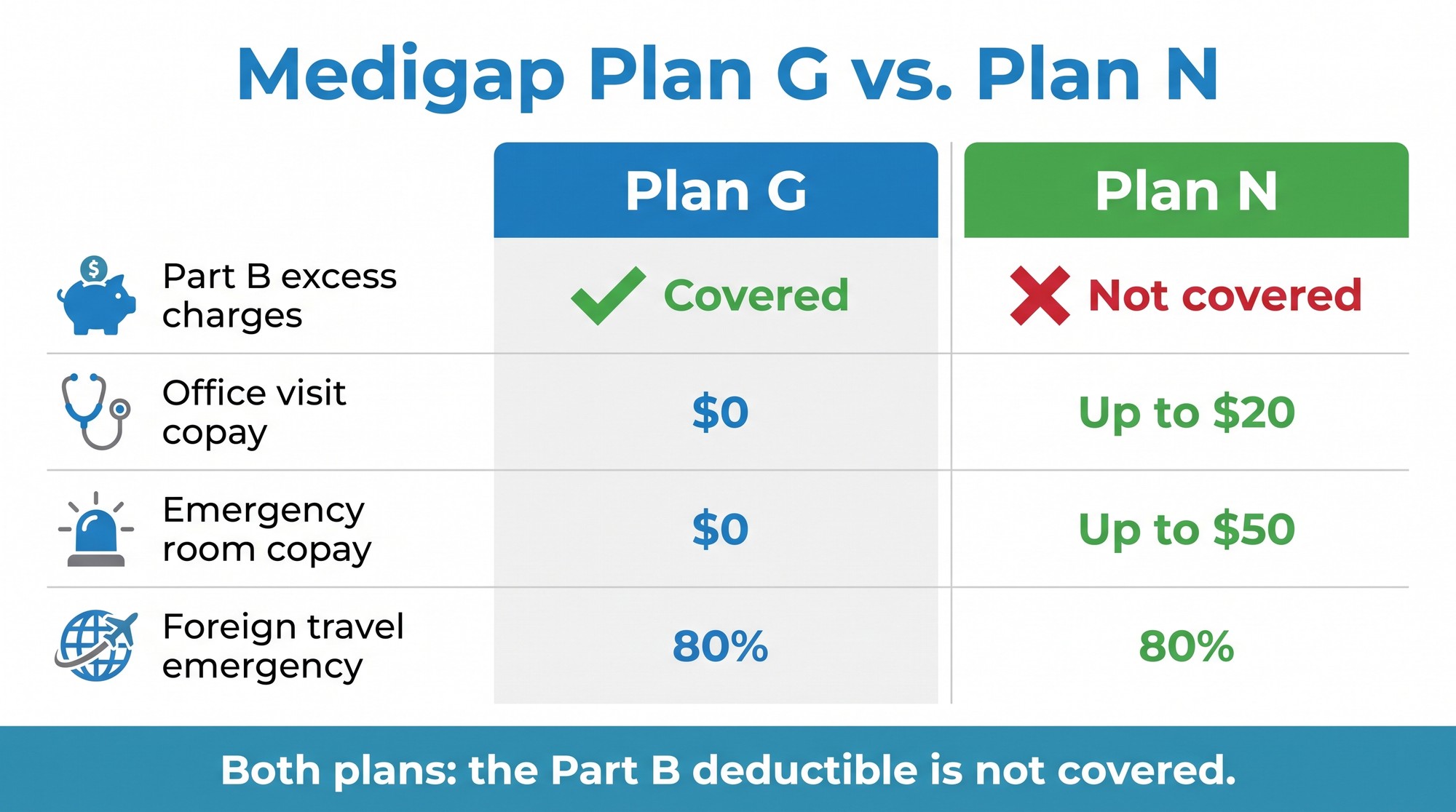
| Feature | Plan G | Plan N |
|---|---|---|
| Part B deductible | Not covered; beneficiary pays the annual deductible | Not covered; beneficiary pays the annual deductible |
| Part B coinsurance | Generally covered after the Part B deductible | Generally covered, subject to Plan N cost-sharing rules |
| Office visit copays | No Plan G copay for covered Medicare-approved services | Up to $20 for some office visits |
| Emergency room copay | No Plan G copay for covered Medicare-approved services | Up to $50 when the emergency-room visit does not result in an inpatient admission |
| Part B excess charges | Covered | Not covered |
| Foreign travel emergency | 80% up to plan limits | 80% up to plan limits |
The exact premium for either plan depends on factors such as the insurer, location, age, and rating method. Therefore, a lower premium for Plan N does not automatically mean it will cost less overall for every beneficiary.
For a complete, plan-by-plan breakdown, see the official Medigap benefits comparison on Medicare.gov.
Why the Part B Excess Charge Difference Matters
One of the most important distinctions between Plan G and Plan N involves Medicare Part B excess charges.
A provider who does not accept Medicare assignment may, in certain circumstances and subject to federal limits, charge more than the Medicare-approved amount for a Part B service. This additional amount is known as a Part B excess charge.
Plan G covers Part B excess charges when the applicable requirements are met. Plan N does not cover them.
For someone who wants to minimize the possibility of unexpected Part B-related expenses, this difference can be an important consideration when comparing the two plans.
How Plan N Copayments Can Affect Your Costs
Plan N may be attractive to beneficiaries who are comfortable accepting some cost-sharing in exchange for potentially lower premiums. However, those costs need to be considered realistically.
Under Plan N, beneficiaries may pay up to $20 for certain office visits and up to $50 for an emergency-room visit when they are not admitted as an inpatient.
For someone who rarely visits a doctor and wants to keep monthly premiums lower, these potential copayments may be manageable. For someone who frequently sees physicians or specialists, the additional cost-sharing may become more noticeable over time.
Who Might Prefer Plan G?
Plan G may be worth considering for beneficiaries who place a high value on predictable cost-sharing after the Part B deductible.
- You want broad coverage for Medicare-approved Part A and Part B cost sharing.
- You want coverage for Part B excess charges.
- You frequently visit doctors or specialists and want to avoid Plan N’s potential office-visit copayments.
- You prefer a plan structure with fewer costs to track when receiving covered Medicare-approved services.
- You are willing to pay a potentially higher monthly premium in exchange for more comprehensive standardized benefits.
Who Might Prefer Plan N?
Plan N may appeal to beneficiaries who are comfortable with some cost-sharing and are looking for a potentially lower premium.
- You generally have limited healthcare utilization.
- You are comfortable paying potential office and emergency-room copayments.
- You understand that Plan N does not cover Part B excess charges.
- You want to compare a lower-premium Medigap option against the broader cost protection of Plan G.
- You have reviewed the providers you use and understand how they bill Medicare.
Don’t Choose Based on Premium Alone
A common mistake is to compare Plan G and Plan N only by their monthly premiums. The lower premium may look attractive, but the total financial picture can be different depending on how often you use healthcare services.
For example, one beneficiary may rarely visit a doctor and be comfortable paying occasional copayments, while another may see several specialists and want to minimize unexpected expenses. The same plan may not be equally suitable for both.
When comparing Plan G and Plan N, consider:
- Monthly premium
- Expected number of doctor and specialist visits
- Potential emergency-room use
- Whether your doctors accept Medicare assignment
- Your exposure to Part B excess charges
- Your ability to handle unexpected healthcare costs
- Your preferred balance between monthly premiums and out-of-pocket expenses
Check Your Doctors Before Choosing Plan N
If you are considering Plan N, ask your doctors’ offices whether they accept Medicare assignment. This can help you understand whether Part B excess charges could become an issue.
You should also check whether the providers you regularly use participate in Medicare and understand how they bill Medicare patients. This is especially useful if you see several specialists or receive care from providers in different locations.
What About AARP Medicare Supplement Plan G?
Once you decide that Plan G may better fit your needs, you can compare the Plan G options available from different insurers. AARP Medicare Supplement plans are offered through UnitedHealthcare Insurance Company in many states, subject to state availability and plan terms.
When evaluating an AARP Medicare Supplement Plan G option, look beyond the name of the insurer. Consider the current premium, rate history, household discounts if available, enrollment requirements, and how the policy fits your overall Medicare coverage.
For a more detailed overview, visit the AARP Medicare Supplement Plan G guide on Medicare Sharks.
When Should You Compare Plan G and Plan N?
The best time to compare Medigap plans depends on your Medicare enrollment situation. Your Medigap Open Enrollment Period can provide important protections when you first become eligible for Medicare Part B, while certain circumstances can create guaranteed-issue rights at other times.
If you are already enrolled in a Medigap policy and are considering switching, do not assume you will automatically receive the same enrollment protections you had when you first enrolled. Depending on your situation and state rules, medical underwriting may apply.
Because of this, it is wise to understand the enrollment rules before cancelling an existing Medigap policy or applying for a different one.
A Simple Way to Decide Between Plan G and Plan N
If you are still unsure which plan may be more suitable, start by answering five questions:
- How often do I expect to visit doctors and specialists?
- How important is it for me to have coverage for Part B excess charges?
- Am I comfortable paying potential office and emergency-room copayments?
- How much more am I willing to pay each month for broader cost protection?
- Would a more predictable cost structure make budgeting for healthcare easier?
Your answers can help clarify whether the higher premium of Plan G may be worthwhile or whether the potential savings of Plan N better match your healthcare and financial priorities.

Final Thoughts
Plan G and Plan N are both standardized Medigap options that can help reduce the out-of-pocket costs associated with Original Medicare, but they approach cost-sharing differently. Plan G generally provides broader protection against Part B-related costs, including excess charges, while Plan N can offer a potentially lower-premium alternative in exchange for certain copayments and no coverage for Part B excess charges.
There is no single best Medigap plan for everyone. The right choice depends on your healthcare usage, preferred doctors, budget, and comfort with potential out-of-pocket costs.
For people researching their options, Medicare Sharks provides educational resources on Medicare Supplement plans and helps consumers understand differences between options such as Plan G and Plan N. Its guide to AARP Medicare Supplement Plan G can be a useful resource for readers who want to explore Plan G in more detail before comparing available coverage and costs. As with any Medicare insurance decision, review the specific policy terms, premiums, eligibility requirements, and state availability before enrolling.
Disclaimer: This article is for general informational purposes only and is not insurance, legal, tax, or financial advice. Medicare rules, plan availability, premiums, eligibility, and costs can vary by state and individual circumstances. Readers should verify current information before making enrollment or coverage decisions.

