
There is a moment in almost every serious weight-loss attempt that nobody warns you about. Not the first week, which is usually easy in a grim sort of way, and not the second, when the clothes start behaving differently. It arrives later, somewhere past the point where the effort has stopped feeling like a project and started feeling like a personality. The food is still measured. The walks still happen. And the number stops moving anyway.
You can watch people reach that point and immediately reach for the same explanation. They decide they got sloppy. They start hunting for the hidden calorie, the weekend they miscounted, and the oil in the sabzi they forgot to log. The search is almost never productive, because the thing that changed was not the discipline.
What the body does when you take food away
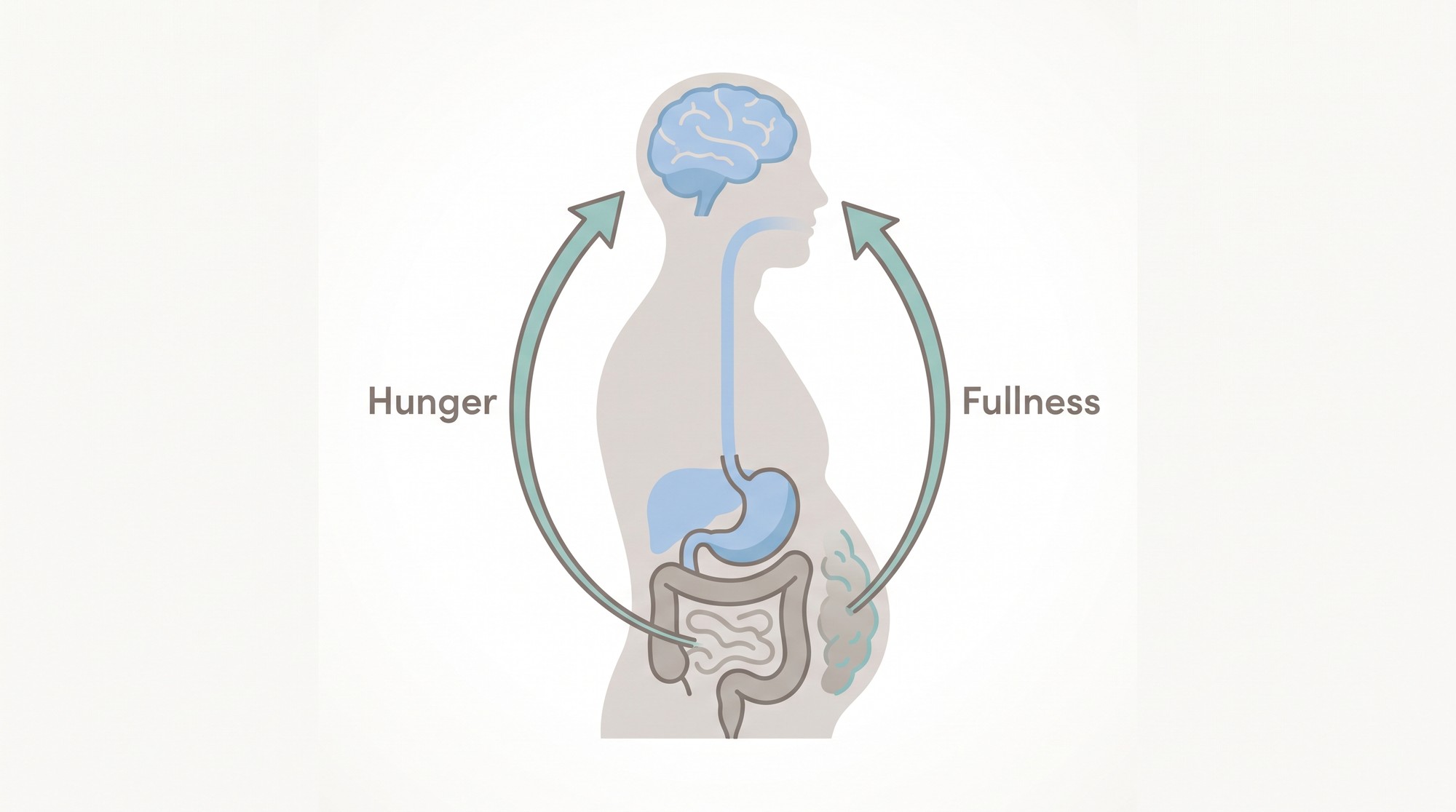
Sustained restriction is not a neutral input. The body treats a falling weight as a problem to be solved, and it has a long list of ways to solve it. Appetite signalling shifts so that hunger arrives earlier and lands harder. Fullness after a meal becomes shorter and less convincing. Movement gets quietly cheaper: the same walk costs less than it used to, which sounds like good news and is actually the opposite if the walk was supposed to be doing work. Researchers describe the wider shift as adaptive thermogenesis, a fall in energy expenditure that runs ahead of the tissue actually lost. Small unconscious activity, the fidgeting and stair-taking and standing up for no reason, tends to fall off without anyone deciding it should.
None of that is willpower. It is a counter-regulation system doing exactly what it evolved to do, on a timescale that outlasts anybody’s motivation. The difference in outcome between the person who holds a loss and the person who does not is very often a difference in how loudly their particular version of that system argues back.
That is the part the standard advice cannot reach. Advice assumes the obstacle is information or resolve. If the obstacle is a physiological response that intensifies the longer you succeed, then more resolve applied to the same plan produces a harder version of the same plateau. The practitioners who write about when diet isn’t enough for weight loss tend to describe the same arc, over and over, in people who did everything they were told.
Why the story gets told as a character flaw
Weight is one of the last health topics where a poor outcome is still routinely read as evidence about the person. You do not hear anyone describe a thyroid disorder as a discipline problem. You hear it about weight constantly, including from the person it is happening to, which is the part that does real damage.
Some of that is history. For decades the public framing rested on a simple arithmetic model, and simple arithmetic invites moral reading: if the sum is that easy, failing it must be a failing. Some of it is survivorship noise. The people who lost weight and held it are visible and happy to explain their method, and their method genuinely worked for them, and the explanation almost never includes the possibility that their biology was a quieter opponent than yours.
Indian households add their own layer. Food is how care gets expressed, so declining a second serving reads as a small rejection of the person who cooked it. The negotiation happens at every meal, in front of an audience, and it is exhausting in a way that no diet plan accounts for. Then someone at a family function comments on the weight anyway, in front of everyone, as though it were a neutral observation about the weather.
The practical cost of all this moralising is that it delays assessment by years. If the frame says the problem is character, the solution is obviously to try harder, and asking a doctor about it feels like an admission rather than a reasonable next step. People arrive for a first proper metabolic workup, having already spent a decade on the character theory.
The plateau is information, not a verdict
A weight loss plateau that survives an honest month of consistency is telling you something specific. It is saying the current approach has found its floor, given what your body is currently doing about it.
Read that way, a plateau becomes a reason to change the question rather than double the effort. The useful next question is not “What else can I cut?” It is closer to what is actually driving this, and is any of it measurable?
Most people never get to ask it, because the plateau is where attempts end. The plan gets abandoned, the weight comes back over a year or two, and the experience gets filed as another personal failure rather than as a data point about how this particular body responds to restriction. Then the next attempt starts from scratch, with the same assumptions, and hits a wall in roughly the same place. You can usually date someone’s history of trying by how many of those cycles they can list from memory. It is one of the reasons most diets fail over the long term, however disciplined the person following them.
Sometimes there is an answer sitting in plain sight, and nobody has looked. Insulin resistance shifts the whole landscape of how easily fat comes off. So does PCOS. So do thyroid function, sleep that has been broken for years, medications taken for something entirely unrelated, and a metabolic picture that a South Asian body can carry at a weight that looks unremarkable on a Western chart. India uses lower body mass index cut-offs than those charts for exactly that reason, and waist measurement and waist-to-height ratio tell you more about visceral fat in South Asian bodies than weight alone ever will.
What effort is still for
It would be a bad reading of all this to conclude that behaviour stops mattering. Nothing here makes food, sleep, protein or resistance training optional. They remain the base layer, and they are doing more work than they appear to be doing when the scale is flat.
The honest version is narrower and more useful:
- Effort determines whether a plan can work at all. It does not determine how much room the plan has.
- Two people running an identical plan can get genuinely different results, and neither of them is lying about what they ate.
- A plan that requires permanent vigilance to hold a result is not a stable plan, whatever the result was.
- The ceiling on what behaviour alone can do is set by physiology you did not choose and cannot see.
Which means the person who has been trying for six years is not less disciplined than the person who succeeded in six months. They are frequently far more disciplined. That is the uncomfortable bit.
Where a clinician changes the shape of the problem
At some point the sensible move stops being another plan and starts being an assessment. Not a diagnosis you arrive at yourself from an article, and not a decision about medication made in advance. An assessment: history, measurements, bloodwork, and a conversation about what has already been tried and how the body responded each time.
That is a different activity from being handed a diet. It is where obesity gets treated as the chronic metabolic condition it is classified as, with the same expectation of ongoing management that any other chronic condition gets. India’s two-stage classification makes the point structurally, separating obesity that has not yet affected organ function from obesity that has, because those two situations call for different levels of urgency.
Whether treatment beyond diet and activity belongs in a particular person’s plan is not a question an article can answer, and it is not a question the person can answer about themselves. GLP-1 medication is prescription-only in India, and getting to it properly runs through a registered medical practitioner who has assessed you and who intends to keep monitoring you afterwards. Some people are not appropriate candidates. Working out which is the clinician’s job, done on your specific facts, and the good ones are direct about it.
There is a reason the people who write about when weight loss needs medical supervision keep emphasising the monitoring rather than the prescription. Continuity is the part that determines whether anything holds. A single consultation that ends in a plan and no follow-up is not supervision, whatever it says on the invoice.

The thing that shifts when the framing changes
Something happens to people when they stop treating a stall as a moral event. The self-negotiation quiets down. They stop running the internal audit at every meal. They get noticeably better at the behavioural side, not worse, because shame is a poor fuel and it burns out fast.
And they get more accurate. They can tell you what they actually eat, because there is no longer any reason to shade it. A clinician can work with that. A clinician cannot work with a food history edited by embarrassment, which is most food histories.
You see the same handful of sentences from people a few months into supervised care, and almost none of them are about the weight. They are about the noise stopping. Not having to think about food every waking hour. Being able to sit at a wedding buffet without running a calculation. Small things, mostly.
Willpower was never the wrong tool exactly. It was just being asked to do a job it was never built for, against an opponent it could not see, by people who then blamed it for losing.

