
Anyone who has boiled a pot of water knows it takes both time and energy to raise the temperature. Marine ecosystems live inside that same physics, yet the official way scientists measure ocean heatwaves has long treated them as short, isolated spikes of heat. A new study suggests that framing has been hiding a large share of the warming that marine life actually experiences.
The research, led by the Virginia Institute of Marine Science (VIMS) at William & Mary and published in the journal Communications Earth & Environment, analyzed more than 2,580 marine heatwaves recorded over two decades at 20 estuaries across the United States. Its conclusion is stark: standard assessments underestimate total heat exposure by more than 150% on average, because they look only at the heatwave itself and ignore the long stretches of unusually warm water on either side of it.
That is more than a technical quibble. It changes how scientists should measure, model, and experiment on ocean warming at a moment when the world’s seas are running hotter than at any point on record.
What Counts as a Marine Heatwave?
A marine heatwave is a stretch of unusually warm ocean water that persists for at least five consecutive days. Under the definition most researchers use, the sea surface temperature has to climb above the 90th percentile of the local 30-year average for that time of year. In plain terms, the water is warmer than 90% of past observations for that season.
Because the threshold is relative to each location’s normal conditions, no single global temperature defines a heatwave. The National Oceanic and Atmospheric Administration tracks these events and grades them by severity, from moderate through strong to severe and extreme, and publishes a public dashboard of current conditions. Unlike heatwaves on land, marine heatwaves can cover thousands of square miles, reach hundreds of meters below the surface, and persist for weeks or even months. The number of these events has roughly doubled since 1982.
The Part the Standard Metrics Miss
The new study grew out of a simple observation. While reviewing long-term temperature records, lead author Ricardo Utzig Nardi and his advisor Piero Mazzini kept noticing warm-water anomalies sitting on either side of marine heatwaves.
We started to notice these warm-water anomalies on either side of marine heatwaves and realized that they are actually embedded within larger periods of warm water. It sounds obvious, but studies usually focus only on the marine heatwave window, and that is not an accurate representation of real-world conditions.
By treating each heatwave as part of a broader warming episode, the researchers found that the warm phases before and after the event were largely independent of the heatwave itself. In many cases, those shoulder periods contributed as much or more cumulative heat than the heatwave they bracketed.
To explain why duration matters so much, Nardi reaches for a familiar comparison. Your risk of sunburn depends on both the intensity of the sunlight and how long you stay exposed. A few minutes may cause little harm, but hours take a toll.
It is similar for marine organisms and warm water. Their biological responses depend not only on how warm the water becomes, but also on how long that warming persists.
Two Kinds of Warming Episode
The study also sorted marine heatwaves into two distinct categories, and the split helps explain why the overlooked heat adds up so quickly.
- Individual events accounted for roughly two-thirds of the heatwaves. These were embedded within about 60 days of elevated temperatures beyond the heatwave itself.
- Compound events made up the remaining third. They produced prolonged warming of about 90 days before and after the heatwave, generating more than three times the cumulative heat exposure of the heatwave alone.
Why Duration Can Matter More Than Peak Temperature
Many laboratory experiments simulate marine heatwaves by raising temperatures for a few days or weeks in total. Mazzini argues that while those experiments hold real value, they often fail to capture the prolonged thermal exposure that organisms face in nature.
We can no longer look at marine heatwaves in isolation when assessing the impact of warming events on coastal and oceanic ecosystems. We must acknowledge the larger framework in which they exist.
That framework offers a way to design more realistic experiments and to quantify cumulative heat exposure, giving researchers a better handle on the biological impacts of warming across ecosystems. That suggests some past estimates of ecosystem vulnerability may have been too optimistic.
What Causes Marine Heatwaves?
Marine heatwaves arise from a mix of ocean and atmosphere processes, often acting together.
- Surface heat flux: A persistent high-pressure system can sit over a region of ocean, heating the surface under clear skies and light winds. These events tend to be shallower and shorter.
- Advection: Ocean currents can push warmer water into a region, producing heatwaves that run deeper and last longer.
- Weak winds and mixing: When winds ease and ocean mixing slows, heat that would normally be stirred into deeper water stays trapped near the surface.
- Large-scale climate patterns: Phenomena such as El Niño and the Pacific Decadal Oscillation can tilt conditions toward prolonged warming.
- Background warming: As greenhouse gas emissions raise the ocean’s baseline temperature, heatwaves start from a higher floor and grow more frequent and intense.
The Blob: A Case Study in Prolonged Warming
One of the most widely cited marine heatwaves was nicknamed “the Blob,” a vast expanse of unusually warm water in the northeastern Pacific that disrupted fisheries and marine food webs. It is exactly the kind of long, diffuse episode that the new framework is designed to capture more honestly. More recently, NOAA tracked a large marine heatwave off the U.S. West Coast in 2026, only the third time since 1982 that so much of the ocean has stayed warm for so long.
The Stakes: Coral, Seagrass, and Fisheries
Seagrass and Coral on the Front Line
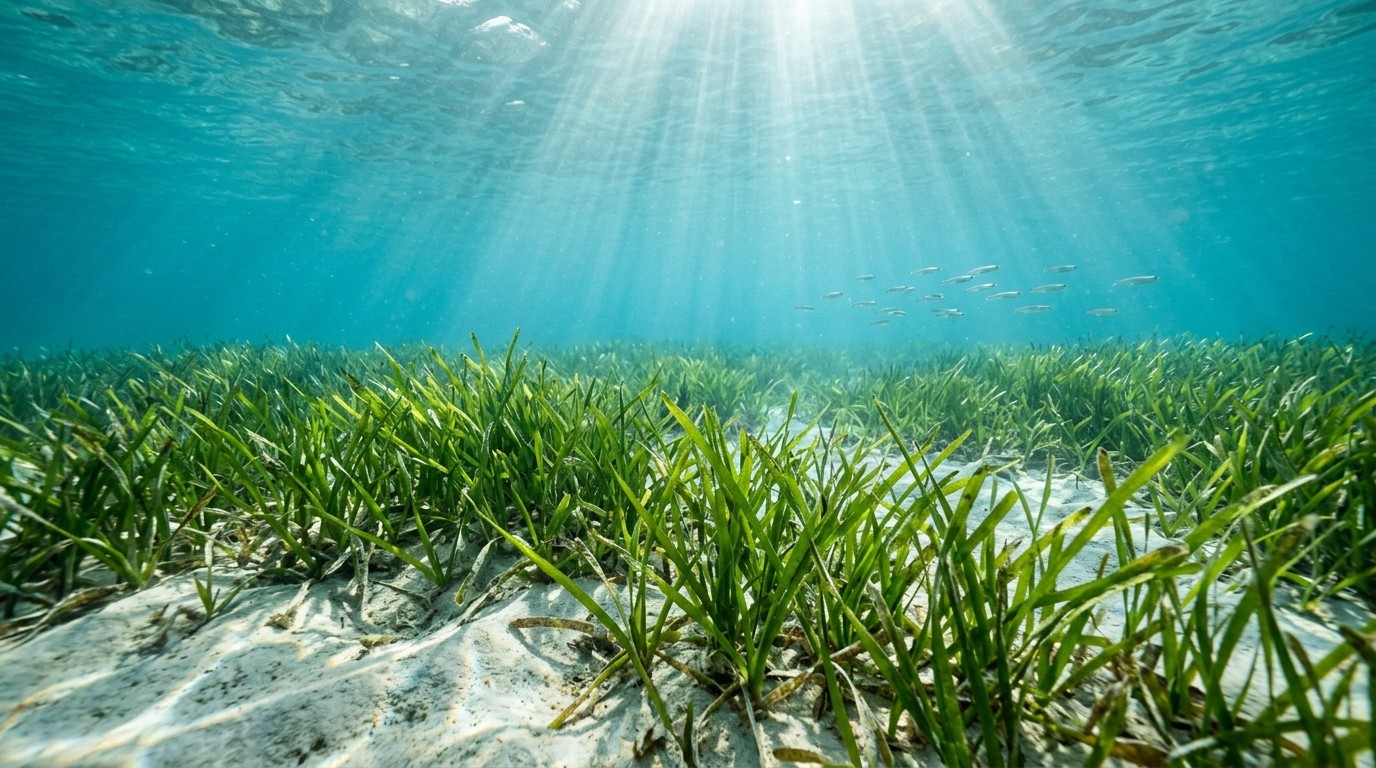
Prolonged warmth is not merely uncomfortable for marine life; it compounds other pressures. Extended periods of warm water can worsen low-oxygen conditions and feed harmful algal blooms, stacking stress on top of stress. Habitats from seagrass beds to coral reefs sit on the front line.
The Ripple Through Fisheries
The cascading effects are visible. Warmer, nutrient-starved water is reshaping the base of the food web and threatening the ocean’s ability to support fish stocks. As warming drains oxygen from the sea, ocean dead zones are multiplying. And in the tropics, marine life is already fleeing the equator in search of cooler water.
An Ocean Already Running Hot
The stakes keep rising because the backdrop keeps shifting. The Copernicus Marine Service reported that summer 2026 was the warmest on record for the global ocean, with a mean sea surface temperature of 21.01°C, edging past the previous record set in 2023. At its peak, 73% of the global ocean was affected by marine heatwave conditions, the largest extent ever recorded.
NOAA logged 38% of the global ocean in heatwave conditions in August 2026 alone, the second-highest share for any month since 1991.
The consequences are already visible on the water. In Europe, the Bay of Biscay had logged 186 heatwave days by the end of August 2026, compared with just a handful per year in the 1980s, and species that sustained coastal communities for generations are disappearing from their traditional grounds.
Most of the excess heat trapped by greenhouse gases ends up in the ocean, which retains it far longer than the land or atmosphere. Intelligent Living has reported on the sheer scale of that transfer, with the seas absorbing heat at a rate of five atom bombs per second.
What the New Framework Changes
By widening the lens beyond the heatwave window, the study gives researchers and coastal managers a more realistic picture of ecosystem vulnerability. The findings rest on the long-term, high-frequency temperature records of NOAA’s National Estuarine Research Reserve System, whose sustained monitoring made the analysis possible.
Better measurement leads to better protection. More accurate estimates of cumulative heat exposure can sharpen predictions, guide conservation and restoration decisions, and help coastal communities prepare for a warmer, more volatile ocean. For the organisms living in it, the difference between a short spike and a months-long stretch of warm water can be the difference between stress and survival.
As marine heatwaves grow more frequent and more intense, the case for counting every degree, and every day, of warming has never been clearer.

