
For years, the electric vehicle conversation has been dominated by range anxiety. How far can it go on a single charge? But as the technology matures, a more consequential question is coming into focus: who can actually plug in, and where?
That question sits at the heart of a new study from the University of Connecticut College of Engineering, which argues that America’s charging rollout has a blind spot, one that could decide whether the shift to electric vehicles narrows or widens existing inequalities.
The researchers set out to answer something deceptively simple: where would one more charging station do the most good? Their answer involves far more than counting plugs. It means layering charging access on top of flood risk, pollution, income, and transportation burden, then asking which communities are struggling on several fronts at once.
In short, it is a framework for EV charging equity, and it suggests that access, not range, may be the barrier that determines who gets to go electric.
The Charging Map Has a Blind Spot
At first glance, the numbers look encouraging. In 2026 the United States passed 250,000 public charging ports across roughly 81,000 locations, including more than 178,000 Level 2 chargers and over 73,000 DC fast chargers. Public charging stations now account for about half of the nation’s estimated 150,000 fueling locations, a milestone that would have been unimaginable a decade ago.
But national totals flatten a stark geography. California alone hosts roughly a quarter of the country’s charging locations, at 18,846. Wyoming has 119. North Dakota has 106. And the newest fast chargers keep clustering where cars and money already are: about four out of five public fast-charging stations opened in the second quarter of 2026 were built in cities and suburbs.
Demand, meanwhile, is outrunning supply. The International Energy Agency reports that by the end of 2025 the United States had 33 electric vehicles for every public charging point, up from fewer than 20 in 2020. Every new electric car on the road raises the stakes for the drivers who depend on public infrastructure the most.
Why “Just Add Chargers” Doesn’t Fix It
Home charging is the quiet workhorse of electric-vehicle ownership. Industry surveys suggest that 75 to 95 percent of EV owners can charge at home at least some of the time, usually overnight, when electricity is cheapest. That convenience is the main reason electric driving costs far less per mile than filling a gas tank.
But it is not universal. Millions of Americans live in apartments, condos, or homes without a driveway or garage. For them, home charging is not a habit to break; it simply is not available. A small but significant minority of drivers, under 5 percent by one industry estimate, rely entirely on public charging. And in rural areas the calculus is different again: a study of rural Michigan found that practical constraints and attitudes together hold adoption well below national levels.
Depending on public chargers also changes the economics. Fast charging can cost several times more per kilowatt-hour than charging at home, and frequent DC fast charging can gradually stress a battery. A driver who cannot charge overnight is not merely inconvenienced; they pay more, wait longer, and plan their week around a plug.
That is the essence of charging equity. The benefits of electrification are shared unevenly, largely along the lines of housing, income, and geography, and a grid of chargers that ignores those lines will reinforce them.
Inside the Electric Vehicle Viability Score
To make those overlaps visible, the UConn team, Ph.D. student Omar Bustami, postdoctoral researcher Francesco Rouhana, associate professor Timothy Vadas, and professor Amvrossios Bagtzoglou, built a tool they call the Electric Vehicle Viability Score. Their work is published in the Journal of Cleaner Production.
The score folds four dimensions into a single picture for each community:
- EV infrastructure and transportation burden, meaning how limited charging access is and whether residents have alternatives to driving.
- Flood risk, or whether a community faces inundation that could disable chargers and strand drivers.
- Environmental burden, the amount of pollution residents already absorb.
- Socioeconomic vulnerability, the financial cushion, or lack of it, that decides who can adapt.
Applied across Connecticut’s 169 towns, the framework exposed sharp contrasts. Affluent Fairfield County, with strong existing infrastructure and resources, scored low on urgency. Rural Windham and Litchfield counties, with fewer chargers and tighter budgets, scored high.
“Where infrastructure is needed most is not always where infrastructure is easiest to build,” Rouhana said.
Crucially, the goal is not a map for its own sake. It is a way to steer funding toward the places where a single charger delivers the greatest benefit, for mobility and for climate resilience alike.
Charging Equity Is Also Climate Resilience
The UConn framework treats chargers as more than retail amenities. An electric vehicle is, in effect, a large battery on wheels; a light-duty pack stores roughly 15 to 100 kilowatt-hours. With bidirectional charging, that stored energy can flow back out to a building or the grid, a capability the U.S. Department of Energy is actively promoting.
During a blackout, an electric car can run a home, a shelter, or critical medical equipment. For communities that face both rising flood risk and unreliable grids, well-placed chargers double as resilience infrastructure. That reframes a charging station as essential public infrastructure rather than a convenience for the comfortable.

The same logic is reshaping transportation more broadly, from electrified ferries and other transit systems to renewable-powered corridors such as South Africa’s off-grid solar highway and to roads that charge electric cars wirelessly.
What Equitable Charging Planning Looks Like
The framework implies a set of practical principles that any state or city could adopt.
Prioritize need over ease
Charging stations are easiest to install where demand is dense and grids are strong, which is precisely where they are least needed. An equity-first approach inverts that logic, ranking projects by the burden they relieve rather than the return they promise. That can mean funding a handful of chargers in a low-income, flood-prone town before adding more to a saturated suburb.
Build with the community, not just for it
Rouhana stresses that communities understand their own needs best and that many projects are implemented without meaningful local input. An iterative, collaborative process helps ensure that a model reflects real conditions on the ground rather than an analyst’s assumptions.
Plan for change
The researchers are adding a temporal dimension to the framework, because communities, infrastructure, and climate all shift over time. They also want to scale it down to the neighborhood level and out to other states, so the approach travels well beyond Connecticut.
Solutions that already work
None of this requires invention from scratch. Several approaches are already proven:
- Curbside and on-street chargers reach residents who have no driveway of their own.
- Workplace charging spreads access across the hours people are already parked.
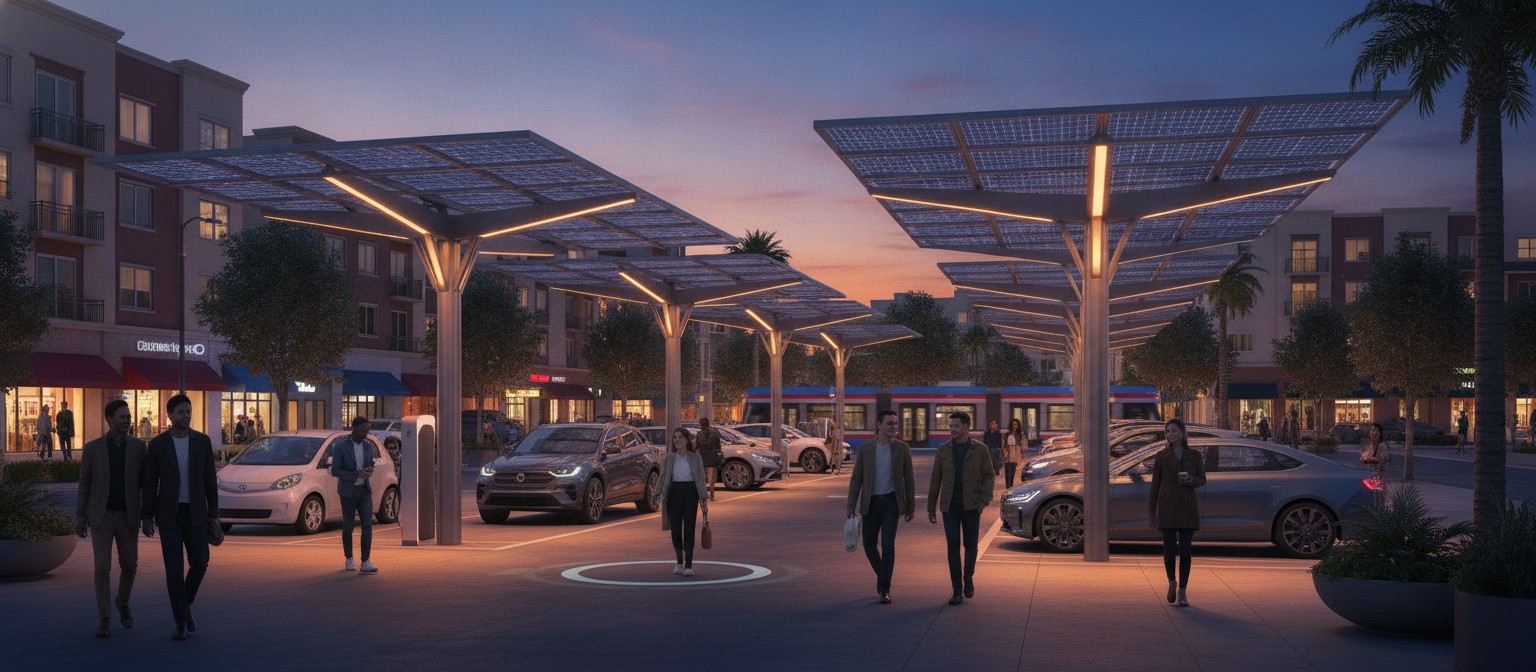
- Solar-canopied community hubs combine clean power with storm resilience, so a single investment serves both mobility and emergency preparedness.
The hard part is not the hardware. It is deciding, deliberately, who gets served first.
The Road Ahead
Federal policy remains a moving target. The National Electric Vehicle Infrastructure (NEVI) program, funded through the 2021 Bipartisan Infrastructure Law, was meant to build a nationwide fast-charging backbone along major highways. Its funding obligations were paused in early 2025 and restarted in January 2026, and as of April 2026, only about 550 NEVI-funded fast charging points were operational across 19 states.
Even as that program finds its footing, the broader effort to extend chargers along highways and into rural areas continues, and private operators keep expanding their networks. But speed is not the same as equity. A network that grows fastest where it is easiest to build will, by default, leave the same communities behind.
That is where a tool like the Electric Vehicle Viability Score earns its keep. It offers a corrective: a way to measure not just how many chargers exist, but whether they reach the people who need them. As electrification accelerates, that distinction may matter more than any range figure on a spec sheet.
The Bottom Line
The next chapter of the EV transition will not be decided by battery chemistry alone. It will be decided by whether the infrastructure that makes electric driving practical is available to everyone, not just to those with a garage, a driveway, and a fast charger down the street.
EV charging equity is, ultimately, a question of design. Score the need first, and the chargers can follow. Skip that step, and the range debate will keep overshadowing the access problem that quietly shapes who gets to participate in the shift to cleaner transport.


